
Natural Remedies for Minor Burns
IMPORTANT: The natural remedies below are appropriate ONLY for first-degree burns (red, painful, dry skin, no blisters) and very small superficial second-degree burns (small blisters under 1 inch, on non-exposed areas). For extensive or deep burns, burns with large blisters, burns on the face, hands, feet, genitals, or burns in small children, go to the ER immediately. Chemical and electrical burns are medical emergencies, regardless of size.
Kitchen accidents happen often: you touch a hot pan, oil splashes, boiling water spills, the iron catches your finger. All minor burns, seemingly trivial at first, but they hurt like crazy and, if not treated correctly, leave marks on the skin for months. My grandmother always kept an aloe vera plant on the windowsill and a small bottle of lavender oil in a drawer. “A burn without an aloe leaf, a household without a doctor”, she would say with a smile.
Before any remedy, remember the most important principle: the first thing to do after a burn is cold water, not ice and not butter. Butter on burns, toothpaste, cooking oil, these are all dangerous myths that either trap heat in the skin (butter) or irritate the injured tissue. Clean cold tap water, held over the burn for 15-20 minutes, is step zero, mandatory. After that come the remedies that aid healing.
Remedy 1: Cold water (step zero, the most important)
It is not a plant and not an exotic remedy, but it is the most effective first aid for any minor burn. Cold water stops the damage from spreading deeper. A burn does not stop the moment you pull your hand away from the heat source: the tissue continues to “cook” from accumulated heat for another 5-10 minutes. Cold water cools things down fast and limits the damage.
How to do it
- Temperature: Cold tap water, not ice. Direct ice on a burn does more harm than good (sudden vasoconstriction, risk of frostbite on already damaged tissue).
- Duration: A minimum of 15 minutes, ideally 20. I know it feels long and you want to do something else, but time yourself. This step alone reduces the final severity of the burn by 50%.
- Procedure: Hold the burned area under a gentle stream of cold water. If the burn is somewhere you cannot run water (for example on the face), use a cold wet compress, changed often.
- What NOT to do: Do not apply ice directly, no toothpaste, no butter, no oil, no flour. Do not break blisters.
After the 20 minutes of cold water, dry the area gently by patting with a clean towel (do not rub), then move on to one of the remedies below.
Remedy 2: Fresh aloe vera gel
Aloe vera (Aloe barbadensis) is the queen of burn remedies. The transparent gel inside the leaves contains acemannan (a polysaccharide that stimulates skin regeneration), salicylic acid (natural anti-inflammatory), glucomannan (deep tissue hydration), vitamins A, C, E, and a whole complex of minerals and amino acids. Clinical studies have shown that aloe vera shortens the healing time of first and second-degree burns by almost 9 days on average.
How to use it
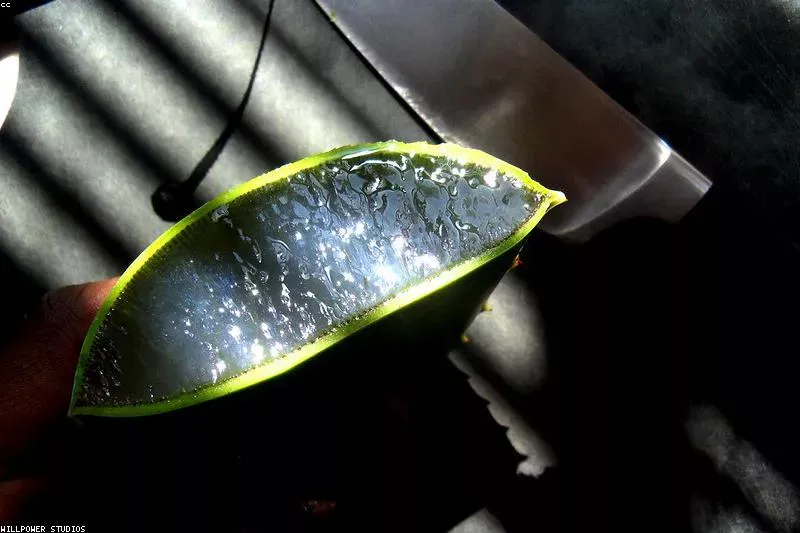
- Best option: A fresh aloe vera leaf, cut from a houseplant. Cut the leaf at the base, let the yellow sap (aloin, which is irritating) drain for 10 minutes, then slice the leaf lengthwise and scrape the transparent gel with a small spoon.
- Application: Spread the gel in a thick layer over the burn. Let it absorb on its own, do not cover with a bandage right away. If the burn is in a place that rubs against clothing, cover with a sterile non-adherent dressing after 20-30 minutes.
- Frequency: 4-5 times a day for 5-7 days, until fully healed.
- Store-bought version: Pure aloe vera gel, at least 95% concentration, alcohol-free, fragrance-free, without harsh preservatives. Read the label carefully, many commercial products contain only 10-20% real aloe.
Why it works: Aloe gel creates a protective film over the burn, maintains moisture (burned skin dries out very fast and that slows healing), fights bacteria, and stimulates fibroblasts (the cells that produce new collagen). My grandmother always had a plant on the windowsill, and when we got burned, the first thing she did was break off a leaf.
Remedy 3: Raw honey applied directly
Honey is an ancient burn remedy, mentioned as far back as ancient Egypt. Modern science has confirmed what old folks knew: honey is a natural antibiotic, a healing stimulator, and a protector of burned skin. It contains inhibine (slow-released hydrogen peroxide), defensins, enzymes, growth factors, and has an acidic pH that prevents bacterial growth.
How to use it
- Type of honey: Raw, unprocessed honey, from a beekeeper. Manuka honey is the most studied for burns, but Romanian linden, acacia or wildflower honey works excellently.
- Application: After cooling the burn with water, apply a thin layer of honey directly on the skin with a clean spatula or a stick. Cover with a sterile dressing (gauze or non-adherent bandage).
- Changing: Change the dressing and reapply honey 1-2 times a day. Wash gently with lukewarm water, without harsh soap.
- Duration: 5-7 days for first-degree burns, longer for mild second-degree.
Why it works: Honey absorbs fluids from the burned tissue (osmotic effect), which reduces swelling and prevents bacteria from thriving. It slowly releases hydrogen peroxide, continuously disinfecting. Growth factors stimulate new skin formation. And very importantly, honey significantly reduces the risk of visible scarring.
Remedy 4: Raw potato, sliced or grated
This is one of the oldest Romanian folk remedies for burns and burn blisters. Raw potato (Solanum tuberosum) contains starch (which forms a cooling protective layer), vitamin C (antioxidant), catecholases (enzymes with a calming effect), and has a slightly acidic pH that soothes irritated skin. In the countryside, potatoes were always on hand and they worked surprisingly well.
How to use it
- Sliced version: Cut a clean potato (washed well, but not peeled) into thin slices. Apply the slices directly to the burn and leave for 15-20 minutes. When they warm up, replace with fresh, cold slices.
- Grated version: Grate a potato on the fine side of a grater. Put the pulp on a piece of gauze and apply to the burn area like a compress. Leave 20-30 minutes.
- Frequency: 2-3 times a day, for the first 2 days after the burn, when pain and inflammation are at their peak.
Why it works: The starch in the potato forms a film that absorbs residual heat from the skin and reduces the burning sensation. Vitamin C supports the formation of new collagen needed for healing. My grandmother swore by grated potato, and after trying it, I can confirm: the cooling effect is almost immediate.
Remedy 5: Lavender essential oil
Lavender (Lavandula angustifolia) is one of the few essential oils that can be applied “neat” to the skin without dilution, being very well tolerated. It is famous for its calming, antiseptic, anti-inflammatory, and healing properties. The modern story of lavender in burn treatment begins with French chemist René-Maurice Gattefossé, who in 1910 severely burned his hand in a lab accident and treated it with lavender oil, healing without scars. That moment gave birth to modern aromatherapy.
How to use it
- Neat version (for very small burns): 1-2 drops of pure lavender essential oil (therapeutic grade) directly on the burn, 2-3 times a day.
- Diluted version (for larger burns): Mix 5-10 drops of lavender oil into a teaspoon of coconut or jojoba oil. Apply gently to the burn 3-4 times a day.
- With aloe: Add 3-4 drops of lavender oil into a teaspoon of aloe vera gel. The combination is excellent for healing and scar prevention.
Caution: Make sure you use pure essential oil, not synthetic “fragrance oils”. Labels should say “Lavandula angustifolia” and “100% pure”. Test first on a small skin area if you have never used it before.
Remedy 6: Cold black tea compress
Black tea (Camellia sinensis) contains tannins, polyphenolic compounds with strong astringent and analgesic effects. Tannins pull fluid out of inflamed tissue, reducing swelling, and create a protective layer over the burn. It is a remedy used throughout Eastern Europe, especially for sunburns (which are also first-degree burns).
How to use it
- Ingredients: 2-3 bags of plain black tea (no flavorings), 300 ml boiling water
- Preparation: Put the bags in boiling water, let steep for 10 minutes. Strain or remove the bags and let the tea cool completely in the fridge.
- Application: Soak a piece of gauze or a clean cotton cloth in the cold tea, wring gently, and apply to the burn. Keep for 20-30 minutes. You can also use the cold tea bags directly on small burns.
- Frequency: 3-4 times a day, for the first 2 days.
Why it works: Tannins form a protective barrier, absorb excess fluid from tissue, and have a mild local analgesic effect. Plus, cold tea keeps the area continuously cool.
Remedy 7: Egg white (only for very fresh burns)
Egg white is a grandmother’s remedy for very fresh burns, applied right after the accident. It contains albumins (proteins) that spread over the skin like a film, forming a protective, cooling barrier. It is an emergency solution, not a long-term treatment.
How to use it
- Ingredients: 1 fresh egg white
- Procedure: Lightly beat the egg white with a fork (not to foam, just to combine). Apply with a clean brush or well-washed fingers to the burned area. Let it dry, then apply another layer. You can build up 3-4 layers.
- Duration: Let it work until it starts peeling off naturally (2-3 hours), then wash with lukewarm water.
Caution: Use only fresh eggs, preferably from free-range chickens, and apply only to mild burns without open wounds. If the skin is broken or blisters have burst, do NOT use this remedy (infection risk, raw egg white can carry salmonella).
Causes and types of minor burns
First-degree burns affect only the top layer of skin (epidermis). They show as redness, pain, tenderness, and sometimes slight swelling. No blisters appear. They usually heal in 3-7 days without scarring.
Very mild superficial second-degree burns have small blisters but still heal at home in 10-14 days, with extra attention to infection.
Common household causes
- Boiling water: splashes from pots, spilled tea, steam
- Hot grease and oil: frying splashes are among the most common kitchen burns
- Hot surfaces: pans, stovetops, irons, ovens
- Sunburns: prolonged sun exposure, especially in fair-skinned people
- Small thermal incidents: matches, lighters, candles
- Hot compresses: used for muscle pain, sometimes left too long or too hot
Preventing burns at home
In the kitchen
- Turn pot handles toward the inside of the stove so they are not caught accidentally
- Use lids when frying meat with a lot of oil
- Thick oven mitts, not thin cloths
- Do not hold small children while cooking
- Remove utensils from pots with hot food
In the bathroom
- Check water temperature before putting a child in the tub, with a thermometer or your elbow
- Set the water heater no higher than 120°F (50°C)
- Watch out for irons, unplug when you leave the room, even for a minute
In the sun
- SPF 30-50 sunscreen in summer, reapplied every 2 hours
- Hats and light cotton clothing
- Avoid 11 a.m. to 5 p.m. for direct exposure
- After swimming, dry off and reapply sunscreen
When to see a doctor right away
Do not treat alone at home, and go immediately to the hospital or call an ambulance if:
- The burn is larger than your palm (even first-degree)
- The burn is on the face, neck, hands, feet, genitals, or major joints
- The burn is circumferential (completely wraps around an arm, leg, finger)
- Large blisters appear (over 1 inch) or many blisters
- The skin looks white, brown or charred (deep burn)
- The burn no longer hurts at all (sign that nerves have been destroyed, a serious deep burn)
- The burn is caused by chemicals (acid, base, industrial products)
- The burn is electrical, even if it looks small on the surface (internal injuries can be serious)
- The person is a small child or an elderly adult
- The burn gets infected: spreading redness, pus, bad smell, fever
Remember: Burns, even minor ones, should be treated with respect. The key to fast healing without scars is: prompt cooling with water, gentle treatment with natural remedies, watching for infection, patience. Do not break blisters (they are a natural, bacterially clean bandage), do not use butter or toothpaste, do not cover freshly burned skin with adhesive bandages. And most importantly, know when to pass the baton to the doctor: any sign of seriousness means an immediate trip to the ER.