 Photo: RCraig09, CC BY-SA 4.0, via Wikimedia Commons
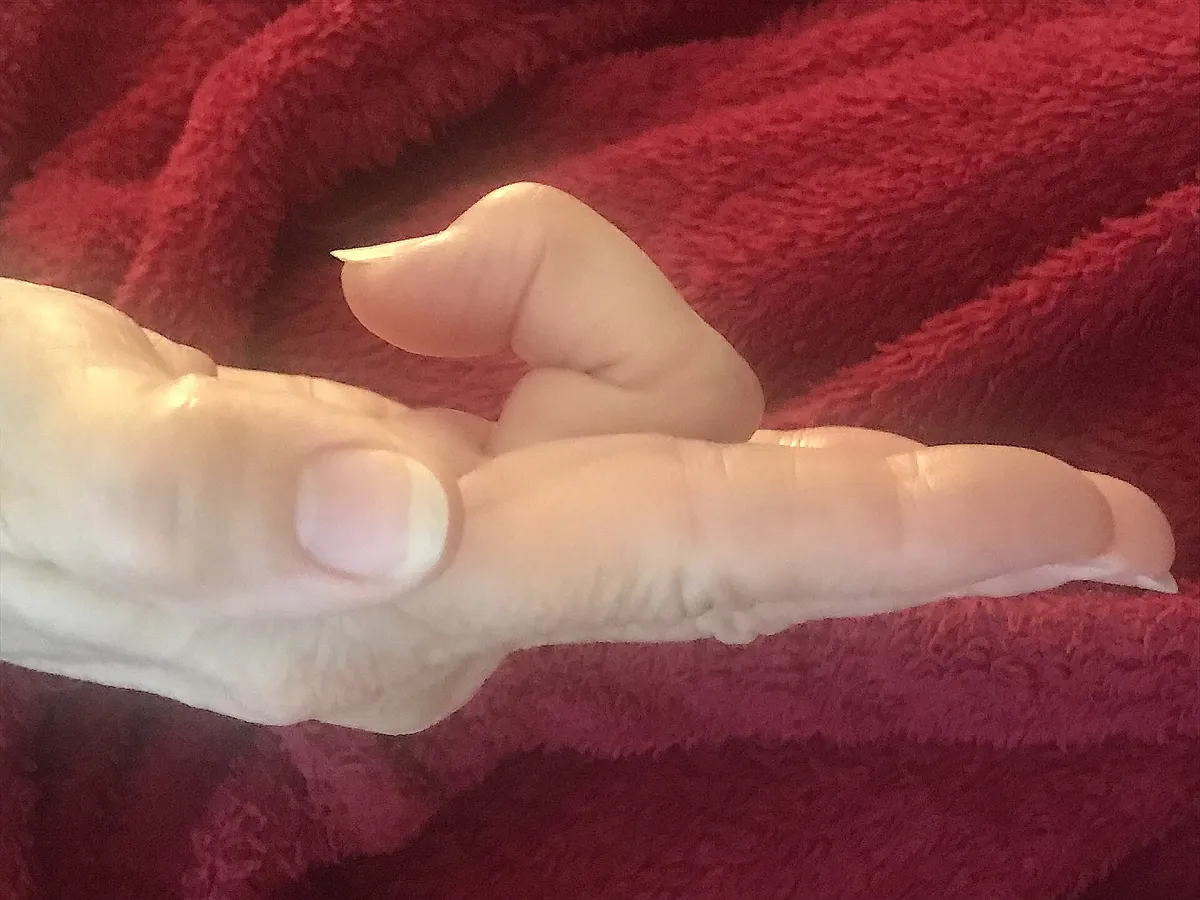
Trigger finger (stenosing flexor tenosynovitis) is a condition in which the tendon that bends a finger no longer glides freely through its sheath, so the finger locks in a bent position and then snaps straight with a click, like a trigger. In mild cases, relative rest, a night splint, morning warmth, gentle tendon-gliding exercises and local anti-inflammatory remedies help; if locking persists, a steroid injection or a minor procedure solves the problem in most cases.
It most often affects the thumb (trigger thumb), the ring finger and the middle finger, and is more common in women over 40 and in people with diabetes. It is annoying and sometimes painful, but almost never dangerous.
Key takeaways
- The cause is thickening of the flexor tendon or of the “ring” (the A1 pulley) it passes through at the base of the finger.
- Typical symptoms: morning locking, a click when straightening, a tender nodule in the palm at the base of the finger.
- A night splint worn for 6 weeks improves a large share of mild cases.
- Morning warmth, massage and tendon-gliding exercises help mobility.
- A steroid injection is the first-line medical treatment; surgical release is quick and effective.
- A permanently locked, red, hot, swollen finger needs urgent care (possible infection).
How the finger works and what goes wrong
Each finger is bent by flexor tendons that start in the forearm muscles and glide through a sheath held against the bone by fibrous rings called pulleys. The first of these, the A1 pulley, sits in the palm just at the base of the finger. When the tendon becomes inflamed and thickened, or the pulley narrows, the tendon passes through with difficulty. Sometimes a small nodule forms on the tendon that “catches” on the ring: the finger stays bent, and when you force it straight, the nodule pops through and the finger jumps.
Stages
| Stage | What you feel |
|---|---|
| 1 | pain and tenderness at the base of the finger, no locking |
| 2 | clicking or catching, but the finger straightens by itself |
| 3 | locking; you need the other hand to straighten the finger |
| 4 | the finger stays fixed in a bent position |
Stages 1-2 usually respond well to conservative measures. Stages 3-4 almost always need medical treatment.
Causes and risk factors
- Repetitive gripping: tools, garden shears, pliers, heavy keyboard and phone use, crochet, climbing.
- Diabetes: the risk is several times higher and several fingers may be affected. See also type 2 diabetes.
- Rheumatoid arthritis and other inflammatory diseases.
- Hypothyroidism, gout, amyloidosis.
- Carpal tunnel syndrome: the two often occur together. More in our article on carpal tunnel.
- Female sex and age 40-60.
Natural remedies and home measures
1. Relative rest
This does not mean total immobilisation but avoiding movements that trigger catching: tight gripping, vibrating tools, carrying heavy shopping bags with bent fingers. Use thicker handles (a piece of pipe insulation on tool handles), padded gloves and breaks every 30 minutes.
2. Night splint
The finger locks most often in the morning because we keep it bent overnight. A splint that holds the knuckle joint (metacarpophalangeal) straight or slightly bent, worn at night for 6-10 weeks, reduced symptoms in a large share of patients with mild cases in clinical studies. Splints are sold in pharmacies and orthopaedic shops; an occupational therapist can adjust one.
3. Morning warmth
Soak the hand for 5-10 minutes in warm water (37-40°C) in the morning, optionally with a spoonful of salt, to relax the tissues and ease the first movements. Follow with the exercises.
4. Ice after effort
If the base of the finger is sore and swollen after a day’s work: ice wrapped in a towel, 10 minutes, 2-3 times a day.
5. Tendon-gliding exercises
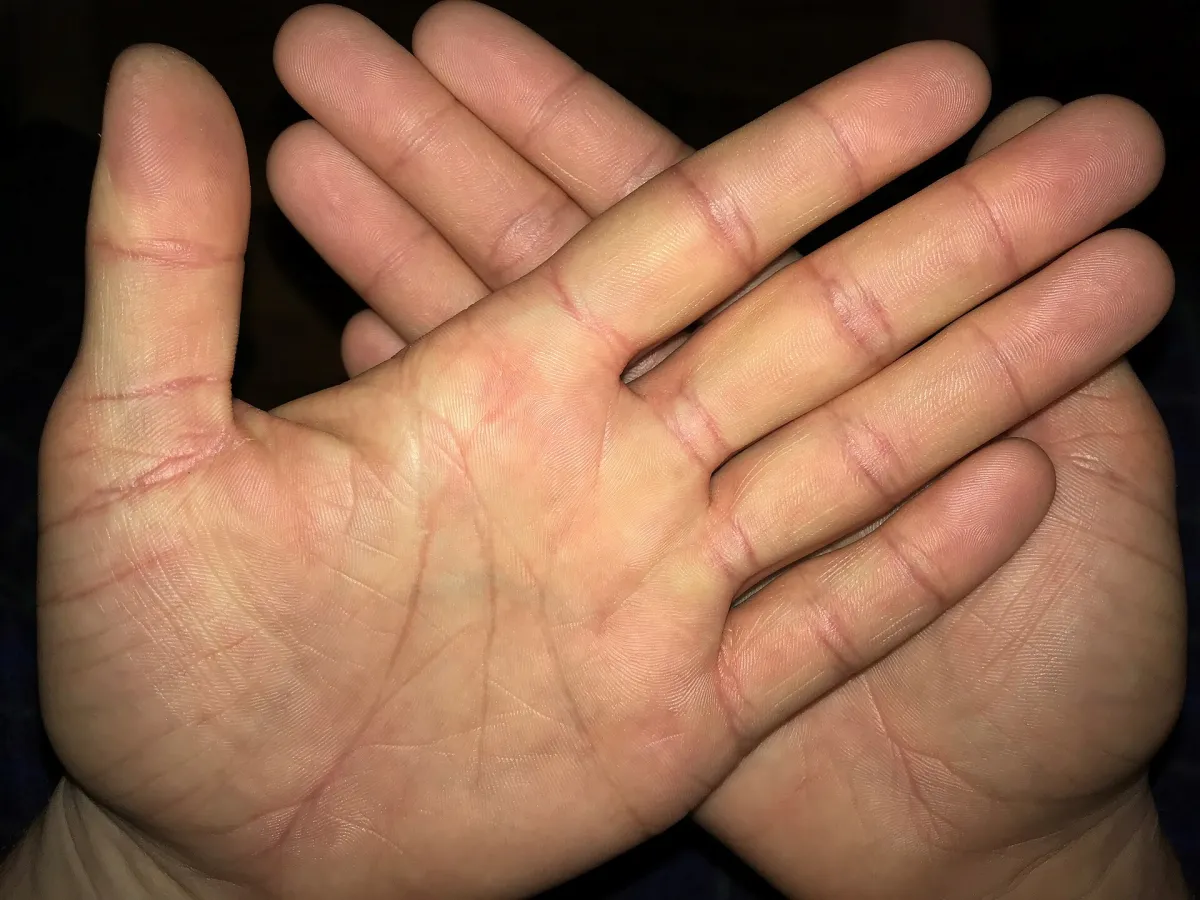 Photo: Eyefive45, CC BY-SA 4.0, via Wikimedia Commons
Do them after the warm soak, 2-3 times a day, 5 repetitions each, without forcing the click:
- Straight hand: fingers straight and together.
- Hook fist: bend only the last two finger joints; the knuckles stay straight.
- Full fist: gently make a fist.
- Tabletop: bend only the knuckles, fingers stay straight, like an “L”.
- Straight fist: bend the knuckles and middle joints; the fingertips touch the base of the palm.
Move slowly from one position to the next. The aim is for the tendon to glide along its full length, not to force it through the ring.
6. Gentle massage
With the thumb of your other hand, massage small circles over the base of the affected finger in the palm for 1-2 minutes, then along the tendon towards the tip. The pressure should feel comfortable.
7. Herbs and topical applications
- Arnica gel or ointment: traditional use recognised by the EMA for local muscle and joint pain.
- Compresses with cooled chamomile or yarrow infusion: soothing, especially in the evening.
- Green clay compresses: 20-30 minutes, cooling effect.
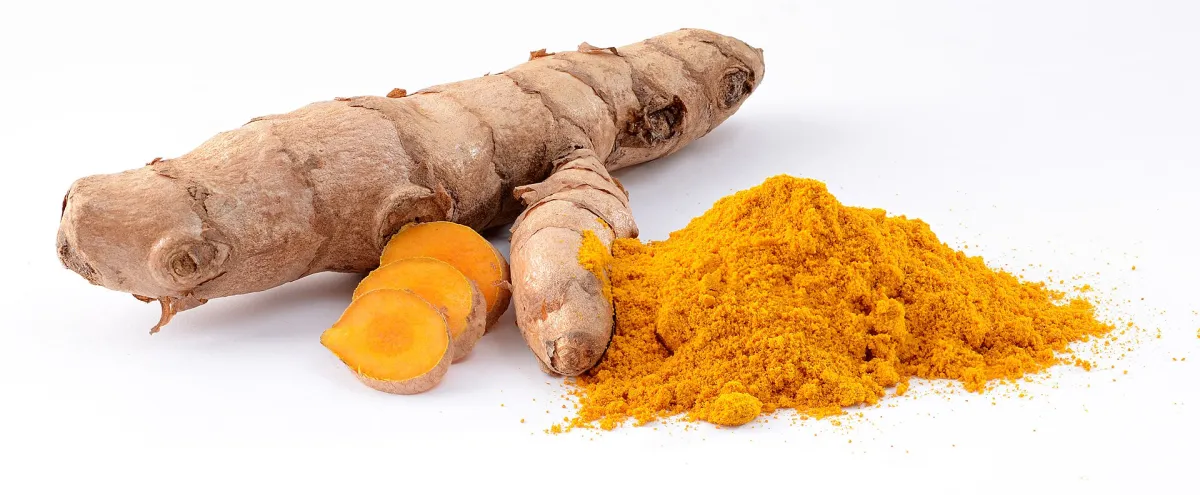
- Turmeric and ginger in food: curcumin and ginger have anti-inflammatory effects shown in the lab and in some studies of people with osteoarthritis, but there are no specific studies on trigger finger.
Recipe: warm ginger massage oil
1 tablespoon freshly grated ginger and 2 tablespoons olive oil, gently warmed for 5 minutes over a water bath, then strained. Use the warm oil to massage the palm for 2-3 minutes. Patch test first on a small area of skin.
Medical treatments in brief
| Option | When | Effectiveness |
|---|---|---|
| Splint + exercises | stages 1-2 | good in mild, recent cases |
| Anti-inflammatories (gel or short course of tablets) | pain | relieve pain, not locking |
| Corticosteroid injection | stages 2-3, or when splinting fails | resolves many cases; can be repeated once |
| Percutaneous or surgical release of the A1 pulley | recurrence, stage 3-4, diabetes | very high; short procedure under local anaesthetic |
In people with diabetes, injections work less well and can temporarily raise blood sugar, so the doctor may recommend release directly.
Contraindications and precautions
- Do not apply arnica to wounds or irritated skin, and never swallow it.
- Ginger oil can irritate sensitive skin.
- High-dose curcumin supplements may interact with anticoagulants and should be avoided with bile duct obstruction.
- Do not force the finger to “click” dozens of times a day: it keeps the inflammation going.
When to see a doctor
- the finger is locked and cannot be straightened at all;
- the base of the finger is red, hot and swollen, with severe pain or fever: infection of the tendon sheath is a surgical emergency;
- numbness appears in the fingers (possible associated carpal tunnel);
- symptoms do not improve after 6-8 weeks of conservative care;
- several fingers are affected at once.
Common mistakes
- Repeatedly “cracking” the finger to unlock it.
- Carrying on with heavy tools without protection or breaks.
- Wearing the splint for a few nights and giving up.
- Delaying a visit for months until the finger stays bent, which can stiffen the joint.
- Confusing trigger finger with ordinary tendinitis or finger arthritis.
Conclusion
Trigger finger is a simple mechanical problem: a thickened tendon that no longer slides easily through a narrow ring. In the early stages, a night splint, warmth, gentle exercises, avoiding tight gripping and soothing local remedies can resolve or greatly improve symptoms. When the finger locks often or stays bent, an injection or a short procedure gives very good results. What you should not do is wait years until the joint stiffens.
Frequently asked questions
Does trigger finger go away on its own? Sometimes, especially in mild and recent cases, symptoms clear within weeks or months with rest and a splint. Cases with frequent locking rarely resolve fully without treatment.
How long should the splint be worn? Usually 6-10 weeks, every night. Some doctors also recommend wearing it during the day for activities that trigger locking.
Is the injection painful? You feel a short sting and pressure. Pain may increase for 1-2 days afterwards, then settle. The effect appears within a few days to 2-3 weeks.
Which exercises should I avoid? Squeezing a stress ball hard, fingertip push-ups and anything that causes repeated clicking. The right exercises are slow, pain-free tendon-gliding movements.
Why does the finger lock mostly in the morning? Because the hand stays bent at night, and fluid and swelling build up in the tendon sheath. Morning movement and warmth reduce the stiffness.
Can children get trigger finger? Yes, there is a congenital form, mostly affecting babies’ thumbs, which is treated differently and should be assessed by a paediatric orthopaedic specialist.
Does turmeric tea help? Turmeric has general anti-inflammatory effects, but there are no studies showing it resolves trigger finger. It can be part of an anti-inflammatory diet but does not replace splinting or treatment.
Sources
- American Academy of Orthopaedic Surgeons (OrthoInfo): “Trigger Finger”.
- American Society for Surgery of the Hand: patient information on trigger finger.
- Cochrane Database of Systematic Reviews: reviews on corticosteroid injection and surgical treatment for trigger finger.
- EMA/HMPC: community herbal monographs on Arnicae flos and Matricariae flos.
This content is for information only and does not replace medical advice. See a qualified professional for diagnosis and treatment.