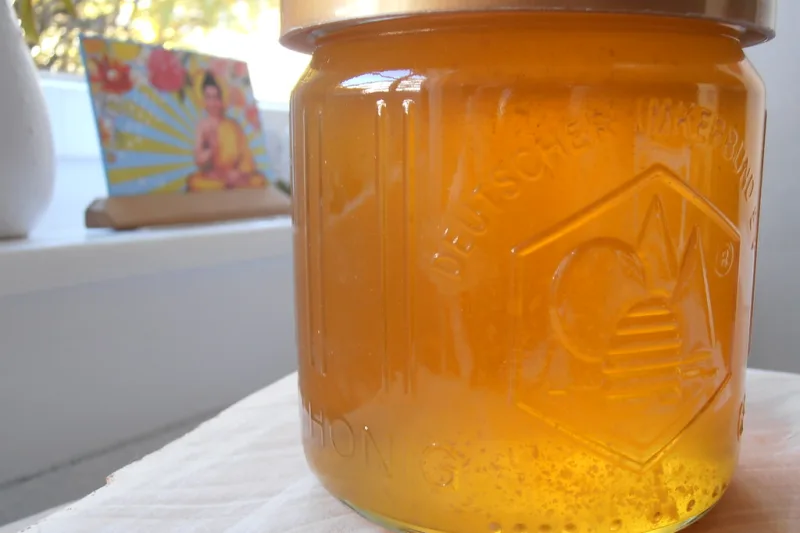

Acacia Honey: Benefits, Uses and How to Consume It Correctly
IMPORTANT: Acacia honey, like any natural honey, must NOT be given to children under 1 year of age because of the risk of infant botulism. People with diabetes may consume it only sparingly and after talking to their doctor, since it remains a source of sugars. Although it has a lower glycemic index than refined sugar, honey still raises blood sugar. Those allergic to pollen or to bee products (propolis, royal jelly, bee venom) should be cautious and test small amounts. Honey does not replace prescribed medical treatment; for serious conditions, always consult your doctor.
Grandma Aurelia, from the Buzău region, kept a large glass jar of acacia honey on the highest shelf of her pantry, so clear that the window light shone through it like a crystal of amber. “This isn’t touched for nothing,” she would tell us grandchildren, “it’s for when your throat hurts or when your mother bakes the Easter sweet bread.” She remembered how, as a child, at the end of May, when the locust trees at the edge of the village bloomed and their sweet, dizzying perfume filled the lanes, the apiaries were moved next to the forest, and the beekeeper promised her a spoonful of fresh honey, dripping straight from the comb, if she helped him carry the frames.
That spoonful of acacia honey was, for her, the taste of summer just begun: sweet, fine, without harshness, without that sharp aftertaste other honeys leave in the throat. Years later, when she learned to fill the jars herself, she kept the same golden rule of her own grandmother: good acacia honey stays clear for months and is in no hurry to crystallize. For her, that was proof that nature, left in peace, knows how to give us things close to perfect.
Acacia honey is one of the most prized monofloral honeys in Europe, made from the nectar of the flowers of the black locust tree (Robinia pseudoacacia), popularly known as “acacia.” It is valued for its light color, ranging from nearly colorless to pale straw-yellow, for its delicately floral aroma, and above all for its low tendency to crystallize, which keeps it fluid for a long time. In Romanian folk tradition, as well as in the cuisine and herbal medicine of many countries, acacia honey is considered a “gentle” honey, well suited for older children, for people sensitive to strong flavors, and for sweetening teas and delicate dishes.
Table of Contents
- What acacia honey is and where it comes from
- Composition and what acacia honey contains
- Health benefits
- Traditional uses of acacia honey
- How to consume it and in what quantity
- Recipes and combinations with acacia honey
- How to recognize genuine acacia honey
- How to store it correctly
- Acacia honey and crystallization
- Lifestyle and practical tips
- Practical tips and common mistakes
- Conclusion
- Frequently Asked Questions
What acacia honey is and where it comes from
Acacia honey is produced when bees gather nectar from the white, fragrant flowers of the locust tree, a species native to North America but perfectly acclimatized in Romania and across much of Central and Eastern Europe. Here, the locust tree usually blooms in the second half of May, sometimes into early June, depending on the region and altitude. The bloom is spectacular but short: only a few good days of nectar flow, which is why authentic acacia honey is relatively limited in production and prized accordingly.
For a honey to be considered “acacia” (monofloral), the bees must have gathered predominantly from locust flowers, which means the hives are placed near forests or rows of locust trees precisely during the flowering period. Beekeepers often practice migratory beekeeping, moving their apiaries to follow the wave of bloom from the lowlands toward the hills. The result is a honey with a distinct aromatic profile: very light in color, transparent, with a subtle floral perfume and a sweet, fine taste free of bitter or sharp notes.
Unlike linden honey, which has a stronger aroma and a slight minty note, or forest (honeydew) honey, which is dark and intense, acacia honey is “diplomatic”: it pairs with almost anything and does not dominate the flavor of a dish. That is precisely why it is so often recommended for sweetening herbal teas, yogurt, or delicate desserts.
Composition and what acacia honey contains
Like all honeys, acacia honey is made up mainly of simple sugars — especially fructose and glucose — and water. What sets acacia honey apart is its high fructose content relative to glucose. This ratio explains two of its most appreciated qualities: its very sweet taste (fructose being sweeter than glucose) and its low tendency to crystallize, since glucose is the sugar that “triggers” crystallization. As a result, acacia honey stays liquid and clear far longer than most other varieties.
Besides sugars, honey contains small but valuable amounts of:
- Enzymes from the bees (such as invertase and diastase), which contribute to the honey’s biological activity;
- Amino acids and traces of protein;
- Minerals and trace elements (potassium, calcium, magnesium, iron, in variable amounts);
- Vitamins from the B complex and small amounts of vitamin C;
- Phenolic compounds and flavonoids with antioxidant roles;
- Suspended pollen, which “signs” the floral origin of the honey.
Studies suggest that it is precisely these phenolic and antioxidant compounds, although present in modest amounts, that contribute to the beneficial effects associated with moderate honey consumption. It is important to remember that honey remains, above all, an energy-dense food rich in sugars, and that its benefits should be viewed within the context of a balanced diet.
Health benefits
Support for the throat and calming a cough
The best-known traditional use of honey — including acacia honey — is soothing throat irritation and cough. The honey’s viscous texture forms a protective coating over the irritated lining, while its sweet taste stimulates salivation, which can reduce the sensation of dryness and the urge to cough. In folk medicine, a teaspoon of acacia honey dissolved in warm (not hot) tea or taken on its own in the evening, before bed, was the basic remedy for an irritated throat. Studies suggest that honey may help calm nighttime cough, especially in children over 1 year of age.
Antioxidant properties
Acacia honey contains flavonoids and phenolic compounds that act as antioxidants, helping the body cope with oxidative stress. Although darker honeys tend to have a higher antioxidant content, acacia honey still contributes to the daily intake of such compounds, especially when it replaces refined sugar, which brings no nutritional benefit at all.
Support for digestion
In folk tradition, acacia honey was considered “the friend of the stomach.” Thanks to its mild flavor and low tendency to ferment, it was recommended for people with sensitive stomachs. A teaspoon of honey in the morning, on an empty stomach, dissolved in warm water, was seen as a way to “wake up” the digestion. Honey also contains small amounts of oligosaccharides that may have a mild prebiotic effect, supporting beneficial gut flora.
Quick, easily absorbed energy
Being rich in simple sugars, acacia honey offers a fast source of energy. Athletes and active people sometimes use it as a natural sweetener before or after exercise. Unlike refined sugar, honey provides — alongside the calories from sugars — those traces of minerals and antioxidants.
A calming effect and help with sleep
Folk tradition associated a teaspoon of honey taken in the evening with more restful sleep. Combined with warm milk or a cup of linden or chamomile tea, acacia honey was the “evening recipe” for the restless or for those who fell asleep with difficulty. The sweet taste and the ritual itself also have a soothing effect.
Skin and lip care
Acacia honey is also used externally, thanks to its humectant and soothing properties. Applied to chapped lips, minor irritations, or as an ingredient in homemade face masks, honey helps maintain skin hydration. Its viscosity and pleasant taste also make it suitable for artisanal lip balms.
Traditional uses of acacia honey
In the traditional Romanian household, acacia honey had numerous uses:
- Tea sweetener: its neutral taste did not mask the aroma of herbs, which is why it was preferred for herbal teas.
- Remedy for the throat and cough: taken on its own or combined with lemon and ginger.
- Morning tonic: dissolved in warm water with a little lemon.
- Ingredient for sweet breads, cakes, and preserves, where a fine sweetness was desired.
- In home cosmetics: face masks, lip balms, sugar-and-honey scrubs.
- A prized gift: a jar of clear acacia honey was considered a quality present, a sign of respect toward the host.
How to consume it and in what quantity
Acacia honey is best consumed raw and unheated, to preserve its enzymes and aroma. The traditionally recommended quantity is moderate: roughly 1–2 teaspoons per day for a healthy adult, as part of a balanced diet. Honey remains a caloric food rich in sugars, so it should not be consumed in excess.
A few simple rules:
- Do not add it to boiling liquids. Wait for the tea or milk to cool down (below about 40°C / 104°F) before stirring in the honey, so you don’t destroy the enzymes and aroma.
- Use a clean, dry spoon each time, to avoid introducing moisture or impurities into the jar.
- Replace sugar, don’t add on top of it. Honey is most useful when it takes the place of refined sugar, not when it is added extra.
- For children: only over 1 year of age and in small amounts.
Recipes and combinations with acacia honey
Winter tea for an irritated throat
Prepare a chamomile or thyme tea. Once it has cooled a little, add a teaspoon of acacia honey, a few drops of lemon juice, and optionally a thin slice of fresh ginger. Drink it warm, in small sips. It is comforting for the throat on cold days.
Morning honey-and-lemon water
In a glass of warm (not hot) water, squeeze half a lemon and dissolve a teaspoon of acacia honey. Drunk in the morning, on an empty stomach, this mixture is, in folk tradition, a pleasant way to start the day.
Yogurt with honey and walnuts
Over a bowl of plain yogurt, add a teaspoon of acacia honey, a handful of crushed walnuts, and, if you like, a few berries. A balanced breakfast or snack, where the honey’s fine sweetness perfectly complements the yogurt’s acidity.
Nourishing honey face mask
For dry skin, mix a teaspoon of acacia honey with a teaspoon of full-fat yogurt. Apply to clean skin, leave on for 10–15 minutes, and rinse with warm water. Honey helps maintain hydration.
Sweet-and-sour dressing
For salads, mix acacia honey with a little apple cider vinegar, olive oil, salt, and pepper. The honey balances the acidity of the vinegar and gives the dressing a velvety taste.
How to recognize genuine acacia honey
Unfortunately, the market is full of adulterated or diluted honeys. Here are some signs of authentic acacia honey:
- Color: very light, from nearly colorless to pale straw-yellow. A dark “acacia honey” should raise questions.
- Clarity: fresh acacia honey is transparent, without cloudiness.
- Slow crystallization: authentic acacia honey stays liquid for months, sometimes over a year. If an “acacia honey” sugars up very quickly and coarsely, it may be blended with other varieties.
- Aroma and taste: floral, fine, sweet, without sharp notes in the throat.
- Flow behavior: it runs off the spoon in a continuous, smooth thread.
The safest approach is to buy honey directly from a trusted beekeeper or from a verified source, ideally with laboratory analyses.
How to store it correctly
Acacia honey should be kept in well-sealed glass jars at room temperature, away from direct sunlight and heat sources. It should not be kept in the refrigerator, as cold accelerates crystallization. Protect honey from moisture and strong odors (honey easily absorbs surrounding smells). Stored correctly, honey has a very long shelf life, being one of the few foods that practically never spoils.
Acacia honey and crystallization
Many consumers wrongly believe that honey which has sugared up is “spoiled” or fake. In reality, crystallization is a natural process that depends on the ratio between glucose and fructose. Acacia honey, being rich in fructose, crystallizes very slowly — sometimes not at all for a long time. That is precisely why, if a honey sold as “acacia” sugars up quickly and completely, you should wonder whether it might be blended.
If your acacia honey does begin to crystallize slightly, you can return it to a liquid consistency by placing the jar in a bowl of warm water (not hot, below 40°C / 104°F), never over direct heat and never in the microwave, so as not to destroy the enzymes.
Lifestyle and practical tips
Acacia honey fits beautifully into a balanced lifestyle. It can be used as a better sweetener than refined sugar, but it is not a “free food” to be consumed without limit. A few ideas for using it wisely:
- Use it to sweeten teas and coffee instead of sugar.
- Add it to yogurt, oatmeal, or smoothies for natural sweetness.
- Keep a small jar in the pantry specifically for days with an irritated throat.
- Combine it with fresh fruit for simple, healthy desserts.
- Give it as a gift — a jar of quality acacia honey is an appreciated present.
Remember that, however “natural” and beneficial, honey remains a concentrated source of sugars. People watching their weight, those with diabetes, and anyone with metabolic issues should consume it with caution.
Practical tips and common mistakes
Mistake no. 1: Adding honey to boiling liquids. Many people put honey straight into hot tea. High heat destroys the enzymes and the fine aroma. Let the liquid cool a little first.
Mistake no. 2: Consuming large amounts, thinking “it’s healthy, so I can eat as much as I want.” Honey is still rich in sugars and calories. Moderation is key.
Mistake no. 3: Giving honey to children under 1 year. This is a dangerous mistake because of the risk of infant botulism. Honey, of any variety, should not be given to babies.
Mistake no. 4: Throwing away crystallized honey. Crystallization does not mean spoilage. Crystallized honey is perfectly good and can be gently returned to a liquid consistency in a warm water bath.
Mistake no. 5: Storing it in the refrigerator. Cold speeds up crystallization. Honey should be kept at room temperature in a well-sealed jar.
Mistake no. 6: Buying by price rather than quality. A very cheap, dark honey sold as “acacia” is often a blend. Look for trusted sources.
Mistake no. 7: Using wet spoons. Moisture introduced into the jar can encourage fermentation. Always use a dry, clean spoon.
Conclusion
Acacia honey is, rightly so, one of the most beloved honeys in Romania and across Europe. Its color, clear as pale amber, its delicate floral aroma, and its low tendency to crystallize make it a quality sweetener and a gentle remedy that has graced the pantries of households for generations. Used in moderation, raw and of good quality, acacia honey can soothe an irritated throat, naturally sweeten teas and desserts, and bring a touch of pleasure to a balanced diet. The important thing is to consume it in measured amounts, buy it from trusted sources, and never forget that even the most natural product is no substitute for a varied diet and a doctor’s advice when needed.
Frequently Asked Questions
Does acacia honey crystallize? Yes, but very slowly, thanks to its high fructose content. It can stay liquid for months, sometimes over a year. If an “acacia honey” sugars up quickly and coarsely, it may be blended with other varieties.
Can I give acacia honey to my child? Only if the child is over 1 year of age. Below that age, honey (of any kind) carries a risk of infant botulism and should not be given at all.
Is acacia honey good for people with diabetes? Although it has a slightly lower glycemic index than refined sugar, honey remains a source of sugars and raises blood sugar. People with diabetes may consume it only sparingly and after talking to their doctor.
Why is acacia honey more expensive? Because the locust tree blooms briefly (only a few good days of nectar flow), and the production of authentic monofloral honey is limited. Its quality and relative rarity justify the higher price.
Can I heat acacia honey? Avoid strong heating. High temperatures destroy the enzymes and aroma. If you want to liquefy it after crystallization, use a warm water bath below 40°C (104°F), never the microwave or direct heat.
How do I recognize genuine acacia honey? By its very light color, transparency, fine floral aroma, sweet taste without sharp notes, and slow crystallization. The safest approach is to buy from a trusted beekeeper.
How much acacia honey can I consume per day? For a healthy adult, moderation is traditionally recommended — around 1–2 teaspoons per day, as part of a balanced diet, preferably in place of refined sugar.
Does acacia honey help with sleep? Folk tradition associates a teaspoon of honey in the evening, perhaps with warm milk or linden or chamomile tea, with more restful sleep. The effect also comes from the soothing ritual of a warm evening drink.