
Kombucha: Benefits, How to Make It and How to Drink It Properly
IMPORTANT: Kombucha is a fermented beverage that contains trace amounts of alcohol (usually below 0.5%, but sometimes more with long fermentations), caffeine from the tea, high acidity and live cultures of bacteria and yeast. It is not recommended for pregnant or breastfeeding women, young children, people with compromised immune systems, those with serious liver or kidney conditions, or anyone with a history of alcohol abuse. If you suffer from gastritis, reflux, ulcers or have a chronic condition, consult your doctor before drinking it. Kombucha brewed in poor hygienic conditions or in unsuitable containers (lead-glazed ceramics, reactive metal) can become hazardous. Always start with small amounts and observe how your body responds.
Aunt Veronica, a sprightly woman of nearly eighty from a village near Sibiu, kept a large jar on her kitchen windowsill, covered with a white cloth and held in place with a rubber band. “That’s my little tea mushroom,” she would say, laughing, whenever a grandchild grimaced at the gelatinous “jellyfish” floating on the surface. Her home always held a bottle of a refreshing, slightly sour, faintly fizzy drink that she offered guests in the summer heat. She said she had learned it from a neighbor of Russian origin back in the 1970s, and that ever since, the “mushroom” had passed from hand to hand, from jar to jar, like a living heirloom.
What she called the “tea mushroom” is, in fact, what the world now knows as kombucha — a tea fermented by a symbiosis of bacteria and yeast. Far from being a recent fad, kombucha has a history spanning centuries, likely originating in East Asia, from where it spread through Russia, Eastern Europe and, later, the entire world. In the Romanian countryside it circulated quietly, from home to home, under various folk names, long before store shelves filled up with colorful bottles of commercial kombucha.
In this article we will explore what kombucha really is, why it is so prized for gut health, how to make it at home step by step, and above all, how to drink it safely without falling into the common traps.
Table of Contents
- What kombucha is and where it comes from
- SCOBY: the heart of fermentation
- Composition and active compounds
- Health benefits
- How to make kombucha at home, step by step
- Second fermentation and flavoring
- How much and when to drink
- Lifestyle and adding it to your diet
- Practical tips and common mistakes
- Conclusion
- Frequently Asked Questions
What kombucha is and where it comes from
Kombucha is a beverage made by fermenting sweetened tea (usually black or green tea) with the help of a symbiotic culture of bacteria and yeast. As it ferments, the sugar is gradually transformed by the microorganisms into organic acids, carbon dioxide, B-complex vitamins and small amounts of alcohol. The result is a lightly acidic, effervescent drink with a taste reminiscent of cider or diluted apple cider vinegar, depending on the length of fermentation.
The name “kombucha” has uncertain origins. The drink is believed to have appeared in East Asia over two thousand years ago and was prized in traditional medicine as an “elixir of long life.” From there it migrated along trade routes toward Russia, where it was known as “grib” (mushroom) or “mushroom tea,” and then on to Central and Eastern Europe. It was precisely along this route that it reached Romanian villages, passed from one housewife to another along with a piece of the living culture.
The essence of kombucha lies in this living culture, which keeps growing and reproducing as long as it is fed with tea and sugar. In practice, kombucha is not something you buy once: it is a living organism that, properly maintained, can produce the drink for years.
SCOBY: the heart of fermentation
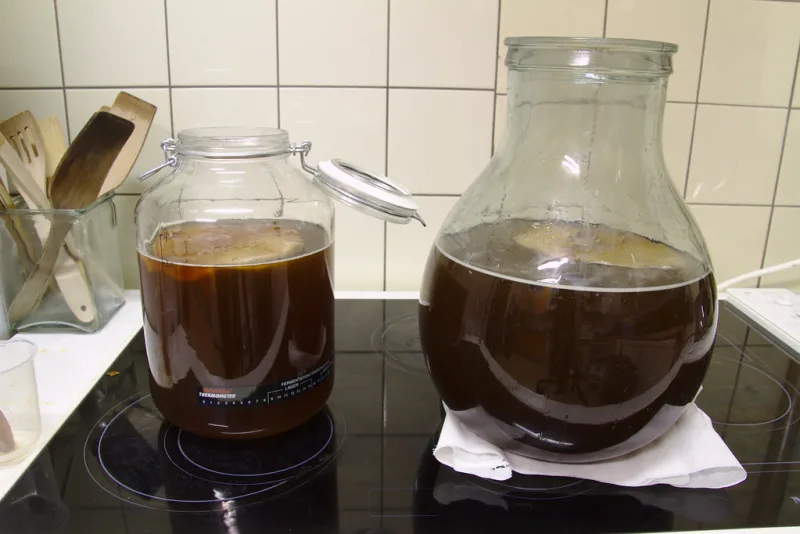
The pale, gelatinous disc that floats on the surface of the jar — what Aunt Veronica called the “little mushroom” — has the technical name SCOBY, an acronym for “Symbiotic Culture Of Bacteria and Yeast.” It is not a mushroom in the biological sense, but a cellulose biofilm produced by bacteria, within which several species of acetic bacteria and yeasts live together.
This symbiosis works like a tiny factory. The yeasts break down sugar into alcohol and carbon dioxide, while the bacteria convert part of that alcohol into organic acids, mainly acetic acid and gluconic acid. The balance between the two groups of microorganisms gives kombucha its acidity, fizz and characteristic aroma.
The SCOBY grows with each fermentation cycle: a new, creamy-white layer forms on the surface over the old one. That is why, after a few batches, you will have an ever-thicker SCOBY that you can split and pass along — exactly the ritual through which kombucha has circulated across generations.
Composition and active compounds
The composition of kombucha depends on the tea used, the amount of sugar and, most importantly, the length of fermentation. Broadly speaking, a well-made kombucha contains:
- Organic acids — especially acetic, gluconic, glucuronic and lactic acid, which give it its tangy taste and help preserve it.
- Probiotics — live bacteria and yeasts that may reach the gut, though the types and amounts vary greatly from batch to batch.
- Tea polyphenols — compounds with antioxidant roles, inherited from the tea leaves and sometimes transformed into more active forms through fermentation.
- B-complex vitamins — produced by the yeasts during fermentation.
- Enzymes — which may support digestion.
- Caffeine — in a reduced amount compared with the original tea, but still present.
- Trace alcohol — a natural result of fermentation.
Folk tradition valued kombucha precisely for this combination of “living” acidity and microorganisms, considering it a drink that “cleanses” and “gets the stomach working.”
Health benefits
Research on this topic is still ongoing, and many of the virtues attributed to kombucha come from folk tradition and from the general properties of fermented foods. Here is what studies suggest and what long experience shows for those who drink it.
Supporting gut health
The most frequently cited benefit is support for the gut flora. As a fermented food, kombucha provides live microorganisms and organic acids that, in principle, may contribute to a more balanced gut environment. Studies suggest that fermented foods in general support microbiota diversity, and many people notice easier digestion and improved abdominal comfort when they include them regularly in their diet, in moderate amounts.
A source of antioxidants
Tea, whether black or green, is rich in polyphenols, compounds with antioxidant roles. After fermentation, some of these remain active in the drink. Antioxidants help the body cope with oxidative stress, a process involved in aging and in numerous imbalances. Thus kombucha can be seen as a pleasant way to benefit from part of the value of tea, in a refreshing form.
An alternative to sugary soft drinks
One of the most practical benefits is that a well-fermented kombucha, with little residual sugar, can replace sugar-laden carbonated soft drinks. The natural fizz and slightly sour taste make it satisfying as a “treat” drink, but with a far more favorable profile. For those wanting to give up sweet sodas, kombucha can be a pleasant step in that transition.
Supporting digestion
The organic acids and enzymes in kombucha are associated in folk tradition with better digestion, especially after heavy meals. Many drinkers say that a small glass of kombucha after a meal gives them a feeling of relief. Although the exact mechanisms are not fully understood, the mild acidity may stimulate the appetite and make meals easier to tolerate.
Flavored hydration with low sugar
For those who tire of plain water, kombucha offers a flavored hydration option without the sugar excess of commercial drinks. Diluted with still or sparkling water, it becomes a light refreshing beverage, well suited for summer days.
How to make kombucha at home, step by step
Making kombucha at home is surprisingly simple, but it requires hygiene and patience. Here is the basic recipe, for about 2 liters.
Ingredients and tools:
- 2 liters of filtered water, or water boiled and cooled
- 8–10 g black or green tea (or 4–5 tea bags)
- 140–160 g white sugar (the sugar is food for the SCOBY, not for you)
- 1 healthy SCOBY
- 200–250 ml “starter tea” (mature kombucha from a previous batch)
- a large, clean glass jar
- a tightly woven cloth or cheesecloth and a rubber band
The steps:
- Brew the tea. Boil the water, turn off the heat and add the tea. Let it steep for 10–15 minutes, then remove the leaves or bags.
- Add the sugar. While the tea is still hot, dissolve the sugar completely, stirring.
- Cool the tea. This is the most important step. Let the sweetened tea cool completely, to room temperature. Hot tea can kill the culture.
- Pour into the jar. Put the cooled tea into the clean jar, add the starter tea, and then the SCOBY, with very clean hands.
- Cover and ferment. Cover the jar with the cloth, secure it with the rubber band, and place it in a warm spot (ideally 22–26°C), away from direct sunlight and strong odor sources.
- Wait. Fermentation takes between 7 and 14 days, depending on temperature and the taste you want. The longer it ferments, the more sour and less sweet it becomes.
- Taste it. After about a week, taste it with a clean straw or a spoon. When the taste pleases you — balanced between sweet and tangy — the kombucha is ready.
Keep in mind that most of the sugar does not remain in the final drink: it is consumed by the microorganisms. A sufficiently fermented kombucha has far less sugar than the original tea.
Second fermentation and flavoring
For a fizzy, flavored drink, many enthusiasts use a second fermentation. After removing the SCOBY (and keeping starter tea for the next batch), pour the kombucha into bottles with airtight caps, adding:
- slices of fruit (apples, peaches, berries)
- a splash of natural fruit juice
- thin slices of ginger
- a few mint leaves
Seal the bottles airtight and leave them for 2–4 days at room temperature. The microorganisms keep producing carbon dioxide, which, being trapped, creates the fizz. Caution: pressure can build up significantly; open the bottles carefully and “burp” them daily if the temperature is high, to avoid the bottle bursting. After flavoring, strain and store the bottles in the refrigerator, where fermentation slows down.
How much and when to drink
As with any fermented food, moderation is key. For someone who has never had kombucha, it is wise to start with a small amount — about 50–100 ml a day — and to observe the body’s reaction over a few days. If all goes well, the amount can be gradually increased to around 200–250 ml a day, that is, one glass.
The timing depends on preference. Some prefer it in the morning, for a feeling of freshness; others drink it after meals, believing it supports digestion. It is best to avoid drinking large amounts in the evening, given the caffeine content and acidity. It is also advisable not to drink it on an empty stomach if you have a sensitive stomach, since the acidity can be irritating.
Lifestyle and adding it to your diet
Kombucha works best as part of a balanced lifestyle, not as an isolated remedy. It fits well alongside a diet rich in vegetables, fiber and other fermented foods, such as sauerkraut, yogurt or naturally fermented pickles. All of these together contribute to a more diverse microbiota.
Many home cooks brew kombucha in a continuous cycle: when one batch is ready, they immediately start another, keeping the “mushroom” always active. Sitting on a kitchen shelf, it becomes part of the rhythm of the home, just like sourdough bread or the jars of pickles put up in autumn. This slow ritual of tending a living culture also has a calming side, which contrasts pleasantly with the rush of modern days.
Practical tips and common mistakes
Mistake no. 1: Using unsuitable containers. Avoid reactive metal vessels and unknown glazed ceramics, which can release substances into the acidic environment. Use only clean glass and wooden or food-grade plastic utensils.
Mistake no. 2: Poor hygiene. Kombucha is a living medium, but for that very reason it can also be colonized by unwanted microorganisms. Wash your hands well, sterilize the jars, and never use a SCOBY that smells moldy or shows colored, fuzzy spots (green, black).
Mistake no. 3: Pouring hot tea over the SCOBY. High temperatures can kill the culture. Always cool the tea completely, to room temperature, before adding the SCOBY.
Mistake no. 4: Fermenting too long. If you forget the jar for weeks on end, the kombucha becomes extremely sour, approaching vinegar. It is not dangerous, but it is no longer pleasant to drink. Taste it periodically and stop the fermentation when you like it.
Mistake no. 5: Drinking large amounts right away. The acidity and microorganisms can cause discomfort if your body is not used to them. Start small and increase gradually.
Mistake no. 6: Ignoring pressure during the second fermentation. Airtight bottles can build up high pressure. Release the gas periodically and keep them cold once they have reached the desired fizz.
Mistake no. 7: Confusing the normal SCOBY film with mold. A new SCOBY forming on the surface is creamy-white, smooth or slightly wrinkled. Mold, by contrast, is fuzzy and colored. At the slightest doubt about mold, discard the entire batch.
Conclusion
Kombucha is more than a trendy drink: it is a living example of how the tradition of fermentation crosses borders and generations. From the jar on Aunt Veronica’s windowsill to the colorful bottles in stores, kombucha remains in essence the same fermented tea, rich in probiotics, organic acids and antioxidants. Its benefits — support for digestion, a supply of antioxidants, a pleasant alternative to sweet sodas — make it a valuable addition to a balanced diet, as long as it is prepared hygienically and consumed in moderation. Made with patience and respect for the living culture inside it, kombucha can become a small healthy ritual in your own kitchen.
Frequently Asked Questions
Does kombucha contain alcohol? Yes, in small amounts, as a natural result of fermentation — usually below 0.5%, but sometimes more with long fermentations. People who avoid alcohol entirely, pregnant women and children should take this into account.
How often can I drink kombucha? For most people, a small glass (150–250 ml) a day is a reasonable amount. Start with less and increase gradually, observing how your body responds.
Can I make kombucha if I don’t have a SCOBY? You need a SCOBY to get started. You can get one from someone who already brews kombucha or, in some cases, from a bottle of unpasteurized kombucha, letting it form a culture. The safest option, however, is to receive a healthy SCOBY from a trustworthy source.
Why did mold appear on my SCOBY? Mold usually appears due to poor hygiene, too little starter tea (insufficient acidity), or unsuitable temperature. A SCOBY with fuzzy, colored spots must be discarded along with the entire batch.
Does kombucha still contain sugar at the end? Part of the sugar is consumed by the microorganisms during fermentation. The longer it ferments, the less sugar remains. A well-fermented kombucha has far less sugar than the original sweetened tea.
Is kombucha suitable for children? Because of the caffeine content, acidity and trace alcohol, kombucha is not recommended for young children. For older children, consult your pediatrician first.
Can kombucha replace medication or treatment? No. Kombucha is a food, not a medicine. It should not replace any prescribed treatment. If you have a medical condition, talk to your doctor before adding it to your diet.
How do I store ready-made kombucha? In the refrigerator, in tightly sealed bottles, where fermentation slows considerably. This way it keeps its taste and fizz longer, usually one to two weeks.