
Propolis: Benefits, Uses and How to Consume It Properly
IMPORTANT: Propolis is one of the most common allergens among bee products. People allergic to bees, bee venom, honey, pollen, or poplars (from whose buds much of propolis originates) can develop serious reactions: rashes, itching, swollen lips, breathing difficulties. Before using it for the first time, perform a patch test on a small area of skin and wait 24 hours. Pregnant and breastfeeding women, children under 3, people with severe asthma, and those taking blood-thinning medication should consult a doctor before using it. Propolis does NOT replace medical treatment for serious infections. If signs of an allergic reaction appear, stop immediately and seek medical advice.
Grandmother Saveta, from a village at the foot of the Moldavian hills, kept a small brown jar in an old cupboard that nobody dared touch without her permission. “This is the gold of the hive,” she would say, swirling the cloudy, burnt-amber liquid in the light. Whenever one of the grandchildren came in from outside with a red throat and a hoarse voice, she would drip a few drops into a teaspoon of honey and hand it over without a word. By the next day, the soreness had eased. And when the eldest cousin cut his hand deeply while mowing, she reached for that same little jar, carefully dressing the wound after cleaning it.
Later, when they asked her how she knew all this, she shrugged: “From my mother, who learned from her own hive. Bees never make a mistake.” And she was right in a way the grandchildren only understood much later: propolis, this glue that bees produce with almost miraculous precision, is one of the hive’s most prized products, used for thousands of years in folk medicine across nearly every continent.
Propolis is a resinous substance that bees collect from the buds and bark of certain trees — especially poplar, birch, willow, fir, and conifers — and then mix with wax, salivary enzymes, and a little pollen. The word comes from Greek: pro (“in front of”) and polis (“city”), meaning “defense of the city,” because bees use it to seal the hive’s cracks, plug gaps, and create an antiseptic barrier that protects the colony from bacteria, fungi, and viruses. In fact, the hive is one of the most sterile structures in nature precisely because of this glue. Folk tradition long ago noticed this power and borrowed it for human health.
Table of Contents
- What propolis is and how bees make it
- Composition and active compounds
- Health benefits
- Traditional uses
- How to prepare it: tincture, ointment, and other forms
- Dosage and how to take it
- How to choose and store propolis
- Lifestyle and practical tips
- Practical Tips and Common Mistakes
- Conclusion
- Frequently Asked Questions
What propolis is and how bees make it
To understand why propolis is so special, it helps to look first at the life of the hive. Worker bees fly to nearby trees and gnaw with their mandibles at the sticky resin that plants secrete to protect their young buds from insects and pathogens. This resin is already, in nature, a defensive substance. The bee carries it on its hind legs, in the pollen baskets, back to the hive, where other bees take it, knead it, mix it with wax and their own enzymes, and so obtain finished propolis.
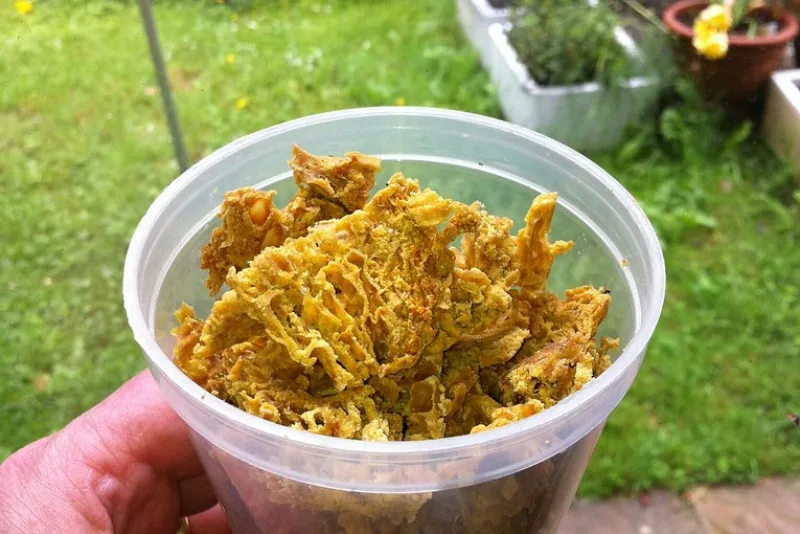
The color of propolis varies considerably depending on the local flora: it can be golden-yellow, reddish-brown, dark green, or almost black. Its consistency changes with temperature — in the cold it becomes hard and brittle, while in heat it turns soft, sticky, and easy to shape. The smell is unmistakable: resinous, sweetish, slightly balsamic, reminiscent of fir resin and honey at the same time.
Bees use propolis for several practical purposes: they seal the hive’s cracks against drafts and pests, polish the honeycomb cells before the queen lays eggs (creating a sterile environment for the larvae), and even “embalm” intruders too large to drag out — a mouse or a caterpillar, for instance — coating them completely in propolis to prevent decay and the spread of bacteria. It is precisely this antiseptic function that caught human attention back in antiquity.
Composition and active compounds
Propolis is one of the most complex natural substances known, with over three hundred identified compounds, and its exact composition varies greatly from one region to another. Broadly speaking, it contains roughly half plant resins and balsams, nearly a third wax, a smaller amount of volatile essential oils, pollen, and a range of trace elements.
The most valuable components, however, are the flavonoids — plant pigments such as galangin, pinocembrin, chrysin, and quercetin — alongside phenolic acids and esters, the most studied of which is caffeic acid phenethyl ester (known in the scientific literature as CAPE). In laboratory studies, these compounds are credited with most of propolis’s biological properties: its antioxidant, antibacterial, antifungal, and anti-inflammatory action.
Propolis also contains B-complex vitamins, vitamin C, traces of vitamin E, and minerals such as zinc, magnesium, iron, copper, and manganese. These micronutrients, though present in small amounts, contribute to the overall effect. An important point to remember: precisely because it is a natural, non-standardized product, the concentration of active compounds differs from batch to batch, depending on local flora and season. Mountain propolis, rich in conifer resin, will have a different profile from lowland propolis harvested in an area with poplars.
Health benefits
Support for the immune system
The best-known use of propolis, both in folk tradition and in modern research interest, is supporting immunity. Studies suggest that certain compounds in propolis may stimulate the activity of immune cells and help the body respond more efficiently to seasonal challenges. Our grandmothers did not know the scientific terms, but they knew one thing empirically: a propolis cure at the start of autumn “strengthened” children for winter. That is why many families still make a preventive cure during the cold months.
Antibacterial and antifungal action
In the laboratory, propolis extracts have shown the ability to inhibit the growth of certain bacteria and fungi. This explains why, in folk medicine, propolis was used for centuries to treat wounds, mouth ulcers, mild oral infections, and certain skin conditions. Propolis tincture applied locally to a clean cut or a small lesion was regarded as the “hive’s disinfectant” adapted for humans.
Soothing sore throats and respiratory complaints
Probably the most popular household use: at the first sign of an irritated throat, hoarseness, or a dry sensation. Propolis sprays and tinctures are frequently used to soothe the inflamed lining of the throat. Tradition recommends a few drops of tincture in a teaspoon of honey, left to dissolve slowly in the mouth, or diluted in a little warm water for a gargle.
Oral cavity health
Propolis is valued in mouth care — for sensitive gums, ulcers, and oral hygiene in general. Many natural toothpastes and mouthwashes include it as an ingredient. Gargling with water containing a few drops of tincture is a traditional remedy for inflamed gums, though it does not replace a visit to the dentist when one is needed.
Healing of skin and superficial wounds
Thanks to its properties, propolis has always been used to dress small wounds, scratches, mild burns, cracked skin, and even cold sores. Propolis-based ointments are still a sought-after product for caring for irritated skin. Important: for deep, infected, or extensive wounds, always see a doctor.
Antioxidant effect
Its wealth of flavonoids and phenolic acids makes propolis a natural source of antioxidants, substances that help neutralize free radicals. While it is no cure-all, including it in moderation within a healthy lifestyle can complement the antioxidant intake from your diet.
Traditional uses
In country households, propolis was a kind of “pocket pharmacy.” Here are some of the uses we inherit from our elders:
- For throat and colds: drops of tincture in honey or warm tea.
- For wounds and scratches: tincture applied locally or propolis ointment.
- For mouth ulcers and gums: diluted gargle or touching the ulcer with a drop of tincture.
- For corns and warts: repeated applications of pure propolis or concentrated tincture.
- For immunity: seasonal cures, especially in autumn and winter.
- For sensitive ears: in some regions, a few drops of extract in warm oil (only on the advice of a specialist, and never if the eardrum is perforated).
These uses represent folk tradition and experience passed down through generations, not formal medical indications.
How to prepare it: tincture, ointment, and other forms
Propolis tincture (the classic recipe)
The tincture is the most widespread homemade form of preparation. Here is the traditional method, step by step:
- Prepare the raw propolis: place the chunks of propolis in the freezer for a few hours. In the cold it becomes brittle and crumbles easily. Then grind or crush it into a coarse powder.
- The proportion: use roughly 20–30 g of ground propolis to 100 ml of food-grade alcohol at 70 percent (alcohol extracts resins and flavonoids best). For a stronger tincture you can go up to a 1:4 ratio.
- Maceration: put everything in a tightly sealed glass jar, preferably dark glass. Keep it in the dark, at room temperature, for 2–3 weeks, shaking it daily.
- Filtering: strain the tincture through a double layer of cheesecloth or a coffee filter. The resulting liquid will be cloudy and amber-colored.
- Storage: pour the tincture into a dropper bottle, label it with the date, and keep it in the dark. It keeps well for many months, even years.
For those who avoid alcohol, there is a vegetable glycerin–based tincture, although the extraction is less efficient and takes longer.
Propolis ointment
For external use, on the skin:
- Melt roughly 100 g of beeswax with 200 ml of vegetable oil (olive, sunflower, or almond) in a double boiler.
- Add 10–15 g of finely ground propolis or a few tablespoons of concentrated tincture.
- Stir over very low heat, without boiling, until smooth and uniform.
- Strain and pour into small containers. Let it set.
Chewable propolis
The simplest form: a small piece of pure propolis, chewed slowly like gum, gradually releases its active compounds into the mouth. It is a traditional method for the throat and gums, but it has an intense, resinous taste that is not for everyone.
Honey with propolis
Mixing a few drops of tincture into a small jar of honey creates a pleasant-tasting remedy, easy to take daily, especially by children over 3 (with a doctor’s approval).
Dosage and how to take it
For propolis tincture, tradition generally recommends between 10 and 30 drops a day for adults, diluted in a teaspoon of honey, a glass of water, or tea, preferably before meals. Cures are usually done over periods of 2–3 weeks, followed by a break.
For children over 3, the dose is reduced considerably and given only after consulting a doctor. For external use, the ointment or tincture is applied locally once or twice a day.
The golden rule: always start with a small dose to test your tolerance, and increase gradually. More does not mean better — propolis is strong and concentrated.
How to choose and store propolis
Quality propolis has a strong, pleasant resinous smell and a uniform color. Raw propolis, harvested directly from trustworthy beekeepers, is usually the purest. Avoid products with no clear origin or with a chemical smell.
Store raw propolis in a sealed container, in a cool, dark place, away from moisture. Keep the tincture in dark glass, in the dark. Unlike many other remedies, propolis has a very long shelf life, thanks to its own preservative properties.
Lifestyle and practical tips
Propolis is not a miracle medicine and does not work in isolation. It gives the best results as part of a balanced lifestyle: enough sleep, a varied diet rich in fruits and vegetables, proper hydration, and movement. An autumn propolis cure makes sense precisely because it prepares the body, not because it “cures” everything.
Combine it with other hive products — honey, pollen, royal jelly — for broader support, but always in moderation. And remember: at the first sign of serious illness, propolis is a helper, not a replacement for a medical consultation.
Practical Tips and Common Mistakes
Mistake no. 1: Using it without an allergy test. This is the most dangerous mistake. Propolis frequently causes allergic reactions. First apply a drop to your wrist and wait 24 hours.
Mistake no. 2: Overdosing. “If a little is good, more is better” is faulty thinking. Large doses can irritate the stomach and mucous membranes. Stick to the recommended amounts.
Mistake no. 3: Preparing it with the wrong alcohol. Using rubbing alcohol or non-food sources can be toxic. Use only food-grade alcohol.
Mistake no. 4: Expecting instant results. Propolis works gradually, as support. It is not an antibiotic that acts within hours.
Mistake no. 5: Stopping medical treatment. Propolis never replaces antibiotics prescribed for a confirmed bacterial infection. It is a complement, not an alternative.
Mistake no. 6: Storing it in light and heat. These conditions degrade the active compounds. Keep everything dark and cool.
Mistake no. 7: Giving it to small children without medical advice. Under age 3, propolis is not recommended because of the risk of allergies.
Conclusion
Propolis, the “gold of the hive” that Grandmother Saveta spoke of, is one of the most fascinating gifts of the bees: a defensive glue that nature perfected to protect the colony, and which humans borrowed for their own health. Rich in flavonoids and phenolic acids, traditionally valued for immune support, for the throat, for the skin, and for the oral cavity, propolis remains a trusted remedy in the natural pharmacy of many families.
Used wisely — with an allergy test, in reasonable doses, and as part of a healthy lifestyle — it can be a valuable ally. But like any powerful remedy, it demands respect and moderation. Listen to your body, consult a doctor when needed, and enjoy the wisdom that the bees and our ancestors have handed down to us.
Frequently Asked Questions
Who should not use propolis? People allergic to bee products, pollen, or poplar; children under 3; pregnant and breastfeeding women (without medical approval); people with severe asthma; and those taking blood thinners. At any sign of an allergic reaction, stop immediately.
How long can I do a propolis cure? Tradition recommends cures of 2–3 weeks, followed by a break of at least a week. Continuous, prolonged cures are not advisable without supervision.
Can propolis be given to children? Only to children over 3, in small doses and after consulting a doctor. Below that age, the risk of allergy is too great.
What is the difference between an alcohol tincture and a glycerin one? The alcohol tincture extracts flavonoids and resins more efficiently and is more concentrated. The glycerin one suits those who avoid alcohol, but it has weaker extractive power.
Does propolis cause weight gain or contain calories? The amounts used are so small (drops) that the caloric intake is negligible. It does not affect weight.
How can I tell if I am allergic? Do a skin test: a drop on the wrist, left for 24 hours. If redness, itching, or swelling appears, you are probably sensitive and should avoid it.
Can I apply propolis directly to an open wound? On small, clean, superficial wounds, tradition uses it locally. On deep, infected, or extensive wounds, see a doctor — propolis does not replace medical care.
Why does propolis taste so strong? The resinous, slightly bitter and balsamic taste comes from the plant resins and essential oils it contains. Mixed with honey, the taste becomes far more pleasant.