
Royal Jelly: Benefits, Uses and How to Consume It
IMPORTANT: Royal jelly is a powerful bee product, but it is not right for everyone. People allergic to bees, bee venom, pollen, or other bee products (honey, propolis) can develop severe reactions, including anaphylactic shock. If you have asthma, known allergies, or an autoimmune condition, talk to your doctor before using it. It is not recommended for children under 1 year of age, and pregnant or breastfeeding women should seek medical advice first. Royal jelly does not replace any prescribed medical treatment and does not cure serious illness; think of it as a supportive supplement, not a medicine.
In a village at the foot of the Carpathian Mountains, Grandma Veta kept a small jar in her pantry, wrapped in brown paper so the light couldn’t reach it, that no one was allowed to touch. “It’s the gold of the hive,” she would say, and every winter morning, while it was still dark outside, she would take a portion the size of a pea on the tip of a wooden spoon and hold it under her tongue until it melted. She was over eighty years old and still walked to the forest for kindling, with rosy cheeks and a sharp mind. When you asked her for the secret, she would smile and point to the hives at the bottom of the garden: “Whatever is good for their queen is good for us too.”
That “gold of the hive” was royal jelly, the most precious and least understood of all bee products. Today we find it in pharmacies and health stores, in vials, capsules, or refrigerated jars, but folk tradition has known it for generations as a remedy for vitality, resistance to fatigue, and the strength to get through hard winters. In this article, we will understand what royal jelly actually is, why it is so special, what benefits are attributed to it, how to consume it properly, and what precautions deserve to be taken seriously.
Table of Contents
- What royal jelly is and how it is made
- Composition and active compounds
- Health benefits
- Traditional uses
- How to consume royal jelly
- Dosage and administration
- How to choose and store it
- Royal jelly in your daily routine
- Practical tips and common mistakes
- Conclusion
- Frequently Asked Questions
What royal jelly is and how it is made
Royal jelly is a secretion produced by young worker bees, specifically by their hypopharyngeal and mandibular glands. It is a creamy substance, whitish-yellow in color, with a characteristically sour, pungent, slightly astringent taste. Its name comes from its biological role: it is the exclusive food of the hive’s future queen.
This is where the entire fascination with this product lies. All bee larvae receive royal jelly during the first three days of life. But the larva chosen to become a queen continues to be fed exclusively royal jelly throughout her development. The result is spectacular: from a larva genetically identical to those that would have become simple workers, a much larger queen is born, capable of laying thousands of eggs a day and living for years, while worker bees live only a few weeks. This enormous difference, driven by diet alone, has always sparked human curiosity and fueled royal jelly’s reputation as a concentrate of vitality.
Beekeepers harvest royal jelly from special cells, called queen cells, in which bees raise future queens. It is painstaking work that requires skill and patience, which is why authentic royal jelly is expensive. Only a small quantity can be obtained from a single hive, which explains why this product has always been considered rare and precious.
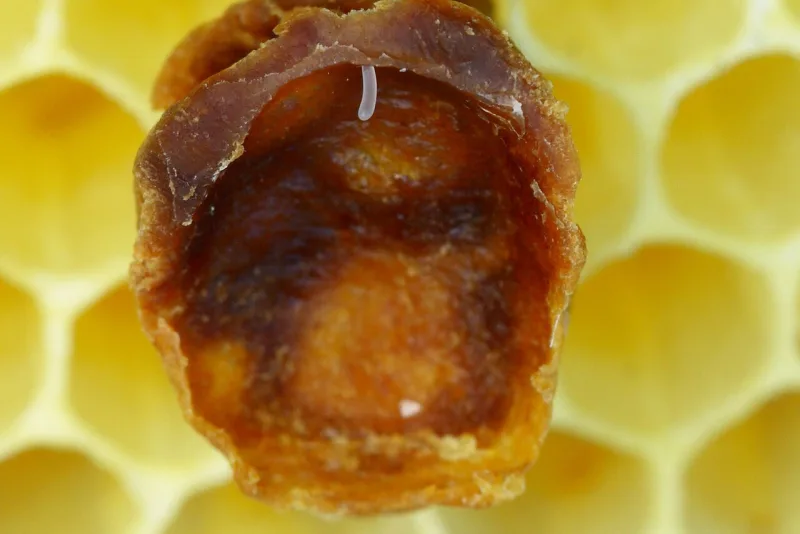
The image in this article shows exactly such a queen cell on the comb, the little “cradle” into which the bees generously deposit royal jelly to feed the future queen.
Composition and active compounds
Royal jelly is a complex substance, and its composition varies with the season, the geographic region, and the bees’ diet. Broadly speaking, it is made up of water (in a large proportion, around two-thirds), proteins, carbohydrates, lipids, vitamins, minerals, and a series of specific bioactive compounds.
Among the components responsible for its reputation are:
- Proteins and amino acids. Royal jelly contains high-quality proteins, including some specific ones called royalactins, thought to be responsible for the effects on queen development. It also contains a broad spectrum of essential amino acids.
- 10-HDA (10-hydroxy-2-decenoic acid). This is a unique fatty acid found almost exclusively in royal jelly, considered a marker of the product’s authenticity and quality. Studies suggest that many of the biological properties attributed to royal jelly are due to this compound.
- B-complex vitamins. Royal jelly is a remarkable source of B vitamins, especially B5 (pantothenic acid), B6, B2, B1, and B3, vitamins involved in energy metabolism and the proper functioning of the nervous system.
- Minerals. It contains iron, calcium, potassium, zinc, magnesium, and other minerals, in small but valuable amounts.
- Carbohydrates and lipids. These provide the energy component, while specific lipids contribute to the antimicrobial effects traditionally attributed to it.
This combination of nutrients makes royal jelly a nutrient-dense food-supplement, which is why it has been valued as a general tonic in many cultures, not just in the Romanian tradition.
Health benefits
First, an honest note: royal jelly is not a cure-all, and many of its properties come from folk tradition and observation rather than absolute certainty. Studies suggest promising directions, but the wisest approach is to see it as support for the body, not a miracle remedy. Here are the benefits most often associated with it.
Supporting energy and fighting fatigue
The best-known use of royal jelly is as an energizing tonic. Its richness in B-complex vitamins and amino acids makes it valued by people who feel exhausted, during periods of burnout, convalescence, or sustained physical and intellectual effort. Many take it especially in spring, when the body feels the fatigue that lingers after winter, or during busy periods of exams and deadlines.
Supporting immunity
Apitherapy tradition uses royal jelly to strengthen the body’s resistance against colds and seasonal infections. Often combined with honey and propolis, it forms a classic trio in Romanian households at the first signs of weakness or during the cold months. Studies suggest that certain compounds in royal jelly may have properties that support natural defenses, which is why it is popular as a preventive tonic during flu season.
Hormonal balance and vitality in women
Royal jelly has a special reputation for supporting hormonal balance, especially in women going through menopause or experiencing premenstrual fatigue. Many women traditionally use it to ease feelings of exhaustion, mood changes, and a sense of low energy. These uses come from folk experience, and research in this area is still ongoing.
Skin health
Whether applied externally or consumed internally, royal jelly is valued in natural cosmetics for its nourishing effect on the skin. It is an ingredient in many anti-wrinkle creams and serums and is considered to support the skin’s elasticity and youthful appearance. Tradition says that women who consumed it regularly had “skin like a young girl’s,” and today the cosmetics industry capitalizes on this reputation.
Support for convalescence and appetite
In the village of old, royal jelly was given to frail children, weakened elders, and those struggling to recover after an illness. It was considered a restorative that brings back the appetite, helps the body recover, and puts color back in the cheeks. This use as a recovery tonic remains one of the most widespread.
Supporting focus and the nervous system
Thanks to its supply of B vitamins, essential for the nervous system, royal jelly is also traditionally used to support mental clarity, concentration, and emotional balance during stressful periods. Many people say it helps them cope better with pressure and nervous fatigue.
Traditional uses
In households with hives, royal jelly always had a place of its own, set apart from ordinary honey. It was the “strong remedy,” brought out only when needed. Here are some of the uses passed down from generation to generation:
- The spring tonic. As nature awakened and people felt drained after winter, a course of royal jelly mixed with honey was taken in the morning on an empty stomach.
- The restorative for the sick. People recovering from illness were given a little each morning to help them regain their strength.
- Support for the elderly. Grandparents were given it to maintain vitality, appetite, and mental clarity.
- Help for students. During exam periods, children and young people received royal jelly for concentration and resistance to fatigue.
- A woman’s beauty. Used as a mask or consumed internally, it was considered a secret of beautiful skin and youthfulness.
Royal jelly was often combined with the hive’s other gifts: honey for sweetness and energy, propolis for protection, and pollen for nutrients. This mixture, known in many homes as the “hive remedy,” is still popular today.
How to consume royal jelly
The key to consuming royal jelly correctly lies in a simple method passed down by beekeepers: sublingual administration, that is, holding it under the tongue. Here is why and how.
The sublingual method (recommended)
Fresh royal jelly is sensitive. Its active compounds can degrade with heat and on contact with stomach acid. That is why the traditional method, considered the most effective, is to take a small amount (about the size of a grain of rice or a pea, depending on the recommendation) on the tip of a spoon and hold it under your tongue until it fully dissolves. This way, the active compounds are absorbed directly through the lining of the mouth, bypassing digestion.
It is usually taken in the morning, on an empty stomach, at least 15-20 minutes before eating. The taste is strongly sour and pungent, which is why some people find it difficult at first. Over time, the body grows accustomed to it.
Royal jelly with honey
A very popular and easier-to-take option is the mixture of royal jelly with honey. It is simple to prepare:
- Measure or estimate the recommended amount of fresh royal jelly.
- Mix it thoroughly with quality honey (raw, unheated bee honey), in a ratio where honey predominates.
- Store the mixture in the refrigerator, in a dark-colored, sealed jar.
- Take a teaspoon each morning, holding it in your mouth for a moment before swallowing.
The honey sweetens the strong taste and helps with preservation. Note, however, that if you want the maximum benefit of sublingual absorption, the pure form is preferable.
Capsules and vials
Commercially, royal jelly is also available in capsules (freeze-dried, that is, dehydrated) or in vials (often combined with honey and other extracts). These forms are convenient and easy to dose, but many purists believe that fresh, refrigerated royal jelly best preserves its properties. Capsules are swallowed with water according to the directions on the package.
Dosage and administration
Doses vary depending on the form of the product, age, and the purpose of the course, which is why the recommendations on the packaging and the advice of a specialist are important. As a general guide, apitherapy tradition uses small amounts of fresh royal jelly, taken in the morning, in courses of several weeks.
A few practical principles:
- Start with a small amount. Especially if you have never taken bee products before, begin with a very small dose to check your tolerance and rule out an allergic reaction.
- Courses, not constant use. Royal jelly is usually taken in courses (for example, one month), followed by breaks. It is not meant for continuous, year-round consumption.
- In the morning, on an empty stomach. For an energizing effect, the morning is the ideal time. The evening is not recommended for everyone, as it can be stimulating.
- Respect the guidelines for children. For children, doses are smaller and should be established together with a doctor; it is not given before the age of 1.
How to choose and store it
The quality of royal jelly makes all the difference. Here is what is worth knowing:
- Fresh vs. freeze-dried. Fresh royal jelly is kept refrigerated (and, ideally, frozen for long-term storage) and has a limited shelf life. The freeze-dried form is stable for longer, but it has gone through a processing step.
- Color and taste. Authentic royal jelly has a whitish-yellow color and a sour, pungent, slightly astringent taste. A sweet or bland taste may indicate a diluted product.
- The source. Buy from trusted beekeepers or authorized sources. Royal jelly that is harvested and stored correctly (cold, away from light) retains its value.
- The packaging. Dark-colored jars and cold storage are essential, because light and heat degrade the active compounds.
At home, always keep it in the refrigerator in a tightly sealed container, and use a clean, dry spoon so you don’t introduce moisture or microbes that would shorten its shelf life.
Royal jelly in your daily routine
To truly benefit from royal jelly, it helps to integrate it into a balanced lifestyle. On its own, it works no miracles; alongside healthy habits, it becomes real support. A few ideas:
- Do a spring course and an autumn course, the seasons when the body needs support.
- Combine it with a diet rich in vegetables, fruit, and foods that are as natural as possible.
- Make sure you get enough sleep; royal jelly supports energy but does not replace rest.
- Use it during demanding periods: stress, exams, exertion, convalescence.
- Combine it, if you like, with the hive’s other products (honey, pollen, propolis) for a synergistic effect.
Seen this way, royal jelly is not a “magic pill” but one piece of a health puzzle in which sleep, movement, nutrition, and peace of mind also matter.
Practical tips and common mistakes
Mistake no. 1: Ignoring the risk of allergy. The most serious mistake is to consume royal jelly without checking your tolerance, especially if you are allergic to bees, pollen, or other bee products. Start with a very small amount and watch for any sign of a reaction (itching, swelling, difficulty breathing). At the slightest sign, stop and seek medical help.
Mistake no. 2: Storing it at room temperature. Fresh royal jelly is sensitive. Left in heat or light, it quickly loses its value. Its place is in the refrigerator, in a dark-colored jar.
Mistake no. 3: Swallowing it quickly. Many people swallow royal jelly directly, missing the advantage of sublingual absorption. Hold it under your tongue until it dissolves, so the active compounds are absorbed better.
Mistake no. 4: Doses that are too large, “to be on the safe side.” More does not mean more effective. Small amounts, taken consistently over the course of a treatment period, are the key. Excess brings no extra benefits and can increase the risk of reactions.
Mistake no. 5: Taking it in the evening if it energizes you. Royal jelly can be stimulating. If you notice it affects your sleep, move the dose to the morning.
Mistake no. 6: Expecting immediate miracles. Tonic effects are felt over time, throughout a course, not overnight. Patience and consistency matter.
Mistake no. 7: Buying from unreliable sources. A cheap, diluted, or poorly stored product will not have the desired properties. Invest in authentic royal jelly from trusted beekeepers.
Conclusion
Royal jelly is, rightly, the “gold of the hive”: a rare, nutrient-dense bee product surrounded by an old reputation as a tonic for vitality, immunity, and beauty. Rich in B vitamins, amino acids, minerals, and unique compounds such as 10-HDA, it has been valued for generations as a restorative for the weak, support during convalescence, and a source of energy in hard times.
Used with moderation and properly — fresh, refrigerated, taken sublingually in the morning, in short courses — royal jelly can be a pleasant ally for the body. It is not a medicine, however, and does not cure illness; it is a support that fits best alongside a healthy lifestyle. And for those allergic to bee products, caution is mandatory. As Grandma Veta used to say, “whatever is good for their queen is good for us too” — provided we are attentive and wise in how we use it.
Frequently Asked Questions
How do you consume royal jelly correctly? The most effective way is sublingual administration: a small amount (about the size of a grain of rice or a pea) held under the tongue until it dissolves, in the morning, on an empty stomach. This way, the active compounds are absorbed directly through the lining of the mouth, avoiding degradation in the stomach. It can also be taken mixed with honey for a more pleasant taste.
What does royal jelly taste like? It has a strong, sour, pungent, and slightly astringent taste, quite unusual at first encounter. This characteristic taste is actually a sign of authenticity. Mixing it with honey makes it easier to take.
How long does a course of royal jelly last? Courses usually last several weeks (for example, one month), followed by breaks. It is not meant for continuous consumption throughout the year. Many people do one course in spring and one in autumn.
Can I take royal jelly if I’m allergic to honey or pollen? Caution: people allergic to bee products, pollen, or bee venom have an increased risk of reactions, including severe ones. If this applies to you, do not consume it without your doctor’s approval, and if they allow it, start with a minimal amount, under supervision.
Does royal jelly help with fatigue and lack of energy? Folk tradition and apitherapy recommend it precisely as an energizing tonic, thanks to its supply of B vitamins and amino acids. Many people use it during periods of burnout, convalescence, or intense effort. The effects are felt over time, throughout a course.
How is fresh royal jelly stored? In the refrigerator, in a dark-colored jar, away from light and heat. For long-term storage, freezing is an option. Always use a clean, dry spoon so you don’t introduce moisture or microbes.
Can I give royal jelly to children? For children, doses are smaller and should be established together with a doctor. It is not given before the age of 1. In children, as in adults, tolerance should be checked first because of the risk of allergy.
Is royal jelly good for the skin? Yes, it is valued in natural cosmetics for its nourishing effect and its support of skin elasticity. It is found in many creams and serums, and tradition attributes to it a role in maintaining a youthful complexion. It can be used both internally and externally, in cosmetic preparations.