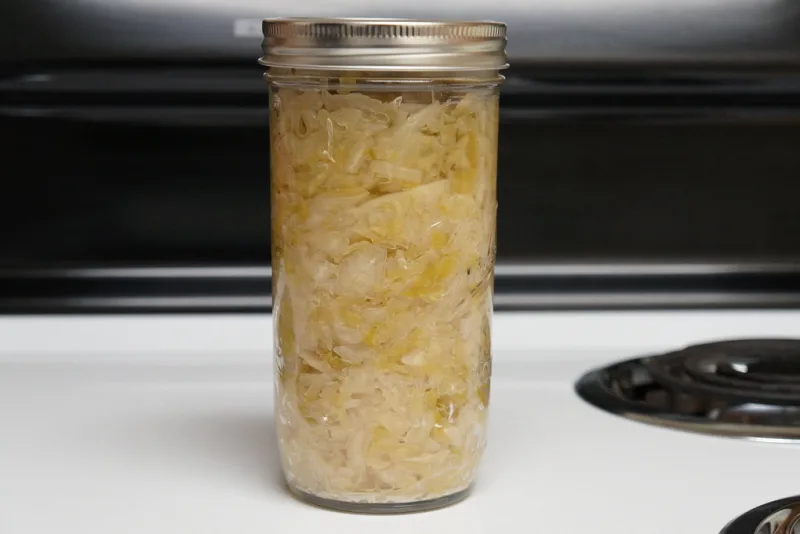

Sauerkraut: Benefits, Probiotics and How to Eat It Properly
IMPORTANT: Sauerkraut is a safe and healthy fermented food for most people, but it contains a large amount of salt. People with high blood pressure, kidney conditions, heart failure, or those following a low-sodium diet should eat it in moderation and, ideally, rinse it well or soak it to reduce salt. Those taking anticoagulant medication such as warfarin should be mindful of the vitamin K content in cabbage and discuss it with their doctor, since variable intake can affect blood clotting. Sauerkraut is rich in histamine and fermentable compounds, so people with histamine intolerance, irritable bowel syndrome, or chronic bloating may experience discomfort. If you develop severe abdominal pain, persistent diarrhea, or any unusual reaction, stop eating it and consult a doctor. This article is for informational purposes only and does not replace professional medical advice.
Grandmother Veronica, from a village in the Mureș Valley, kept in her pantry an oak barrel almost as tall as she was, brimming with whole heads of cabbage set to ferment back in October. She always said that “winter without sauerkraut is like a house without fire.” On every cold December evening she would reach into the cloudy, fragrant brine, pull out a head with her own hand, cut it into thin ribbons, and set it on the table beside cornmeal porridge and a slice of cured fat. The grandchildren sometimes wrinkled their noses at the sour taste, but she would laugh and say: “You’ll thank me when you don’t catch a cold all winter, like the others.”
And she was right, just as generations of Romanian households were right. Without knowing a single word about lactic bacteria or probiotics, they had understood from experience that cabbage set to ferment keeps people healthy through the winter. Today science confirms what folk tradition practiced for centuries: fermentation turns an ordinary cabbage into a living food, full of friendly bacteria and vitamins, a true pantry remedy.
Sauerkraut is, in essence, white (or red) cabbage shredded or left whole and allowed to undergo lactic fermentation in its own salted juice. It is not pickling with vinegar, but a natural transformation in which the lactic bacteria naturally present on the cabbage leaves “eat” the sugars in the vegetable and produce lactic acid. This acid preserves the cabbage, gives it its characteristic sour taste, and creates an environment where probiotics multiply. It is one of the oldest and most widespread fermented foods in the world, found from Romanian and German villages all the way to Korea (in the form of its relative, kimchi).
Table of Contents
- What sauerkraut is and how it is made
- Nutritional value and composition
- Health benefits
- How to make sauerkraut at home (step-by-step recipe)
- How to eat it and how much
- How to choose and store it
- Lifestyle: the place of sauerkraut in a balanced diet
- Practical Tips and Common Mistakes
- Conclusion
- Frequently Asked Questions
What sauerkraut is and how it is made
Sauerkraut is produced through a process called spontaneous lactic fermentation. On the surface of fresh cabbage leaves live, naturally, numerous strains of lactic bacteria (especially from the genera Leuconostoc, Lactobacillus, and Pediococcus). When the cabbage is cut or pressed and covered with brine (salted water) or allowed to release its own juice, an oxygen-free environment is created. In this anaerobic environment, the lactic bacteria multiply rapidly, consume the cabbage’s natural sugars, and turn them into lactic acid.
The lactic acid lowers the pH, that is, it acidifies the environment, to a point where spoilage bacteria and molds can no longer survive. This is how cabbage keeps for months without refrigeration and without chemical preservatives. The process takes, depending on temperature, between two and six weeks: it goes faster in warmth, slower in the cold, but more controlled and with a finer taste.
Unlike vegetables pickled in vinegar, traditional sauerkraut receives no acid from the outside. All the acid comes from fermentation, which means the food stays “alive” — full of active beneficial bacteria, as long as it is not cooked or pasteurized. This is the key difference between authentic sauerkraut and store-bought cabbage preserved with heat: the first is a natural probiotic, the second, although tasty, has lost much of its living bacteria.
Nutritional value and composition
Sauerkraut is surprisingly rich for such a simple and inexpensive food. The fermentation process not only preserves the nutrients in the cabbage, but actually boosts some of them and creates new, beneficial compounds.
The main nutritional components are:
- Vitamin C — sauerkraut is a remarkable source of vitamin C, which is why it has always been the staple of winter, when fresh vegetables were scarce. Folk tradition used it instinctively against “winter sickness,” and history records that sailors carried it on long voyages to prevent scurvy.
- Vitamin K2 — produced by the fermentation bacteria themselves, important for bone and blood-vessel health.
- B-complex vitamins — including folate, partly synthesized by the microorganisms.
- Dietary fiber — which feeds the good bacteria in the colon and supports intestinal transit.
- Live probiotics — millions of beneficial lactic bacteria per serving, in unpasteurized sauerkraut.
- Minerals — iron, manganese, potassium, and calcium, in useful amounts.
- Sulfur compounds and antioxidants — glucosinolates and their derivatives, characteristic of cabbage and plants in the cruciferous family.
Sauerkraut is, at the same time, very low in calories and almost free of fat, which makes it an ideal food for those who want to eat healthily without gaining weight. The only nutritional “downside” is the high sodium content, coming from the salt used in fermenting.
Health benefits
Supports digestive health and gut flora
The best-known benefit of sauerkraut concerns digestion. The live probiotics it contains reach the gut and contribute to the balance of the intestinal flora, that ecosystem of bacteria that influences nearly every aspect of health. Studies suggest that fermented foods, eaten regularly, may improve the diversity of the microbiota and ease some digestive disturbances such as bloating, mild constipation, or discomfort after heavy meals. Romanian folk tradition has always used a spoonful of sauerkraut or a cup of sour brine as a “remedy” for a sluggish stomach after the holidays.
Strengthens immunity
A large part of the immune system is located in the gut, and a balanced intestinal flora supports the body’s natural defenses. Added to this is the generous supply of vitamin C, recognized for its role in immune function. The combination of probiotics and vitamin C explains why, in village wisdom, sauerkraut was considered the shield of winter against colds and respiratory infections.
Aids nutrient absorption
Fermentation partly “predigests” the cabbage, breaking down some hard-to-absorb components and making minerals more available to the body. In addition, a healthy gut flora helps with better absorption of nutrients from all foods eaten, not just from cabbage.
May contribute to general well-being
Modern research is exploring the link between the gut and the brain, the so-called “gut-brain axis.” Studies suggest that a balanced microbiome could positively influence mood and energy levels. While we should not view sauerkraut as a remedy for emotional problems, it is part of an eating pattern that supports the body’s overall balance.
A food ally in weight control
Being low in calories, rich in fiber, and with an intense taste that creates a feeling of fullness, sauerkraut can be an ally in the diet of those watching their weight. Fiber delays stomach emptying and prolongs the feeling of satiety, reducing the temptation to overeat.
A source of antioxidants
Cabbage and its fermented products contain compounds with antioxidant action, which help the body defend itself against oxidative stress. Antioxidants are important for long-term cellular health, and eating vegetables from the cruciferous family has long been valued for their protective contribution.
How to make sauerkraut at home (step-by-step recipe)
Homemade sauerkraut is not only tastier but also guaranteed alive, without pasteurization. Here is the classic method for shredded cabbage, the simplest for beginners.
Ingredients:
- 2 kg of fresh, firm white cabbage
- 40 g of coarse, non-iodized salt (about 2% of the cabbage’s weight)
- optional: dill seeds, peppercorns, bay leaves, horseradish, a few carrot slices for color
Steps:
- Clean the cabbage of wilted outer leaves and remove the hard core. Cut the cabbage into ribbons as thin as possible, with a large knife or a special shredder.
- Weigh the cabbage and calculate the salt: about 20 g of salt for every kilogram of cabbage. This ratio is essential — too little salt lets the cabbage spoil, too much blocks the fermentation.
- Massage the cabbage with the salt in a large bowl, with your hands, for a few good minutes. You will feel the cabbage start to release juice and soften. This is the key step: the salt draws the water out of the cabbage and creates the natural brine.
- Add the spices if you wish (dill, pepper, bay) and mix well.
- Pack the cabbage into a clean jar or a ceramic crock, pressing firmly, layer by layer, so that the juice completely covers the cabbage. Leave a few centimeters free at the top, since fermentation produces gases and the volume rises.
- Press the cabbage below the level of the liquid with a small plate and a clean weight (for example, a smaller jar filled with water). The cabbage must always stay covered by brine — the part exposed to air will mold.
- Let it ferment at room temperature (18–22°C / 64–72°F), covered with a cloth or a loose lid, to let gases escape. In the first days, bubbles will appear — a good sign, the fermentation has started.
- Taste after 1–2 weeks. When the acidity is to your liking, move the jar to a cold place (refrigerator or cellar). In the cold, fermentation slows greatly, and the sauerkraut keeps for months.
For whole heads (barrel cabbage), the brine method is used: a solution of about 20–30 g of salt per liter of water, in which the cored heads are submerged. These are “racked” (the brine is circulated) periodically for an even fermentation.
How to eat it and how much
Sauerkraut is best eaten raw, so that it keeps its probiotics and vitamin C. A reasonable serving for daily benefits is about 1–2 heaping tablespoons up to a small cup (50–150 g). Large amounts are not needed — even a modest portion, eaten regularly, delivers beneficial bacteria.
Here are a few ways to work it into your diet:
- As a simple salad, drizzled with a little oil and, perhaps, thinly sliced onion — the Romanian classic alongside roasts and rich dishes.
- Beside cornmeal porridge, potatoes, or meat dishes, as a sour accompaniment that aids digestion.
- In sandwiches and burgers, for a sour, crunchy note.
- Added at the end to soups or stews that are already finished, without cooking it, so as not to destroy the bacteria.
- The brine can be drunk as a digestive tonic, especially after copious meals or as a folk remedy for hangovers.
Note: if the cabbage is cooked (in stuffed cabbage rolls, braised cabbage, or baked cabbage), the probiotic benefits disappear through heat, but the fiber, part of the minerals, and the wonderful taste remain. Braised cabbage is delicious, but should not be confused with the probiotic source.
How to choose and store it
When buying sauerkraut, choose, if possible, the version sold loose, from a barrel, by local producers — it is more likely to be alive and unpasteurized. The cabbage should have a light, yellowish-white color, a pleasant sour smell (not rotten), and a crunchy texture, not soft and limp.
For store-bought cabbage packaged in jars, read the label: if it says “pasteurized” or is preserved at high temperature, the probiotics are no longer active. Such products remain tasty and provide fiber and vitamins, but not the benefits for the gut flora.
At home, store sauerkraut in the cold, always covered by brine. Always use a clean spoon to take it out, so as not to introduce unwanted bacteria. If a white film appears on the surface (harmless yeasts), remove it; if colored mold appears (green, black, pink), discard everything as a precaution.
Lifestyle: the place of sauerkraut in a balanced diet
Sauerkraut is not a “miracle food” that solves everything on its own, but a valuable piece in a healthy dietary mosaic. The greatest benefit goes to those who eat it regularly, in small amounts, as part of a diet rich in vegetables, whole grains, and minimally processed foods.
Romanian tradition integrated it naturally: people did not eat a kilogram at once, but a modest portion, almost daily, alongside the main dishes. This “little but often” approach is exactly what modern nutritionists also recommend for fermented foods: a steady supply of probiotics matters more than a huge amount eaten occasionally.
Sauerkraut fits excellently into a lifestyle in which we value home cooking, seasonality, and self-sufficiency. Setting cabbage to ferment in autumn is a gesture that links the generations, saves money, and brings a healthy food into the pantry for the whole winter.
Practical Tips and Common Mistakes
Mistake no. 1: The wrong amount of salt. The most common error when making it at home. Too little salt lets the cabbage spoil and develop an unpleasant smell; too much stops the fermentation and makes the cabbage excessively salty. Stick to the ratio of about 2% salt by weight of the cabbage.
Mistake no. 2: Cabbage left above the brine. Any ribbon exposed to air oxidizes and molds. The cabbage must always remain completely submerged under the liquid, pressed with a weight.
Mistake no. 3: Boiling the cabbage “for the probiotics.” Many people cook the cabbage and then wonder why “it doesn’t do anything anymore.” Heat destroys the living bacteria. For probiotics, eat it raw; for taste, cook it without worry, but without probiotic expectations.
Mistake no. 4: Using iodized salt. The iodine and anti-caking agents in fine table salt can inhibit the lactic bacteria. Use coarse, non-iodized salt.
Mistake no. 5: Overconsumption by sensitive people. The high content of sodium and histamine can cause problems for those with high blood pressure or intolerances. Start with small portions and observe how your body reacts.
Mistake no. 6: Throwing away the brine. The cabbage brine is just as valuable as the cabbage itself, full of probiotics and vitamins. Drink it as a tonic or use it in sour soups (such as cabbage borscht).
Mistake no. 7: Unsuitable containers. Avoid reactive metal containers (aluminum) or low-quality plastic. Use glass, glazed ceramic, or food-grade wood.
Conclusion
Sauerkraut is one of the smartest foods that folk tradition has left us as a legacy: cheap, filling, easy to make, and full of beneficial bacteria, vitamins, and fiber. Behind the sour taste we know from childhood lies a small biological miracle — the transformation of an ordinary cabbage, through the power of lactic bacteria, into a living food that supports digestion, immunity, and overall well-being.
The key is to eat it raw, in small portions but regularly, and to be mindful of the salt content. For most people, a tablespoon or two of sauerkraut a day is a simple and healthy habit, exactly as our grandparents knew when they filled their barrels every autumn. Grandmother Veronica was right: winter without sauerkraut really is like a house without fire.
Frequently Asked Questions
Is sauerkraut healthier than fresh cabbage? Both are healthy, but different. Fresh cabbage has its own vitamins and fiber, while sauerkraut adds live probiotics, vitamin K2, and better availability of some nutrients. Ideally, eat both, each in its season.
Can I eat sauerkraut every day? Yes, for most people a small daily portion is beneficial. People with high blood pressure, kidney conditions, or histamine intolerance should eat it in moderation and consult their doctor.
Why does sauerkraut cause bloating? It contains fermentable fiber and, through fermentation, produces compounds that generate gas in some people. Start with small portions so your gut gets used to it gradually.
Does supermarket jarred cabbage have probiotics? It depends. If it is pasteurized or preserved with heat (as many shelf-stable versions are), the probiotics are destroyed. Live sauerkraut is usually found in the refrigerated section or loose, from a barrel.
How long should the cabbage ferment? At room temperature, active fermentation usually lasts 1–4 weeks, depending on how sour you want it. Once it reaches the desired taste, move it to the cold to stop the process.
Can I drink the cabbage brine? Yes, cabbage brine is a traditional digestive tonic, full of probiotics and vitamins. Drink it in small amounts, especially if you are watching your sodium intake.
What should I do if mold appears? A thin white film (yeasts) can be removed and the cabbage can still be eaten. Colored mold (green, black, pink) and a rotten smell mean spoilage — discard the entire batch.
Does sauerkraut help with weight loss? It can be an ally, being low in calories and rich in fiber that provides satiety. It is not, however, a “fat burner” in itself, just a useful component in a balanced diet.