
Angelica: Benefits, Uses and How to Prepare It
IMPORTANT: Angelica (Angelica archangelica) is a powerful plant, and using it requires caution. The root and the fresh plant contain furanocoumarins that can cause photosensitization — avoid intense sun exposure after taking it. Angelica is contraindicated during pregnancy (it has an emmenagogue effect and may stimulate the uterus) and while breastfeeding. People taking anticoagulants or diabetes medication, or who have an active ulcer, should consult a doctor before use. Never confuse cultivated angelica with poisonous wild umbellifers (hemlock, for example) — foraging should ONLY be done with solid botanical knowledge. This information is educational and does not replace medical advice.
Grandmother Veronica, from a village at the foot of the Apuseni Mountains, kept in her pantry a large jar of dried roots with a penetrating, sweet-bitter scent that filled the whole house whenever she opened it. “This is the herb of the angels,” she would say, “it wakes up your stomach and clears your head.” Whenever someone in the family came home from a heavy meal with a swollen belly and no appetite for life, grandmother would boil a few pieces of the root and hand the sufferer a cup of warm decoction. Within minutes, the bloating eased and the appetite returned as if by magic.
Later I learned that this “herb of the angels” was not grandmother’s invention but a tradition stretching back centuries, widespread across northern and central Europe. Angelica was one of the most prized plants in folk medicine, considered a heavenly gift against the plague and all manner of ills. Today, although it has fallen out of fashion, it remains a remarkable plant for digestion, for the respiratory system, and for strengthening a tired body.
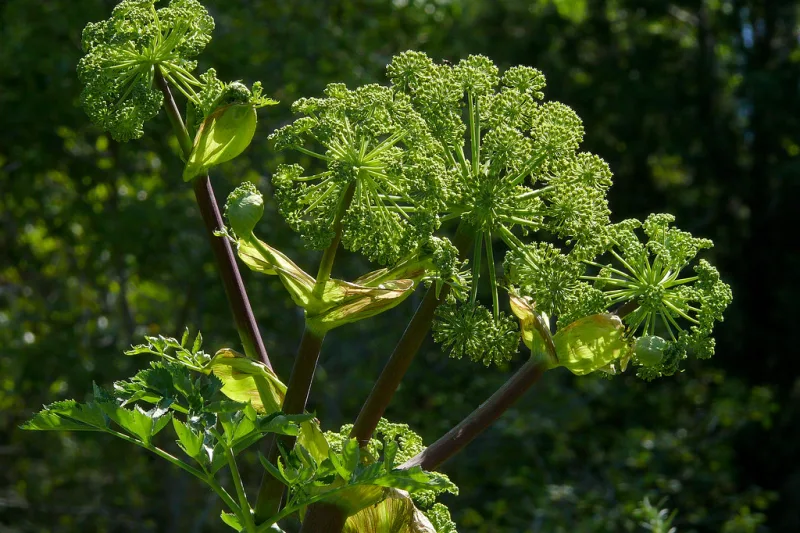
Angelica archangelica, also known as garden angelica or wild celery, is a biennial or short-lived plant in the Apiaceae family (the umbellifers) — the same family as carrot, celery, fennel and parsley. It grows impressively tall, sometimes up to two meters, with thick, hollow stems and large, spherical umbels of greenish-white flowers. The entire plant, from root to seeds, is aromatic and has been used in folk medicine, in cooking, and in the making of liqueurs.
Table of Contents
- What angelica is and where it grows
- Composition and active principles
- The health benefits of angelica
- Traditional uses
- How to prepare angelica (step-by-step recipes)
- Dosage and how to take it
- Angelica in cooking and drinks
- Practical tips and common mistakes
- Precautions and contraindications
- Conclusion
- Frequently Asked Questions
What angelica is and where it grows
Angelica archangelica is native to northern and eastern Europe — the cold regions of Scandinavia, Iceland, Russia and the Alps. Unlike many medicinal plants that prefer warmth, angelica loves cool, damp places: stream banks, mountain meadows, sparse forests and humus-rich soils. In Romania it can be found in mountain and sub-Carpathian areas, but it is mostly cultivated in gardens for its root and seeds.
The plant’s name comes from the Latin “angelus” (angel). One legend says a monk dreamed of an angel who showed him this plant as a cure against the plague. Hence the names “root of the Holy Spirit” and “herb of the angels.” In Nordic tradition, angelica was so valued that it was one of the few plants systematically cultivated as far back as the Middle Ages and traded as a precious commodity.
The plant has an interesting life cycle: in the first year it forms only a rosette of large, pinnate, deep-green leaves. Only in the second year does it send up its spectacular flowering stem, blooms, sets seed and then dies. That is why, if you want to harvest the root — the part richest in active principles — you do so in autumn of the first year or early spring of the second, before the plant uses up its reserves for flowering.
Three parts of the plant are used: the root (the most concentrated), the seeds (aromatic, used for digestion and in liqueurs), and sometimes the young leaves and stems (which are candied or used fresh). Each has its characteristic aroma — sweet, musky and slightly bitter.
Composition and active principles
Angelica’s therapeutic richness comes first and foremost from its volatile (essential) oil, which gives it its unmistakable aroma. This oil contains compounds such as beta-phellandrene, alpha-pinene, limonene, and a macrocyclic compound called angelica lactone, responsible for the characteristic sweet-musky scent.
In addition to the volatile oil, angelica root contains:
- Coumarins and furanocoumarins (bergapten, xanthotoxin, angelicin) — compounds with antispasmodic effects, but also those responsible for photosensitization;
- Bitter substances — which stimulate digestive secretions and appetite;
- Organic acids — such as angelic, valeric and malic acids;
- Tannins — with an astringent role;
- Resins and starch;
- Sugars and pectins.
Folk tradition and herbalism hold that it is precisely the combination of aromatic volatile oil and bitter substances that explains angelica’s dual action: on one hand it calms spasms and bloating, on the other it wakes up sluggish digestion. Studies suggest that angelica extracts have carminative (anti-bloating) and antispasmodic properties on the smooth muscle of the digestive tract.
The health benefits of angelica
Supports digestion and eases bloating
This is angelica’s primary use in folk tradition. Thanks to its bitter substances and volatile oil, the plant stimulates the production of saliva, gastric juice and bile, preparing the body for more efficient digestion. Tradition recommends it for the feeling of fullness after heavy meals, for bloating, gas and slow digestion. Many traditional digestive bitters (those herbal liqueurs taken before or after meals) contain angelica precisely for this effect.
Calms cramps and spasms
Angelica’s antispasmodic action makes it useful for abdominal cramps, especially those of nervous origin or those that arise during digestion. Studies suggest that the furanocoumarins and volatile oil relax the smooth muscle of the intestine, easing discomfort. In folk tradition, angelica tea was given to women with menstrual cramps and to people with colic.
Supports the respiratory system
In the folk medicine of northern Europe, angelica was used for respiratory complaints — cough, bronchitis, colds. It was thought to help thin and clear secretions, with a mild expectorant effect. Its warm, balsamic aroma made it valued in winter syrups and teas.
Stimulates appetite and energy
For people who were convalescing, weak, or had lost their appetite, angelica was considered a precious tonic. The bitter substances “wake up” the appetite, and the plant was seen as a general strengthener for a tired body. That is why it frequently appears in tonic wines and traditional fortifying blends.
Carminative and anti-fermentation effect
Beyond combating bloating that has already set in, angelica also helps prevent excessive intestinal fermentation. The seeds in particular were chewed or used in tea to reduce gas and to freshen the breath after meals.
Diaphoretic (sweat-inducing) action
In feverish states and at the first signs of a cold, angelica was given as a warm tea to stimulate sweating and “drive the illness out” — a traditional practice common to many aromatic plants.
Traditional uses
Over the centuries, angelica has filled many roles. In the Nordic peasant household, dried root was stored for winter and used as needed. Young stems were candied with sugar and used as sweets or as decoration for cakes — a tradition still kept today in fine pastry-making. The seeds went into digestive liqueurs and vermouths.
In folk medicine, the root decoction was the basic remedy for an upset stomach, lack of appetite and “a cold stomach.” Women used the tea to regulate their cycle, and the elderly used it for rheumatism and joint pain (both internally and as baths and compresses with the decoction). The root was also chewed to combat bad breath and to stimulate digestion.
How to prepare angelica (step-by-step recipes)
Root decoction (tea)
The decoction is the classic method, because the active principles in the root are best extracted by gentle boiling.
- Put one teaspoon of crushed dried root into a cup with about 250 ml of cold water.
- Bring slowly to a boil and simmer gently, covered, for 5–10 minutes.
- Turn off the heat and let it infuse for another 10 minutes, then strain.
- Drink warm, 15–30 minutes before a meal to stimulate digestion, or after a meal for bloating.
Drink at most 2 cups per day, in short courses (1–2 weeks), with breaks.
Infusion from angelica seeds
For the seeds, a simple infusion is enough:
- Put one teaspoon of lightly crushed seeds into a cup.
- Pour over 250 ml of boiling water.
- Cover and let infuse for 10–15 minutes.
- Strain and drink warm, after a meal, for bloating and gas.
Angelica tincture
The tincture is a concentrated form, easy to store and dose.
- Crush 20 g of dried angelica root.
- Place it in a clean jar and pour over 100 ml of food-grade alcohol at 60–70%.
- Close the jar and let it macerate for 2–3 weeks in a dark, cool place, shaking daily.
- Strain through cheesecloth and store in dark glass bottles.
Approximate dosage: 10–20 drops diluted in a glass of water, 2–3 times a day, before meals.
Angelica tonic wine
A traditional, pleasant-tasting preparation:
- Place 30 g of dried angelica root into one liter of good, dry white wine.
- Let it macerate for 8–10 days, shaking occasionally.
- Strain and keep cool.
- Take a small glass (30–50 ml) before main meals as a tonic digestive aperitif.
Angelica decoction bath
For rheumatic pain and fatigue:
- Boil 100 g of root in 2–3 liters of water for 15–20 minutes.
- Strain and add the liquid to warm bath water.
- Soak for 15–20 minutes. Be mindful of photosensitization after the bath.
Dosage and how to take it
Angelica is an active plant and should be used in moderate doses, not daily over the long term. Traditional and herbal recommendations generally fall around:
- Decoction/tea: 1–2 cups per day, in courses of 1–2 weeks;
- Tincture: 10–20 drops, 2–3 times a day;
- Crushed root: 1–4 g per day (total).
It is best to take short courses with breaks rather than consume angelica continuously. Because of the furanocoumarin content, prolonged exposure can increase the skin’s sensitivity to sunlight. Always start with small doses to observe how your body reacts.
Angelica in cooking and drinks
Beyond its medicinal use, angelica holds a special place in gastronomy. Candied young stems (boiled in sugar syrup) are a classic decoration for cakes, muffins and festive desserts, with an unmistakable green, sweet-aromatic flavor. The seeds and root are essential ingredients in many famous liqueurs, vermouths and gin, providing that complex, slightly musky aromatic backdrop.
Young leaves can be added in small amounts to stewed sour fruits (rhubarb, tart apples) to balance the acidity and reduce the need for sugar — an old trick from Nordic kitchens. Boiled stems were also eaten as a vegetable in the past, much like a distant cousin of celery.
Practical tips and common mistakes
Mistake no. 1: Confusing angelica with poisonous plants. The umbellifer family includes extremely toxic species such as hemlock. Never forage angelica from the wild unless you have solid botanical knowledge. The safest approach is to cultivate it or buy it from trusted sources.
Mistake no. 2: Sun exposure after taking it. The furanocoumarins in angelica can make the skin sensitive to UV radiation, leading to burns or spots. Avoid the beach or tanning beds on days when you take angelica.
Mistake no. 3: Use during pregnancy. Angelica has an emmenagogue effect (it stimulates menstruation) and may affect the uterus. It is strictly contraindicated in pregnancy. Do not treat this plant like an ordinary tea.
Mistake no. 4: Excessive doses and prolonged courses. “More” does not mean “better.” Large doses can irritate and intensify photosensitization. Respect the recommended amounts and take breaks.
Mistake no. 5: Harvesting at the wrong time. The root is richest in active principles in autumn of the first year, or in early spring of the second. If you harvest it after flowering, the reserves will be spent and the woody root depleted.
Mistake no. 6: Improper storage. Dried root must be kept in well-sealed jars, away from light and moisture, otherwise it loses its volatile oil and aroma — and with them, much of its value.
Precautions and contraindications
Angelica is not for everyone. In addition to its absolute contraindication in pregnancy and breastfeeding, it should be avoided or used only with a doctor’s approval in the following situations:
- Treatment with anticoagulants — the coumarins may affect clotting;
- Diabetes — it may interfere with blood sugar and medication;
- Active gastric ulcer or acute gastritis — the bitter substances stimulate acid secretion;
- People with very sun-sensitive skin or those taking photosensitizing medications;
- Young children — not recommended without medical advice.
If unexpected reactions appear (rashes, severe abdominal pain, dizziness), stop taking it and consult a doctor. Angelica is a good ally when used sensibly, but it is not a substitute for the treatment of serious conditions.
Conclusion
Angelica is one of those venerable plants worth rediscovering. With its warm, sweet-musky aroma and its traditional effects on digestion, bloating and a tired body, the “herb of the angels” earned a well-deserved place in European folk medicine over the centuries. Used with care, in moderate doses and mindful of contraindications, it can be a gentle support for a sluggish stomach, a lost appetite or digestive discomfort. But, like any truly active plant, it demands respect: watch out for photosensitization, pregnancy, and confusion with toxic species. Used wisely, angelica can still live up to its reputation as the plant of the angels.
Frequently Asked Questions
What does angelica taste and smell like? Angelica has a warm, sweet-musky aroma with a slightly bitter, earthy note. The root is the most intense, while the seeds have a sweeter scent, similar to fennel. This aromatic profile makes it popular in liqueurs and vermouths.
Which part of the plant is used? The root is most commonly used, as it is the richest in active principles. The seeds are also valued for digestion and in drinks, and the young stems are candied with sugar for desserts.
Can I drink angelica tea every day? It is not recommended to consume it continuously over the long term. Tradition and herbalism recommend short courses of 1–2 weeks, with breaks, because of the furanocoumarins that can increase sensitivity to sunlight.
Is angelica safe during pregnancy? No. Angelica is contraindicated in pregnancy because it may stimulate the uterus and has a menstruation-regulating effect. It is also avoided while breastfeeding.
Why should I avoid the sun after taking angelica? Because the furanocoumarins in the plant can make the skin more sensitive to UV rays, increasing the risk of sunburn or pigment spots. This is an important precaution, especially in summer.
How do I tell angelica apart from poisonous plants in the same family? The umbellifer family includes very toxic species such as hemlock. Telling them apart requires serious botanical knowledge. For safety, cultivate angelica or buy dried root from trusted sources — never foraged at random.
Which digestive problems is angelica most useful for? Tradition recommends it mainly for bloating, gas, the feeling of fullness after heavy meals, slow digestion and lack of appetite. The bitter substances and volatile oil stimulate digestive secretions.
Can I use angelica if I take medication? If you take anticoagulants, diabetes medication or other chronic treatments, consult your doctor first. Angelica can interact with some medications, and caution is essential.