
Ashwagandha: Benefits, Uses and How to Prepare the Adaptogenic Root
IMPORTANT: Ashwagandha is a plant with genuine effects on the body, not merely a “trendy powder.” It is not recommended during pregnancy (Ayurvedic tradition considers it potentially abortifacient in large doses) and should be used cautiously while breastfeeding. People with autoimmune diseases (lupus, Hashimoto’s thyroiditis, rheumatoid arthritis, multiple sclerosis) should avoid it or use it only under supervision, because it may stimulate the immune system. It can interact with thyroid medication (it raises thyroid hormones), with sedatives, with blood pressure and blood sugar drugs, and with immunosuppressants. If you are on long-term treatment, have hyperthyroidism, or have surgery scheduled, consult your doctor before starting. It is not a substitute for prescribed treatment.
A Story to Begin With
Aunt Aurelia, a woman well past seventy from a mountain village in Bucovina, had never heard the word “adaptogen.” But when her grandson came back from the city exhausted, pale, and sleepless after a year of working without rest, she told him plainly: “You need a root to put your mind back where it belongs.” The grandson, who worked in a pharmacy, brought her a bag of brown ashwagandha powder and explained what it was. The old woman smelled it, tasted a little, and nodded: “It smells like a horse, but if it calms you down, it’s good.” That evening he prepared a cup of warm milk with a teaspoon of powder and a drizzle of honey, exactly as the bag instructed.
After a few weeks of drinking the “milk with root” every evening, the young man noticed he fell asleep more easily, no longer flinched at every sound, and woke up in the morning without his heart pounding. Aunt Aurelia smiled wisely: “See? It doesn’t have to be from around here to be good. Indians have grandmothers too.” This story, repeated in many families who discovered ashwagandha in recent years, perfectly captures what the plant does: it doesn’t “energize” brutally, it puts things back in their place.
What Ashwagandha Is
Ashwagandha (Withania somnifera) is a small shrub from the Solanaceae family — the same family as the tomato and eggplant — native to India, the Middle East, and the arid regions of northern Africa. In Ayurvedic medicine, practiced in India for thousands of years, its root is one of the most prized plants, classified as rasayana — that is, a plant of “rejuvenation” and balancing of vitality. The name “ashwagandha” comes from Sanskrit: ashva means “horse” and gandha means “smell” — both because the fresh root smells of horse and because tradition says it confers “the strength and vigor of a stallion.”
In the West, the plant is often called “Indian ginseng,” though it has no botanical relationship with true ginseng. The resemblance lies in the way it acts: ashwagandha is considered an adaptogen, that is, a plant that helps the body adapt to stress, regulate its energy levels, and regain balance without overtaxing it. Unlike coffee, which whips the nervous system, adaptogens work “both ways”: they calm you when you are agitated and support you when you are depleted.
Table of Contents
- Where it grows and what it looks like
- Composition and active principles
- Health benefits
- Traditional uses in Ayurveda
- How to prepare it: step-by-step recipes
- Dosage and how to take it
- A lifestyle that amplifies the effects
- Practical tips and common mistakes
- Precautions and contraindications
- Conclusion
- Frequently Asked Questions
Where It Grows and What It Looks Like
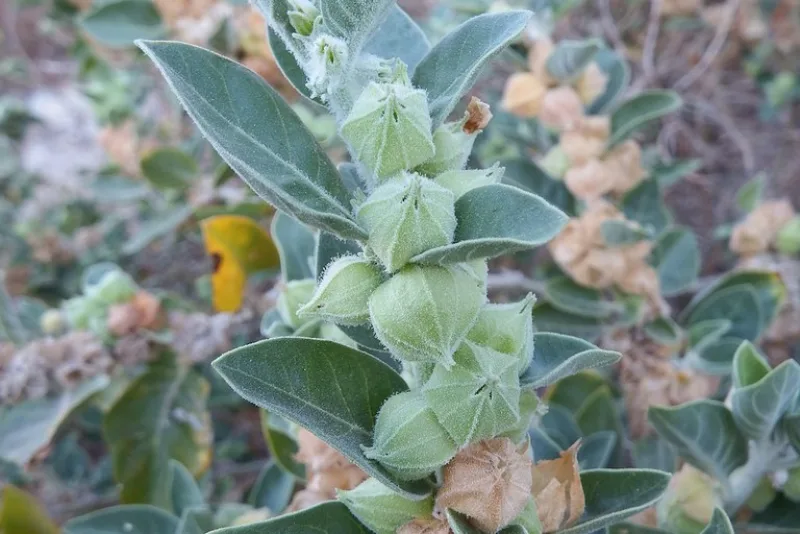
Ashwagandha is a hardy plant adapted to hot, dry climates. It grows wild and is cultivated in India (especially the states of Rajasthan, Madhya Pradesh, and Gujarat), in Pakistan, Sri Lanka, the Middle East, and in some dry regions of southern Europe and northern Africa. It is a low shrub, 30–150 cm tall, with stems covered in a fine, silvery down and oval, grayish-green leaves.
The flowers are small and greenish-yellow, and the fruits are tiny red-orange berries enclosed in a thin papery “husk,” similar to those of the ground cherry (note, however: the fruit is not used as a remedy — the part used is the root). The root is thick and fleshy, cream to light brown in color, and it is precisely this that is harvested, dried, and ground to obtain the well-known powder. Some preparations also use the leaves, but the root remains the “heart” of the plant in Ayurvedic tradition.
Composition and Active Principles
The strength of ashwagandha lies in a group of specific compounds studied intensively in recent decades. The most important are:
- Withanolides — a group of steroidal compounds (including withaferin A and withanolide D) believed to be responsible for most of the plant’s effects. The quality of a powder or extract is often measured by its withanolide percentage.
- Alkaloids (such as somniferine and withanine) — with a relaxing effect on the nervous system.
- Saponins — with a role in supporting immunity.
- Phytosterols, flavonoids, and amino acids — contributing to the general tonic effect.
- Iron and other minerals — which is why tradition also recommended it for states of weakness.
Studies suggest that these substances act especially on the “brain–adrenal gland” axis, influencing how the body manages cortisol, the main stress hormone. In short: ashwagandha appears to help the body avoid staying locked “in overdrive,” in a permanent state of alarm.
Health Benefits
Reducing Stress and Anxiety
This is the main reason ashwagandha has become so popular. Studies suggest that regular intake of the root extract may be associated with a decrease in perceived stress and the feeling of being overwhelmed. The proposed mechanism is cortisol regulation: in chronically stressed people, this hormone remains elevated for days on end, producing fatigue, irritability, and insomnia. Ashwagandha appears to temper this excessive secretion, helping the body return to a healthier rhythm.
Improving Sleep
The plant’s scientific name, somnifera, literally means “sleep-bringing.” Tradition and modern observation agree here: ashwagandha is not a sleeping pill that “knocks you out,” but a plant that calms an agitated mind and aids natural sleep. Many people use it in the evening precisely to stop the “carousel of thoughts” that keeps them awake.
Supporting Energy and Stamina
Paradoxically for a plant that calms, ashwagandha is also used against fatigue. The difference from stimulants is essential: it doesn’t give a peak followed by a crash, but a steady, background support. Ayurvedic tradition recommended it for athletes, convalescents, and those worn out by work, considering it a “rebuilder” of vitality. Studies suggest a possible beneficial effect on muscle strength and exercise endurance.
Hormonal Balance and Reproductive Health
In traditional medicine, ashwagandha was one of the main “manhood” plants, used to support male vitality. Studies suggest a possible positive effect on male hormonal balance. In women, it was used as a general tonic, especially during periods of exhaustion — but, careful, not during pregnancy.
Supporting Cognitive Function
Tradition called it a plant “for a clear mind.” Ashwagandha is believed to aid concentration and memory, especially when these are impaired by stress and fatigue. Its antioxidant compounds may protect nerve cells from oxidative stress.
Supporting Immunity and the Thyroid
The saponins and withanolides appear to support the immune response. Ashwagandha may also influence thyroid activity (it tends to stimulate it), which is why it is helpful to some people with hypothyroidism but dangerous for those with hyperthyroidism.
Traditional Uses in Ayurveda
In Ayurveda, ashwagandha has been used for over 3,000 years in the form of a powder called churna, usually mixed with warm milk, honey, or ghee (clarified butter). This mixture — sometimes called a “golden milk” in its root version — was given to the weak, the elderly, convalescing children, and those with insomnia. It was considered balya (strength-giving), rasayana (rejuvenating), and medhya (mind-supporting).
Tradition often paired it with other plants: with brahmi for memory, with shatavari for female toning, with turmeric for an anti-inflammatory effect. Root paste was also applied externally, to aching joints or wounds, as a soothing poultice.
How to Prepare It: Step-by-Step Recipes
Ashwagandha Milk (the Classic Evening Recipe)
This is the most appreciated form, ideal for sleep and relaxation.
- Heat one cup (about 200–250 ml) of milk (cow’s milk or plant-based — almond, oat).
- Add half to one level teaspoon of ashwagandha powder.
- Let it simmer gently for 5 minutes, stirring, so the powder “cooks” (in Ayurveda, gentle simmering is considered important).
- Remove from heat, let it cool a little, and add a teaspoon of honey and, optionally, a pinch of cinnamon or cardamom.
- Drink 30–60 minutes before bedtime.
Dried Root Decoction
If you have cut root rather than powder:
- Place 1 teaspoon of chopped root in 250 ml of cold water.
- Bring to a boil and simmer over low heat for 10–15 minutes, until the liquid has reduced by about a third.
- Strain and drink warm, perhaps with honey.
Tincture (for Long Storage)
- Half-fill a clean jar with chopped ashwagandha root.
- Cover completely with 40–50% food-grade alcohol (good vodka).
- Seal, keep in the dark for 4–6 weeks, shaking daily.
- Strain through cheesecloth and store in dropper bottles.
- Usual dose: 2–4 ml (about 30–60 drops) once or twice a day, diluted in a little water.
Plain Powder in a Smoothie or Yogurt
The most convenient option for those in a hurry: half a teaspoon of powder stirred into a smoothie, into yogurt, or into a cup of milky coffee. The bitter, earthy taste hides well with banana, cocoa, or honey.
Dosage and How to Take It
- Root powder: generally 1–3 grams per day (about half to one teaspoon), split into 1–2 doses.
- Standardized extract (capsules): the usual doses are smaller, typically 300–600 mg per day of concentrated extract — always follow the package directions.
- Tincture: 2–4 ml once or twice a day.
For sleep and relaxation, ashwagandha is taken in the evening. For energy and stamina, it can be taken in the morning. The effects of adaptogens are usually cumulative: they don’t act “on the spot” like coffee, but are felt after 2–4 weeks of consistent use. Many people take it in “cycles” of 6–8 weeks, followed by a 1–2 week break.
A Lifestyle That Amplifies the Effects
Ashwagandha is not a magic wand. It works best as part of a whole. If you want the plant to show its strength:
- Sleep at regular hours. Adaptogens support the natural rhythm, but they cannot compensate for repeated sleepless nights.
- Cut caffeine in the afternoon. There’s no point calming in the evening a nervous system you’ve whipped all day.
- Move moderately. A daily walk, yoga, or light exercise boosts the anti-stress effect.
- Eat in a balanced way. Tradition paired ashwagandha with “warm,” nourishing foods, not with a starvation diet.
- Breathe consciously. A few minutes of slow breathing in the evening, together with your cup of ashwagandha milk, turns the remedy into a calming ritual.
Practical Tips and Common Mistakes
Mistake no. 1: Expecting immediate effects. Ashwagandha is not an instant energizer. If you give up after three days because you “feel nothing,” you haven’t given it time. Allow at least 2–4 weeks.
Mistake no. 2: Buying powder of dubious quality. The market is full of diluted or poorly stored products. Choose powder or extract from reputable producers, ideally with a stated withanolide percentage, and check that it contains no useless additives.
Mistake no. 3: Taking it on an empty stomach and feeling nauseous. Some people tolerate it poorly without food. Take it with milk, in yogurt, or after a meal.
Mistake no. 4: Combining it with sedatives or sleeping pills without asking your doctor. Ashwagandha potentiates the calming effect; the combination can cause excessive drowsiness.
Mistake no. 5: Using it in pregnancy because “it’s natural.” “Natural” does not mean “harmless.” Ashwagandha is contraindicated in pregnancy.
Mistake no. 6: Taking it endlessly without a break. Cycles of 6–8 weeks with breaks are wiser than continuous, uninterrupted use for years on end.
Mistake no. 7: Ignoring thyroid problems. If you have hyperthyroidism or take thyroid medication, ashwagandha can unbalance your hormones. Talk to your doctor.
Precautions and Contraindications
In addition to the warning at the start of this article, keep in mind several situations in which ashwagandha must be avoided or used with great care:
- Pregnancy and breastfeeding — to be avoided, especially in pregnancy.
- Autoimmune diseases — it may stimulate immunity and worsen the disease.
- Hyperthyroidism — it may raise thyroid hormones.
- Before surgery — it may intensify the effect of anesthetics and sedatives; stop at least two weeks beforehand.
- Chronic treatments — for diabetes, blood pressure, thyroid, anxiety, depression, or autoimmune disease — only with your doctor’s approval.
- Liver disease — in rare cases liver reactions have been reported; with abdominal pain, dark urine, or yellowing of the skin, stop immediately and consult a doctor.
Common side effects, usually mild, include digestive discomfort, drowsiness, or headaches, especially at high doses.
Conclusion
Ashwagandha is one of the most valuable adaptogenic plants, a “gift” of Ayurvedic medicine that has also won over the modern world. Used sensibly, it can be a real ally in periods of stress, fatigue, and restless sleep — not because it “energizes,” but because it helps the body regain its balance. Like all truly active plants, however, it demands respect: correct dosage, cycles with breaks, good product quality, and attention to contraindications. Paired with regular sleep, movement, and nourishing food, this horse-scented root can become, as it did for Aunt Aurelia’s grandson, the calming ritual you needed.
Frequently Asked Questions
How long does it take to feel ashwagandha’s effects? Usually between 2 and 4 weeks of consistent use. Unlike coffee, adaptogens work cumulatively, not “on the spot.” Patience and regularity are essential.
Should it be taken in the morning or evening? It depends on your goal. For sleep and relaxation, in the evening, 30–60 minutes before bed. For energy and stamina, in the morning. Some people split it into two doses.
Does ashwagandha cause weight gain or weight loss? It is neither a slimming product nor one that “makes you gain weight.” Indirectly, by reducing stress and cortisol, it may help balance nervous appetite, but do not treat it as a weight remedy.
Can I take ashwagandha and coffee on the same day? Yes, but it makes more sense to cut back on coffee, especially in the afternoon. There’s no point calming in the evening a nervous system overstimulated all day.
Is it safe long-term? Tradition has used it for thousands of years, but the wise approach remains cycles of 6–8 weeks with breaks, rather than continuous use for years. If you take it for long periods, do so under medical supervision.
Can children take ashwagandha? In Ayurveda there was a tradition of giving it to convalescing children, but in small doses and under supervision. For safety, use it in children only on a specialist’s recommendation.
What does it taste like and how do I hide the smell? It has a bitter, earthy taste and a characteristic “horsey” smell. It hides well in warm milk with honey, in a smoothie with banana and cocoa, or in yogurt.
Can I take ashwagandha if I have Hashimoto’s thyroiditis? Here great caution is needed: since it is an autoimmune disease affecting the thyroid, ashwagandha (which stimulates both immunity and the thyroid) can have unpredictable effects. Use it only after consulting an endocrinologist.