 Photo: PROPOLI87, CC BY-SA 4.0, via Wikimedia Commons
Borage (Borago officinalis), also called starflower, is the plant with sky-blue, star-shaped flowers traditionally used as a sweat-inducing remedy for colds, a soothing herb for coughs, a “mood lifter” and for the skin. Today, however, real interest focuses on the seed oil, very rich in gamma-linolenic acid (GLA) and studied for skin, joints and premenstrual syndrome. The leaves and flowers contain pyrrolizidine alkaloids, substances toxic to the liver, which is why borage tea is not meant for long courses.
It is a good example of a plant where “natural” does not automatically mean “safe”. Below you will learn which part is used, how and how much.
Key takeaways
- Leaves and flowers contain pyrrolizidine alkaloids (PAs), liver-toxic with prolonged use; the tea is for occasional use over a few days only.
- Seed oil contains 20-24% GLA and is sold in capsules; choose only products certified PA-free.
- For eczema, a Cochrane review found no benefit of borage oil over placebo.
- For rheumatoid arthritis there is modest evidence in favour of GLA as an add-on.
- Contraindicated in pregnancy, breastfeeding, liver disease and with anticoagulants or drugs that lower the seizure threshold.
What borage is and how to recognise it
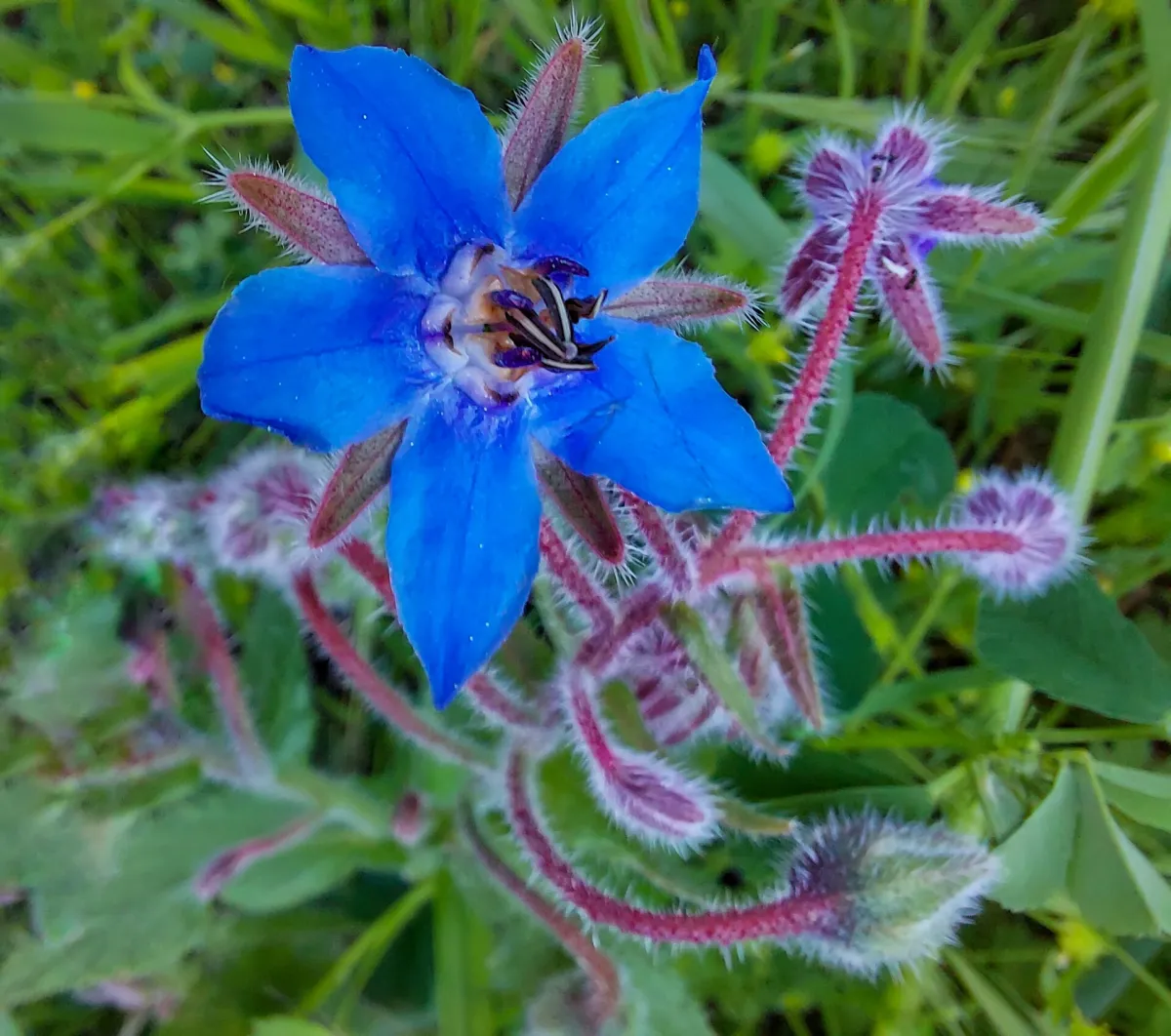
Borage is an annual in the Boraginaceae family, 30-70 cm tall and covered entirely in rough, whitish bristles that prickle slightly to the touch. The leaves are large, oval and wrinkled; in Romanian the plant is called “limba-mielului” (“lamb’s tongue”) because of them. The flowers are its loveliest feature: sky-blue, five-pointed stars with a central cone of dark purple anthers; the buds are often pink.
Native to the Mediterranean, it is grown in gardens and self-seeds freely, easily escaping into fields. It is an excellent bee plant. The raw leaves taste surprisingly of cucumber, which is why German and Italian cooking uses them in green sauces and fillings.
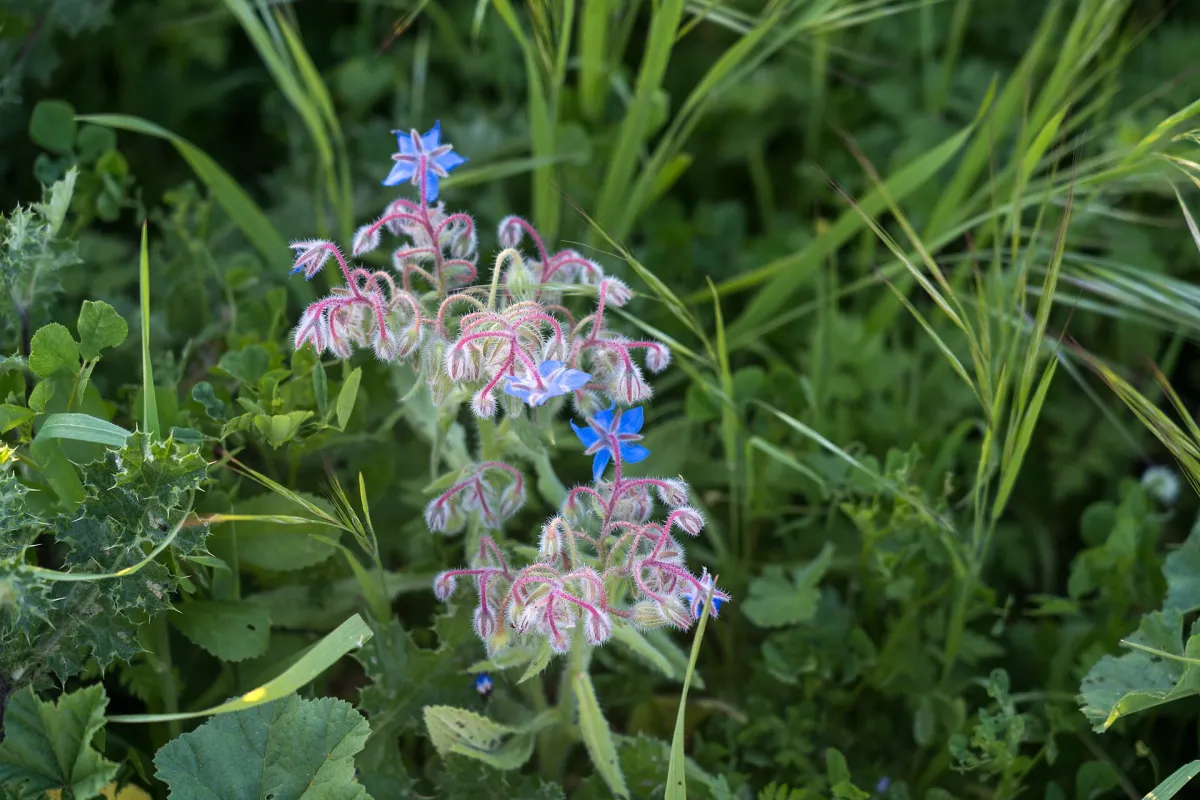 Photo: Alexkom000, CC BY 4.0, via Wikimedia Commons
Which part is used
- Flowers (without sepals) and leaves: for occasional infusion and external use.
- Seeds: pressed for oil (borage oil, also sold as “starflower oil”).
Composition and active compounds
- Mucilage (in leaves and flowers): soothing, explaining the use for cough and skin.
- Tannins, phenolic acids (rosmarinic), flavonoids, potassium and silica salts.
- Pyrrolizidine alkaloids (lycopsamine, intermedine, amabiline, supinine): in small amounts but with liver-toxic and, in animal studies, genotoxic potential. Levels vary widely by variety, plant part and growth stage.
- Seed oil: gamma-linolenic acid (GLA, 20-24%), the richest common plant source, ahead of evening primrose oil; plus linoleic and oleic acids.
Benefits: what tradition says and what studies show
Borage oil and the skin
GLA is a precursor of anti-inflammatory compounds (prostaglandin E1), and the hypothesis was that skin with atopic eczema has a deficit in this pathway. The theory is elegant, but results did not confirm it: a Cochrane systematic review of oral evening primrose oil and borage oil in eczema found no improvement over placebo. Some people still report less dry skin, and the oil applied topically can act as an emollient. For eczema, the basic recommendations remain those in our article on eczema.
Joints: rheumatoid arthritis
Several small clinical trials found that GLA (from borage or evening primrose oil), at fairly high doses, may reduce pain and stiffness in rheumatoid arthritis as an add-on after a few months. The evidence is modest, and the supplement does not replace disease-modifying treatment. More on the condition in our article on rheumatoid arthritis.
Premenstrual syndrome and menopause
GLA-rich oils have been used for breast tenderness and premenstrual symptoms. Studies are conflicting, and any effect is small. See also our article on PMS.
Colds, fever and cough (traditional use of the plant)
An infusion of flowers and leaves was drunk hot as a diaphoretic for colds and fever, while the mucilage soothed a dry cough. Old herbalists called it the plant that “drives away melancholy” and gives courage (the Latin saying “Ego borago, gaudia semper ago”). These effects have not been studied in modern times, and the presence of pyrrolizidine alkaloids makes safer alternatives such as mallow or linden preferable.
External use
Poultices of crushed leaves and compresses soaked in the infusion were used for irritated skin, insect stings and inflammation. On intact skin, short term, the PA-related risk is very low.
The pyrrolizidine alkaloid issue, in plain words
Pyrrolizidine alkaloids are defence substances found in plants of the Boraginaceae family (borage, comfrey), the Asteraceae family (coltsfoot, groundsel) and others. In the liver they are converted into reactive compounds that can damage small hepatic vessels (veno-occlusive disease) and are carcinogenic in animal studies. The risk depends on the cumulative dose over time, not on a single cup. That is why the European Medicines Agency (EMA) has issued recommendations strictly limiting daily PA intake from herbal products.
In practice:
- Borage tea: occasionally, for a few days at most, not courses lasting weeks.
- Leaves in salads: small amounts, now and then; not as a daily vegetable.
- Seed oil: the seeds contain very little PA, and properly refined oil is practically free of them; choose products labelled “PA-free”.
How to use borage
Infusion (occasional use)
- Put 1 teaspoon (about 1-1.5 g) of dried flowers and leaves into a cup.
- Pour over 200 ml of boiling water.
- Cover and steep for 5-10 minutes, then strain.
At most 2 cups a day, for no more than 3-5 days. Not in pregnancy, breastfeeding or for children.
Borage oil (capsules)
The usual dose in studies: 1-3 g of oil a day, about 200-700 mg of GLA, with food, for 6-12 weeks before judging the effect. Follow the manufacturer’s directions.
Oil on the skin
A few drops of borage oil, neat or mixed into a neutral cream, on dry skin once or twice a day. Patch-test on a small area first.
Flowers in the kitchen
Fresh flowers are used to decorate salads, lemonades or ice cubes. A few flowers now and then are not a concern for a healthy adult.
Dosage guide
| Form | Dose | Duration | Notes |
|---|---|---|---|
| Flower/leaf infusion | 1-1.5 g per 200 ml, max 2 cups/day | max 3-5 days | occasional only, contains PAs |
| Seed oil (capsules) | 1-3 g oil/day (200-700 mg GLA) | 6-12 weeks, then review | PA-free products only |
| Oil on skin | a few drops | as needed | patch test first |
| Fresh flowers | a few, as garnish | occasionally | not for young children |
Contraindications and interactions
- Pregnancy and breastfeeding: contraindicated (PAs cross the placenta and pass into milk; GLA may influence prostaglandins).
- Liver disease or heavy alcohol use: avoid any internal form of the plant.
- Children: not recommended.
- Anticoagulants and antiplatelet drugs (warfarin, aspirin, clopidogrel): GLA-rich oil may increase bleeding risk.
- Epilepsy and drugs that lower the seizure threshold (for example phenothiazines): seizures have been reported with GLA oils; avoid.
- Liver enzyme-inducing drugs: may increase conversion of PAs into toxic metabolites.
- Surgery: stop the oil 2 weeks before.
When to see a doctor
- Unusual tiredness, nausea, pain in the upper right abdomen, dark urine, yellowing of the skin or eyes (possible liver problem).
- Eczema that spreads, becomes infected or disturbs sleep.
- Swollen, warm joints with morning stiffness lasting more than an hour.
- Unusual bleeding or easy bruising while taking borage oil.
Common mistakes
Long courses of borage tea. The risk comes from alkaloids building up over time.
Cheap oil without specifications. Look for “PA-free” and the GLA content on the label.
High expectations of the oil for eczema. Studies have not confirmed a clear benefit.
Confusing it with comfrey. Young leaves look similar; both contain PAs, comfrey in much larger amounts.
Combining it with anticoagulants without medical advice.
Conclusion
Borage is a beautiful plant with a long history in European pharmacy and cooking, but it is one where moderation matters more than usual. The leaves and flowers deserve only occasional use because of their pyrrolizidine alkaloids, while clean, certified seed oil is the safest and best-studied modern form. Even so, its benefits are modest: possibly helpful as an add-on in rheumatoid arthritis, less convincing for eczema. Use it in an informed way and talk to your doctor if you take other treatments.
Frequently asked questions
Is borage tea dangerous? Not as an occasional cup, but the leaves and flowers contain pyrrolizidine alkaloids that are toxic to the liver with repeated use. That is why it is used for only a few days and never in pregnancy or for children.
What is borage oil? Oil pressed from borage seeds, very rich in gamma-linolenic acid (GLA). It comes in capsules; choose products certified free of pyrrolizidine alkaloids.
Does borage oil help eczema? A Cochrane review found no clear benefit over placebo when taken by mouth. Applied to the skin it can act as an emollient for dryness.
Can I eat borage leaves in salads? Occasionally and in small amounts, yes, for a healthy adult. Not as a daily vegetable, and not in pregnancy or for children.
Borage oil or evening primrose oil? Both provide GLA; borage oil is more concentrated (20-24% versus about 8-10%), so fewer capsules are needed for the same dose.
Can I take borage oil with aspirin? Only with your doctor’s approval, because GLA may increase bleeding risk alongside antiplatelet and anticoagulant drugs.
Are borage flowers edible? Yes, a few fresh flowers as a garnish are considered acceptable for adults. Avoid regular consumption, especially for young children.
Sources and further reading
- Cochrane: “Oral evening primrose oil and borage oil for eczema” (Bamford et al.).
- EMA / HMPC: Public statement on the use of herbal medicinal products containing toxic, unsaturated pyrrolizidine alkaloids.
- NCCIH: “Borage” fact sheet and information on gamma-linolenic acid.
- Cochrane: review of herbal therapy for rheumatoid arthritis (Cameron et al.), including GLA.
This article is for information only and does not replace medical advice. Talk to your doctor or pharmacist before using medicinal plants, especially if you take medication or have a chronic condition.