
Burdock: Benefits for Skin and Hair, Uses and How to Prepare It
IMPORTANT: Burdock (Arctium lappa) is generally well tolerated, but it is not without precautions. People allergic to plants in the Asteraceae family (daisies, calendula, chamomile, wormwood, ragweed) may develop cross-reactions. Burdock can lower blood sugar, so diabetics taking glucose-lowering medication should monitor their blood sugar carefully. It has a diuretic effect, so it should be used with caution by those taking diuretics or with serious kidney problems. It is not recommended during pregnancy and breastfeeding, as it has traditionally been considered a uterine stimulant. When foraging, be careful not to confuse it with deadly nightshade (Atropa belladonna), which is toxic. Burdock does NOT replace medical treatment: for persistent skin conditions, hormonal imbalances or chronic illness, always consult your doctor or a qualified herbalist.
Grandma Maria, from the village at the foot of the hills, kept one corner of her garden that she never fully weeded. “Leave that big burr alone, it’s good medicine,” she would say whenever a grandchild tried to pull up the leaves, each one as broad as a hat. In autumn she dug up the thick roots with a spade, washed them at the well, cut them into pieces and hung them to dry on a string in the attic. In winter she made a bitter decoction from them and gave it to those with “bad blood” — meaning anyone breaking out in spots, itching, or slow-healing sores. And for her granddaughters’ hair she kept a little bottle of greenish oil in which she had steeped the chopped root; she rubbed it into the scalp at night, before bed, “so the hair grows thick and beautiful.”
Burdock is one of those plants you trample underfoot without suspecting the treasure it hides below ground. It grows along roadsides, beside fences, on waste ground and on riverbanks, instantly recognizable by its enormous leaves and by the clusters of burrs that cling like little hedgehogs to the clothes of passers-by. It is precisely those burrs that made it famous: it is said that, observing how they stuck to his dog’s fur and to his own socks, a Swiss engineer invented the hook-and-loop fastener (Velcro). Beyond this story, burdock has for centuries been one of the most prized “blood-cleansing” plants in Romanian and European folk medicine.
Table of Contents
- What burdock is and where it grows
- Composition and active principles
- Health benefits
- Traditional uses
- How to prepare burdock (step-by-step recipes)
- Dosage and how to take it
- Burdock in your hair and skin care routine
- Practical tips and common mistakes
- Conclusion
- Frequently asked questions
What burdock is and where it grows
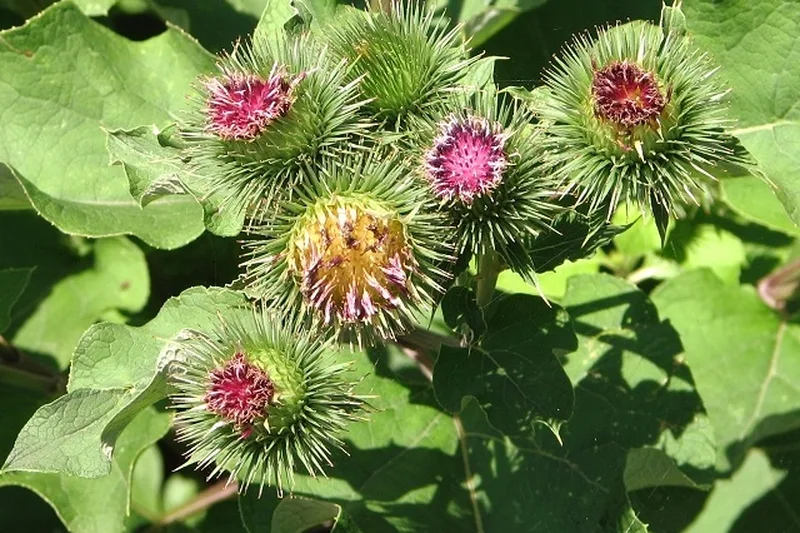
Burdock (scientific name Arctium lappa, along with the related species Arctium minus and Arctium tomentosum) is a robust biennial plant in the Asteraceae family. In its first year it develops a rosette of large, oval leaves — green on top and whitish-hairy underneath — together with a long, fleshy taproot that can reach more than a meter deep. In its second year it flowers, sending up a branched stem a meter and a half tall, crowned with purple flowers surrounded by the hooked bracts that become the famous burrs.
The plant is found throughout Europe, Asia and North America, and is considered a weed by many gardeners. In Romania you encounter it everywhere: along ditches, around farmsteads, on uncultivated land. The part most used medicinally is the root (harvested in autumn of the first year or in early spring of the second), followed by the leaves and, more rarely, the seeds. In Asian cuisine, especially Japanese, burdock root is called gobō and is eaten as a vegetable, prized for its slightly sweet, earthy flavor.
Composition and active principles
Burdock’s richness lies mainly in the root, which concentrates a series of valuable compounds:
- Inulin — a prebiotic soluble fiber that can make up a significant portion of the root’s dry weight. Inulin feeds the beneficial bacteria in the gut and helps regulate blood sugar.
- Polyacetylene compounds — substances with antimicrobial and antifungal properties, partly responsible for the plant’s “cleansing” reputation.
- Phenolic acids and chlorogenic acid — antioxidants that combat oxidative stress.
- Lignans (such as arctiin and arctigenin) — compounds studied for their anti-inflammatory effects and support of cellular balance.
- Mucilage — emollient substances that soothe mucous membranes and irritated skin.
- Mineral salts — potassium, magnesium, calcium, iron, as well as B-complex vitamins.
The leaves in turn contain bitter substances that stimulate digestion, while the seeds are rich in oils and lignans. This combination explains why folk tradition used burdock both for internal cleansing and for external care of skin and hair.
Health benefits
Support for clearer skin
Burdock’s best-known use is for skin problems. Folk tradition called it the “clean-blood plant,” recommending it for acne, eczema, psoriasis, boils and itching. Studies suggest that the antibacterial and anti-inflammatory properties of the root’s compounds, together with its antioxidant effect, may help calm skin inflammation. Used internally (as tea or decoction) and externally (as a lotion or poultice), burdock remains a staple in herbalism dedicated to problem skin.
Depurative effect and support for elimination
Burdock is classically considered a “depurative” plant — one that supports the body in eliminating metabolic waste. This effect is due to its mild diuretic action (encouraging the elimination of water and salts through the kidneys) and its diaphoretic action (stimulating sweating), combined with support for liver and gallbladder function. In the tradition of spring cures, burdock was one of the staple plants for “reviving” the body after winter.
Support for digestion and gut flora
Thanks to its high inulin content, burdock root acts as a prebiotic: it feeds beneficial bacteria in the colon and may contribute to more balanced digestion. The bitter substances in the plant stimulate the secretion of digestive juices and bile, which can ease the feeling of heaviness after meals and support regular transit.
Balancing blood sugar
Inulin and other compounds in burdock have been studied for their ability to slow the absorption of sugars and support a more stable blood sugar level. Studies suggest a potential benefit in this respect, which is why burdock often appears in teas recommended for people watching their blood sugar. For this very reason, diabetics on medication should consult their doctor.
Antioxidant action
The phenolic acids and other antioxidants in burdock help neutralize free radicals — molecules involved in cellular aging and many inflammatory processes. A regular intake of plant antioxidants is part of a balanced, prevention-oriented lifestyle.
Support for the liver
In traditional medicine, burdock was used to “ease” the liver, especially after periods of dietary or alcohol excess. Its compounds appear to support the liver’s natural protective processes, although burdock works best here in the company of other liver-supporting plants, such as milk thistle or artichoke.
Traditional uses
In the peasant household, burdock had dozens of uses. The large, cool leaves were placed on the forehead on scorching days, or applied to aching joints and swellings as a kind of natural “plaster.” The root decoction was drunk during spring and autumn cures to “cleanse the blood.” Burdock oil, made by steeping the root in vegetable oil, was a fixture in the hair care routine, considered a staple remedy against hair loss and dandruff. In some regions, the boiled root was given to animals to make their coats glossy — a folk testament to its effect on hair.
How to prepare burdock (step-by-step recipes)
1. Burdock root decoction (for internal use)
The root is hard and woody, so you do not make a simple infusion but a decoction (boiling):
- Put one teaspoon to one tablespoon of dried, chopped root into a cup (about 250 ml of cold water).
- Bring to a boil and simmer gently, covered, for 10–15 minutes.
- Remove from the heat and let it steep, covered, for another 10 minutes.
- Strain and drink warm.
It is usually taken at 1–2 cups per day, in cures of 2–3 weeks followed by a break. The taste is slightly bitter and earthy; it can be improved with a little honey (if blood sugar permits) or a slice of lemon.
2. Cold root infusion (maceration)
To preserve as many heat-sensitive compounds as possible:
- Put a tablespoon of chopped root in a cup of cold water in the evening.
- Leave to macerate overnight (8–10 hours).
- In the morning, strain and drink, gently warmed if you prefer.
3. Burdock tincture
- Fill a jar halfway with dried, chopped root.
- Pour 40–50% food-grade alcohol over it until the plant is well covered.
- Seal the jar and leave to macerate for 2–3 weeks in a dark place, shaking daily.
- Strain through cheesecloth and store in dark glass bottles.
Suggested dosage: 20–30 drops diluted in a little water, 1–2 times per day.
4. Burdock hair oil
- Finely chop dried root (or use fresh root, washed and patted dry).
- Place it in a jar and cover with a quality vegetable oil (olive, cold-pressed sunflower, castor or almond).
- Leave to macerate for 2–4 weeks in moderate warmth (near a gentle heat source or in the sun), shaking often. Quick version: warm the oil with the root in a water bath over very low heat for 1–2 hours, without boiling.
- Strain and store cool.
5. Leaf poultice
For aching joints or irritations: lightly scald fresh leaves, let them cool until bearable, and apply to the affected area, secured with gauze, for 20–30 minutes.
Dosage and how to take it
As a general rule, burdock is used in short, repeated cures, not continuously. A typical cure lasts 2–4 weeks, followed by a break of at least a week. For decoction, the usual dose is 1–2 cups per day; for tincture, 20–30 drops once or twice a day. For external use (hair, skin), applications can be more frequent, since the risk is minimal. Always start with a smaller amount to see how your body responds, and increase gradually if needed. Good hydration is important, especially given the plant’s mild diuretic effect.
Burdock in your hair and skin care routine
For hair, burdock oil is massaged into the scalp with the fingertips in gentle circular motions, left to work for at least an hour (or overnight, covered with a towel), then washed out with a mild shampoo. An alternative is a final rinse with cold root decoction after washing, left to act for a few minutes. Applied regularly, burdock is traditionally valued for supporting hair growth, reducing dandruff and soothing an irritated scalp.
For skin, the cold root decoction can be used as a tonic: applied to the face with a cotton pad, morning and evening, for blemish-prone skin. Poultices and lotions complement the internal action of the tea. Combining it with calendula and yarrow enhances the soothing effect on irritated skin.
Practical tips and common mistakes
Mistake no. 1: Misidentifying burdock when foraging. Young burdock leaves can resemble, to an inexperienced eye, those of other plants, including deadly nightshade, which is highly toxic. Harvest only if you are certain of the identification, or buy the root from a trusted source.
Mistake no. 2: Making an infusion instead of a decoction. The root is woody and will not release its active principles if you simply pour hot water over it. For the root, always make a decoction (boiling), not a short infusion.
Mistake no. 3: Continuous use without breaks. Burdock is used in cures. Uninterrupted use, month after month, is not recommended; alternate with rest periods.
Mistake no. 4: Ignoring hydration. With its diuretic and diaphoretic effect, burdock “asks” for a good intake of water. If you drink burdock tea, drink extra still water as well.
Mistake no. 5: Unrealistic, short-term expectations. Burdock works slowly and deeply, especially on the skin. Benefits for the complexion usually appear after several weeks of consistent use, not overnight.
Mistake no. 6: Use during pregnancy or by diabetics without medical advice. These situations call for caution; do not improvise.
Conclusion
Burdock is a perfect example of a despised “weed” that actually hides a whole pharmacy beneath the soil. Its root, rich in inulin, lignans and antioxidants, supports digestion, blood sugar balance and the body’s natural elimination processes, while the oil and external lotions remain staple traditional remedies for hair and skin. Used with respect — in cures, with breaks, and with attention to precautions — burdock can become a trustworthy ally in your natural remedy kit. As always, it complements but does not replace medical advice and a healthy lifestyle.
Frequently asked questions
How long can I drink burdock tea? Cures of 2–4 weeks are usually recommended, followed by a break of at least a week. Continuous, long-term use is not advisable without the supervision of a specialist.
Does burdock really help hair grow? Folk tradition has used it for this purpose for centuries, and burdock oil is valued for supporting the scalp and hair shaft. Results vary from person to person and appear gradually, after weeks of regular use.
Which part of the plant is used most often? The root is the part most used, both internally (decoction, tincture) and externally (oil). The leaves are used mainly for poultices, and the seeds more rarely.
Can I use fresh root instead of dried? Yes. Fresh root can be grated or finely chopped and used in a decoction or steeped in oil. The amount is increased, since fresh root contains water.
Does burdock have side effects? In most people it is well tolerated. Allergic reactions can occur in people sensitive to plants in the daisy family, along with a mild diuretic effect. Rarely, skin irritation may occur with external use; that is why it is wise to do a patch test on a small area.
Can I take burdock if I have diabetes? Burdock can lower blood sugar, which, combined with glucose-lowering medication, could lead to values that are too low. Talk to your doctor first and monitor your blood sugar.
What other plants does burdock combine well with? For skin, it combines with calendula and yarrow; for the liver, with milk thistle and artichoke; for depurative cures, with dandelion and nettle.
How do I recognize burdock in the wild? By its very large, oval leaves, green above and whitish underneath, and by the clusters of hooked burrs that cling to clothing. It flowers with purple blooms in its second year of life.