
Calamus (Acorus calamus): Benefits, Uses and How to Prepare It
IMPORTANT: Calamus contains a substance called beta-asarone, found in large amounts especially in the Asian (tetraploid) variety of the plant. Beta-asarone is considered potentially toxic and possibly carcinogenic in high doses and prolonged use. For this reason, calamus should NOT be used over long periods, in large doses, or by pregnant or breastfeeding women, children, or people with liver or kidney conditions. Whenever possible, choose the European variety (Acorus calamus var. calamus), which is lower in beta-asarone, and use the plant only in short courses. Before starting any course, especially if you are on medication or have a chronic illness, consult your doctor or pharmacist. This article is for informational purposes only and does not replace medical advice.
A story from the edge of the marsh
Grandma Veronica, a woman who spent her whole life in a village in the Danube floodplain, had a habit no one in the family ever questioned. Whenever someone got up from the table with a bloated belly, with nausea or with no appetite, she would rise without a word, take a small knife, and head for the marsh. She would return half an hour later with a few pieces of thick, whitish-red rhizome that gave off a strong, aromatic, slightly camphorous smell. “This is sweet flag,” she would say, “the weed that wakes the stomach from its sleep.”
She cut the rhizome into thin slices, dried it on the stove, and from it made bitter teas, giving a small cup before meals to those with a sluggish stomach. She said her own grandfather used to chew a small piece of dried rhizome before setting off on a long journey, “so his stomach wouldn’t turn” and to keep his breath fresh. Throughout the village, calamus was considered the plant of digestion and appetite, and its penetrating smell was as much a part of childhood memories as the smoke from the bread oven.
What is calamus
Calamus (Acorus calamus), popularly known as sweet flag or sweet sedge, is a perennial marsh plant of the Acoraceae family. It grows at the edge of still or slow-moving water — lakes, ponds, marshes, canals and oxbow lakes — forming dense clumps of long leaves, pointed like swords, which can reach more than a meter in height. At first glance the leaves resemble those of reed or iris, but they are distinguished by their smell: when broken, they release a powerful, sweet-bitter, camphorous aroma.
The part used medicinally is the rhizome — the thick, fleshy underground stem that creeps horizontally through the mud. It concentrates the volatile oils and bitter principles that give the plant its reputation as a digestive tonic. Calamus is native to Asia, but spread through Europe as early as the Middle Ages, becoming a common plant in the wetlands of much of the continent. Over the centuries it has been valued not only as a remedy, but also as an aromatic plant, used to perfume rooms and to flavor certain bitter liqueurs.
Table of Contents
- Where it grows and how to recognize it
- Composition and active principles
- Health benefits
- Traditional uses
- How to prepare: tea, tincture, powder
- Dosage and method of administration
- Calamus in a healthy lifestyle
- Practical tips and common mistakes
- Conclusion
- Frequently Asked Questions
Where it grows and how to recognize it
Calamus prefers damp, muddy places with shallow water and plenty of sun. You will often find it alongside reeds, cattails and marsh iris, which can cause confusion for the inexperienced. The safest identifying sign remains the smell: a leaf broken between the fingers immediately releases the characteristic, intense, camphorous aroma that other marsh plants do not have.
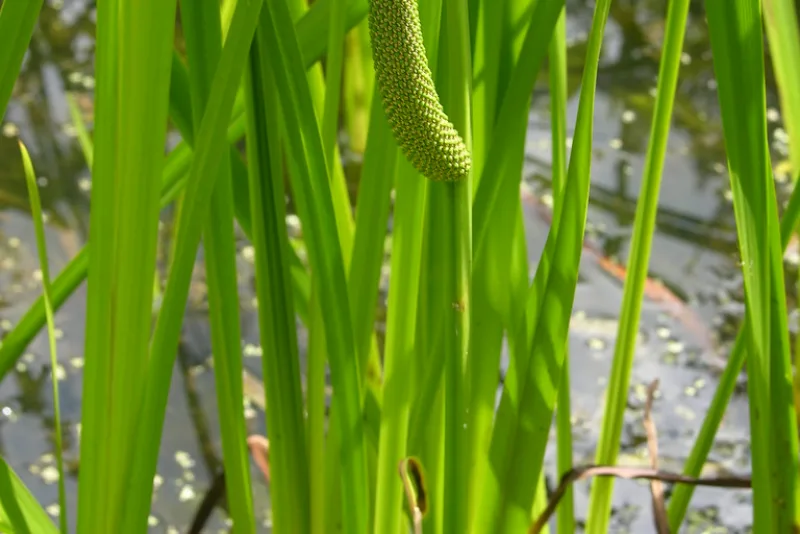
The leaves are linear, stiff, bright green, with a prominent midrib that gives them a slightly wavy edge. The flower is unusual: a cylindrical, greenish-yellow spadix, covered with hundreds of tiny flowers, that emerges at an angle from a leaf, as can be seen in the image above. The rhizome, pulled from the mud, is as thick as a finger, reddish-brown on the outside and pinkish-white inside, marked with rings and bearing numerous thin roots.
The rhizome is usually harvested in late autumn or early spring, when the plant has concentrated its active substances in the underground part. After being dug up, the rhizome is washed thoroughly to remove the mud, cleaned of fine roots, and cut into slices or pieces that are dried in the shade, in a thin layer, or by a gentle heat source. Folk tradition recommends drying it without removing the bark, in order to preserve as much of the aroma as possible.
Composition and active principles
The reputation of calamus rests on a few categories of substances that specialist studies have identified in the rhizome:
- Volatile (essential) oil, responsible for the penetrating smell. It contains compounds such as asarone (alpha- and beta-asarone), eugenol, calamenol and other terpenes. Beta-asarone is also the component that calls for caution, being the reason why the plant should not be used in large quantities or for a long time.
- Bitter principles, particularly a compound called acorin, which, on reaching the tongue and stomach, reflexively stimulates the secretion of saliva and gastric juices. This is, in fact, the mechanism by which calamus “wakes up” digestion.
- Tannins, with a mild astringent effect, which help to tone the digestive lining.
- Mucilage and starch, which give the rhizome its fleshy consistency and a mild soothing effect.
- Minerals and small amounts of vitamins, present, as in most plants, in varying proportions.
The combination of aromatic oil and bitter principles is what explains the classic action of calamus: aromatic-bitter-tonic, that is, a plant that, through its taste and smell, stimulates appetite and sets the digestive processes in motion.
Health benefits
Stimulating appetite
The best-known effect of calamus, passed down from generation to generation, is its ability to open the appetite. The bitter principles in the rhizome act on the bitter-taste receptors, reflexively triggering the secretion of saliva and digestive juices. Folk tradition has always used calamus for convalescents, for people weakened after illness, or for those who, because of stress or fatigue, “have no taste for anything.” A small cup of bitter tea, drunk a quarter of an hour before a meal, was considered the best natural aperitif.
Supporting digestion
Beyond stimulating appetite, calamus is renowned for its effect on digestion itself. Studies suggest that bitter, aromatic plants of this kind may help with a better secretion of gastric juices and a smoother emptying of the stomach. In folk medicine, calamus tea was given after heavy meals, for the sensation of a full stomach, for slow digestion and for the discomfort that arises when food “sits.” Its warm, slightly pungent aroma was perceived as a genuine comfort for a tired stomach.
Fighting bloating and gas
Thanks to its volatile oil with a carminative effect (relieving gas), calamus has been used traditionally against bloating and flatulence. The aromatic substances help relax the intestinal muscles and expel accumulated air, easing the feeling of tension in the abdomen. It was one of the “after-meal” plants that housewives always kept at hand, alongside mint, fennel and anise.
General and nervous-system tonic
In herbalist tradition, calamus was also considered a mild tonic, capable of combating fatigue and lack of vigor. Its stimulating smell led it to be used as a remedy for clearing the mind and supporting concentration. The elders chewed a piece of dried rhizome when they felt the need to be more alert, attributing to it an effect of “awakening” the senses. These uses belong to folk wisdom rather than to firm clinical evidence, which is why they should be viewed with moderation.
Oral and breath health
The habit of chewing calamus rhizome also served to freshen the breath and care for the mouth. Thanks to its tannins and aromatic oil, the plant has a mildly astringent and antiseptic effect on the oral lining. In some traditions, gargling with a diluted infusion of calamus was used for a sore throat and tender gums.
A tonic effect on the digestive lining
The combination of tannins and bitter principles gives calamus a toning effect on the whole upper digestive tract. Tradition recommended it for states of “cold stomach,” lack of tone and heavy digestion — situations in which the plant was seen as a kind of “gentle whip” that sets a sluggish digestive system in motion again.
Traditional uses
Over time, calamus has had many uses beyond the strictly medicinal:
- Household aromatic plant: the dried, crushed rhizome was used to perfume cupboards and rooms, as well as to keep moths away.
- Ingredient for bitter liqueurs: in the past, calamus was part of the composition of certain herbal blends used to prepare bitter digestive drinks, alongside wormwood, gentian and other tonic plants.
- Flavoring agent: in very small amounts, the rhizome was used as a flavoring for certain preparations, although this use has been restricted because of its beta-asarone content.
- Skin and bath remedy: a strong rhizome infusion was sometimes added to bathwater as a general tonic and to care for tired skin.
- Ritual and healing plant: in many cultures, calamus held a special place, being regarded as a plant of health and protection, scattered on floors during festivities for its pleasant smell.
How to prepare: tea, tincture, powder
Calamus tea (infusion)
Calamus tea is traditionally prepared as an infusion or a cold macerate, in order to preserve as much of the aromatic principles as possible without extracting too much of the volatile oil.
Infusion recipe:
- Place half a teaspoon of dried, ground rhizome (about 1–2 grams) in a cup.
- Pour 200–250 ml of hot — but not boiling — water over it.
- Cover the cup and let it steep for 10 minutes.
- Strain and drink the tea lukewarm, a quarter of an hour before a meal if the goal is to stimulate appetite, or after a meal for digestion and bloating.
Cold macerate (considered milder): place the same amount of ground rhizome in cold water in the evening and let it macerate overnight. In the morning, strain and drink. This method extracts less beta-asarone and is preferred for short courses.
Calamus tincture
The tincture is a concentrated form, obtained by macerating the rhizome in alcohol.
- Place 20 grams of dried, ground rhizome in a clean jar.
- Pour 100 ml of food-grade alcohol of 60–70 percent over it.
- Close the jar and let it macerate for 10–14 days, at room temperature, away from light, shaking daily.
- Strain through cheesecloth and store the tincture in a dark bottle with a dropper.
The tincture is taken in very small doses — a few drops diluted in water — precisely because it is a concentrated form.
Rhizome powder
The dried rhizome can be finely ground in a mill, producing a powder taken on the tip of a knife, possibly mixed with a little honey, before a meal. This is the form closest to the old habit of chewing the rhizome, but easier to dose.
Dosage and method of administration
Because of its beta-asarone content, calamus dosage must always be cautious and the courses short:
- Tea/infusion: a maximum of 1–2 cups per day, in courses of no more than 1–2 weeks.
- Tincture: a few drops (usually 10–20), diluted in water, 1–3 times a day, before meals.
- Powder: an amount the size of a knife’s tip (under half a gram), 1–2 times a day.
The best time for administration is 15–20 minutes before a meal, when the aim is to stimulate appetite, or after a meal, when the aim is to ease digestion. A break is always left between courses. Calamus is not a plant to be consumed daily for months on end, but a short-term remedy, used as needed.
Calamus in a healthy lifestyle
Calamus fits best into a lifestyle in which digestion is supported through healthy habits, not just remedies. A few practical ideas:
- Use bitter calamus tea as a short ritual before important meals, to “prepare” the stomach, but do not turn this gesture into a permanent daily habit.
- Combine the plant with habits that aid digestion: unhurried meals, thorough chewing, moderate portions, and a short walk after eating.
- Stay properly hydrated; many digestive discomforts are worsened by a lack of water.
- Regard calamus as an occasional “natural aperitif,” especially during periods of convalescence or loss of appetite, rather than as a daily supplement.
Used with measure and wisdom, calamus can be a pleasant ally at the table, provided we respect the golden rule of strong aromatic plants: small doses, short courses, regular breaks.
Practical Tips and Common Mistakes
Mistake no. 1: Using calamus for a long time. The most serious mistake is to consume calamus for months on end, like an ordinary tea. Because of beta-asarone, the plant should be used only in short courses, of no more than 1–2 weeks, with breaks in between.
Mistake no. 2: Large doses. “More is better” does not apply to calamus. Large doses bring no additional benefits but increase the risk of irritation and exposure to potentially toxic substances. Always stick to the small recommended amounts.
Mistake no. 3: Confusing it with other marsh plants. Those who harvest on their own may confuse calamus with marsh iris or other similar plants, some of them toxic. The only reliable identifying criterion remains the aromatic-camphorous smell of the broken leaf. If you are not sure, buy the rhizome from a trusted source.
Mistake no. 4: Prolonged boiling. Prolonged boiling destroys the aroma and may concentrate unwanted compounds. Calamus is prepared by short infusion or cold maceration, not by a long decoction.
Mistake no. 5: Using it during pregnancy, breastfeeding or in children. Calamus should not be given to pregnant or breastfeeding women, or to small children, because of the risks associated with beta-asarone.
Mistake no. 6: Ignoring interactions and chronic conditions. People with liver or kidney conditions, or who take chronic medication, should talk to their doctor before using calamus.
Conclusion
Calamus, or sweet flag, is one of those plants of which it can be said that it carries within it both promise and warning. On the one hand, it is a digestive tonic prized by folk tradition, capable of opening the appetite, easing heavy digestion and chasing away bloating, thanks to its unique combination of bitter principles and aromatic oils. On the other hand, its beta-asarone content demands respect and caution: small doses, short courses and attention to contraindications. Used wisely, as an occasional remedy and not as an everyday habit, calamus can keep its well-deserved place among the natural remedies for the stomach, as it has done for centuries — from the edges of the marshes to the cups of bitter tea of our grandmothers.
Frequently Asked Questions
What is calamus good for? Calamus is used traditionally as a digestive tonic: it stimulates appetite, supports digestion, fights bloating and the feeling of a full stomach. It also has a reputation as a general tonic and breath freshener, thanks to its aromatic smell.
Why must it be used with caution? Calamus contains beta-asarone, a substance considered potentially toxic and possibly carcinogenic in large doses and prolonged use. For this reason it is used only in small doses and short courses, choosing preferably the European variety, which is lower in this substance.
How is calamus tea prepared? Place half a teaspoon of dried, ground rhizome in 200–250 ml of hot (not boiling) water, cover and let it steep for 10 minutes, then strain. The overnight cold macerate is an even milder alternative.
When should calamus tea be drunk? To stimulate appetite, 15–20 minutes before a meal. To ease digestion and fight bloating, after a meal. At most 1–2 cups per day are drunk, in short courses.
Can I use calamus during pregnancy or breastfeeding? No. Calamus is not recommended for pregnant or breastfeeding women, or for small children, because of the risks associated with beta-asarone.
Can the calamus rhizome be chewed? Folk tradition includes the habit of chewing a small piece of dried rhizome to freshen the breath and “awaken” the senses. Here too the rule of small doses and occasional use applies.
How long can I follow a course of calamus? Courses of calamus should be short, usually no more than 1–2 weeks, followed by breaks. It is not a plant for daily, long-term consumption.
How do I recognize calamus in nature? By its long, stiff, sword-like leaves, and above all by the strong, sweet-bitter, camphorous smell released when you break a leaf. The greenish-yellow spadix, emerging at an angle from a leaf, is another characteristic sign. If you are not sure, avoid harvesting on your own.