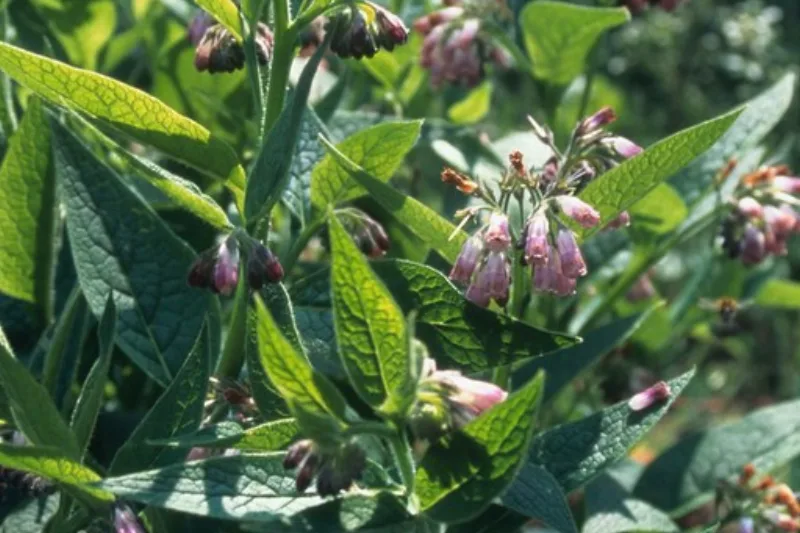

Comfrey: Benefits, External Uses for Bones and Skin, and How to Prepare It
IMPORTANT: Comfrey (Symphytum officinale) contains pyrrolizidine alkaloids, substances that can be toxic to the liver if swallowed in significant amounts or over a long period. For this reason, the firm recommendation of modern herbalism is that comfrey be used EXCLUSIVELY EXTERNALLY, on intact skin, for short periods. Do not drink the tea, take the tincture, or eat the leaves internally; do not apply it to deep open wounds; and do not use it on young children, pregnant or breastfeeding women. People with liver conditions should avoid the plant entirely. Comfrey is not a substitute for medical care: a fracture, a serious sprain, or a wound that will not heal must be evaluated by a doctor.
Grandma Veronica, from the village in the Trotuș valley, had a corner of her garden near the well fence where she let no one mow. Year after year, tall plants grew there, with leaves as large and rough as a cow’s tongue and little drooping, bell-shaped flowers, sometimes pink, sometimes purple. “That’s the bone herb, child, don’t touch it with the hoe,” she would say whenever a grandchild wandered too eagerly toward the patch of “weeds.” And whenever someone in the village scraped themselves badly, twisted an ankle while scything, or brought in a child with a hand swollen from a knock, it was at her gate that they knocked. Grandma would dig up the thick roots, black on the outside and white and mucilaginous on the inside, grate them, and make a sticky paste that she spread on a clean linen cloth.
I still remember our neighbor, a strong man who worked in the forest, coming home one day with his thumb crushed by a log. Bruised, swollen, twice its normal width. Grandma Veronica applied comfrey poultices evening after evening, changing them in the morning, always saying: “Patience, neighbor Gheorghe; knitbone works wonders, but not overnight.” Within a few days the swelling went down, the pain eased, and the man could close his fist again. That is how I learned, as a small child, that comfrey is not swallowed but applied on top — a lesson that today’s herbalism wholeheartedly confirms.
Comfrey, known scientifically as Symphytum officinale and popularly by dozens of names — knitbone, boneset, bruisewort, slippery root — is a perennial plant of the Boraginaceae family, the same family as borage. It grows wild in damp places, along the edges of waters, near ditches, in moist meadows, and on riverbanks throughout Europe and much of Asia. Its Latin name comes from the Greek symphyo, which means “to grow together, to unite” — a direct reference to its ancient fame as a plant that “knits” bones and tissues. For thousands of years, folk healers used it for exactly this purpose, and its reputation has crossed the centuries almost unchanged.
Table of Contents
- What comfrey is and where it grows
- Composition and active principles
- Health benefits (external uses)
- Traditional uses in the countryside
- How to prepare it: poultices, ointment, infused oil
- Dosage, duration, and how to use it
- Lifestyle and recovery: how to support healing
- Practical tips and common mistakes
- Conclusion
- Frequently Asked Questions
What comfrey is and where it grows
Comfrey is a robust plant that can reach a meter or even more in height. It has a thick stem, branched at the top, covered with rough hairs that give it that coarse feel to the touch. The basal leaves are large, lance-shaped, and broad, while those on the stem narrow toward the tip. The flowers, which appear from late spring through summer, are grouped in curled, downward-drooping clusters and have the shape of small bells, in shades ranging from creamy white to pink, violet, or purple, depending on the subspecies and the stage of flowering.
The most prized part in folk medicine is the root: thick, fleshy, black or brown on the outside and whitish and mucilaginous within. When you cut or grate it, it releases a sticky, gel-like substance — precisely that mucilage which makes comfrey an emollient, softening remedy for the skin. It is usually harvested in late autumn or early spring, when the plant has concentrated its active substances in the root. The leaves are gathered in full growth, before or during flowering.
Comfrey prefers moist, rich soils and does not tolerate prolonged drought. That is why we will almost always find it where water is nearby: on the bank of a stream, in a damp valley, at the edge of a pond. It is such a vigorous plant that, once established in a corner of the garden, it returns year after year from the root left in the ground — which is why many gardeners deliberately cultivate it, both as a remedy and as a natural fertilizer for the compost heap.
Composition and active principles
Comfrey’s traditional effectiveness is no mere superstition — the plant contains a set of substances that explain, at least in part, why it was so prized in healing wounds and injuries.
Allantoin is, without a doubt, the star of this plant. It is a substance that stimulates cell regeneration, accelerates the division of healthy cells, and helps restore tissues. Allantoin is so valuable that it is found today in countless cosmetic creams and over-the-counter dermatological products, precisely for its soothing, moisturizing, and skin-healing effect. In comfrey it appears in generous concentration, especially in the root.
The abundant mucilages give the plant its characteristic gel-like texture. Applied to the skin, they form a fine, emollient film that calms irritations, softens rough areas, and creates an environment favorable to healing. They are also responsible for the velvety sensation we feel when using a comfrey ointment.
Tannins have astringent properties, helping to “tighten” tissues and calm superficial inflammations. Rosmarinic acid and other polyphenolic compounds contribute antioxidant and anti-inflammatory effects. The plant also contains plant sterols, asparagine, starch, resins, and mineral salts, including silicon, potassium, and calcium.
This is also where the pyrrolizidine alkaloids must be mentioned — the substances that make comfrey unsuitable for internal use. They can be metabolized into compounds toxic to the liver, which is why, although our ancestors sometimes drank comfrey tea, modern herbalism has entirely abandoned this practice in favor of strictly external use.
Health benefits (external uses)
Support for healing sprains and bruises
The best-known use of comfrey is for sprains, dislocations, knocks, and bruises. Folk tradition holds, and studies suggest, that external application of comfrey may help reduce swelling, ease pain, and speed the reabsorption of bruises. Poultices of grated root or ointment applied to the injured area have always been a homemaker’s first response when someone in the house twisted an ankle or scraped themselves badly.
Easing joint and muscle pain
For pain in the knees, hips, or back, or for muscles overworked after heavy labor, comfrey ointment has been considered a reliable ally. It was applied in the evening, with gentle massage, to the painful joint or muscle, and many people describe a feeling of relief and relaxation in the area. The plant’s local anti-inflammatory effect seems to explain this long-standing use.
Caring for rough, cracked, and irritated skin
Thanks to its wealth of allantoin and mucilage, comfrey is excellent for dry, cracked, or irritated skin. The ointment was used for the rough hands of those who worked in the cold, for cracked heels, for dry elbows and knees. The skin becomes smoother and more supple, and rough areas visibly soften after a few applications.
Support for skin after superficial scratches
On already-closed superficial scratches, on healing scrapes, or on skin recovering from an irritation, comfrey can support the natural regeneration process. Be careful, however: it must never be applied to deep open wounds or deep cuts, because it can “close” the wound at the surface too quickly, before it heals at depth, favoring infections.
Calming local inflammation
Tradition also used comfrey to calm superficial inflammations, swellings, and reddened areas of the skin. The combined effect of allantoin, mucilage, and tannins seems to soothe the skin and reduce local discomfort.
Traditional uses in the countryside
In village life, comfrey had a well-established place in the “pharmacy” up in the attic, alongside chamomile, calendula, and plantain. It was “the bone herb,” the plant turned to whenever someone hurt their hands, feet, or joints. The old women dug up the roots, washed off the soil thoroughly, grated them, and made that viscous paste they bound to the affected area with a cloth.
From comfrey they also prepared, by simmering it in lard or butter, a yellowish ointment that was kept in clay or glass jars and used all winter long. Scalded leaves were also applied, warm, to aching joints. In some regions, a concentrated root decoction was used for baths and compresses on the tired, swollen feet of those who stood at work all day. The key point is that, in almost all of these time-honored uses, the plant was applied externally — a folk intuition that today proves to have been the wise one.
How to prepare it: poultices, ointment, infused oil
Fresh root poultice (the classic recipe)
- Wash a piece of fresh comfrey root thoroughly, removing all soil.
- Grate the root on a fine grater until you obtain a sticky, mucilaginous paste.
- If the paste is too dry, add a few drops of warm water to bind it.
- Spread the paste in a layer about half a centimeter thick on a piece of clean linen or cotton cloth.
- Apply the cloth, paste-side toward the skin, to the bruised or sprained area (on intact skin, not on open wounds).
- Secure with a bandage and let it work for 1-2 hours, or possibly overnight.
- Remove the poultice, gently wash the area, and repeat, if needed, once or twice a day for a few days in a row.
Dried root poultice
If you do not have fresh root, you can use dried, ground root. Mix the root powder with warm water until you obtain a thick paste, then proceed as in the recipe above. The powder can also be mixed with a little flaxseed meal to obtain a more substantial, more velvety poultice.
Comfrey ointment
- Clean and finely chop about one part of fresh root (or use dried root).
- Place it in a double boiler over five parts of fat: butter, good-quality lard, or vegetable oil solidified with beeswax.
- Heat gently, without boiling, for about an hour, stirring from time to time.
- Strain through a dense cloth, squeeze well, and pour the warm liquid into clean jars.
- Let it solidify, then store in a cool, dark place.
- Apply the ointment with gentle massage to joints, muscles, or rough skin, once or twice a day.
Comfrey infused oil
Fill a clean jar with chopped comfrey root (or dried leaves), cover completely with good-quality vegetable oil (olive, sunflower, or almond), and let it macerate for 3-4 weeks in a warm place protected from light, shaking occasionally. Strain and use the oil for massage or as a base for ointments. This oil draws out the allantoin and mucilage beautifully and is gentle on the skin.
Dosage, duration, and how to use it
Unlike herbs that are consumed internally, with comfrey we do not speak of “doses” in the classic sense, but rather of the frequency and duration of external application. The golden rule, recognized by modern herbalism, is that of short periods: comfrey is applied externally for limited periods, usually a few days up to one or two weeks for an acute problem, not month after month. This is to limit the absorption of pyrrolizidine alkaloids through the skin.
It is generally applied once or twice a day, on clean, intact skin. After application, it is good to wash the area before a new application. If any irritation, redness, or itching appears, application should be stopped immediately. For chronic or recurring problems, breaks between courses are recommended, and ideally consultation with a doctor or herbalist. Never, but absolutely never, take it internally: no tea, no tincture, no swallowed leaves.
Lifestyle and recovery: how to support healing
Comfrey is a helper, not a miracle in itself. For a sprain, a knock, or irritated skin to truly heal, we need to support the body with other simple measures as well. Resting the affected area is essential — an overworked muscle or joint needs time to recover. In the first hours after a knock or sprain, applying cold (ice wrapped in a cloth) helps limit swelling; comfrey poultices usually come in later, in the reabsorption phase.
A diet rich in quality protein, vitamin C, zinc, and silicon supports tissue regeneration from within. Proper hydration, sufficient sleep, and avoiding sudden strain on the recovering area complete the picture. For dry, rough skin, beyond comfrey ointment, it also matters to protect the hands from cold and harsh detergents and to moisturize regularly. Think of comfrey as a helping hand working together with the body’s own healing capacity, not in place of it.
Practical tips and common mistakes
Mistake no. 1: Using comfrey internally. The most serious and widespread mistake. Many people, recalling that their grandparents once drank comfrey tea, repeat this habit. Modern herbalism firmly discourages it because of the pyrrolizidine alkaloids, which are potentially toxic to the liver. Comfrey is a plant for external use.
Mistake no. 2: Applying it to deep open wounds. Comfrey accelerates surface healing, which can cause a deep wound to “close” at the skin before it is cleaned and healed at depth, trapping any infection beneath. Use it only on intact skin or on already-closed superficial scratches.
Mistake no. 3: Using it for too long. Applying it for months without a break increases the cumulative absorption through the skin. Short courses with breaks between them are better.
Mistake no. 4: Using it on young children, pregnant or breastfeeding women. These groups should avoid comfrey entirely, as a precaution against the pyrrolizidine alkaloids.
Mistake no. 5: Ignoring a serious problem. A fracture, a severe sprain, swelling that will not subside, or a wound that becomes infected cannot be “treated” with poultices alone. Comfrey can support recovery, but it does not replace medical diagnosis and treatment.
Mistake no. 6: Confusing comfrey with other plants. The young leaves of comfrey resemble those of other plants. Harvesting must be done by someone who knows the plant well, or the material should be bought from a trustworthy source.
Conclusion
Comfrey is one of the most respected plants of folk medicine — “the bone herb,” the remedy at the grandparents’ gate for knocks, sprains, rough skin, and aching joints. Its wealth of allantoin, mucilage, and tannins explains its reputation as a plant that “unites” and regenerates tissues. The correct way to use it, validated by modern herbalism, is however strictly external: poultices, ointments, and infused oils applied to intact skin, for short periods, never swallowed. Used wisely and with respect for the warnings about pyrrolizidine alkaloids, comfrey remains a precious traditional ally. Used improperly, it becomes dangerous. The difference is made by being well informed — and, when needed, by a doctor’s advice.
Frequently Asked Questions
Can I drink comfrey tea? No. Although our ancestors sometimes did, modern herbalism firmly discourages internal use of comfrey because of the pyrrolizidine alkaloids, which can be toxic to the liver. Comfrey is used exclusively externally.
Why is it also called “knitbone” or “boneset”? Because of its ancient fame as a plant that helps heal bones, sprains, and bruises. Its Latin name, Symphytum, comes from the Greek “to grow together,” an allusion to its effect on tissues.
Can I apply comfrey to an open wound? Not to deep open wounds or deep cuts. Comfrey can close the surface too quickly, trapping an infection beneath. Use it on intact skin or on already-closed superficial scratches.
How long can I use comfrey ointment? For short periods: a few days up to one or two weeks for an acute problem. For recurring problems, take breaks between courses and consult a specialist.
Is comfrey safe for children? Young children, pregnant women, and those who are breastfeeding should avoid comfrey entirely, as a precaution against the pyrrolizidine alkaloids. For older children, short external use should only be done on a doctor’s advice.
How do I recognize comfrey in the wild? It is a tall plant with large, rough, hairy leaves and drooping, bell-shaped, pink-purple flowers that grows in damp places near water. The root is thick, black on the outside and white and mucilaginous within. If you are not sure, ask the help of someone knowledgeable.
Can I make comfrey ointment at home myself? Yes, by macerating the root in oil or by gently heating it in fat, followed by straining. The important thing is to use clean, trustworthy material and to respect the rule of strictly external use.
What do I do if irritation appears after application? Stop applying immediately, wash the area with clean water, and, if the irritation persists, consult a doctor. As with any plant-based remedy, individual sensitivity reactions can occur.