
Elderberry Plant: Benefits of Flowers and Berries, Uses and How to Prepare It
IMPORTANT: Raw (unripe) and green elderberries, as well as the bark, leaves and seeds, contain cyanogenic compounds and lectins that can cause nausea, vomiting and diarrhea. For this reason, elderberries are always eaten cooked/processed, never raw. The flowers are gentler, but should also be used in moderation. People with autoimmune conditions should be cautious, since elderberry stimulates the immune system. During pregnancy and breastfeeding, and in young children, use elderberry only with your doctor’s approval. If you take medications (diuretics, diabetes drugs, immunosuppressants) or have a chronic condition, consult your doctor before using elderberry preparations. This article is for informational purposes and does not replace medical advice.
A story from the edge of the village
Grandma Veta had, at the far end of her garden, an old elder tree as big as the house, which she would never have cut down for anything in the world. She used to say that “the elder is the poor man’s doctor” and that, as long as it bloomed in May, no cold would set foot in the house. Every spring, when the white flowers opened and their sweet, honey-like scent drifted everywhere, she would head out at dawn with a wicker basket and gather the umbels only in dry weather, after the dew had lifted. From them she made elderflower cordial in a large clay pot, which she kept in the shade of the pantry, and which we children awaited as eagerly as the best lemonade in the world.
In autumn, when the berries turned black and bowed the branches with their weight, it was the elder’s turn again. Grandma simmered the berries with sugar and made a thick, dark syrup, which she poured into little bottles and gave us by the spoonful at the first sign of a scratchy throat or a stuffy nose. “One in the morning, one at night, and you’ll see how it passes,” she would say. Many years later I realized that Grandma had invented nothing: Romanian folk tradition and herbalists across Europe have valued elder for centuries, and modern science has, in turn, begun to confirm many of the old people’s intuitions.
What is elderberry
Black elder (Sambucus nigra) is a shrub or small tree of the Adoxaceae family, growing wild at the edges of woods, along hedgerows, near water and in untended places across most of Europe, including Romania, from the plains to the hills. It can reach 4–6 metres in height, has greyish furrowed bark, leaves made up of 5–7 toothed leaflets, and a characteristic, slightly unpleasant smell when the leaves are crushed.
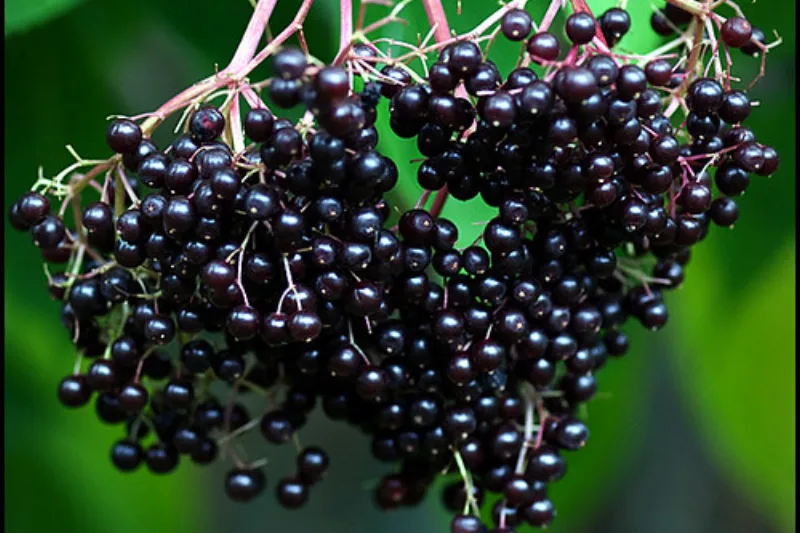
The two “treasures” of the elder are its flowers and its berries. The flowers, small and creamy-white, gather in flat, wide umbels that open in May–June and release a sweet, honeyed aroma. The fruits are small, spherical berries that turn from green to a glossy purple-black at maturity, hanging in heavy, drooping clusters in August–September. Both the flowers and the ripe, heat-treated berries are edible and valued in folk medicine, but the rest of the plant (leaves, bark, branches, seeds) is considered toxic.
Elder has long been called “the village pharmacy” precisely because a single shrub could provide remedies for colds, syrup for coughs, a refreshing summer drink and even ointments for the skin. In European folklore it was seen as a protective tree, planted near the house to bring luck and keep evil away.
Table of Contents
- What elderberry is and where it grows
- Composition and active principles
- Benefits of elderflowers
- Benefits of elderberries
- Traditional uses
- How to prepare it: step-by-step recipes (syrup, cordial, tea, jam)
- Dosage and administration
- How to harvest and store it
- Practical tips and common mistakes
- Precautions and contraindications
- Conclusion
- Frequently Asked Questions
Composition and active principles
The richness of elder lies in the variety of its compounds, distributed differently between the flowers and the berries.
Elderflowers contain flavonoids (especially rutin and quercetin), phenolic acids (chlorogenic acid), volatile oils (which give them their characteristic aroma), mucilage and small amounts of tannins. This combination is traditionally credited with diaphoretic (sweat-inducing), diuretic and soothing effects on the respiratory mucosa.
Elderberries, once ripe, are especially rich in anthocyanins — the pigments that give them their purple-black colour and that are powerful antioxidants. They also contain vitamin C, B-group vitamins, iron, potassium, fibre and a wide range of polyphenols. Studies suggest that these anthocyanins explain the modern interest in elderberry as immune support and as a source of antioxidants that help the body combat oxidative stress.
It is important to remember that unripe berries and green plant parts contain cyanogenic glycosides (such as sambunigrin) and lectins, compounds that are largely broken down or inactivated by cooking. Hence the golden rule: elderberries are eaten cooked, never raw.
Benefits of elderflowers
Support during colds and flu
Elderflower tea is probably the best-known folk remedy for colds. Tradition uses it for its diaphoretic effect: drunk hot, it helps the body sweat, which is associated with “breaking a fever” and easing the chills. Studies suggest that the flowers may support the body during mild respiratory infections, especially when combined with rest and hydration.
Soothing coughs and an irritated throat
The mucilage in the flowers has an emollient effect, coating the irritated mucous membranes of the throat. This is why warm elder tea, sweetened with honey if desired, is traditionally used for dry coughs and the scratchy throat that comes with colds.
Support for sinuses and a blocked nose
The steam of a warm elderflower infusion, inhaled, is used in folk medicine to ease breathing and decongest the nasal passages. Drunk as a tea, it serves the same purpose of thinning secretions.
Mild diuretic effect
Elderflowers have a gentle diuretic effect, which is why they appear in many traditional “slimming” or “cleansing” teas, helping to eliminate excess water and supporting kidney function.
Benefits of elderberries
Antioxidants and immune support
Elderberries are one of the richest natural sources of anthocyanins. These antioxidants help neutralize free radicals, and studies suggest that elderberry extracts may support the immune response during the cold season. Elderberry syrup is, for this reason, a much-sought traditional preparation at the first signs of a cold.
A source of vitamins and minerals
Thanks to their vitamin C and B-group vitamin content, ripe elderberries contribute to a varied diet. Iron and potassium round out the nutritional profile, while fibre supports digestion.
Support for the respiratory tract
In folk tradition, elderberry syrup and jam are given for coughs and to soothe respiratory irritation during colds, appreciated by adults and (in small doses) by older children alike.
A general tonic effect
Drinks and syrups made from elderberries are considered “winter tonics” that provide energy and help the body get through the cold season more easily. Their pleasant, slightly tart taste makes them easy to incorporate into everyday eating.
Traditional uses
In the Romanian household, elder always played several roles. The flowers were used for:
- cordial (socată) — the fermented, sweet-sour refreshing drink, indispensable in the countryside in summer;
- diaphoretic tea — for colds and fever;
- elderflower fritters — whole umbels dipped in batter and fried;
- compresses and baths — for irritated skin and tired eyes.
The berries were turned into:
- syrup — the basic remedy for coughs and colds;
- jam and marmalade — often combined with apples;
- wine and elderberry liqueur — in some regions;
- fermented juice — preserved for winter.
How to prepare it: step-by-step recipes
Elderflower tea
- Place 1–2 teaspoons of dried flowers (or one fresh umbel) in a cup.
- Pour 250 ml of boiling water over them.
- Cover the cup and let it steep for 8–10 minutes — covering preserves the volatile oils.
- Strain and, to taste, sweeten with honey (once the tea has cooled a little, so as not to destroy the honey’s enzymes).
For a diaphoretic effect during colds, drink the tea hot, ideally in the evening, under a warm blanket.
Traditional elderflower cordial
- Place in a large (5-litre) jar 8–10 fresh elderflower umbels, shaken free of insects (not washed, to preserve the natural yeasts).
- Add 2 sliced lemons, 300–400 g sugar and, optionally, a tablespoon of vinegar or whey.
- Pour over 4–4.5 litres of water (spring water, or boiled and cooled).
- Cover with cheesecloth and leave at room temperature, in diffuse light, for 2–4 days, stirring daily.
- When bubbles appear and the taste turns slightly tart and effervescent, strain and chill in bottles.
Serve cold, like a natural lemonade. Note: being a fermented drink, it contains small amounts of alcohol and CO₂ — don’t leave it too long, or the bottles may “explode”.
Elderberry syrup
- Pick 1 kg of ripe berries, purple-black, and strip them off the stems with a fork.
- Place the berries in a pot with a little water (enough to half-cover them) and simmer over low heat for 20–30 minutes, gently crushing them.
- Strain through a fine sieve or cheesecloth, squeezing well.
- Measure the resulting juice and add sugar (about 700–800 g per litre). For flavour: a piece of cinnamon, a few cloves or some lemon peel.
- Simmer again for 10–15 minutes, skim off the foam and pour hot into sterilized bottles.
The syrup keeps refrigerated and is taken 1 teaspoon to 1 tablespoon, 2–3 times a day, as needed.
Elderberry and apple jam
- Simmer the elderberries (cleaned of stems) together with grated apples, in a ratio of roughly 2 parts elderberry to 1 part apple.
- Add sugar to taste and cook until it sets.
- The natural pectin in the apples helps the jam set without additives.
Dosage and administration
In folk medicine, indicative doses for an adult are:
- Flower tea: 1–3 cups a day, during cold spells;
- Berry syrup: 1 teaspoon up to 1 tablespoon, 2–3 times a day;
- Cordial: as a refreshing drink, without excess.
Elderberry-based treatments are recommended for short periods (a few days to 1–2 weeks), not continuously. For children, doses are reduced proportionally and given only with the pediatrician’s approval. The berries must always be cooked, never raw.
How to harvest and store it
The flowers are gathered in May–June, in the morning, after the dew has lifted, in dry and sunny weather, choosing fully open, fragrant umbels. They are dried spread out in the shade, in a thin layer, in a well-ventilated place, then kept in paper bags or jars, away from light and moisture.
The berries are gathered in August–September, when fully ripe, black and glossy, with the clusters hanging heavy. They are stripped from the stems (stems and branches are not used) and processed as soon as possible or frozen. Avoid fruit from the edges of busy roads, due to pollution.
Beware of confusion: black elder must not be confused with red-berried elder (Sambucus racemosa), with red, more toxic berries, or with dwarf elder / danewort (Sambucus ebulus), a herbaceous plant whose berries are not used in the same way. If you are unsure, ask an experienced forager for help.
Practical tips and common mistakes
Mistake no. 1: Eating the berries raw. Raw berries can cause nausea, vomiting and diarrhea. Always cook them before eating.
Mistake no. 2: Using green berries or stems. These concentrate the most undesirable compounds. Use only ripe, black berries without stems.
Mistake no. 3: Washing the flowers for cordial. Washing removes the natural yeasts that trigger fermentation. Just shake the flowers free of insects.
Mistake no. 4: Boiling the flower tea. The flowers are not boiled but steeped covered, otherwise the aromatic volatile oils are lost.
Mistake no. 5: Confusing the species. Red elder and danewort are not used like black elder. Learn to identify the plant correctly.
Mistake no. 6: Prolonged treatments. Elder is a short-term “shock” remedy, not a drink to be consumed daily for months on end.
Lifestyle and support during the cold season
Elder works best when it is part of a healthy lifestyle, not an isolated remedy. In the cold season, combine elderberry syrup or tea with enough rest, good hydration (water, soups, warm teas), a diet rich in seasonal vegetables and fruit, and moderate exercise outdoors. Airing out rooms, quality sleep and managing stress all contribute to a strong immune system. Elder thus becomes a reliable support rather than a magic solution — exactly the way our grandparents used it.
Conclusion
Black elder is one of the most generous medicinal plants of Romanian tradition: from its fragrant flowers we make diaphoretic tea and refreshing cordial, and from its black, anthocyanin-rich berries we prepare syrup and jam to support us through the cold season. The secret to using it correctly lies in two simple rules: harvesting the right parts (flowers and ripe berries) and heat-treating the berries, never eating them raw. Used in moderation, for short periods and as part of a balanced lifestyle, elder remains “the village pharmacy” — a trustworthy ally that nature places within reach, right at the edge of the garden.
Frequently Asked Questions
Can elderberries be eaten raw? No. Raw berries contain compounds that can cause nausea, vomiting and diarrhea. They must be cooked or processed (syrup, jam, simmered juice) before consumption.
What is the difference between elderflowers and elderberries? The flowers are harvested in spring (May–June) and used mainly for diaphoretic tea and cordial. The berries are gathered in autumn (August–September), are rich in anthocyanins and used for syrup and jam. Both are valued in colds, but the berries absolutely require cooking.
How do I tell black elder from the toxic kinds? Black elder has purple-black berries hanging in drooping clusters. Red (mountain) elder has red berries, while danewort is a low, herbaceous plant. If in doubt, ask an experienced person for help.
Can children take elderberry syrup? Older children can be given cooked elderberry syrup in small doses, but always with the pediatrician’s approval. For young children, caution is essential.
Is elderberry good for immunity? Folk tradition and studies suggest that elderberry extracts may support immunity, especially in the cold season. They do not, however, replace vaccination, rest or medical treatment.
How long does the cordial keep? The cordial ferments in 2–4 days, then it is strained and chilled. Being a live drink, it is consumed within a few days; left too long, it becomes too acidic and can build up pressure in the bottles.
Does elder have contraindications? Yes. Avoid eating raw berries, exercise caution during pregnancy and breastfeeding, in young children and in people with autoimmune diseases. If you take diuretics, diabetes drugs or immunosuppressants, consult your doctor.
Can I drink elder tea every day? Elder tea is intended as a short-term remedy during colds. For prolonged use, it is better to alternate with other plants and ask a specialist for advice.