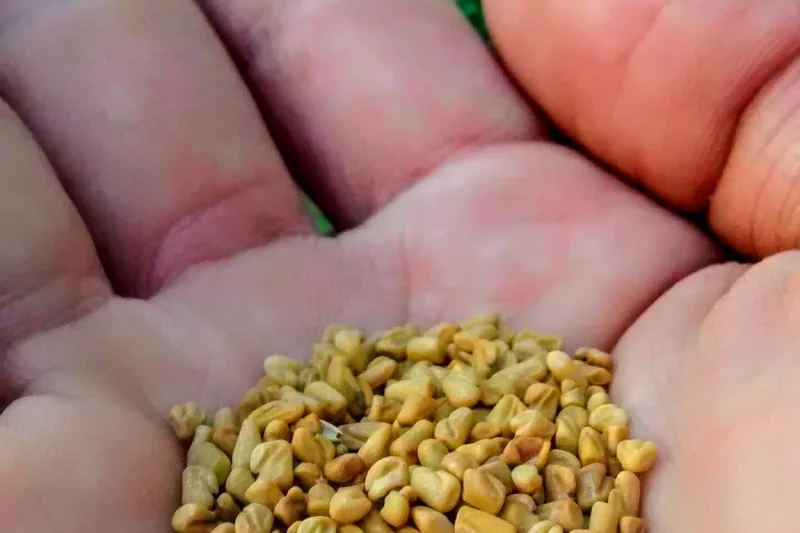

Fenugreek: Benefits, Uses and How to Prepare It
IMPORTANT: Fenugreek (Trigonella foenum-graecum) is a plant with genuine effects on the body, which is why it should not be used carelessly. Pregnant women should avoid medicinal doses, since folk tradition and studies suggest it may stimulate uterine contractions; in controlled amounts, however, it is used to support lactation after birth. Anyone taking diabetes medication or blood thinners must speak with their doctor first, because fenugreek can lower blood sugar and may influence clotting. People allergic to peanuts, chickpeas or other legumes may also react to fenugreek. This plant is a support, not a replacement for medical treatment: for diabetes, hormonal or liver conditions, always consult your doctor.
Grandmother Veta from the Banat region kept a glass jar on the shelf next to the stove, filled with small, yellowish seeds that gave off a penetrating scent reminiscent of both celery and walnut. She called them “the goats’ wheat” and would set them to sprout on a saucer lined with damp cheesecloth whenever someone in the house grew too thin, lost their appetite or was slow to recover after a long illness. “Fenugreek puts flesh on a person and appetite in the spoon,” she used to say, stirring the sprouted seeds into chicken soup or crushing them in a mortar to make a paste she spread on bread with a little honey.
She also used them for the young mothers of the village. When a new mother complained that “her milk would not come,” Grandmother Veta prepared her a warm tea of ground seeds, sweetened with linden honey, and advised her to drink it two or three times a day. The maple-syrup scent that lingered afterward in the mother’s perspiration was, she said, the sign that “the remedy is working.” These customs, passed from household to household, actually conceal knowledge thousands of years old, for fenugreek is one of the oldest plants cultivated by humankind.
Fenugreek is an annual plant of the legume family (Fabaceae), the same family as peas, beans and chickpeas. It grows to 40-60 centimeters tall, with fresh green trifoliate leaves and small whitish-yellow flowers that develop into long, slender pods containing the hard, golden, almost cube-shaped seeds. Native to the Mediterranean and the Near East, fenugreek has been used for more than six thousand years - it has even been found in Egyptian tombs. Today it is widely cultivated in India, North Africa and southern Europe, valued equally as a kitchen spice (it is an essential component of curry blends and garam masala), as a fodder plant and as a traditional remedy for a surprisingly wide range of ailments.
Table of Contents
- What fenugreek is and where it grows
- Composition and active compounds
- Health benefits
- Traditional uses in the Romanian village
- How to prepare fenugreek (tea, powder, sprouts, poultice)
- Dosage and how to take it
- Fenugreek in everyday cooking
- Practical Tips and Common Mistakes
- Conclusion
- Frequently Asked Questions
What fenugreek is and where it grows
The scientific name, Trigonella foenum-graecum, literally means “Greek hay,” a reference to the way the Romans used the dried plant as aromatic fodder for animals. “Trigonella” refers to the triangular shape of its flowers. In Romanian the plant is known as schinduf or molotru; in English it is fenugreek, and in Indian cuisine the leaves are called methi.
Fenugreek prefers well-drained, slightly limestone soils and sunny spots. It is sown in spring, once the danger of frost has passed, and harvested at the end of summer, when the pods have turned yellow. Three parts of the plant are used: the seeds (the most prized part from a medicinal standpoint), the fresh leaves (used as a vegetable and herb, especially in Indian cooking) and the dried leaves (kasuri methi), an aromatic seasoning.
In the traditional Romanian household, fenugreek was never a staple food but rather a “remedy from the jar,” kept on hand for times when someone needed strengthening. This dual identity - exotic spice and home remedy - makes it especially interesting.
Composition and active compounds
The richness of fenugreek lies in the diversity of its compounds. The seeds are remarkable for their high content of soluble fiber, particularly mucilage (galactomannans), which swells in contact with water and forms a viscous gel. This gel explains much of the plant’s effect on digestion and blood sugar.
Among its main active compounds are:
- Galactomannans - soluble fibers that slow the absorption of sugars and create a feeling of fullness.
- Steroidal saponins (especially diosgenin) - compounds with a structure similar to steroid hormones, thought to be responsible for some of the hormonal effects traditionally attributed to the plant.
- Trigonelline - an alkaloid with a role in regulating metabolism.
- 4-hydroxyisoleucine - an unusual amino acid studied for its possible role in supporting normal insulin secretion.
- Coumarins, flavonoids and polyphenols - with antioxidant action.
- Good-quality protein - the seeds contain an appreciable amount of plant protein.
- Minerals and vitamins - iron, magnesium, manganese, copper, as well as B-complex vitamins.
The characteristic sweet-bitter taste and aroma, reminiscent of maple syrup, comes from an aromatic compound called sotolon, the same one that gives certain foods their “burnt caramel” note.
Health benefits
Supporting blood sugar balance
The most researched benefit of fenugreek is its effect on blood sugar. Thanks to soluble fibers that slow the digestion of carbohydrates and to the amino acid 4-hydroxyisoleucine, studies suggest that fenugreek seeds may help maintain more stable blood sugar after meals. In folk tradition, people with “high sugar” drink a glass of water in which seeds have soaked overnight. This habit does not replace medication but may be a support to discuss with a doctor.
Stimulating lactation
Fenugreek is probably the best-known galactagogue plant in the world - that is, a plant that stimulates milk production in nursing women. Generations of midwives and grandmothers recommended it to mothers with low milk supply. The saponins and phytoestrogens in the seeds are believed to stimulate the mammary glands. The effect usually appears within a few days, and a characteristic sign is the faint maple scent of perspiration and milk. Nursing mothers should nevertheless consult their doctor or a lactation specialist before starting.
Support for appetite and recovery
Precisely because it “puts flesh on a person,” fenugreek was traditionally given to convalescents, to those weakened by illness and to people with no appetite. It stimulates digestive secretions and helps the body absorb nutrients better, acting as a gentle tonic for an exhausted body.
Digestive health
The mucilage in the seeds has a soothing and mildly laxative effect, forming a gel that protects the lining of the stomach and intestines. Folk tradition uses fenugreek for heartburn, mild gastritis and constipation. The fibers also nourish beneficial gut flora.
Cholesterol balance
The soluble fibers and saponins in fenugreek may, according to studies, help bind some of the cholesterol and fats in the intestine, favoring their elimination. Regular consumption of the seeds may therefore support a healthy lipid profile as part of a balanced lifestyle.
Hormonal support and vitality
Because of its steroidal saponin content, fenugreek has traditionally been used both to support male vitality and to ease certain discomforts of the menstrual cycle and menopause in women. Some studies suggest a possible role in supporting normal testosterone levels and libido, though research is still ongoing.
Skin and hair
Applied externally as a paste of ground seeds, fenugreek is an ancient cosmetic remedy: it is used to soothe irritated skin, against dandruff and to strengthen hair. The mucilage moisturizes, while the antioxidant compounds support scalp health.
Traditional uses in the Romanian village
In households of old, fenugreek had several well-established uses. For nursing mothers, the milk-stimulating tea was prepared. For the weak, sprouted seeds were made and added to soups and stews. For boils, abscesses and skin inflammations, a warm poultice of boiled, crushed seeds was applied, which “drew” the pus to the surface. For coughs and sore throats, the tea sweetened with honey was drunk, the mucilage soothing the irritation.
In folk medicine it was also used for “cleansing the blood” in spring, alongside other bitter herbs, and as a general tonic after long winters poor in fresh vegetables. Many of these uses are also found in Ayurvedic and Arabic medicine, showing how universal the appreciation for this humble plant is.
How to prepare fenugreek
Fenugreek tea
This is the simplest form of preparation. Use one teaspoon (about 5 grams) of seeds per cup of water.
- Lightly crush the seeds in a mortar or with the back of a spoon - this releases the active compounds better.
- Place the seeds in a pot with 250 ml of cold water.
- Bring to a boil and let simmer gently for 5 minutes (this is a decoction, not a simple infusion, because the seeds are hard).
- Remove from heat, cover and let steep for another 10 minutes.
- Strain and, if desired, sweeten with honey.
The taste is bitter-sweet and quite strong; some prefer to add a slice of lemon, ginger or cinnamon to make it more pleasant.
Fenugreek water (cold)
A gentle variant, used mainly for blood sugar and digestion:
- Place one teaspoon of seeds in a glass with 200 ml of room-temperature water.
- Leave to soak overnight (8-12 hours).
- In the morning, dissolve the gel that has formed by stirring, then drink the water on an empty stomach. The soaked seeds can also be chewed or added to yogurt.
Sprouted seeds
Very nourishing and easy to digest:
- Wash 2-3 tablespoons of seeds and soak them for 8 hours.
- Rinse them and place them in a jar with the mouth covered by cheesecloth, tilted so the water drains out.
- Rinse twice a day, morning and evening.
- In 2-4 days small white sprouts will appear. Eat them fresh, in salads, soups or sandwiches.
Fenugreek powder
The dried seeds are finely ground in a coffee grinder. The powder can be added to food, smoothies, yogurt, or taken directly, a quarter to half a teaspoon, with water. This is the most concentrated form.
Poultice for the skin
- Boil 2-3 tablespoons of seeds in a little water until they soften and form a paste.
- Crush them and let the paste cool until lukewarm.
- Spread it on a piece of cheesecloth and apply to the affected area (boil, inflammation), covering with a warm cloth.
- Leave for 20-30 minutes. Repeat 1-2 times a day.
Hair mask
Soak 2 tablespoons of seeds overnight, grind them into a paste the next day, optionally with a little yogurt, and apply to scalp and hair. Leave for 30 minutes, then rinse. Tradition says it reduces dandruff and adds shine to the hair.
Dosage and how to take it
For general health support, the usual dose is 5-10 grams of seeds per day (one teaspoon to one tablespoon), as tea, fenugreek water or powder. For stimulating lactation, the traditionally recommended doses are somewhat higher, but it is essential that nursing women adjust them together with a specialist.
It is recommended to start with a small amount, to see how the body reacts, and to increase gradually. Fenugreek is usually taken in courses of 3-4 weeks, followed by a break. Consumed in large amounts, it can cause bloating, gas or digestive discomfort, especially at first.
Fenugreek in everyday cooking
Beyond its use as a remedy, fenugreek is a wonderful spice. A few seeds lightly toasted in a dry pan before being ground give a warm, slightly caramelized aroma to lentil soups, vegetable stews and curry blends. The fresh leaves are cooked like spinach, and the dried ones are sprinkled over finished dishes for extra flavor.
Be careful when toasting, though: if the seeds burn, they become very bitter and ruin the whole dish. Toasting should be done over low heat, just until the aroma is released. Adding fenugreek to your diet is a gentle, pleasant and safe way to benefit from its properties every day.
Practical Tips and Common Mistakes
Mistake no. 1: Using too much at the start. Fenugreek has fibers that ferment in the gut. Starting with a whole tablespoon a day often leads to bloating and gas. Begin with a teaspoon and increase gradually.
Mistake no. 2: Burning the seeds while toasting. Burnt seeds become bitter and useless. Toast them over low heat, stirring constantly, for just 1-2 minutes, until the aroma is noticeable.
Mistake no. 3: Ignoring the contraindications in pregnancy. Fenugreek in medicinal doses is not recommended during pregnancy, as it may stimulate the uterus. Small amounts used simply as a culinary spice in food are generally considered safe, but at remedy doses it should be avoided.
Mistake no. 4: Combining it carelessly with diabetes medication. Because it can lower blood sugar, fenugreek taken alongside antidiabetic drugs may cause hypoglycemia. Always discuss this with your doctor and monitor your blood sugar.
Mistake no. 5: Expecting immediate results. Fenugreek works gently and gradually. The benefits for digestion, blood sugar or lactation usually appear after a few days or weeks of consistent use.
Mistake no. 6: Storing the seeds incorrectly. Kept in light and moisture, the seeds lose their aroma and may grow moldy. Store them in an airtight jar, in a dry, dark place.
Conclusion
Fenugreek is one of those humble plants that conceal a surprising richness. Used for thousands of years as food, spice and remedy, it remains a valuable support today for digestion, blood sugar balance, lactation and the recovery of a weakened body. Grandmother Veta’s jar of golden seeds was not merely a picturesque memory but the expression of a practical wisdom passed down from generation to generation.
Like any remedy with real action, fenugreek must be used with measure and common sense, respecting its contraindications and consulting a doctor when there are serious conditions or ongoing treatments. Used correctly, it can prove its qualities gently and steadily, whether as a remedy from the jar or as a warm aroma in the everyday plate.
Frequently Asked Questions
How quickly does fenugreek stimulate lactation? The effect usually appears within 1-3 days of starting regular use. A characteristic sign is the faint maple-syrup scent of perspiration. If no change is noticed within a few days, a consultation with a lactation specialist is advisable.
Can I take fenugreek if I have diabetes? Fenugreek may support stable blood sugar, but because it potentiates the effect of antidiabetic medications, there is a risk of hypoglycemia. Its use should be discussed with your doctor and accompanied by blood sugar monitoring.
Why do my perspiration and urine smell of maple? Fenugreek contains sotolon, an aromatic compound responsible for the sweet-caramel scent. It is completely harmless and disappears once you stop consuming it.
Is fenugreek safe during pregnancy? In small amounts, as a simple spice, it is generally considered safe. In medicinal doses, however, it should be avoided, as it may stimulate uterine contractions. Consult your doctor.
How do I choose good-quality fenugreek seeds? Choose seeds of a uniform golden-brown color, free of mold, with a strong, aromatic scent. Old, scentless seeds have lost some of their properties.
Can I replace the seeds with fenugreek leaves? The leaves (methi) are a delicious vegetable and herb, rich in iron, but they contain fewer concentrated active compounds than the seeds. For remedy effects, the seeds are preferred.
How long can I take a course of fenugreek? Usually 3-4 weeks, followed by a break of at least one week. Prolonged courses without breaks are not recommended.
Does fenugreek cause side effects? Most commonly bloating and gas, especially at high doses or at the start. Rarely, people allergic to legumes (peanuts, chickpeas) may react. At the first signs of an allergic reaction, stop and seek your doctor’s advice.