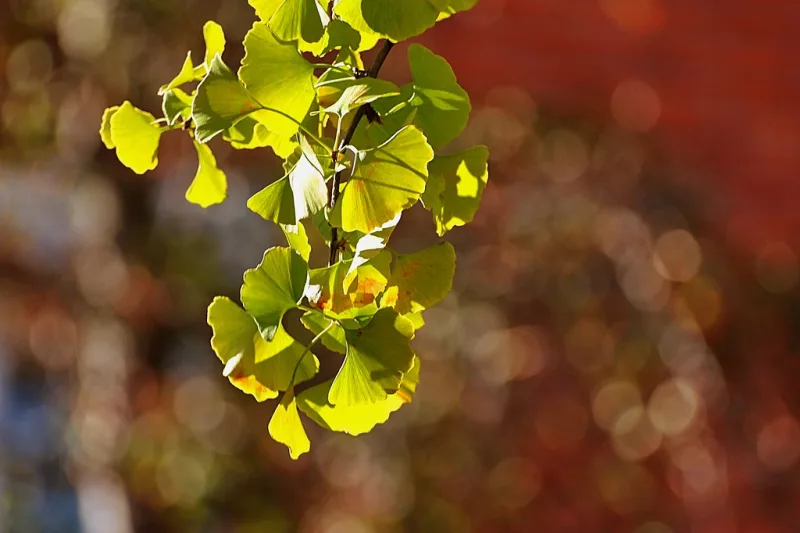

Ginkgo Biloba: Benefits for Memory and Circulation, Uses and How to Prepare It
IMPORTANT: Ginkgo biloba can thin the blood and increase the risk of bleeding. Do not use it if you take anticoagulants (warfarin, acenocoumarol), aspirin, antiplatelet drugs, or if you are scheduled for surgery within the next two weeks. People with epilepsy, pregnant or breastfeeding women, children, and those taking antidepressants or diabetes medication should avoid ginkgo or use it only under medical supervision. The fresh fleshy fruit pulp contains irritating and potentially toxic substances (ginkgolic acids) and must not be consumed. Always consult your doctor or pharmacist before starting ginkgo, especially if you have a chronic condition.
Grandmother Veronica, a slender and sprightly woman from the Sibiu region, had a strange tree in her yard, with leaves like tiny fans. “That is the tree of the mind,” she would tell her grandchildren, tracing with her finger the delicate veins that fanned out like rays from the leaf’s stem. Every autumn she gathered the golden leaves into a wicker basket, dried them in the shade under the eaves, and brewed a slightly bitter tea that she drank “so I don’t forget the way to my own gate,” she joked. At ninety she still remembered the names of all her neighbours, the birthdays of her great-grandchildren, and the recipes she had learned from her own mother.
For many years I thought that tree was just an ornamental oddity brought from who knows where. Only later did I learn that it is one of the oldest plant species on Earth, a survivor of a vanished world, and that the tradition of using its leaves for mental clarity and the health of tired legs has deep roots in Asian medicine. Ginkgo biloba was not a grandmother’s fancy, but a living inheritance from millions of years of evolution.
Ginkgo biloba, also known as the “maidenhair tree” or the “pagoda tree,” is the only surviving species of an extremely ancient plant family, regarded as a true “living fossil.” Native to China, it has been cultivated for centuries around Buddhist temples, and today we find it as an ornamental tree on city streets all over the world, thanks to its remarkable resistance to pollution and disease. Its leaves, with their unmistakable fan shape, are the ones that concentrate the active compounds valued in herbal medicine.
Table of Contents
- What ginkgo biloba is and where it comes from
- Composition and active principles
- Health benefits
- Traditional and modern uses
- How to prepare ginkgo: tea, tincture, powder
- Dosage and administration
- Ginkgo in a modern lifestyle
- Practical tips and common mistakes
- Conclusion
- Frequently Asked Questions
What ginkgo biloba is and where it comes from
Ginkgo biloba is an imposing tree that can reach 30-40 metres in height and live for over a thousand years. The species name “biloba” refers to the shape of the leaf, often divided into two lobes by a central notch. This shape, like a small fan with parallel veins radiating from a single point, is unique in the plant world and makes ginkgo impossible to confuse with any other species.
The plant is considered a “living fossil” because its structure has remained practically unchanged for over 200 million years. Back when dinosaurs roamed the Earth, entire forests of ginkgo covered the continents. Almost the whole family disappeared, but this species survived, largely thanks to its cultivation in the temple gardens of China and Japan. Buddhist monks considered it sacred and planted it around their places of worship, which ensured its continuity.
Today ginkgo is cultivated on a large scale, both ornamentally and for the harvest of leaves destined for the herbal industry. The leaves are usually gathered in summer, when they are still green and rich in active compounds, or in early autumn, before they turn fully yellow. The tree is remarkably hardy: it tolerates cold, drought, poor soils and urban pollution, which is why we often see it planted along busy boulevards where other species would not survive.
Composition and active principles
Ginkgo leaves contain a complex combination of substances that work together synergistically. The two most important groups of compounds are:
Flavonoids (especially flavone glycosides such as quercetin, kaempferol and isorhamnetin) are powerful antioxidants. They help neutralise free radicals, unstable molecules that contribute to cell ageing and damage to blood vessels. Flavonoids support the integrity of vascular walls and have a protective effect on tissues.
Terpene lactones are substances specific to this plant, divided into ginkgolides (A, B, C, J) and bilobalide. The ginkgolides, especially ginkgolide B, are studied for their ability to influence blood flow and to modulate certain inflammatory processes. Bilobalide appears to have protective effects on nerve cells.
In addition, the leaves also contain organic acids, proanthocyanidins and a small amount of ginkgolic acids. The latter can be irritating and allergenic, which is why quality standardised extracts are purified to reduce the ginkgolic acid content to a minimum. Folk tradition used tea made from dried leaves, but in home preparation the concentration of these compounds is lower and harder to control than in pharmaceutical extracts.
Health benefits
Supporting memory and concentration
The best-known benefit of ginkgo is linked to cognitive function. Asian tradition, and later European herbalism, used it to support memory, attention and mental clarity, especially in older people. Studies suggest that ginkgo may help improve blood flow to the brain, thereby ensuring a better supply of oxygen and nutrients to nerve cells. Many people use it during periods of intense intellectual effort, to combat the feeling of “brain fog” and to maintain their focus.
Improving peripheral circulation
Ginkgo is traditionally known for its effect on blood circulation in the extremities. People who suffer from cold hands and feet, a feeling of heaviness, or tingling in the legs often use it to support peripheral blood flow. Studies suggest that ginkgo may ease symptoms associated with poor circulation in the legs, such as the cramping pain that appears when walking and eases with rest. This effect is attributed to its ability to influence the elasticity and tone of the small blood vessels.
Antioxidant and protective action
Its richness in flavonoids makes ginkgo a remarkable antioxidant. Free radicals, produced naturally by the body but also under the influence of pollution, stress and an unhealthy diet, attack cells and accelerate ageing. The antioxidants in ginkgo help neutralise these molecules and protect both nerve cells and the walls of blood vessels. This general protective effect is one of the reasons ginkgo is valued as a tonic for healthy ageing.
Support for hearing and balance
In herbal tradition, ginkgo has also been used for disorders such as ringing in the ears (tinnitus) and dizziness of circulatory origin. The idea behind this use is the same: better blood flow to the inner ear and to the nerve centres that control balance might ease these complaints. Results vary from person to person, and these conditions always require a medical evaluation to rule out more serious causes.
Supporting eye health
The eyes are organs with a very fine and sensitive blood supply. Folk tradition and some modern observations have associated ginkgo with supporting circulation at the level of the retina. The antioxidants in the leaves may help protect the delicate tissues of the eye against oxidative stress. Here too, ginkgo is used as complementary support, not as a substitute for proper eye care.
Mood balance and mental energy
Many people report that using ginkgo gives them a feeling of mental vitality and a better mood. This effect might also be related to the improved oxygen supply to the brain and to its antioxidant action. Tradition regarded it as a “tonic of old age,” a plant that helps keep the mind sharp and the spirit serene as the years go by.
Traditional and modern uses
In traditional Chinese medicine, both the leaves and the seeds of ginkgo were used, although for different purposes. The roasted seeds (cleaned of the toxic pulp) were considered a food affecting the lungs and bladder, while the leaves were valued for their effects on the heart and lungs. It must be stressed that the seeds are not consumed in large quantities and never raw, as they can be toxic.
In modern European herbalism, attention has focused almost exclusively on the leaves, from which standardised extracts are produced. These extracts are among the most studied plant products on the market and are used especially to support cognitive function and circulation. At home, people make teas and tinctures from dried leaves, although their potency is lower than that of concentrated extracts.
In addition to internal use, ginkgo leaves sometimes appear in the composition of cosmetic products, thanks to their antioxidant effect and the support they give to the skin’s microcirculation. They are used in creams and lotions for mature skin or skin with circulation problems.
How to prepare ginkgo: tea, tincture, powder
Ginkgo leaf tea
Tea is the simplest form of home preparation. Here is how to make it:
- Use one teaspoon (about 1-2 grams) of dried, crumbled leaves per 200-250 ml cup.
- Pour hot but not boiling water (around 90 °C) over the leaves.
- Cover the cup and let it infuse for 8-10 minutes.
- Strain and drink the tea warm.
The tea has a slightly bitter and astringent taste. It can be sweetened with a little honey or flavoured with a slice of lemon. A maximum of 1-2 cups per day is recommended, and not for more than a few consecutive weeks, with breaks. Note: home-made tea contains a variable amount of active compounds and cannot replace a standardised extract when a precise therapeutic effect is sought.
Ginkgo tincture
The tincture is a concentrated form, obtained by macerating the leaves in alcohol:
- Fill a clean jar halfway with crumbled dried ginkgo leaves.
- Pour food-grade alcohol of 40-50 percent over the leaves until they are fully covered.
- Close the jar and let it macerate for 2-3 weeks in a dark, cool place, shaking it daily.
- Strain through cheesecloth, squeeze well and store the tincture in dark glass bottles.
The tincture is taken in small doses, usually 20-30 drops diluted in a little water, once or twice a day. Here too, caution and consulting a specialist are recommended, especially because of its effect on blood clotting.
Leaf powder
Finely ground dried leaves can be used as a powder, mixed into a little water, honey, or added to smoothies. An approximate amount is about half a teaspoon per day. The powder should be kept in an airtight container, away from light and moisture.
Standardised extracts
For consistent therapeutic effects, the most widely used products are standardised extracts, available as capsules or drops, which guarantee a precise content of flavonoids and terpene lactones, with reduced ginkgolic acids. These are taken according to the instructions on the package or your doctor’s advice.
Dosage and administration
For standardised extracts, the usual doses recommended by manufacturers generally range between 120 and 240 mg per day, divided into 1-3 servings. The effects are not immediate: ginkgo acts slowly, and the benefits for memory and circulation are usually noticed only after 4-8 weeks of consistent use. For this reason, ginkgo is used in longer courses, not occasionally.
It is advisable to take it in the first part of the day, possibly with meals, to reduce the risk of stomach discomfort. People taking ginkgo for the first time should start with a small dose to see how their body reacts. Courses are usually taken with breaks, to avoid continuous use over an unlimited period.
Ginkgo in a modern lifestyle
Ginkgo can be a valuable support, but it works best as part of a healthy lifestyle, not as an isolated miracle solution. For a sharp mind and good circulation, herbalists recommend combining it with habits such as:
- Regular movement: walks, walking and light exercise stimulate circulation far more effectively than any plant alone.
- Proper hydration: a well-hydrated brain and blood vessels function optimally.
- A diet rich in antioxidants: colourful vegetables, berries, nuts and oily fish complement the action of ginkgo.
- Quality sleep: memory is consolidated during sleep, and ginkgo cannot make up for sleepless nights.
- Mental stimulation: reading, logic games and learning new things keep the brain active.
Used wisely, ginkgo becomes one piece of a larger mosaic of health, not a substitute for caring for your own body.
Practical Tips and Common Mistakes
Mistake no. 1: Using ginkgo together with blood-thinning medication. This is the most dangerous error. Ginkgo itself has a blood-thinning effect, and combining it with anticoagulants or aspirin can significantly increase the risk of bleeding. Never use ginkgo alongside such medication without your doctor’s approval.
Mistake no. 2: Expecting immediate results. Ginkgo is not a coffee that “switches on” your mind in a few minutes. The effects set in slowly, over weeks. Many people give up too early, believing it does not work.
Mistake no. 3: Eating raw fruit or seeds. The fleshy pulp around the seeds and the raw seeds contain irritating and potentially toxic substances. Only the leaves are used in ordinary home preparations, and the seeds are rarely eaten, only roasted and in small amounts, in traditional Asian cooking.
Mistake no. 4: Harvesting leaves from polluted areas. Because ginkgo is often planted along busy boulevards, leaves from the street can be loaded with pollutants. Harvest only from clean places, away from traffic.
Mistake no. 5: Taking it without breaks, for an unlimited time. As with any medicinal plant, it is wise to take courses with breaks, rather than using it continuously for years without supervision.
Mistake no. 6: Using ginkgo before surgery. Because of its effect on clotting, ginkgo should be stopped at least two weeks before any surgery or major dental procedure.
Mistake no. 7: Ignoring side effects. Although it is generally well tolerated, ginkgo can sometimes cause headaches, dizziness or stomach discomfort. If such symptoms appear, reduce the dose or stop and consult a specialist.
Conclusion
Ginkgo biloba is one of the most fascinating medicinal plants, a survivor of a prehistoric world that continues to offer us its fan-shaped leaves. Valued for centuries for the support it gives to memory, concentration and circulation, it remains today one of the most studied products in herbal medicine. Used correctly, with appropriate doses, in courses with breaks and with attention to contraindications, ginkgo can be a valuable ally for a clear mind and a lively body. But, like any remedy, it gives the best results when it accompanies a balanced lifestyle and does not replace a doctor’s advice. Grandmother Veronica was, in her own way, perfectly right: the “tree of the mind” deserves to be respected, understood and used with good judgement.
Frequently Asked Questions
How long does it take for ginkgo to work? Ginkgo acts slowly. Usually, the benefits for memory and circulation are noticed after 4 to 8 weeks of consistent use. It is not a plant with an immediate effect, so patience and regularity are essential.
Can I take ginkgo together with aspirin or anticoagulants? No, not without your doctor’s explicit approval. Ginkgo itself has a blood-thinning effect, and the combination can increase the risk of bleeding. This is one of the most important contraindications.
Is ginkgo tea as effective as a standardised extract? No. Home-made tea contains a smaller and more variable amount of active compounds than standardised extracts, which are concentrated and have a guaranteed content of flavonoids and terpene lactones. The tea is more of a gentle, pleasant tonic, but weaker.
Does ginkgo really help the memory of young, healthy people? The most obvious benefits are seen in people with circulation problems or with mild age-related cognitive decline. In healthy young people the effects are more subtle and vary from person to person. Studies suggest results, but do not guarantee a memory “superpower.”
Does ginkgo have side effects? It is generally well tolerated, but it can sometimes cause headaches, dizziness, stomach discomfort or, more rarely, allergic skin reactions. The most serious risk is bleeding, which is why caution is essential.
Can I harvest ginkgo leaves myself from the park? Yes, if the park is clean and far from heavy traffic. Pick healthy leaves, green (in summer) or just turning yellow (in early autumn), dry them in the shade and keep them in an airtight container. Avoid leaves from busy boulevards, which can be full of pollutants.
Can pregnant women use ginkgo? No. Because of its effect on clotting and the lack of sufficient safety data, pregnant or breastfeeding women should avoid ginkgo.
How long can I take ginkgo without a break? Courses of a few weeks to a few months are recommended, followed by breaks. Continuous use, year after year, without medical supervision, is not recommended. It is best to discuss the length of the course with your doctor or pharmacist.