
Ginseng: Benefits, Uses and How to Prepare the Energizing Root
IMPORTANT: Ginseng is a powerful herb, not just an “energy supplement.” It is not recommended for pregnant or breastfeeding women, children under 12, or people with uncontrolled high blood pressure. It can interact with anticoagulant medications (warfarin), antidiabetic drugs (risk of hypoglycemia), antidepressants and stimulants. If you are on long-term medication, have an autoimmune disease, heart problems or sleep disorders, talk to your doctor before starting a course. Ginseng never replaces a proper diagnosis and medical treatment.
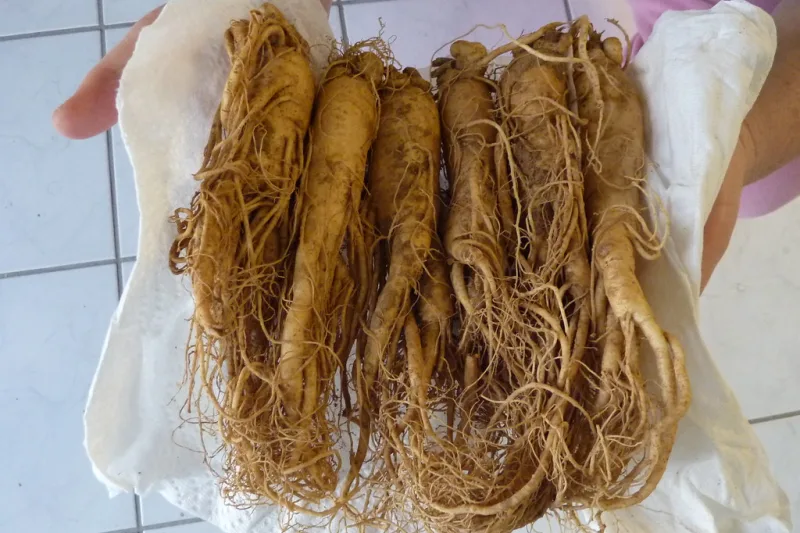
Grandfather Gheorghe, an old forester from the Maramureș region who had spent some time working in Asia in his youth, kept a few wrinkled, yellowish roots in a glass jar hidden behind his books — roots that looked uncannily like little twisted men. “This is ginseng, boy,” he would tell me, “the root of man.” Every autumn, when he felt his strength fading and a cough creeping up on him, he would cut a thin slice from a root and hold it under his tongue in the morning, on an empty stomach. He said it “put color back in his cheeks” and that he no longer dozed off over his axe at noon.
Later I learned this was more than a forester’s tale. Ginseng is one of the most studied and respected tonic plants in the world, used for thousands of years in traditional Chinese and Korean medicine. That “little man” shape of the root (hence the name Panax, related to “panacea,” a universal remedy) has fascinated people for ages. This article explains what ginseng really is, what it can and cannot do, how to prepare it correctly, and where caution is required.
Table of Contents
- What ginseng is and where it comes from
- Types of ginseng and how they differ
- Composition and active compounds
- Health benefits
- Traditional uses
- How to prepare ginseng: step-by-step recipes
- Dosage and how to take it
- How to choose and store it
- Lifestyle: using ginseng intelligently
- Practical tips and common mistakes
- Conclusion
- Frequently Asked Questions
What ginseng is and where it comes from
Ginseng is the fleshy root of several plant species in the Panax genus, of the Araliaceae family. The best known are Asian ginseng (Panax ginseng), native to Korea, northeastern China and eastern Russia, and American ginseng (Panax quinquefolius), which grows in the shady forests of eastern North America. The plant grows slowly, in partial shade beneath the tree canopy, and a medicinally valuable root needs four to six years to mature — which is why it commands a high price and is treated with such respect.
The term “ginseng” is sometimes also applied to unrelated plants, such as Siberian ginseng (Eleutherococcus senticosus), which is not a true Panax, even though it has similar adaptogenic effects. It is worth knowing the distinction, because both are sold on the market and their composition differs.
What makes ginseng so prized is that it is considered an adaptogen — a plant that helps the body adapt better to stress (physical, mental, environmental), tending to restore balance, whether the issue is too much agitation or too much exhaustion. It does not “whip” the body the way a strong coffee does; in tradition, it “nourishes” the body’s energy reserves.
Types of ginseng and how they differ
Before talking about benefits, it helps to understand that not all ginseng is the same:
- White ginseng – Panax ginseng root simply cleaned and dried, with no special heat treatment. Its effect is somewhat gentler.
- Red ginseng – the same root, but steamed and then dried, which changes its color and, according to tradition, intensifies its tonic and “warming” properties.
- American ginseng – considered in Asian tradition more “cooling” and calming, suitable for restless or overheated people, while the Asian variety is more stimulating.
This distinction is not a whim: in traditional medicine, the choice of ginseng type is made according to a person’s “constitution.” Someone already energetic and prone to insomnia may tolerate American ginseng better, while an exhausted person who always feels cold might lean toward red Asian ginseng.
Composition and active compounds
The main active substances in ginseng are the ginsenosides (also called panaxosides), a group of triterpenoid saponins found almost exclusively in the Panax genus. Dozens of such ginsenosides have been identified so far, usually labeled with letters and numbers (Rb1, Rg1, Re, Rd and others). It is thought that the balance between different ginsenosides explains why ginseng can both energize and calm — different ginsenosides appear to have slightly different, sometimes even opposite, effects, which may underlie its adaptogenic action.
Besides ginsenosides, the root contains:
- polysaccharides (complex sugars) that may support immunity;
- peptides and amino acids;
- polyacetylenes;
- B-complex vitamins and small amounts of minerals;
- volatile oils that give it its characteristic slightly bitter, earthy aroma.
The ginsenoside concentration varies greatly depending on the species, the age of the root, the drying method and the processing. This is why two ginseng products can have very different effects.
Health benefits
Let us be honest from the start: ginseng is intensely studied, but research results are sometimes inconsistent, because products differ so much from one another. Studies suggest a range of benefits, but these should be seen as tendencies rather than absolute certainties. Folk tradition, in turn, attributes broad virtues to it as a general tonic.
Energy and fighting fatigue
The best-known reason people turn to ginseng is chronic tiredness and lack of vitality. Studies suggest ginseng might reduce the sensation of fatigue, especially in physically or mentally exhausted people, and might improve the overall perception of energy. Unlike coffee, the effect is not a sudden “spike” followed by a crash but, in tradition, a more steady support of one’s tone.
Supporting cognitive function
Ginseng is traditionally valued as an aid for the mind: for concentration, memory and clarity. Studies suggest a possible beneficial effect on attention and certain cognitive functions, especially when combined with other herbs. Many people use it during periods of intense mental effort (exams, demanding projects), precisely because of this reputation.
Supporting immunity
The polysaccharides and ginsenosides seem to interact with the immune system. In folk tradition, ginseng was used as a tonic during the cold season, to “strengthen” the body against colds. Studies suggest it might support the immune response, although the mechanisms are not yet fully clarified.
Adapting to stress
As a classic adaptogen, ginseng is used to help the body cope better with demanding periods. The basic idea is one of balancing: helping the body remain functional under pressure without overstimulating it.
Vitality and general tone
Asian tradition views ginseng as a tonic of “vital energy,” used from the tiredness of old age to convalescence. Many people report an overall sense of well-being and better tone after courses of a few weeks, although part of this effect may also be due to the lifestyle adjustments that usually accompany such a course.
Blood sugar balance
Some studies suggest ginseng might influence blood sugar levels. For this very reason, people with diabetes who take medication must be cautious: the effect could add to that of their treatment, increasing the risk of hypoglycemia. This is a potential benefit that immediately turns into a precaution.
Traditional uses
In traditional Chinese and Korean medicine, ginseng has held a place of honor for thousands of years, considered a supreme tonic of energy (qi). It was often reserved for emperors and weakened elders, being too valuable for ordinary people. It was used as a decoction (a boiled brew), powder, or simply by chewing a slice of root.
In European folk tradition, where it arrived later, ginseng was adopted as a tonic for convalescents, the elderly, and periods of weakness after long illnesses. It was prized as a remedy that “gets a person back on their feet” and as a cure for tiredness that does not pass even after rest.
How to prepare ginseng: step-by-step recipes
Ginseng can be used in several forms. Here are the most common ones, explained step by step.
Ginseng tea (infusion)
This is the gentlest method and the most suitable for beginners.
- Use 2–3 thin slices of dried root (about 1–2 g) or half a teaspoon of powder per cup (250 ml).
- Bring the water close to boiling, then turn off the heat.
- Pour the hot water over the slices and cover the cup.
- Let it steep for 10–15 minutes.
- Strain (if you used powder) and drink it warm, preferably in the morning.
The root slices can be reused two or three times in the same day, since they release their active compounds gradually.
Ginseng decoction (boiled brew)
For a stronger effect, tradition uses boiling, not just steeping.
- Place 3–5 g of root in a pot (preferably ceramic, not metal) with two cups of cold water.
- Bring it to a boil, then lower the heat to minimum.
- Simmer gently, covered, for 20–30 minutes, until the liquid reduces to about one cup.
- Strain and drink it warm.
The decoction is more concentrated and is usually used in short courses, not daily over the long term.
Ginseng tincture
A tincture keeps for a long time and is easy to dose, drop by drop.
- Chop 20 g of dried root.
- Place it in a clean jar and pour over 100 ml of food-grade alcohol of about 40–60% (for example, good-quality brandy).
- Seal it tightly and keep it in the dark for 3–4 weeks, shaking the jar every day.
- Strain through cheesecloth and store the tincture in dark glass bottles.
It is usually taken as a few drops (15–30), diluted in a little water.
Chewing the root directly
“Grandfather Gheorghe’s” method: a very thin slice of dried root is held under the tongue and chewed slowly, in the morning, on an empty stomach. It is simple, but the bitter-earthy taste is not to everyone’s liking.
Honey with ginseng
For a tonic that is more pleasant to taste, you can stir ginseng powder into a jar of honey (one teaspoon of powder per 100 g of honey). Take one teaspoon in the morning. This combination is especially appreciated in the cold season.
Dosage and how to take it
Dosage depends heavily on the form used and the concentration of the product, but a few general guidelines are useful:
- Dried root: generally 1–2 g per day for maintenance; tradition sometimes uses larger doses in short courses.
- Tincture: 15–30 drops, once or twice a day, diluted in water.
- Standardized powder/capsules: follow the manufacturer’s instructions, since the ginsenoside content varies.
Important rules for taking it:
- It is usually taken in the morning or at midday, not in the evening, so as not to disturb sleep.
- Courses are typically 2–3 weeks, followed by a break of at least one week. Ginseng is not meant for permanent, uninterrupted use.
- Always start with the lowest dose, to observe how your body reacts.
How to choose and store it
The quality of ginseng varies enormously. Here is what to watch for:
- Prefer whole roots or slices rather than powders of unknown origin; the whole root is harder to adulterate.
- Look for a product that specifies the species (Panax ginseng or Panax quinquefolius) and, ideally, the ginsenoside content.
- Good-quality root has a characteristic earthy aroma and a uniform color, with no mold or suspicious spots.
- Store ginseng in a dry, dark and cool place, in airtight containers. Moisture is its enemy — it encourages mold and degrades the active compounds.
- Tinctures and ginseng honey should be kept in sealed bottles/jars, away from light.
Lifestyle: using ginseng intelligently
Ginseng works no miracles on its own. It performs best as part of a balanced way of life. If you sleep four hours a night, eat chaotically and never move, no root will “repair” your energy in the long run.
To truly benefit from a course of ginseng:
- Try to get enough sleep at regular hours; ginseng supports your tone but does not replace sleep.
- Stay well hydrated and eat a balanced diet, with enough protein and vegetables.
- Get at least a little daily movement — a brisk walk amplifies the sense of vitality.
- As much as possible, cut down on other stimulants (excess coffee, energy drinks), especially if you take Asian ginseng, so you don’t pile up the stimulating effects.
Seen this way, ginseng becomes a support, not a crutch.
Practical tips and common mistakes
Mistake no. 1: Taking it in the evening. Many people take ginseng before bed, hoping to “gather strength,” and then complain of insomnia. Ginseng, especially the Asian variety, is a tonic — its place is in the morning.
Mistake no. 2: The endless course. Ginseng is not meant for permanent use. Taken without breaks, for months on end, it can cause nervousness, headaches or sleep disturbances. Respect the rule of courses with breaks.
Mistake no. 3: Too large a dose from the start. “If one slice is good, two are better” — this is faulty reasoning. Excess can cause palpitations, agitation and raised blood pressure. Always begin with a little.
Mistake no. 4: Ignoring drug interactions. People taking anticoagulants, antidiabetics or antidepressants should not start ginseng without asking their doctor. This is one of the most important precautions.
Mistake no. 5: Choosing a product of dubious origin. The market is full of “ginseng supplements” with a negligible content of real root. Read the label and prefer trustworthy sources.
Mistake no. 6: Using it during pregnancy or in children “because it’s only a plant.” The fact that it is natural does not mean it is harmless. Ginseng is not recommended in pregnancy, while breastfeeding, or for small children.
Conclusion
Ginseng is one of the most fascinating medicinal plants — a root with a reputation thousands of years old and a well-deserved place among the classic adaptogens. Used wisely — in short courses, in the morning, with reasonable doses and attention to interactions and contraindications — it can be a valuable support for tone, energy and the ability to cope with stress. It is not a panacea, however, despite its name, and it does not replace sleep, a healthy diet and a doctor’s advice. The “little man” root that Grandfather Gheorghe kept hidden behind his books deserves respect, not just enthusiasm: handled with care, it can truly reveal its virtues.
Frequently Asked Questions
How long does it take to feel ginseng’s effects? Some people report a sense of tone within the first few days, but the more stable effects on energy and general well-being usually appear after one to two weeks of regular use. Patience matters.
Can I take ginseng every day, long term? Continuous use without breaks is not recommended. Tradition and prudence indicate courses of 2–3 weeks followed by breaks. Permanent use can lead to nervousness and sleep disturbances.
What is the difference between red and white ginseng? Both come from Panax ginseng. White ginseng is simply dried and has a gentler effect; red ginseng is steamed, which, according to tradition, intensifies its tonic and “warming” effect.
Does ginseng cause insomnia? It can, if taken in the evening or in large doses, especially the Asian variety. Taken in the morning and in moderate doses, this risk drops considerably.
Can I take ginseng if I have high blood pressure? People with uncontrolled high blood pressure should be cautious and discuss it with their doctor, since ginseng may influence blood pressure. Do not start a course on your own in this situation.
Does ginseng help concentration during exams? Tradition and some studies suggest a possible support for attention and mental clarity. However, it does not replace sleep and preparation; it works best as part of a balanced regimen.
Can I combine ginseng with other herbs? Yes, ginseng is traditionally combined with herbs such as ginger or with honey. However, avoid stacking it with other strong stimulants and, if you take medication, ask your doctor or pharmacist first.
Is there a ginseng more suitable for restless people? In Asian tradition, American ginseng is considered more “cooling” and calming than the Asian variety, and is preferred by those who are already energetic or prone to agitation and insomnia.