
Greater Celandine: Benefits, Uses, Preparation and Precautions
IMPORTANT: Greater celandine is a powerful plant, considered toxic in large doses. It contains alkaloids that, if used improperly, can damage the liver. Internal use (teas, tinctures) should only be undertaken under the guidance of a doctor or an experienced herbalist, in short courses and small doses. It is STRICTLY contraindicated during pregnancy and breastfeeding, in children, and in people with liver conditions, glaucoma, or who take medications metabolized by the liver. The fresh yellow latex can irritate the eyes and sensitive skin. This article is for informational purposes only and does not replace medical advice. At the first sign of nausea, dark urine, or yellowing of the skin, stop use immediately and consult a doctor.
I still remember how Grandma Veta, our neighbor in the village at the foot of the hill, went out every spring to the edge of the fence where, year after year, a corner of greater celandine grew. She had a single goal: the warts that appeared on the hands of the neighborhood children. She would carefully break off a stem, let that drop of yellow-orange “milk” flow, and gently dab it onto the wart, repeating the operation for several days in a row. “Swallowwort,” she called it, because, the legend said, swallows used it to heal their young. And the warts, little by little, dried up and fell off.
Aunt Veta had no pharmacist’s diploma, but she possessed that wisdom passed from mother to daughter: she knew that greater celandine is a “powerful” plant and therefore one to be respected. She never gave it to children to drink, never tossed it into random teas. She used it only externally, for warts and for cleaning small wounds, and always with measure. This distinction — between the popular external use and the risky internal use — is the key to understanding this remarkable but demanding plant.
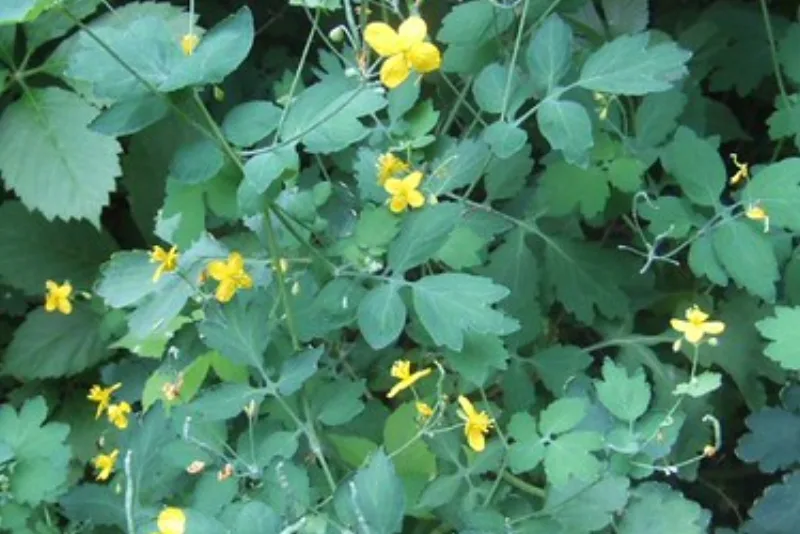
Greater celandine (scientific name Chelidonium majus) is a perennial herbaceous plant from the poppy family (Papaveraceae), widespread throughout Romania and much of Europe, especially along fences, old walls, roadsides, and shaded, damp places. It is easily recognized by its pinnate leaves of a matte blue-green color, its small yellow four-petaled flowers, and above all by the yellow-orange juice that flows the moment you break the stem. This characteristic latex is both the plant’s “signature” and its most active and most delicate part to handle.
Table of Contents
- What greater celandine is and where it grows
- Composition and active principles
- Benefits and traditional uses
- External use: the plant’s star application
- Internal use: with maximum caution
- How to prepare it: step-by-step recipes
- Dosage and administration
- Harvesting and storage
- Practical tips and common mistakes
- Conclusion
- Frequently Asked Questions
What greater celandine is and where it grows
Greater celandine belongs to the same botanical family as the poppy, which explains the presence of alkaloids and colored latex. It grows wild throughout Europe and many parts of Asia, being an extremely adaptable plant. Here you will frequently encounter it in “neglected” spots — exactly along fences, near the ruins of old houses, at the base of shady walls, in open woodlands, and along the banks of streams.
The plant reaches between 30 and 90 centimeters in height. The stem is branched, slightly hairy, and contains a milky sap of yellow-orange, sometimes even reddish, color. The leaves are deeply lobed, of a matte green with a bluish tint underneath, which gives them an unmistakable appearance. The flowers, small and delicate, have four golden-yellow petals and appear from spring until late autumn, which makes the plant easy to identify in almost any warm season. The fruits are slender, elongated pods that open at maturity and release small seeds.
In Romanian folk tradition, greater celandine has always been the “wart plant” and the “bile plant.” The popular names “swallowwort” or “warrior’s cross” show how deeply it took root in our culture. It was also known to folk medicine in other European countries, where it was used for centuries for liver and biliary conditions.
Composition and active principles
The power — and at the same time the risk — of greater celandine comes from its wealth of isoquinoline alkaloids, complex substances that act strongly on the body. Among the best known are chelidonine, coptisine, berberine, sanguinarine, chelerythrine, and protopine. These are found in all parts of the plant, but the highest concentration is in the root and in the fresh latex.
In addition to alkaloids, greater celandine also contains organic acids (chelidonic acid, malic acid, citric acid), flavonoids, saponins, volatile oil, enzymes, and vitamin C. This combination explains the varied effects attributed to the plant in traditional herbalism.
Studies suggest that some of these alkaloids have antispasmodic properties (they relax smooth muscle), choleretic effects (they stimulate bile production), and cholagogue effects (they promote bile elimination). Studies also suggest antimicrobial and antiviral actions of the latex against certain agents on the skin’s surface — exactly the component that folk medicine exploited for warts. It must be remembered, however, that these same alkaloids, in large doses or in long courses, can become hepatotoxic, which is why the plant demands special care.
Benefits and traditional uses
Folk tradition and classical herbalism attribute several directions of use to greater celandine. I present them one by one, always emphasizing the difference between external use (safer, more accessible) and internal use (reserved for specialists).
Support for bile and liver
The best-known traditional internal use of greater celandine targets the biliary system. Thanks to its choleretic and antispasmodic effect, the plant has been used to ease spasms of the bile ducts, to promote the flow of bile, and to relieve the digestive discomfort associated with sluggish bile. In folk medicine, small amounts of tea were given for the feeling of heaviness after fatty meals or for biliary dyskinesia. Caution: precisely for the liver the greatest care is required, since overdosing has the opposite, harmful effect.
Digestive antispasmodic effect
Beyond the bile ducts, greater celandine was traditionally used to relax spasms of the stomach and intestines, in abdominal cramps and colic. The smooth-muscle relaxing effect is attributed mainly to chelidonine.
Treating warts and skin problems
This is the territory where greater celandine shines safely. The yellow latex applied directly to warts, corns, calluses, and certain skin growths is the folk remedy par excellence. It was also used to soothe certain irritations, cold sores, and to clean small superficial wounds.
General support in detoxification
In traditional “spring cures,” greater celandine sometimes appeared in mixtures for “blood cleansing” and stimulating elimination. These cures were done briefly and under control, never prolonged.
External use: the plant’s star application
For most people, the safest and most recommendable way to use greater celandine is the external application of fresh latex to warts. The traditional procedure is simple:
- Identify a healthy celandine plant, away from polluted roadsides.
- Break a stem or leaf; a drop of yellow-orange juice will appear immediately.
- Apply the drop directly to the wart, being careful not to touch the surrounding healthy skin (you can protect the area with a little petroleum jelly or an adhesive plaster with a hole in it).
- Let the juice dry on the wart.
- Repeat once or twice a day for 2-3 weeks, until the wart blackens, dries, and falls off.
Patience is essential: unlike aggressive cauterizations, this folk method works gradually. Never apply the latex near the eyes, on mucous membranes, or on deep wounds.
Internal use: with maximum caution
I repeat the warning, because it deserves repeating: internal use of greater celandine should NOT be done on your own. Internal teas and tinctures belong to the domain of the herbalist and the doctor. Doses are small, courses are short (usually a few days, at most 1-2 weeks, with long pauses), and supervision is mandatory. The hepatotoxic risk is real and documented. If you have liver conditions, take chronic medications, are pregnant, or are breastfeeding, internal greater celandine is forbidden to you.
How to prepare it: step-by-step recipes
I present the preparation methods for informational and ethnobotanical purposes. For any internal administration, first consult a specialist.
Greater celandine tea (informational)
- Use a small amount: about a pinch (roughly 1 gram) of dried, crushed plant per cup of water.
- Pour over with hot (not boiling) water, cover, and let it infuse for 10 minutes.
- Strain well.
- In tradition, at most one cup a day was drunk, in short courses and only with a doctor’s approval.
Greater celandine tincture
- Fill a jar halfway with chopped fresh plant (or one-third with dried plant).
- Add food-grade alcohol of 40-50 percent until it completely covers the plant.
- Seal tightly and keep for 2-3 weeks in a dark place, shaking daily.
- Strain through cheesecloth and store in dark-colored bottles.
- The internal dosage (drops) is determined only by a specialist; the diluted tincture can also be used externally, on warts.
Fresh juice (for warts)
- The simplest “preparation”: break the stem and use the drop of latex directly on the wart.
- It requires no other ingredients.
Greater celandine ointment
- Macerate chopped fresh plant in a vegetable oil (for example, olive oil) for 2-3 weeks, in warmth, away from direct light.
- Strain and incorporate into a little melted beeswax to obtain an ointment.
- Use externally, on problem skin, avoiding sensitive areas.
Dosage and administration
The golden rule with greater celandine is: as little as possible, as briefly as possible, under supervision. For external use on warts, fresh latex or diluted tincture is applied to the spot, once or twice a day. For internal use, doses are extremely small and must not be improvised. Long courses are dangerous for the liver. The breaks between courses must be generous. Do not combine internal celandine with alcohol, with hepatotoxic medications, or with other powerful plants without specialist advice.
Harvesting and storage
If you want to harvest greater celandine for external use, choose spring and early summer, when the plant is in bloom and rich in sap. Harvest away from roads, from land treated with pesticides, and from polluted areas. Wear gloves, because the latex stains and can irritate sensitive skin. To dry it, tie the stems into small bundles and hang them in an airy, shady, dry place. After drying, store the crushed plant in paper bags or jars, clearly labeled — especially if there are children in the house, it is essential that it not be confused with ordinary tea plants.
Practical tips and common mistakes
Mistake no. 1: Drinking greater celandine tea “for the liver” on your own. This is exactly the opposite of what you should do. The plant can help bile in small, controlled doses, but in excess it becomes toxic to the liver. Do not treat yourself internally.
Mistake no. 2: Applying the latex to healthy skin. The yellow juice is irritating. Protect the skin around the wart and apply only to the growth.
Mistake no. 3: Confusing it with other yellow plants. The yellow flowers with four petals, the bluish lobed leaves, and especially the orange latex are the sure signs. If the broken plant does not “weep” yellow sap, it is not greater celandine.
Mistake no. 4: Using long courses. More does not mean better. Courses must be short, with pauses.
Mistake no. 5: Giving it to children or during pregnancy. This is strictly forbidden. The risks far outweigh any benefit.
Mistake no. 6: Harvesting near polluted roads. The plant absorbs heavy metals and residues; choose clean places.
Mistake no. 7: Ignoring the warning signs. Nausea, dark urine, unusual fatigue, or yellowing of the skin call for immediate cessation and medical consultation.
Conclusion
Greater celandine is a perfect example of how a plant can be both a precious remedy and a serious risk, depending on how you use it. For warts and certain skin problems, fresh latex remains one of the best-known and most accessible Romanian folk remedies, used by entire generations with good results and without danger, as long as it is applied externally and with care. For bile and liver, the plant has tradition and a rational basis, but here the line between help and harm is thin, and internal use belongs exclusively to the specialist. Grandma Veta’s wisdom — “a powerful plant, therefore one to be respected” — remains the best guide. Use greater celandine with knowledge, with measure, and with caution, and it will reward your respect.
Frequently Asked Questions
How do I get rid of warts with greater celandine? Break a fresh stem and apply the drop of yellow-orange juice directly to the wart, once or twice a day, for 2-3 weeks, protecting the surrounding healthy skin. The wart gradually blackens, dries, and falls off. Be patient and consistent.
Is it safe to drink greater celandine tea? Not without the approval of a doctor or herbalist. The plant contains alkaloids that, in large doses or long courses, can damage the liver. Internal use is done only under supervision, in small doses and short courses.
Is greater celandine latex toxic? The latex is the most active part and can irritate sensitive skin and the eyes. For warts it is used to the spot, but it must not be ingested and must not be applied to mucous membranes or near the eyes.
Can I use greater celandine during pregnancy? No. Greater celandine is strictly contraindicated during pregnancy and breastfeeding, both internally and in extensive external courses. The risks are too high.
How do I recognize greater celandine in nature? Look for a plant 30-90 cm tall, with deeply lobed bluish-green leaves, small yellow four-petaled flowers, and above all the yellow-orange juice that flows when you break the stem. This colored “milk” is the unmistakable sign.
When is greater celandine harvested? In spring and early summer, during the flowering period, when the plant is rich in active sap. Harvest from clean places, free of pollution and pesticides.
What should greater celandine not be combined with? Internally, it should not be combined with excess alcohol, with medications metabolized by the liver, or with other hepatotoxic plants, without the guidance of a specialist. Discuss any combination with your doctor.
Why is it called “swallowwort”? The name comes from an old folk belief, according to which swallows used the plant to care for their young. It is one of the many popular names of this well-known plant.