
Horsetail: Benefits, Uses and How to Prepare It
IMPORTANT: Horsetail (Equisetum arvense) is a valued plant, but it is not without precautions. It should be used for limited periods (usually courses of 2-4 weeks with breaks in between), because it contains an enzyme, thiaminase, that can break down vitamin B1 (thiamine) with prolonged use in large amounts. It is contraindicated during pregnancy and breastfeeding, in young children, in people with severe kidney or heart conditions, in those with edema caused by heart or kidney failure, and in people sensitive to nicotine (the plant contains traces). Be very careful not to confuse it with toxic Equisetum species, especially marsh horsetail (Equisetum palustre), which contains dangerous alkaloids. If you take diuretics, blood-pressure medication, lithium, or other drugs, talk to your doctor before using the plant. It does not replace a medical consultation or prescribed treatment.
Grandmother Veta, from a village in the Trotuș valley, kept a corner of her garden that she never weeded: there, beside the water ditch, grew horsetail — the “bone weed,” as she called it. Whenever a grandchild turned up with brittle nails after a long winter or with lifeless hair, she would fill a pot with those green stems, segmented like tiny joints, and boil a brew that she left to cool overnight. “This one has sand in it,” she would say, rubbing a stem between her fingers to make it squeak roughly. That “sand” was, in fact, silica — the mineral that has made horsetail one of the best-known remineralizing plants in folk medicine.
She said our ancestors even used it to polish pewter dishes and wooden handles, scrubbing them with dried bundles of the plant, precisely because the stems are rough to the touch. Hence one of its old names, “nature’s scouring brush.” And what made wood smooth and shiny, grandmother believed, also strengthened the nails and bones of those who drank her tea in moderation.
Horsetail is one of the oldest plants on Earth, a “living fossil” that has survived since the age of the dinosaurs. Its giant ancestors, as tall as trees, formed the forests that later became coal deposits. Today the plant is modest in size, but it remains extraordinary for its mineral content. It is traditionally used as a remineralizer, a diuretic, a hemostatic, and a support for the health of skin, hair, nails, and connective tissue.
Table of Contents
- What horsetail is and where it grows
- Composition and active compounds
- Health benefits
- Traditional uses
- How to prepare it: tea, decoction, tincture, compress
- Dosage and how to take it
- Horsetail for beauty: hair, nails, skin
- Practical tips and common mistakes
- Precautions and contraindications
- Conclusion
- Frequently asked questions
What horsetail is and where it grows
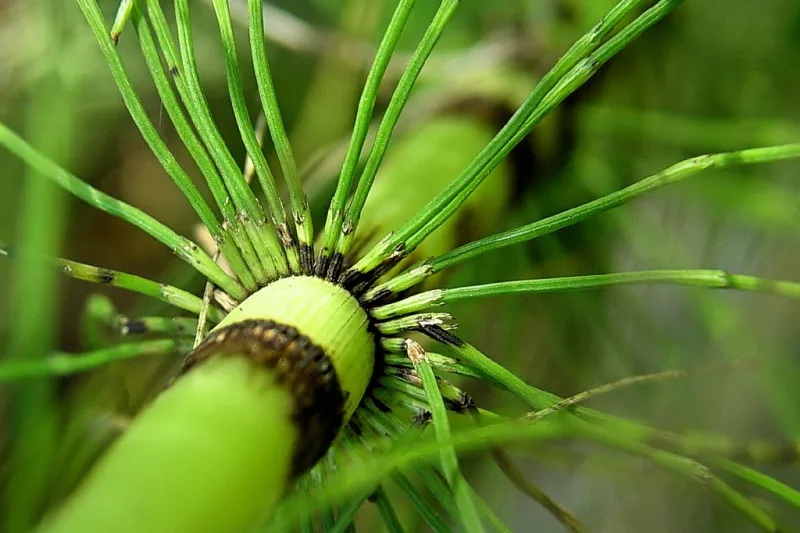
Horsetail (Equisetum arvense), also known as field horsetail, is a perennial, flowerless plant of the Equisetaceae family. It reproduces by spores, not seeds, much like ferns. The plant develops two types of stems: in spring, fertile brown stems without chlorophyll appear, bearing spores; later come the sterile green, branched stems that look like little fir trees or a horse’s tail — these are the ones harvested for medicinal use.
It grows wild throughout Europe, Asia, and North America, favoring damp places: the edges of waterways, ditches, clay soils, wet meadows, roadsides, and the margins of cultivated fields. In many regions it is considered an invasive weed by farmers, because its rhizomes penetrate deep into the soil and are very hard to eradicate.
For medicinal use, the sterile green stems are harvested in summer (June–August), when the silica content is at its peak. They are cut a few centimeters above the ground, cleaned of impurities, and dried in the shade, spread thinly in a well-ventilated place. It is essential to harvest only from clean areas, far from busy roads, pesticide-treated land, or contaminated water, because the plant readily absorbs heavy metals from the soil.
Composition and active compounds
Horsetail’s value comes first and foremost from its remarkable mineral richness. The main components are:
- Silica (silicic acid and soluble silicates): the star of the plant. Horsetail is one of the richest plant sources of silica, a mineral involved in forming and maintaining collagen, bones, cartilage, hair, nails, and skin. Part of the silica is present in a soluble, absorbable form.
- Flavonoids: quercetin, kaempferol, apigenin, and their derivatives, with antioxidant and anti-inflammatory roles.
- Phenolic acids: caffeic acid, chlorogenic acid, and other antioxidant compounds.
- Saponins (notably equisetonin), partly responsible for the diuretic effect.
- Mineral salts: potassium, calcium, magnesium, manganese, plus traces of other minerals.
- Organic acids and a small amount of alkaloids (trace nicotine, palustrine).
- Plant sterols and tannins.
The combination of potassium and flavonoids explains the gentle diuretic effect, while silica underpins the plant’s reputation as a remineralizing, “beauty” herb. The tannins add a slight astringent and hemostatic effect.
Health benefits
Supporting bone and connective tissue health
Silica is involved in collagen synthesis and bone mineralization. Folk tradition uses horsetail during recovery from fractures, in osteoporosis, and to strengthen the skeleton and joints in general. Studies suggest that silica intake may support bone density, although the plant does not replace medical treatment of osteoporosis. For joints and ligaments, its support of collagen may contribute to the elasticity of connective tissue.
Diuretic effect and support for kidneys and bladder
One of the best-known uses is as a diuretic. Horsetail increases urine output, helping to “flush” the urinary tract. In traditional medicine it is used to support mild urinary infections, water retention, mild (non-cardiac) edema, and as an aid in preventing the formation of kidney stones. Important: the diuretic effect can lead to loss of potassium and dehydration if the plant is used excessively.
Hemostatic and astringent action
Thanks to its tannins and silica, horsetail has a mild astringent effect and can help stop minor bleeding. Traditionally it has been used for nosebleeds, bleeding gums, heavy periods, and superficial wounds. The cooled decoction was applied to small wounds to speed healing.
Support for skin and wound healing
Applied externally as compresses or local baths, the plant can help heal superficial wounds, scratches, dry eczema, and irritated skin. Its astringent effect helps tighten tissue and calm minor inflammation.
Antioxidant and anti-inflammatory
The flavonoids and phenolic acids give the plant antioxidant capacity, helping to neutralize free radicals. This profile supports a gentle anti-inflammatory effect, useful in various conditions where inflammation plays a role.
Support for the airways and mucous membranes
In some traditions, horsetail tea has been used as an adjuvant in mild respiratory complaints, for its mild expectorant effect and for supporting the mucous membranes.
Traditional uses
In folk medicine, horsetail was the “all-purpose weed”:
- Internally, as a tea, for “blood cleansing,” urinary problems, weak bones, and to strengthen hair and nails.
- Externally, as a decoction for washes, compresses on wounds, baths for sweaty feet, and hair rinses.
- Cosmetically, in hair-rinse water and in soaks for fragile nails.
- Around the house, dried bundles were used to polish wood and metal, thanks to the roughness provided by silica.
In other European traditions, the plant was recommended by renowned herbalists for tuberculosis and lung complaints (in combination), for rheumatism, and for sitz baths.
How to prepare it: tea, decoction, tincture, compress
Unlike many herbs, horsetail needs special preparation to release its silica, which does not dissolve easily in water. That is why a decoction (boiling) is more effective than a simple infusion for extracting the minerals.
Decoction (for remineralizing, internal use)
- Put 1-2 teaspoons of dried, chopped plant into a cup of cold water (250 ml).
- Bring to a boil and simmer gently for 10-15 minutes (some sources recommend up to 20-30 minutes, or soaking overnight before boiling, to extract as much silica as possible).
- Cover, let cool, and strain.
- Drink 2-3 cups a day, between meals, in courses of 2-4 weeks with a break.
A traditional trick: soak the plant in cold water for 10-12 hours, then boil. The pre-soak helps release soluble silica.
Infusion (quick tea)
- Pour a cup of boiling water over 1 teaspoon of the plant.
- Cover and steep for 10-15 minutes.
- Strain and drink warm.
The infusion is gentler, suited to the diuretic effect, but extracts less silica than the decoction.
Tincture
- Put 20 g of dried, chopped plant into 100 ml of food-grade alcohol at 40-50% strength.
- Macerate for 10-14 days at room temperature, away from light, shaking daily.
- Strain and store in a dark glass bottle.
- Take 20-30 drops diluted in water, 2-3 times a day.
Compress and poultice (external use)
- Prepare a stronger decoction (2-3 tablespoons of plant in 500 ml water, boiled for 15 minutes).
- Soak a clean compress in the cooled decoction and apply to the affected area.
- For a poultice, wrap the boiled, squeezed plant in gauze and apply locally.
Baths and washes
For foot baths, sitz baths, or hair rinses, use 50-100 g of plant boiled in 1-2 liters of water, strained and added to the bathwater or used directly as a rinse.
Dosage and how to take it
The traditional dose for internal use is about 2-3 cups of tea/decoction a day, corresponding to roughly 3-6 g of dried plant daily. Courses usually last 2-4 weeks, followed by a break of at least one week, to avoid the effects associated with prolonged use (especially the depletion of vitamin B1 due to thiaminase). For the tincture, the usual dose is 20-30 drops, 2-3 times a day, diluted.
Drink the tea between meals, in small sips. If you are aiming for the diuretic effect, avoid drinking it late in the evening. Hydrate extra to make up for the loss of fluids.
Horsetail for beauty: hair, nails, skin
Its reputation as a “beauty plant” comes from its silica content, a mineral linked to the health of keratin (the protein in hair and nails) and collagen (in skin).
For hair: a final rinse with horsetail decoction can give hair shine and strength. Traditionally it was used for fragile, split hair and to support growth. Prepare a decoction, let it cool, and use it as the final rinse after shampooing.
For nails: local soaks in warm decoction for 10-15 minutes, a few times a week, can help brittle nails that break and peel. The internal tea course complements the effect.
For skin: decoction compresses soothe irritated skin, and the astringent effect is appreciated for oily skin or enlarged pores. A facial toner made from cooled decoction was a beauty secret in the villages of old.
Practical tips and common mistakes
Mistake no. 1: Confusing the species. The most dangerous mistake is confusing field horsetail (Equisetum arvense, used medicinally) with marsh horsetail (Equisetum palustre), which is toxic. The marsh species grows in boggy places and has stems with larger channels. Harvest only if you are certain of the identification; otherwise, buy the plant from a trusted source.
Mistake no. 2: Long-term use without breaks. Continuous use for months can lead to vitamin B1 deficiency and mineral imbalances. Stick to courses with breaks.
Mistake no. 3: Only an infusion for remineralizing. If you are after silica, a simple infusion extracts too little. Use the decoction, ideally with a pre-soak.
Mistake no. 4: Harvesting from polluted places. The plant absorbs heavy metals. Avoid roadsides, industrial areas, and chemically treated land.
Mistake no. 5: Ignoring the diuretic effect. In sensitive people or those already taking diuretics, the plant can intensify fluid and potassium loss. Compensate with hydration and potassium-rich foods.
Mistake no. 6: Using it during pregnancy or in young children. Horsetail is not recommended for these groups. Do not give it to young children without a doctor’s advice.
Conclusion
Horsetail is a plant as old as the world, modest in appearance but rich in a precious mineral — silica. Folk tradition prizes it for remineralizing, for its gentle diuretic effect, for the support it offers bones, hair, nails, and skin, and for its astringent and hemostatic properties. The key to using it correctly lies in proper preparation (decoction, not just an infusion), in reasonable doses, in courses with breaks, and in careful attention to correctly identifying the plant. Used with moderation and knowledge, horsetail remains one of the most reliable “weeds” of folk medicine — but never a substitute for medical advice when it is needed.
Frequently Asked Questions
How long can I drink horsetail tea without a break? The traditional and prudent recommendation is a course of 2-4 weeks, followed by a break of at least one week. Continuous use for months is not advised because of the risk of vitamin B1 deficiency and mineral imbalances.
Does horsetail really help strengthen nails and hair? Tradition and its silica content support this use. Silica is involved in the health of keratin and collagen. Effects appear gradually, over several weeks, and are more visible when you combine the internal course with local soaks and rinses.
Can I use horsetail if I have kidney stones? The diuretic effect may help as an adjuvant in preventing the formation of small stones, but in the presence of existing stones or a kidney condition you must consult your doctor first. Do not use it on your own in severe kidney disease.
Why does it need to be boiled rather than just steeped? Silica, the plant’s main value, is released only with difficulty into water. Boiling (a decoction), especially after a cold-water pre-soak, extracts far more silica than a simple infusion.
Is it safe during pregnancy or breastfeeding? No. Horsetail is not recommended during pregnancy and breastfeeding because of its diuretic effect and the lack of sufficient safety data. Avoid it during these periods.
What is the difference between good and toxic horsetail? Field horsetail (Equisetum arvense) is the one used medicinally. Marsh horsetail (Equisetum palustre) is toxic and grows in boggy places. If you are unsure of the identification, buy the plant from a pharmacy or herbal shop, from verified sources.
Can it interact with medications? Yes. It can potentiate diuretics, affect potassium levels, and interact with medications for the heart, blood pressure, or with lithium. If you are on treatment, ask your doctor or pharmacist before using it.
Can I use horsetail externally for sweaty feet? Yes, foot baths with horsetail decoction are a traditional use valued for their astringent effect, which reduces sweating and refreshes the skin. Use the cooled decoction for 10-15 minutes, a few times a week.