
Iceland Moss: Benefits, Uses and How to Prepare It
IMPORTANT: Iceland moss is generally well tolerated, but it is not free of precautions. It contains bitter lichen acids that, in large amounts or over very long courses, can irritate a sensitive stomach. People with gastritis, an active ulcer or excess stomach acid should use it only as a cold macerate (which extracts more soothing mucilage and fewer bitter acids) and with caution. Pregnant and breastfeeding women should avoid prolonged use and consult a doctor first. Lichen harvested from polluted areas, near roads or factories can accumulate heavy metals, because lichens absorb everything in the air — use only material from clean, trustworthy sources. Iceland moss does not replace treatment for pneumonia, bacterial bronchitis or tuberculosis; if a cough lasts more than two to three weeks, or if you develop fever, blood in the phlegm or difficulty breathing, see a doctor.
A story from the foot of the mountain
Aunt Veronica, a short, brisk woman from her village at the edge of a spruce forest, kept a wooden cupboard she called her “pharmacy.” Among the paper bags of linden flowers and chamomile, there was always a bag with a strange, grey-green, curly lichen she called “stone moss” or “Iceland moss.” She said she had learned about it from an aunt who had once gone north to work, and that since then no winter had passed without it. Whenever a child in the village had a dry, scratchy, rasping cough, as if the chest were being scraped, Aunt Veronica would put a few pieces into cold water in the evening, leave them overnight, then briefly simmer everything in the morning and sweeten it with linden honey.
“See how it turns slippery?” she would say, lifting a spoon from which a slightly gel-like liquid dripped. “That’s the balm. It coats the throat and chest like a soft shirt and calms the cough.” The children wrinkled their noses at the slightly bitter taste, but after two or three days of the tea, the rasping eased and sleep returned. Many who grew up in that village still remember that spoonful of “moss balm” and the faint forest smell the simmering pot left behind in the house.
What Iceland moss is
Iceland moss (scientific name Cetraria islandica) is, in fact, neither a moss nor a plant in the ordinary sense, even though folk tradition often calls it “moss.” It is a lichen — a double being, formed by the symbiosis of a fungus and an alga. The fungus provides the structure and the ability to hold water, while the alga produces food through photosynthesis. This alliance lets the lichen live where few other organisms survive: on bare rock, on stony ground, in the Arctic tundra and on the cold, windy coasts of Iceland, from which it takes its name. It also grows in Central and Eastern Europe, including the high mountain zones of the Carpathians, on acidic soils, in coniferous forests and in alpine meadows.
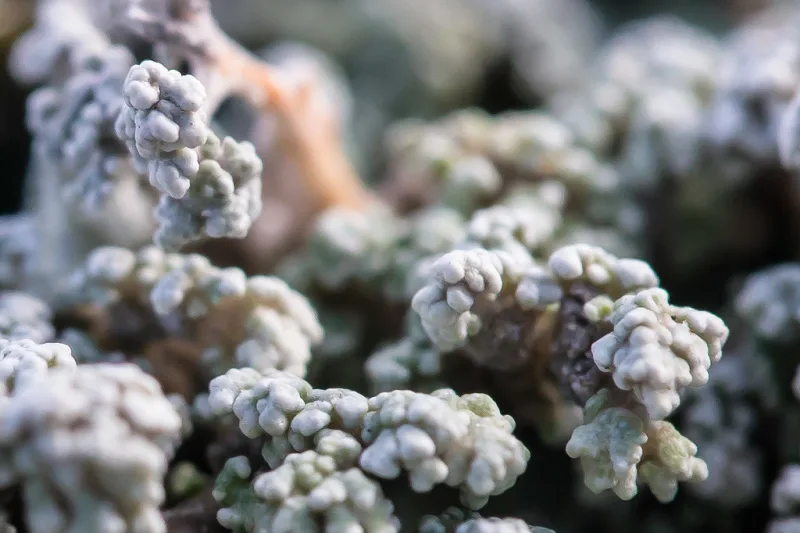
It looks like a low, fleshy, branching tuft, with twisted fronds (lobes) that range from olive-green to grey or brown depending on moisture and light. The edges of the fronds carry small fringes and fine cilia. When dry, the lichen is hard and brittle, but once placed in water it becomes soft and elastic.
It has been valued for centuries in Nordic and European traditional medicine precisely for a special quality: its richness in mucilage (polysaccharides that, in contact with water, form a protective gel) combined with the presence of lichen acids that have a bitter-tonic and mildly antimicrobial effect. This double nature — soothing yet toning — makes it a particularly valuable winter remedy for the throat, gullet and lungs.
Table of Contents
- What it is and where it grows
- Composition and active principles
- Health benefits
- Traditional uses
- How to prepare it (tea, macerate, syrup, decoction)
- Dosage and how to take it
- Lifestyle and practical tips for the cold season
- Practical tips and common mistakes
- Conclusion
- Frequently Asked Questions
Composition and active principles
The value of Iceland moss comes from a balanced mix of substances, each with its own role. Studies suggest that the main components are:
- Mucilage and polysaccharides (lichenin and isolichenin) — these can make up a significant part of the lichen’s dry mass. They are responsible for the soothing, “coating” effect on irritated mucous membranes. When the lichen is placed in water, they swell and form a fine gel that calms the throat and the digestive tract.
- Lichen acids (cetraric acid, protolichesteric acid, fumarprotocetraric acid and others) — bitter substances that give it its characteristic taste. Tradition attributes to them a bitter-tonic effect, stimulating appetite and digestion, as well as a mildly antimicrobial and anti-inflammatory action.
- Vitamins and trace elements — traces of the B complex, along with minerals absorbed from the environment.
- Bitter tonic substances which, in traditional formulas, are associated with supporting a sluggish stomach and difficult digestion.
The preparation method changes the ratio of these substances: a cold macerate extracts mostly mucilage (soothing, bland-sweet), while long boiling draws out more bitter acids (toning, but harsher on the stomach). That is why the choice of method matters depending on your goal.
Health benefits
Support for cough and the airways
The best-known and most appreciated benefit of Iceland moss is its soothing effect on the throat and on coughing. Thanks to its mucilage, it forms a fine, protective film over the irritated lining of the throat and pharynx, reducing the scratchy feeling and the urge to cough. Folk tradition recommends it especially for a dry, irritating cough, for a dry throat after colds, and for the vocal discomfort of people who talk a lot (teachers, singers, speakers). For productive coughs, it is used as a gentle adjunct alongside expectorant herbs.
Soothing for an irritated throat and hoarseness
A warm macerate or tea of Iceland moss, sipped slowly, coats the throat and may ease hoarseness and dryness. It is a frequent ally at the start of the cold season, when the mucous membranes are more vulnerable.
Support for digestion and appetite
The bitter acids in the lichen are considered, in traditional medicine, digestive tonics. A short course of slightly bitter tea, drunk before meals, is used to stimulate the appetite in those who are weak, in convalescents or in older people who “no longer feel like eating.” The mucilage may also have a protective and soothing effect on an irritated stomach and intestinal lining.
General soothing (emollient) effect
Because of its mucilage, the lichen has a recognized emollient (softening and soothing) action. This makes it useful whenever a mucous membrane is dry and irritated, whether in the throat or in the digestive tract.
Support for a weakened body
In the Nordic tradition, in times of famine, Iceland moss was thoroughly washed of its bitterness, dried, ground and mixed with flour to make bread or porridge. It was considered a survival food and a support for convalescents, thanks to its polysaccharides, which provide a sense of fullness and nourish the body gently.
Traditional uses
Over time, Iceland moss has been used in several ways:
- Tea and macerate for cough — the most widespread use, especially in the cold months.
- Winter syrup — combined with honey, as a pleasant remedy, also for older children (honey for over 1 year; do NOT give honey under 1 year).
- Lozenges and throat drops — in the herbal trade, the lichen is part of the formula of some throat pastilles.
- Bitter digestive tonic — tea drunk before meals.
- Emergency food — ground and mixed into doughs, in the Scandinavian tradition.
- Addition to pectoral tea blends — alongside linden, mallow, plantain and thyme.
How to prepare Iceland moss
Here are several step-by-step methods, adapted to the goal. The amounts are approximate; adjust to your needs and tolerance.
Cold macerate (most soothing for the throat)
This method best preserves the mucilage and has the mildest taste, without the strong bitterness.
- Place 1-2 teaspoons of chopped lichen into a cup (250 ml).
- Pour cold or room-temperature water over it.
- Leave it to macerate for 6-8 hours or overnight, covered.
- In the morning, strain. The liquid will be slightly gel-like and blandly sweet.
- You may warm it gently before drinking, without boiling it.
- Sweeten with honey (once it has cooled a little, so you don’t destroy the honey’s enzymes).
Bitter decoction (digestive tonic)
For a bitter-tonic effect on digestion, boiling is used.
- Place 1 teaspoon of lichen in 250 ml of cold water.
- Bring to a boil and simmer over low heat for 5-10 minutes.
- Strain and drink warm, before meals, to stimulate appetite.
- The taste will be more bitter — this is the desired effect for digestion.
“Double” cough tea (combined)
A traditional method that combines the advantages of both.
- First make a cold macerate overnight (for the mucilage).
- In the morning, strain and gently warm the liquid.
- Drink it warm, in small sips, 2-3 times a day.
Iceland moss syrup for winter
- Prepare a concentrated decoction: 2 tablespoons of lichen in 500 ml of water, boiled down to half.
- Strain well.
- While it is still warm (not hot), mix with honey in roughly equal parts, or slightly more honey than liquid.
- Pour into a clean jar, keep refrigerated and use within a few weeks.
- Dose: 1 teaspoon, 2-3 times a day, let it slide slowly down the throat.
Tip for reducing the bitterness
If the bitter taste bothers you, rinse the dried lichen with cold water, or soak it for 1-2 hours in water with a little baking soda, then rinse. Some of the bitter acids are removed while the soothing mucilage stays.
Dosage and how to take it
- For cough and throat: macerate or tea, 2-3 cups a day, in small sips, drunk warm.
- As a digestive tonic: one cup of bitter decoction before the main meals.
- Syrup: 1 teaspoon 2-3 times a day.
- Length of the course: usually until symptoms improve, with breaks. Very long, uninterrupted courses are not recommended; tradition suggests courses of 1-2 weeks, with a pause.
The lichen combines very well with linden flowers, plantain leaves, mallow and thyme for a pleasant, effective pectoral blend. For taste, add honey and a slice of lemon.
Lifestyle and practical tips for the cold season
Iceland moss gives its best results when it is part of a broader approach to caring for the airways. A few habits that complement it:
- Stay well hydrated. Dry mucous membranes are more vulnerable; water, teas and warm soups help them stay supple.
- Humidify the air in the bedroom, especially in winter, when radiators dry out the atmosphere. Air that is too dry sustains an irritating cough.
- Avoid cigarette smoke and polluted air, which directly irritate the throat and lungs.
- Rest your voice if you are hoarse. The lichen helps, but a forced voice keeps the irritation going.
- Eat warm and light food during recovery — soups, porridges, foods that don’t strain a weakened stomach.
- Air out your room daily, even in winter, for cleaner air.
These simple habits, together with a cup of macerate in the evening, can make the difference between a winter with a constantly irritated throat and a calmer one.
Practical tips and common mistakes
Mistake no. 1: Long boiling when you want a soothing effect. Many people boil the lichen for a long time, thinking they will “get more out of it.” In fact, prolonged boiling destroys the delicate mucilage and draws out more bitter acids. For the throat, choose the cold macerate.
Mistake no. 2: Harvesting from the wrong places. Lichens absorb everything from the air, including pollutants and heavy metals. Do not harvest near roads, factories or cities. Use material from clean mountain sources, or buy from trustworthy pharmacies and herbal shops.
Mistake no. 3: Courses that are too long and too concentrated. Bitter acids, in excess and over the long term, can irritate the stomach. Do short courses, with breaks.
Mistake no. 4: Adding honey to boiling liquid. Honey added to very hot liquid loses some of its properties. Let the drink cool until it is just warm.
Mistake no. 5: Expecting instant miracles. The lichen soothes gradually; the effect is felt after a few servings, not on the first spoonful. Patience and consistency matter.
Mistake no. 6: Mistaking it for a medicine. Iceland moss is a support, not a treatment for serious infections. A persistent cough, fever or difficulty breathing call for medical advice.
Conclusion
Iceland moss is one of those quiet, unglamorous remedies whose calm effectiveness has been proven by centuries of use. Its richness in mucilage makes it a gentle balm for an irritated throat and a dry cough, while its bitter acids offer a toning support for sluggish digestion. Prepared correctly — preferably as a cold macerate for the throat and as a short decoction for the stomach — and used in moderation, in short courses and from clean sources, it can be a reliable companion through cold winters. As always in the world of natural remedies, it works best alongside common sense: hydration, rest, clean air and, when needed, the advice of a doctor.
Frequently Asked Questions
Is Iceland moss the same thing as moss? No. Although it is popularly called “Iceland moss,” it is actually a lichen — a symbiosis between a fungus and an alga. True mosses are simple plants, while lichens are double organisms. The confusion comes from their similar low, fleshy appearance.
What kind of cough is it used for? Mainly for a dry, irritating cough, for a dry throat and hoarseness. Thanks to its mucilage, it coats the lining and calms the urge to cough. For a productive cough with a lot of phlegm, it is used as an adjunct alongside expectorant herbs.
How do I reduce the bitter taste? Use the cold macerate instead of boiling; it extracts more mucilage and fewer bitter acids. You can also rinse the lichen with cold water before use and sweeten with honey.
Can I give it to children? For older children, as a macerate or syrup sweetened with honey, it is used in tradition for a dry cough. NOTE: honey must not be given to children under 1 year. For very young children, consult a pediatrician first.
Is it safe during pregnancy and breastfeeding? Caution is advised. During pregnancy and breastfeeding, avoid prolonged courses and consult your doctor before use.
How long can I take the course? Usually short courses of 1-2 weeks, until symptoms improve, with breaks in between. Very long, concentrated courses are not recommended because of the bitter acids.
Where do I find it and how do I store it? It is available in pharmacies, herbal shops and natural food stores, in dried form. Keep it in a dry, dark, cool place, in a paper bag or jar, away from moisture. Properly dried, it keeps its properties for a long time.
Can I combine it with other herbs? Yes, very well. It is traditionally combined with linden, mallow, plantain, thyme and elderflower for pleasant, effective pectoral blends against cough and throat irritation.