
Knotgrass: Benefits, Uses and How to Prepare a Forgotten Plant
IMPORTANT: Knotgrass (Polygonum aviculare) is generally well tolerated, but it is not without precautions. Because of its pronounced diuretic effect, people with serious kidney disease, heart failure, or those taking synthetic diuretics should use the plant only with their doctor’s approval. Knotgrass also contains tannins and oxalic acid, which is why it is contraindicated for people with oxalate kidney stones, active gout, or hyperacidic gastritis. It is not recommended during pregnancy or breastfeeding, as it may affect uterine tone. Young children, people with low blood pressure, and those on anticoagulant therapy should seek a specialist’s advice before using it. Knotgrass is a support for health, not a replacement for medical treatment: any persistent symptom (blood in the urine, kidney pain, chronic cough) must be investigated by a doctor.
A story from the roadside
Aunt Veta from my grandparents’ village had a habit that, as a child, made no sense to me. Every summer morning, with her skirt tucked into her belt and a small wicker basket hanging from her arm, she would set off down the dusty lane and bend down to gather precisely that tiny, trailing weed that the rest of us trod underfoot without a second glance. “This is knotgrass, my dear,” she would tell me, “the grass everyone steps on and no one sees. And yet it’s the very one that keeps the kidneys clean and the chest clear.” She patiently gathered the whole stems, laid them out to dry on a white cloth spread in the attic, and over the winter she made from them a bitterish tea that she drank whenever she felt “a burning when passing water” or a cold that wouldn’t go away.
Many years later, I understood that Aunt Veta was doing nothing out of the ordinary; she was preserving a tradition centuries old. Knotgrass is one of the most widespread plants on earth and, at the same time, one of the most underestimated. It grows between paving stones, along the edges of paths, in trodden yards and courtyards, where almost no other plant can survive. It is precisely this tenacity that led folk medicine, over time, to attribute to it a healing power equal to its resilience.
What is knotgrass
Knotgrass is an annual herbaceous plant of the Polygonaceae family, known scientifically as Polygonum aviculare. In folk tradition it bears many descriptive names: birdweed, prostrate knotweed, lowgrass, doorweed or wireweed. The species name aviculare comes from the fact that birds, especially hens and geese, eat its tiny seeds with great relish. It is a cosmopolitan plant, found on nearly every continent, perfectly adapted to poor, compacted, trodden soils.
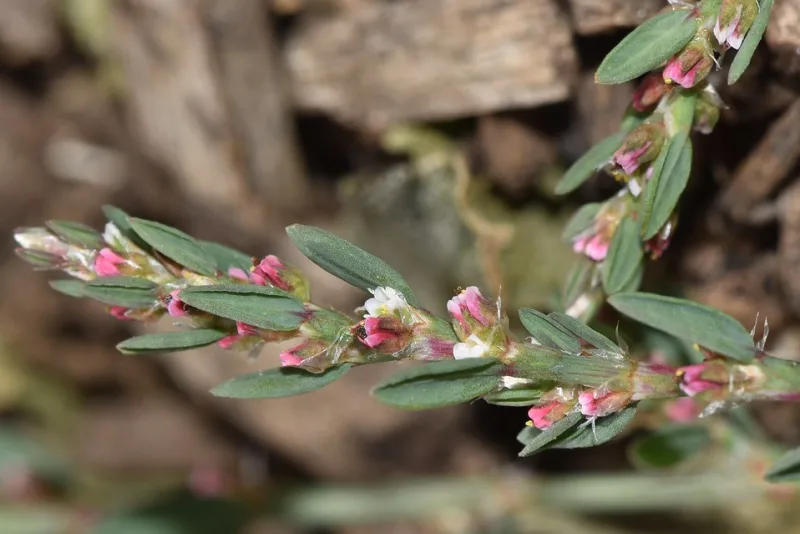
The appearance of knotgrass is modest and easy to overlook. The stems are slender, branching, trailing or slightly erect, often forming dense mats over bare ground. The leaves are small, lance-shaped or elliptical, of a pleasant green, and at the base of each leaf there is a silvery, translucent membrane called an ochrea, characteristic of the entire family. The flowers are minuscule, greenish-pink, hidden in the leaf axils, which is why the plant always seems “just green.” It blooms for a long time, from May until late autumn, allowing a generous harvesting period.
In traditional folk medicine, knotgrass has always been used as a diuretic and astringent plant, but also as a general tonic for those weakened by illness or hard labor. It was considered an “all-purpose” remedy, accessible to anyone, because it did not have to be bought from a pharmacy but simply gathered from the edge of the yard.
Table of Contents
- Where it grows and how to recognize it
- Composition and active principles
- Health benefits
- Traditional uses
- How to prepare knotgrass (step-by-step recipes)
- Dosage and administration
- Knotgrass in a healthy lifestyle
- Practical tips and common mistakes
- Conclusion
- Frequently Asked Questions
Where it grows and how to recognize it
Knotgrass is probably the plant you have walked past thousands of times without noticing. It grows exactly where other plants will not venture: in the cracks of sidewalks, on trodden paths, along country roads, in yards of compacted soil, in neglected gardens and on vacant lots. Precisely because it tolerates being stepped on, it is one of the first plants to colonize compacted ground.
Recognizing it is not difficult once you know what to look for. Look for a low, green mat spreading across the ground, with branching stems radiating like spokes from a single point. The small, alternate leaves, and above all the silvery ochrea at their base, are the distinctive signs. If you gently crush a leaf between your fingers, the plant has no strong smell, only a faint, neutral, grassy one.
For medicinal use, the flowering aerial part, the stems with leaves and flowers, is harvested in midsummer, in dry, sunny weather, preferably after the dew has lifted. Avoid polluted places: the edges of busy roads, land sprayed with herbicides, or areas where animals roam. Harvesting from clean places, away from traffic and chemical treatments, is essential, because knotgrass, being a plant of compacted soils, can accumulate substances from its environment.
Composition and active principles
Beneath its insignificant appearance, knotgrass hides a rich chemistry that explains its reputation in folk medicine. Phytochemical research has identified in the plant a range of compounds with genuine biological activity:
- Flavonoids (especially avicularin, quercetin and their derivatives) — substances with antioxidant roles that contribute to protecting blood vessels and to the diuretic effects.
- Tannins — responsible for the slightly astringent taste and the tissue-tightening properties, useful in diarrhea and in treating superficial wounds.
- Silicic acid and soluble silicates — knotgrass is one of the plants rich in silicon, an important mineral for the elasticity of connective tissue and the health of skin, hair and nails.
- Mucilage — with an emollient, soothing effect on the irritated membranes of the throat and respiratory tract.
- Phenolic acids (caffeic acid, chlorogenic acid) — with antioxidant and anti-inflammatory action.
- Vitamins and minerals — useful amounts of vitamin C, provitamin A and mineral salts.
Folk tradition holds, and modern studies suggest, that it is precisely the combination of flavonoids and silicon that underlies the gentle diuretic effect and the toning action on tissues.
Health benefits
Support for the kidneys and urinary tract
The best-known use of knotgrass, faithfully preserved in country villages, is as a plant “for the kidneys.” Its gentle diuretic effect helps increase urine volume, which may support the natural elimination of excess water and the “flushing” of the urinary tract. Tradition recommended it for burning during urination, mild urinary infections, and as an aid in preventing the formation of kidney grit. Studies suggest that the flavonoids and silicon contribute to these effects. It is important to stress that, in the case of a real urinary infection or kidney stones, knotgrass remains an adjuvant, not a substitute for the treatment prescribed by a doctor.
Astringent action in digestive disorders
Thanks to its tannins, knotgrass has an astringent effect that has been used in folk medicine to calm diarrhea and mild inflammations of the digestive tract. The bitterish tea “tightens” the irritated intestinal lining and can reduce discomfort. Grandmothers gave it to children with an “upset tummy,” but in small amounts and for short periods.
Support for the respiratory system
The mucilage and tannins make knotgrass a traditional ally in mild respiratory conditions. The tea has been used to soothe coughs, to ease expectoration, and to relieve throat irritation in seasonal colds and mild bronchitis. Its gently emollient effect coats the irritated membranes, offering a sense of relief.
A source of silicon for skin, hair and bones
Its richness in silicic acid makes knotgrass a plant valued in folk tradition for the beauty and resilience of tissues. Silicon is involved in collagen synthesis and in maintaining skin elasticity, nail strength and hair health. Tradition used it as a tonic for convalescents and for strengthening a weakened body, but also externally, in baths and compresses for healthier skin.
Tonic and remineralizing effect
Through its content of minerals and vitamins, knotgrass was regarded as a general tonic, suitable for those weakened by long illness, hard physical labor or a poor diet. It was not a spectacular “medicine” but a discreet support, drunk daily like an ordinary tea.
Help in wound and skin care
Applied externally, in the form of compresses or washes, knotgrass has been used to cleanse superficial wounds, to soothe skin irritations, and as a gargle for inflammations of the throat and gums. The astringency of the tannins helps tighten the tissues and create an environment less favorable to irritation.
Traditional uses
In the peasant household, knotgrass had a well-established place. It was gathered in summer, carefully dried in the attic, and kept in cloth bags to be used as needed throughout the year. Here are some of its traditional uses:
- Tea for the kidneys and “for water” — drunk in courses of a few weeks, in spring and autumn.
- Tea for cough and colds — sometimes sweetened with honey, to soothe an irritated throat.
- Washes and compresses — on wounds, scrapes and skin irritations.
- Gargle — for inflammations of the throat and gums.
- Tonic baths — a decoction added to the bath water for strengthening the body and caring for the skin.
- Food for birds — the seeds and green plant were given to hens and geese, hence the names “birdweed” and “goosegrass.”
How to prepare knotgrass (step-by-step recipes)
Knotgrass infusion (tea)
This is the simplest and most commonly used form.
- Put one to two teaspoons of dried, chopped plant (or one tablespoon of fresh plant) into a cup.
- Pour over it 250 ml of boiling water.
- Cover the cup and let it infuse for 10–15 minutes.
- Strain and drink the tea while warm, plain or sweetened with a little honey (once it has cooled slightly, so as not to destroy the honey’s properties).
For a diuretic and kidney-supporting effect, 2–3 cups a day are usually drunk, between meals, in courses of 2–3 weeks.
Knotgrass decoction (for external use or a stronger effect)
The decoction extracts the tannins and silicon better, making it suitable for washes, compresses and gargles.
- Put 2 tablespoons of dried plant into a pot with 500 ml of cold water.
- Bring to a boil and let it simmer over low heat for 5–10 minutes.
- Remove from the heat, cover and let it infuse for another 10 minutes.
- Strain. Use the decoction warm for gargling, washing wounds, or compresses applied to the skin.
Knotgrass tincture
The tincture allows long-term storage and precise dosing.
- Fill a clean jar halfway with dried, chopped plant.
- Pour over it food-grade alcohol of 40–50 proof until the plant is completely covered.
- Seal tightly and let it macerate for 2–3 weeks, at room temperature, away from light, shaking daily.
- Strain through cheesecloth, squeeze well, and store the tincture in dark glass bottles.
Usually 20–30 drops are used, diluted in a little water, 2–3 times a day.
Fresh juice
In summer, when the plant is abundant, the fresh juice pressed from well-washed knotgrass best preserves vitamin C and the volatile principles. A few teaspoons a day are taken, diluted in water.
Dosage and administration
As with any medicinal plant, “more” does not mean “better.” For a healthy adult, the usual doses are:
- Infusion: 2–3 cups a day.
- Internal decoction: 1–2 cups a day.
- Tincture: 20–30 drops, 2–3 times a day, diluted in water.
Courses are usually taken over periods of 2–3 weeks, followed by a break of at least one week. Continuous use over long periods is not recommended, especially because of the diuretic effect, which can upset the body’s mineral balance (particularly potassium). Adequate hydration is essential when using a diuretic plant.
Knotgrass in a healthy lifestyle
Knotgrass does not work in isolation but as part of a balanced way of life. A cup of knotgrass tea drunk in seasonal courses makes the most sense when accompanied by good hydration (plain water remains the most important natural “diuretic”), a diet low in salt and rich in vegetables and fruit, and regular movement. For the health of the kidneys and urinary tract, folk tradition combined knotgrass with other friendly plants: yarrow, corn silk, horsetail or birch leaves.
For supporting the respiratory system, knotgrass pairs well with linden, wild thyme and plantain. And for the beauty of the skin, knotgrass decoction can be used as a facial toner or added to bath water, alongside calendula and chamomile. The important thing is to view the plant as a gentle, steady support, not as a miracle cure.
Practical tips and common mistakes
Mistake no. 1: Harvesting from polluted places. Knotgrass often grows at the edge of busy roads or on land treated with herbicides. These plants accumulate heavy metals and toxic substances. Always gather from clean places, away from traffic, animals and chemical treatments.
Mistake no. 2: Prolonged boiling of the infusion. For tea (infusion), boiling water is poured over the plant; the plant is not boiled for minutes on end. Prolonged boiling destroys the sensitive flavonoids and vitamin C. The decoction (boiling) is used only for external use or when you want to extract the tannins.
Mistake no. 3: Courses that are too long, without a break. Used continuously for weeks on end, the diuretic effect can lead to loss of minerals and imbalances. Respect the breaks and hydrate properly.
Mistake no. 4: Ignoring the contraindications. People with oxalate kidney stones, gout, serious kidney disease, or those who are pregnant should not use knotgrass without their doctor’s approval. The oxalic acid and the effect on uterine tone are serious reasons for caution.
Mistake no. 5: Improper drying and storage. A plant dried in strong sunlight or kept in sealed plastic bags loses its properties and may grow moldy. Dry it in the shade, in a thin layer, in an airy place, and store it in cloth bags or glass jars.
Mistake no. 6: Confusing serious symptoms with trivial ones. If blood in the urine, severe kidney pain, fever, or a cough that will not clear appear, knotgrass is not enough. See a doctor — the plant is an adjuvant, not a substitute for diagnosis and medical treatment.
Conclusion
Knotgrass is a living lesson in how the most modest things often hide the greatest value. The weed we tread on daily without seeing it is in fact a medicinal plant valued for centuries for its gentle diuretic effect, its astringent action in digestive disorders, the support it offers the respiratory system, and its richness in silicon, so precious for skin, hair and tissues. Aunt Veta and all the grandmothers who gathered knotgrass from the edge of the yard knew, from experience passed down through the generations, what modern research is beginning to confirm: that nature often places its remedies right beneath our feet.
Used in moderation, in seasonal courses, with respect for its precautions and contraindications, knotgrass can be a discreet and valuable support for health. But, like any remedy from nature, it demands respect, moderation, and the common sense to ask a doctor’s advice when symptoms call for it. The next time you pass that low, green mat between the paving stones, stop for a moment: before your eyes is an entire pharmacy that our ancestors knew well.
Frequently Asked Questions
What is knotgrass and where can I find it? Knotgrass (Polygonum aviculare) is a tiny, trailing herbaceous plant that grows abundantly along roadsides, in yards, on paths and in the cracks of sidewalks. It is one of the most widespread plants in the world and tolerates compacted, trodden soils perfectly.
What is knotgrass tea mainly used for? Most often it is used as a gentle diuretic, to support the kidneys and urinary tract. Tradition also recommends it for coughs, mild colds, mild diarrhea (thanks to the tannins) and as a remineralizing tonic rich in silicon.
How do I correctly prepare knotgrass tea? Put one to two teaspoons of dried plant in a cup, pour over 250 ml of boiling water, cover and let it infuse for 10–15 minutes, then strain. Usually 2–3 cups a day are drunk, in courses of 2–3 weeks.
Does knotgrass have side effects or contraindications? Yes. Because of its diuretic effect and oxalic acid content, it is not recommended for people with serious kidney disease, oxalate kidney stones, active gout, hyperacidic gastritis, pregnant or breastfeeding women, or those with low blood pressure, without a doctor’s approval.
Can I use knotgrass gathered from the roadside? It is not recommended. Plants from the edge of busy roads or from land treated with herbicides accumulate pollutants and heavy metals. Always gather from clean places, away from traffic and chemical treatments.
How long can I drink knotgrass tea? Courses are usually taken over 2–3 weeks, followed by a break of at least one week. Continuous use over long periods is not recommended because of the diuretic effect, which can upset the body’s mineral balance.
Can knotgrass replace treatment for urinary infections or kidney stones? No. Knotgrass is an adjuvant, a natural support, not a replacement for medical treatment. In the case of a real urinary infection, kidney stones, or any serious symptom, consulting a doctor is essential.
How do I recognize knotgrass so I don’t confuse it with another plant? Look for a low, green mat with slender stems branching from a single point, small alternate leaves, and above all a silvery, translucent membrane (the ochrea) at the base of each leaf — the plant’s distinctive sign.