 Photo: Andrew Curtis, CC BY-SA 2.0, via Wikimedia Commons
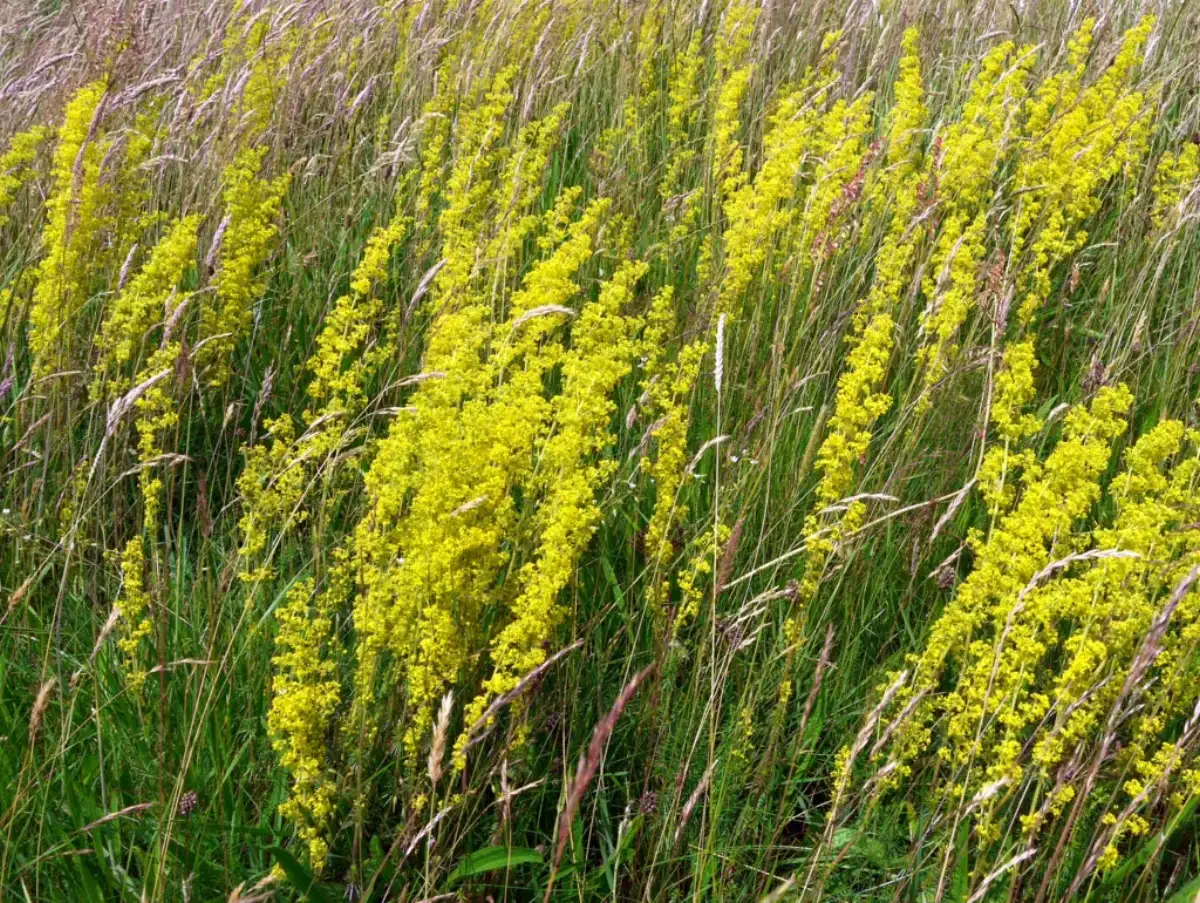
Lady’s bedstraw (Galium verum), known in Romania as sânziene or drăgaică, is the plant with tiny, golden, honey-scented flowers that blooms around 24 June. In folk medicine it is used as a mild diuretic tea, for calm and sleep, and above all externally, in baths and compresses for the skin (eczema, irritation, slow-healing wounds). Scientific evidence is modest, but the plant is gentle and well tolerated at usual doses.
It is one of the few herbs that ties folk medicine directly to the traditional Romanian calendar. Below you will find what is known about it, how to recognise it, how to prepare it and when to leave it aside.
Key takeaways
- The flowering tops are used, gathered in June-July.
- It contains iridoids (asperuloside, monotropein), flavonoids, phenolic acids and an enzyme that curdles milk.
- Traditional uses: mild diuretic, calming, baths and compresses for the skin.
- Research is mainly laboratory-based; there are no solid human clinical trials.
- Usual dose: 1-2 teaspoons per cup, 2-3 times a day, in courses of 2-3 weeks.
What lady’s bedstraw is and how to recognise it
Lady’s bedstraw is a perennial in the Rubiaceae family (the same family as coffee), 30-80 cm tall, with thin stems that become slightly woody at the base. The leaves are very narrow, almost needle-like, arranged in whorls of 8-12 (like the spokes of a wheel) around the stem. The flowers are minute, four-petalled and golden yellow, gathered in dense panicles with a strong scent of honey and hay.
It grows on dry meadows, sunny slopes, woodland edges and stubble fields, from lowlands to mountains. It is easily confused with hedge bedstraw (Galium mollugo), which has white flowers and broader leaves, and with cleavers (Galium aparine), the clinging plant that sticks to your clothes. For medicinal use, tradition relies almost exclusively on the yellow species.
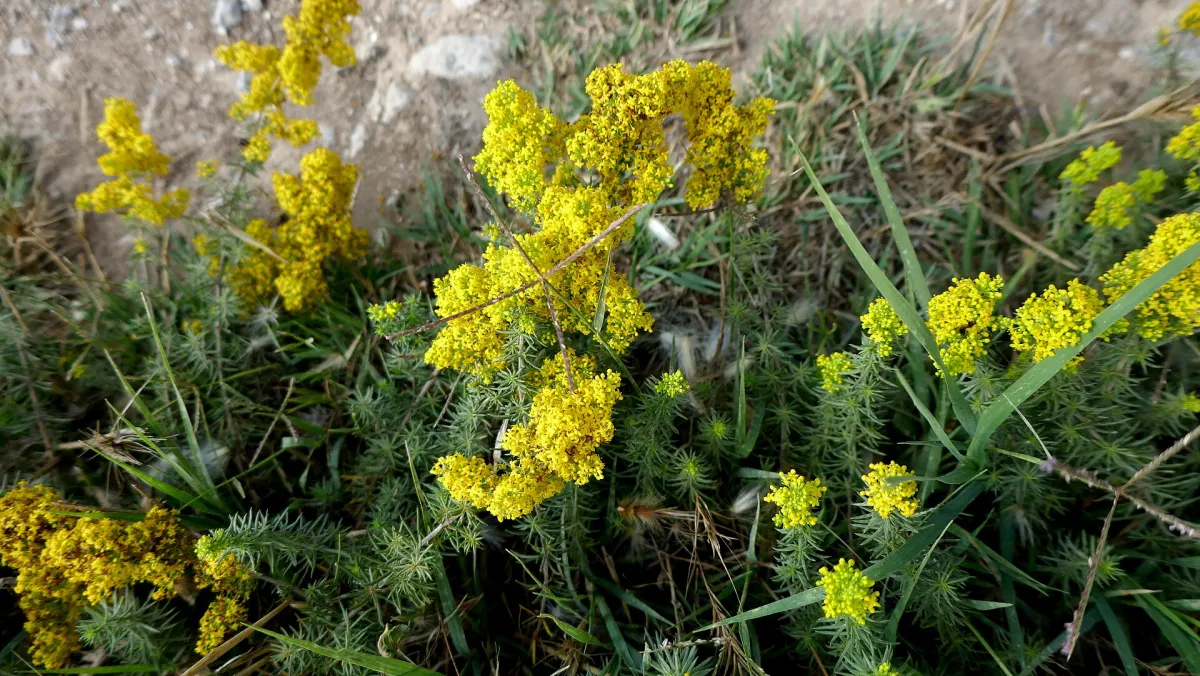 Photo: PhilippeGerbet, CC BY-SA 4.0, via Wikimedia Commons
Lady’s bedstraw in Romanian tradition
On Sânziene night (23-24 June), girls wove crowns from these flowers and threw them over the house: if a crown stayed on the roof, the girl would marry that year. The crowns were kept through the year and used for fumigation and “healing” baths for children. Plants gathered on that night were believed to be strongest. Beyond the legend, the timing is botanically sound: the plant is in full bloom and rich in active compounds.
Harvesting and drying
Cut the flowering tops, about 20-30 cm, on clear afternoons. Tie them in small bunches and hang them in a shady, airy place. Properly dried, they keep their yellow colour and honey-and-hay smell (partly due to coumarins). Discard anything blackened or mouldy.
Composition and active compounds
- Iridoid glycosides: asperuloside, monotropein, deacetylasperulosidic acid; studied for anti-inflammatory effects in the lab.
- Flavonoids (rutin, quercetin and luteolin derivatives): antioxidant.
- Phenolic acids (chlorogenic, caffeic).
- Anthraquinones, concentrated in the roots: historically used as a red dye for wool.
- Small amounts of coumarins, responsible for the hay scent.
- An enzyme that curdles milk: in England bedstraw was used in cheesemaking as a vegetable rennet and to colour cheese yellow.
Benefits: what tradition says and what studies show
Skin: eczema, irritation, wounds
This is the most widespread use in Romania. Bedstraw baths and compresses were recommended for weeping eczema, irritated skin in children, mild burns and slow-healing wounds. Laboratory studies have shown anti-inflammatory and antioxidant effects of extracts, and the flavonoids and iridoids fit this action. Solid clinical trials, however, are missing. For true eczema the basics (moisturising, emollients, avoiding irritants) remain essential; see our article on eczema.
Kidneys and water retention
Tradition uses bedstraw tea as a mild diuretic for “swelling” and kidney gravel, often blended with couch grass or horsetail. A diuretic effect is plausible but poorly documented. Persistent leg swelling must be investigated; see also our article on water retention.
Calm and sleep
Bedstraw tea in the evening was given to restless children and adults who slept lightly. The sedative effect has not been confirmed clinically; it can be a calming ritual alongside better-studied herbs such as lemon balm or linden.
Other folk uses
Bedstraw appears in folk recipes for epilepsy, goitre or “liver disease”. These uses have no support and must not replace medical treatment.
How to prepare lady’s bedstraw
Tea (infusion)
- Put 1-2 teaspoons (1.5-3 g) of dried flowering tops into a cup.
- Pour over 250 ml of boiling water.
- Cover and steep for 10 minutes.
- Strain and drink warm.
Drink 2-3 cups a day in courses of 2-3 weeks. The taste is mild, slightly sweet, with hay notes.
Bedstraw bath
For a full bath: simmer 100 g of dried herb for 10 minutes in 2 litres of water, leave covered for 20 minutes, strain and add to bath water at 36-37°C. Soak for 15-20 minutes. For children, halve the amount and patch-test on a small area of skin first. For sitz baths or hand and foot soaks: 2-3 tablespoons per litre of water.
Compress
Strong infusion (2 tablespoons per 250 ml of water), cooled. Apply to the irritated area for 15-20 minutes, 2-3 times a day, using clean gauze each time.
Homemade salve
Traditionally the fresh herb was warmed in lard; a modern alternative is an infused oil: loosely fill a jar with dried herb, cover with sunflower or olive oil, leave somewhere warm for 3 weeks, then strain. Use it on dry, cracked skin.
Dosage guide
| Form | Amount | Frequency | Duration |
|---|---|---|---|
| Tea (infusion) | 1.5-3 g per 250 ml, 10 min | 2-3 cups/day | 2-3 weeks |
| Full bath | 100 g herb in 2 l decoction, added to the tub | 2-3 times/week | 2-3 weeks |
| Local soak | 2-3 tbsp per 1 l water | daily | 1-2 weeks |
| Compress | 2 tbsp per 250 ml | 2-3 times/day | until improved |
Contraindications and precautions
Lady’s bedstraw is considered safe at usual doses, but safety data are limited:
- Pregnancy and breastfeeding: no data, avoid internal use.
- Young children: internal use only with a paediatrician’s approval; baths are more suitable, after a patch test.
- Anticoagulants: the plant contains small amounts of coumarins; although the risk seems low, talk to your doctor if you take warfarin or acenocoumarol.
- Swelling due to heart or kidney failure: like any herbal diuretic, not without a doctor.
- Allergies: rare; stop if itching or rash appears after use.
- Infected wounds: do not treat them with herbal compresses; see a doctor.
When to see a doctor
- Widespread eczema with weeping, yellow crusts or fever (secondary infection).
- Wounds that do not heal within 2-3 weeks, especially in people with diabetes.
- Sudden leg swelling, especially in one leg only (possible thrombosis).
- Insomnia lasting more than a month or seriously affecting your days.
- Painful urination, blood in the urine or kidney pain.
Common mistakes
Confusing it with hedge bedstraw or cleavers. Medicinal tradition refers to yellow lady’s bedstraw, Galium verum.
Harvesting by roads or on sprayed pastures. Choose clean places away from traffic and treated crops.
Drying it in large, packed bundles. The plant blackens and goes mouldy; dry it in small, airy bunches.
Expecting a quick effect on eczema. Baths help as complementary care but do not replace dermatological treatment.
Using it for serious diseases based on folk recipes (epilepsy, goitre). These need medical treatment.
Conclusion
Lady’s bedstraw belongs as much to folklore as to the folk pharmacy. Its iridoids and flavonoids plausibly explain its soothing effect on the skin, and the tea is a mild diuretic and a calming evening ritual. Modern research is still in its early days, so bedstraw should be seen as a gentle, complementary remedy rather than a treatment. Gathered cleanly, dried properly and used in short courses, it can be a joy for both skin and tradition.
Frequently asked questions
What is lady’s bedstraw good for? Traditionally for the skin (baths and compresses for eczema and irritation), as a mild diuretic and for relaxation. Scientific evidence is preliminary and comes from laboratory studies.
When is lady’s bedstraw harvested? In full bloom, in June-July. Romanian tradition ties harvesting to Sânziene night, 23-24 June.
Can I give a child a bedstraw bath? Yes, baths are traditionally used for children, with half the adult amount and after a patch test. For internal use in children, ask a paediatrician.
What is the difference between yellow and white bedstraw? Lady’s bedstraw (Galium verum) has golden flowers and needle-like leaves; hedge bedstraw (Galium mollugo) has white flowers and broader leaves. Traditional medicinal use refers mainly to the yellow one.
Does lady’s bedstraw tea help with sleep? It is traditionally drunk in the evening to relax, but the effect has not been shown clinically. It can be combined with better-studied herbs such as lemon balm.
Can I drink it if I take anticoagulants? The plant contains small amounts of coumarins. The risk appears low, but talk to your doctor first, especially if you take warfarin or acenocoumarol.
How long can I drink lady’s bedstraw tea? In courses of 2-3 weeks, followed by a 1-2 week break.
Sources and further reading
- Phytochemical and pharmacological reviews of Galium verum and iridoids of the genus Galium (PubMed).
- Romanian ethnobotanical literature on Sânziene plants and customs.
- WHO: general principles on the safety and quality of medicinal plants (WHO guidelines on good agricultural and collection practices for medicinal plants).
This article is for information only and does not replace medical advice. Talk to your doctor or pharmacist before using medicinal plants, especially if you take medication or have a chronic condition.