
Milk Thistle: Liver Benefits, Uses and How to Prepare It
IMPORTANT: Milk thistle is considered safe for most adults, but it is not without cautions. People allergic to plants in the Asteraceae family (daisies, marigolds, ragweed, chamomile) may also react to milk thistle. Anyone taking medication metabolized by the liver should talk to their doctor, because silymarin can influence how the body processes certain substances. Pregnant or breastfeeding women, people with serious liver disease, bile duct obstruction, or hormone-sensitive conditions should use milk thistle only with medical advice. Milk thistle does NOT replace medical treatment for liver disease and is not an excuse for drinking alcohol. If you have jaundice, persistent abdominal pain, dark urine, or unexplained fatigue, see a doctor.
Old Aunt Veta from the village at the foot of the hill had a saying she repeated every time someone complained of nausea, a bitter taste in the mouth, or a heavy, tired feeling after holidays full of rich meals: “Your liver works in silence, dear, so lend it a hand.” Her helping hand was always the same — a jar of small, glossy, grayish-brown seeds that she ground in an old coffee mill and sprinkled over food or steeped into a brew. She said those spiny herbs, with their violet flower like a regal thistle, were “the liver’s medicine,” and she gathered them from roadsides and fallow fields, where no one else dared venture because of the thorns.
Many viewed her with skepticism, yet the tradition Aunt Veta kept had roots stretching back more than two thousand years. Milk thistle, the plant of those seeds, is one of the most studied remedies in herbal medicine for supporting the liver, and the modern interest in it has only confirmed what folk healers had long sensed. In this article you will learn everything you need to know about milk thistle: what it is, why it is so prized, how to prepare it correctly, and what precautions are worth remembering.
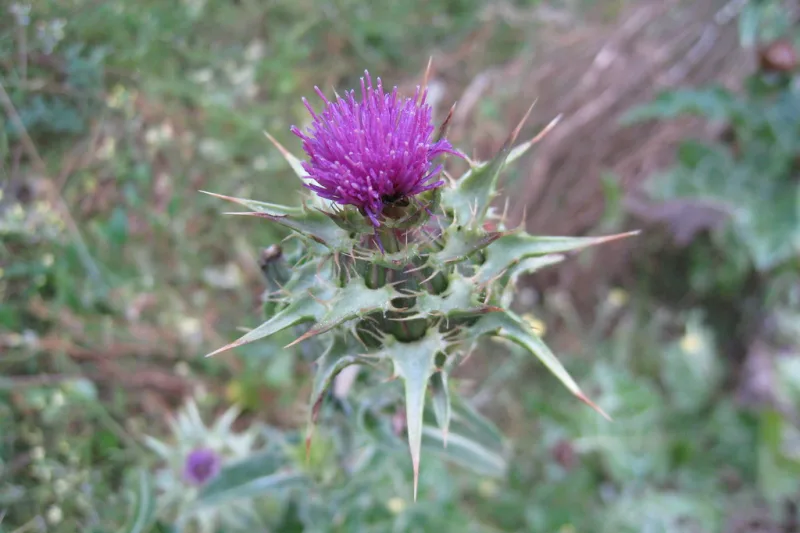
Milk thistle (Silybum marianum), also known as Saint Mary’s thistle or Marian thistle, is a herbaceous plant of the Asteraceae family, with a sturdy stem, large glossy leaves marbled with white streaks, and a striking deep-violet flower head surrounded by spiny bracts. Its Latin name recalls a Christian legend according to which the white streaks on the leaves were drops of the Virgin Mary’s milk. Native to the Mediterranean region, milk thistle has spread across Europe, Asia, and other continents, growing easily on dry, stony, sunny ground. The part of medicinal value is the seeds (more precisely, the fruits, the achenes), from which the complex of compounds called silymarin is extracted.
Table of Contents
- What milk thistle is and where it grows
- Composition and active compounds
- Health benefits
- Traditional uses
- How to prepare milk thistle (step-by-step recipes)
- Dosage and how to take it
- Milk thistle in a modern lifestyle
- Practical tips and common mistakes
- Precautions and contraindications
- Conclusion
- Frequently Asked Questions
What milk thistle is and where it grows
Milk thistle is an annual or biennial plant that can reach heights of one to two meters. It is easy to recognize by its large leaves with toothed, spiny margins, marked by those characteristic white veins that look “splashed with milk.” The flowers, gathered in an egg-shaped head, are violet-purple and protected by rigid, sharp, thorn-like bracts — exactly as in the photo above. After flowering, the plant produces small, hard, glossy seeds, dark brown to black, which are milk thistle’s therapeutic treasure.
In the wild, milk thistle grows along roadsides, on uncultivated land, in fallow fields, and on sunny, dry spots. It tolerates drought and poor soils well, which is why it was long regarded as a hardy weed. Today, however, it is deliberately cultivated in many countries, precisely for the value of its seeds. Harvesting is done in late summer, when the heads have matured; the seeds are separated, dried, and stored in a cool, dry place.
Both Romanian and European folk traditions used milk thistle as a “liver plant” since antiquity. Greek and Roman physicians recommended it for ailments of the liver and bile, and medieval herbalists considered it a fundamental remedy for “cleansing” the body. This reputation as a liver protector has continued unbroken to this day.
Composition and active compounds
What makes milk thistle so special is the complex of flavonolignan compounds extracted from the seeds, known generically as silymarin. Silymarin is not a single substance but a mixture of several related components, the most important being silibinin (or silybin), silychristin, silydianin, and isosilybin. Silibinin is regarded as the most active fraction and the most extensively studied.
In addition to silymarin, milk thistle seeds contain:
- Essential fatty acids, especially linoleic acid and oleic acid, present in the seed oil.
- Tocopherols (forms of vitamin E), with antioxidant action.
- Plant sterols, which contribute to effects on metabolism.
- Dietary fiber, present in whole-seed powder.
- Mucilage and plant proteins, in smaller amounts.
- Additional flavonoids, which reinforce the overall antioxidant action.
Silymarin is fat-soluble, meaning it is better absorbed in the presence of fats. This detail explains why ground seeds consumed alongside fatty foods, or standardized extracts, are often more effective than a simple water infusion, in which silymarin passes only partially.
Health benefits
Milk thistle’s reputation rests first and foremost on its action on the liver, but studies suggest other interesting directions as well. Here are the main benefits associated with the plant.
Supporting and protecting the liver
This is milk thistle’s star benefit. Silymarin, and especially silibinin, acts on liver cells (hepatocytes) in several complementary ways. It is believed to help stabilize the membrane of liver cells, making them more resistant to the entry of toxic substances. At the same time, silymarin stimulates cellular regeneration, supporting the renewal of liver tissue. Tradition and part of modern research suggest milk thistle can help support a liver under stress from an unbalanced diet, occasional excess, or an environment loaded with harmful substances. It is important to stress that milk thistle supports but does not “repair” a liver damaged by serious disease without medical treatment.
Powerful antioxidant action
Silymarin is a remarkable antioxidant. It helps neutralize free radicals, those unstable molecules that contribute to cellular aging and inflammatory processes. Moreover, silymarin is believed to support the production of glutathione, one of the body’s most important internal antioxidants, concentrated precisely in the liver. Through this mechanism, milk thistle indirectly contributes to defending the whole body against oxidative stress.
Supporting digestion and bile
Milk thistle has a long tradition as a remedy for difficult digestion, especially after heavy, fatty meals. By supporting the proper function of the liver and gallbladder, it is believed to help emulsify fats better and reduce feelings of heaviness, bloating, and bitterness. Many people traditionally use it to ease mild nausea linked to sluggish digestion.
Support for metabolism and blood sugar
Some studies suggest silymarin might have a favorable effect on the metabolism of sugar and fats. In traditional medicine, milk thistle was used as a supportive aid for overall metabolic balance. These effects do not, however, replace modern treatments and medical recommendations for metabolic conditions.
Benefits for the skin
Thanks to its antioxidant and anti-inflammatory power, milk thistle is also valued in natural cosmetics. Cold-pressed seed oil is used to moisturize the skin, soothe mild irritations, and support a healthy complexion. Folk tradition used plant poultices for inflamed skin.
Supporting the body during periods of toxic stress
Among country folk, milk thistle was the “after-the-holidays” or “after-the-party” remedy, when the body needed support. This use makes sense in light of the liver’s role in processing unwanted substances. Milk thistle was seen as a plant for “internal cleansing” and for reinvigoration after excess.
Traditional uses
In folk medicine, milk thistle had many uses, passed down from generation to generation:
- Liver tonic — the spring and autumn cure, when people wanted to “cleanse” the body.
- Digestive aid — used after heavy meals, fried foods, fatty dishes, and feasts.
- Remedy for a bitter taste in the mouth and for the feeling of heaviness under the ribs.
- Skin support — as poultices and, more recently, oil.
- Reinvigorating plant — for fatigue associated with sluggish digestion.
Village healers ground the seeds and mixed them with honey, added them to soups, or steeped them. Some prepared a tincture from crushed seeds and alcohol, kept in a dark place.
How to prepare milk thistle (step-by-step recipes)
Because silymarin is fat-soluble and difficult to extract in water, there are several preparation methods, each with its advantages.
1. Seed powder (the most effective home method)
This is probably the best way to benefit from milk thistle at home, because it preserves all the seed components, including the fiber and the oils.
- Obtain quality milk thistle seeds from a trustworthy source.
- Grind a small amount (enough for a few days) in a coffee or spice mill. Do not grind large amounts in advance, because the powder goes rancid.
- Consume one level teaspoon of powder (about 3-5 g), once or twice a day.
- Sprinkle the powder over yogurt, porridge, soup, salad, or stir it into a smoothie. For better absorption, eat it alongside a food containing healthy fats (full-fat yogurt, avocado, olive oil).
2. Milk thistle seed tea (decoction)
Although a water infusion extracts only part of the silymarin, the tea remains a pleasant and useful option, especially for supporting digestion.
- Lightly crush a teaspoon of milk thistle seeds (crushing helps release the compounds).
- Place the seeds in a cup and pour 250 ml of boiling water over them.
- Cover the cup and let it steep for 10-15 minutes. For a stronger decoction, you can simmer the crushed seeds over low heat for 3-5 minutes, then let them rest covered for another 10 minutes.
- Strain and drink the tea warm, preferably before or during a meal.
You can drink 2-3 cups a day, in cures of a few weeks, with breaks.
3. Milk thistle tincture
- Place 50 g of crushed seeds in a clean jar.
- Pour 250 ml of food-grade alcohol (40-50 proof) over them.
- Close the jar and let it macerate for 2-3 weeks, in a dark, cool place, shaking it daily.
- Strain and store the tincture in a dark-colored bottle.
- The usual dose is 20-30 drops diluted in a little water, 2-3 times a day. (Note: the tincture contains alcohol and is not suitable for everyone.)
4. Milk thistle oil
Cold-pressed seed oil is used both internally (a teaspoon a day, with food) and externally for the skin. It is rich in fatty acids and vitamin E.
Dosage and how to take it
Doses vary depending on the chosen form. For seed powder, a common amount is one teaspoon (3-5 g) once or twice a day. Standardized silymarin extracts available in pharmacies come with their own instructions on the label — always follow them. For tea, 2-3 cups a day are enough.
Milk thistle is usually taken in cures of 4-6 weeks, followed by a break. It is neither necessary nor advisable to take it continuously, without interruption, for years on end. It is best consumed during periods when you feel the body needs support, or as a seasonal spring and autumn cure.
Since silymarin is better absorbed with fats, take milk thistle together with meals containing healthy fats. Start with a small dose to check individual tolerance.
Milk thistle in a modern lifestyle
However valuable it may be, milk thistle works no wonders on its own. The liver’s best “ally” remains a balanced lifestyle. Here are some practical tips that enhance the plant’s benefits:
- Stay properly hydrated. Water helps the body eliminate unwanted substances. Aim for steady water intake throughout the day.
- Limit alcohol. No supplement makes up for excess alcohol. Milk thistle supports the liver but is not an “antidote” for drinking.
- Eat a balanced diet. Vegetables, fruit, fiber, healthy fats, and fewer processed foods and fried dishes — this is the best framework for a healthy liver.
- Move. Regular physical activity supports metabolism and overall health.
- Rest. Quality sleep is when the body repairs itself.
Milk thistle fits naturally into a “reset” cure after busy periods, but its effect shows best when it is part of a healthy whole.
Practical tips and common mistakes
Mistake no. 1: Expecting instant wonders. Milk thistle is not a fast-acting medicine. Its benefits build over time, through consistent, moderate use in cures. Do not expect to feel a transformation after a single cup of tea.
Mistake no. 2: Consuming it only as a water infusion. Because silymarin is fat-soluble, plain tea extracts only part of the active compounds. If you want maximum effect, opt for whole-seed powder or standardized extracts, taken with fats.
Mistake no. 3: Using milk thistle as an excuse for excess. Many believe they can eat and drink anything as long as they take milk thistle. This is mistaken thinking. The plant supports the liver but does not cancel out the effects of an unbalanced diet or alcohol.
Mistake no. 4: Grinding large amounts in advance. Seed powder goes rancid quickly because of its oil content. Grind only as much as you use in a few days and keep the whole seeds in a cool place.
Mistake no. 5: Ignoring contraindications. People allergic to plants in the Asteraceae family or those taking important medications should not use milk thistle without talking to their doctor.
Mistake no. 6: Giving up medical treatment. Milk thistle is an adjunct, not a replacement. Liver diseases require specialist diagnosis and treatment.
Precautions and contraindications
Milk thistle is generally well tolerated, but a few rules must be respected:
- Allergies. People allergic to daisies, marigolds, ragweed, chamomile, or other Asteraceae plants may also react to milk thistle.
- Drug interactions. Silymarin can influence how the liver processes certain medications. If you take chronic treatments, consult your doctor or pharmacist.
- Pregnancy and breastfeeding. As a precaution, avoiding milk thistle is recommended during these periods, absent medical advice.
- Hormonal conditions. Some plant components may have a mild estrogen-like action; people with hormone-sensitive conditions should be cautious.
- Mild effects. Rarely, milk thistle may cause mild digestive discomfort or a laxative effect. In that case, reduce the dose.
- Children. Do not give to children without a doctor’s advice.
Remember: any serious liver symptom (jaundice, abdominal pain, marked fatigue, dark urine) calls for a medical consultation, not self-treatment with herbs.
Conclusion
Milk thistle is one of the most prized medicinal plants for supporting the liver, a reputation built over two millennia of tradition and backed by modern research interest in its silymarin. A powerful antioxidant, a protector of liver cells, and a digestive aid, milk thistle finds its natural place within a balanced lifestyle — not as a cure-all, but as an honest support for the body. Used in moderation, in cures, alongside a healthy diet and proper hydration, the milk thistle can be exactly the “helping hand” Aunt Veta offered to a weary liver. As long as you keep the precautions in mind and do not give up on medical advice when needed, milk thistle remains a gentle and reliable ally.
Frequently Asked Questions
How long does it take to feel the effects of milk thistle? Milk thistle acts slowly and cumulatively. Effects on digestion and general well-being are usually noticed after a few weeks of consistent use. Do not expect immediate results.
Can I drink milk thistle tea every day? Yes, but it is advisable to use it in cures of 4-6 weeks, with breaks, rather than continuously for years. The seasonal spring and autumn cure is a wise traditional approach.
What is the best form of milk thistle? For home use, whole-seed powder (freshly ground) is highly valued because it preserves all the components. Standardized silymarin extracts from pharmacies offer a consistent concentration. Tea is pleasant but extracts less silymarin.
Does milk thistle really help the liver? Tradition and part of modern research suggest silymarin supports liver cells and has an antioxidant effect. Still, milk thistle is an adjunct, not a treatment for liver diseases, which require medical care.
Can I take milk thistle if I am also on other medications? Only after talking to your doctor or pharmacist, because silymarin can influence the metabolism of some medications in the liver.
Does milk thistle have side effects? For most people it is well tolerated. Rarely it may cause mild digestive discomfort or a mild laxative effect. People allergic to Asteraceae plants should be cautious.
How do I choose and store milk thistle seeds? Choose seeds from trustworthy sources — whole, glossy, with no rancid smell. Store them in a cool, dry, dark place in closed containers. Grind only as much as you use in a few days.
Can I use milk thistle to compensate for heavy alcohol use? No. This is a mistaken and dangerous belief. Milk thistle does not cancel out the effects of alcohol. The best protection for the liver is limiting alcohol and a healthy lifestyle.