 Photo: Alexbrn, Public domain, via Wikimedia Commons
European mistletoe (Viscum album) is a semi-parasitic shrub that grows on tree branches. In Romanian folk medicine it has been used mainly for high blood pressure, dizziness and “nerves”. The medicinal part is the young leafy twigs, traditionally prepared as a cold infusion rather than boiled. The white berries are poisonous, and the plant can interact with heart and blood pressure medication, so mistletoe is not an everyday tea but a remedy to be used sparingly and with your doctor’s approval.
In Germany, Switzerland and Austria, injectable mistletoe extracts have been used for decades as complementary therapy in cancer care. That is a strictly medical field and has nothing to do with a homemade tea. Below you will find what is known for sure, what is purely traditional and how to avoid the usual mistakes.
Key takeaways
- Use the young leafy twigs, harvested in winter or early spring; the white berries are poisonous and must never be eaten.
- The traditional preparation is a cold infusion: 1 teaspoon of herb in 250 ml of water, left overnight.
- The blood-pressure-lowering effect is supported by tradition and a few small studies; it does not replace antihypertensive treatment.
- It is off-limits in pregnancy, breastfeeding, for children and for people with low blood pressure.
- Injectable extracts used in oncology are prescription medicines; mistletoe tea does not treat cancer.
What mistletoe is and where it grows
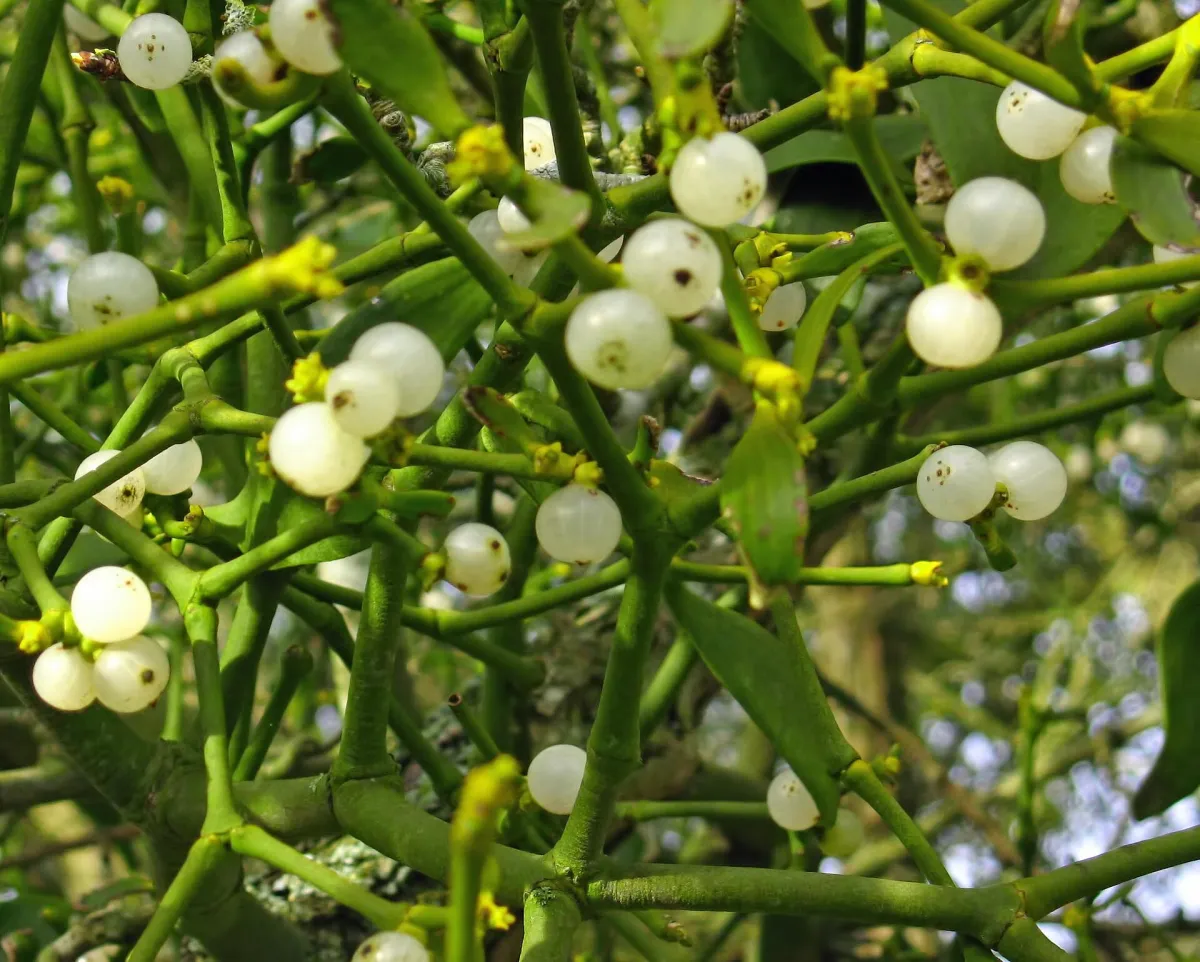
Mistletoe is a small, evergreen perennial with forked stems and thick, oblong, yellow-green leaves. It has no true roots: it sends structures called haustoria into the host tree’s wood to draw water and minerals, while making its own sugars through photosynthesis. That is why it is called semi-parasitic. Its fruits are glossy white berries with sticky pulp, spread by birds (especially thrushes) that wipe the seeds onto other branches.
In Romania, mistletoe is very common on apple, pear, poplar, linden and black locust trees, as well as on firs and pines. Old herbalists valued mistletoe from apple or pear trees most and avoided the one growing on black locust or walnut. Science partly confirms this: the chemical profile varies with the host tree, and modern medicinal extracts always state the host species.
Mistletoe also carries strong symbolism. The druids cut it with a golden sickle, and in Romania a sprig hung above the door at Christmas or New Year brings luck and protection. Its presence in homes during the holidays also explains many accidental poisonings in children and pets who swallow the berries.
Which part is used and when to harvest it
The thin, leafy twigs are collected, ideally between November and March, when the plant is easy to see on bare trees. Cut them with shears, remove every berry and dry them in the shade in a thin layer. Store the chopped dried herb in a glass jar or paper bag, away from light, for no longer than a year.
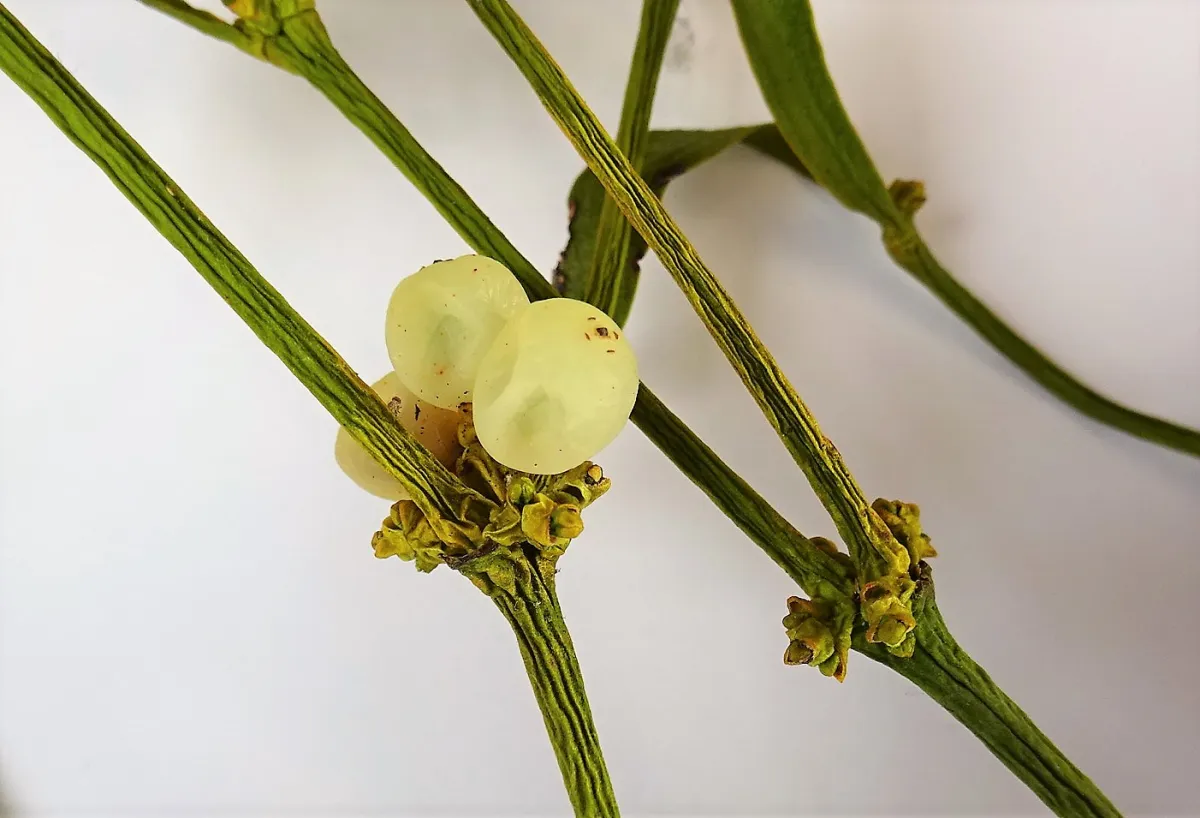 Photo: Rosser1954, CC BY-SA 4.0, via Wikimedia Commons
Composition and active compounds
Mistletoe has unusually complex chemistry:
- Mistletoe lectins (ML I, II, III): proteins with immunomodulating and cytotoxic activity, studied mainly in injectable extracts. They are largely destroyed by boiling and poorly absorbed from the gut.
- Viscotoxins: peptides that are toxic in large doses, concentrated in the leaves and young stems.
- Flavonoids (quercetin derivatives), phenolic acids and phenylpropanoids (syringin): antioxidant and possibly relaxing for blood vessel walls.
- Triterpenes (oleanolic and betulinic acid), polysaccharides and amines (choline, traces of tyramine).
The mix of vasoactive compounds and substances acting on the nervous system explains both the traditional use for blood pressure and calming, and why doses must be respected strictly.
Benefits: what tradition says and what studies show
Blood pressure
This is mistletoe’s best-known use in Romania: “mistletoe tea lowers blood pressure”. Animal studies and a few small clinical trials have observed moderate reductions in blood pressure and heart rate, possibly through relaxation of blood vessels and an effect on the autonomic nervous system. The quality of evidence, however, is low: small groups, different preparations, short durations. In practice, mistletoe can only be considered for mildly raised readings, as an add-on, with monitoring. Moderate or severe hypertension needs medication; lifestyle measures are covered in our article on high blood pressure.
Dizziness, palpitations, nervous tension
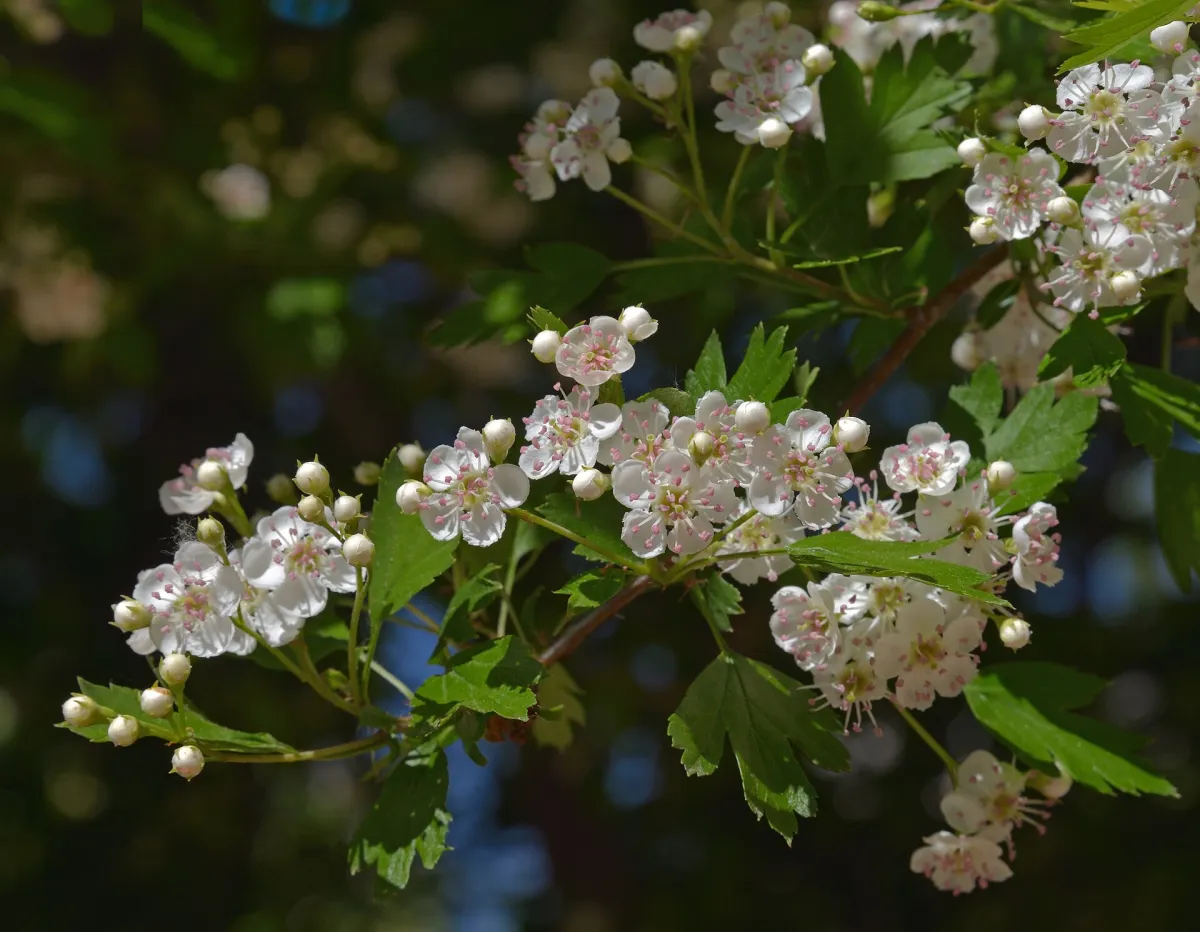
Tradition links mistletoe with blood-pressure dizziness, hardening of the arteries in older people and restlessness. There are no solid studies for these uses. Many folk blends combine it with hawthorn, the native plant with the best heart data, and with motherwort for nervous palpitations.
Mistletoe in oncology: where tea ends and medicine begins
Injectable mistletoe extracts (anthroposophic preparations and lectin-standardised extracts) are among the most researched complementary therapies in cancer. A Cochrane review and summaries by the US National Cancer Institute (NCI) report that some studies suggest better quality of life and fewer chemotherapy side effects, but many trials have methodological weaknesses, and an effect on survival has not been convincingly shown. Remember: these products are injected, precisely dosed and prescribed by a doctor. Mistletoe tea has no such effect and must never be used as a “cancer treatment”.
Other traditional uses
In some regions mistletoe was used for epilepsy, hot flushes, rheumatic pain (as compresses) or to stop bleeding. None of these uses is supported by research, and some, such as epilepsy, are dangerous if they replace treatment.
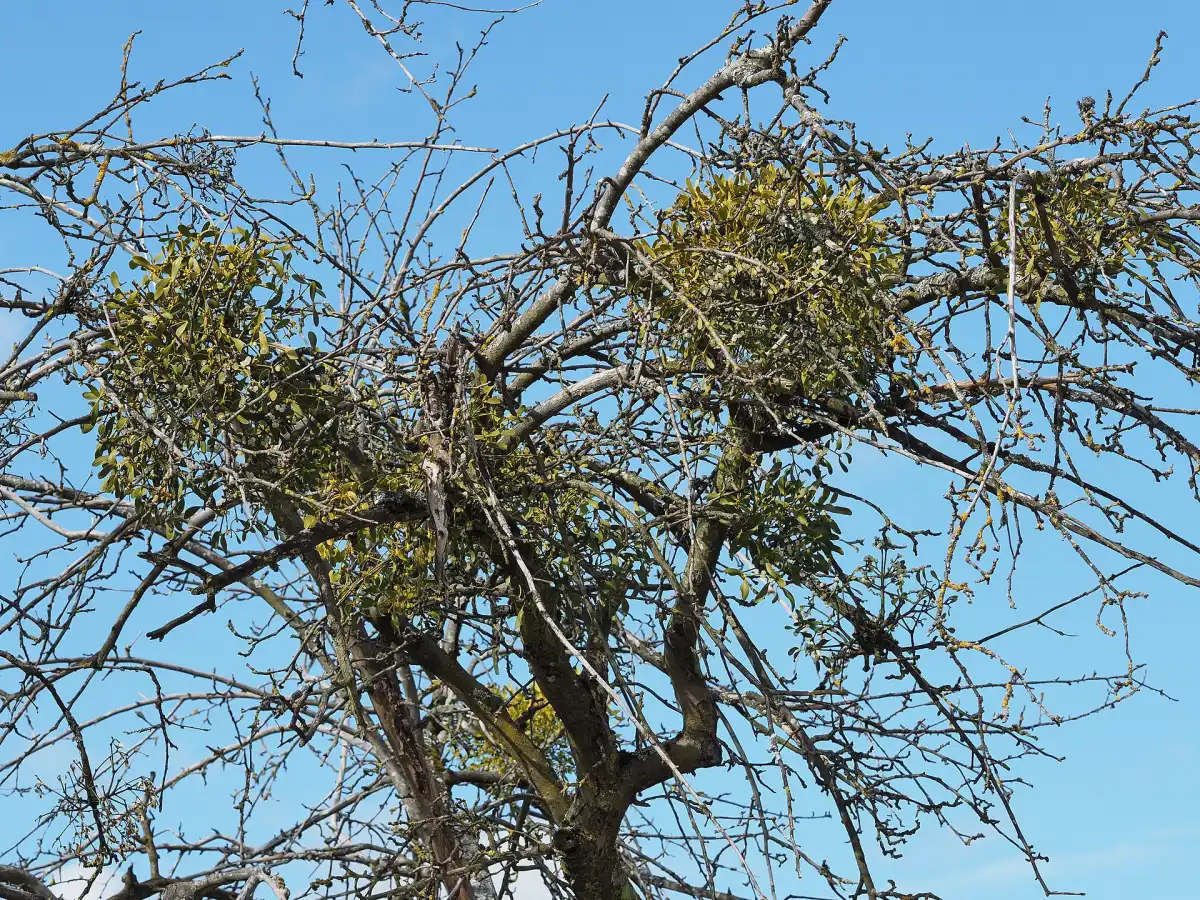 Photo: Kreuzschnabel, CC BY-SA 3.0, via Wikimedia Commons
How to prepare mistletoe
Cold infusion (recommended)
Herbal tradition insists on cold maceration for a practical reason: it extracts the water-soluble compounds gently without concentrating irritant substances.
- Put 1 level teaspoon (about 2-2.5 g) of dried, chopped mistletoe into a jar.
- Add 250 ml of cold drinking water.
- Cover and leave for 8-12 hours (overnight) at room temperature.
- Strain in the morning; if you like, warm it gently (do not boil) to body temperature.
Drink 1 cup a day, at most 2, split into two portions before meals, in courses of 3-4 weeks, followed by a break of at least 2 weeks.
Quick infusion
If you have no time for maceration: 1 level teaspoon in 250 ml of hot (not boiling, about 80-90°C) water for 5-10 minutes, then strain. Some authors accept it, but the cold infusion is preferred.
Tincture
Mistletoe tincture is sold in pharmacies and health shops in varying strengths. Because potency differs, follow the label strictly (usually 10-20 drops, 2-3 times a day). Homemade tincture is not advisable since you cannot control its strength. General principles are in our guide to herbal tinctures.
External compresses
For joint pain, tradition uses compresses soaked in a stronger cold infusion (2 teaspoons per 250 ml), applied for 20 minutes. The effect is modest and not well supported.
Dosage guide
| Form | Amount | Frequency | Course length |
|---|---|---|---|
| Cold infusion | 1 level tsp (2-2.5 g) per 250 ml | 1 cup/day, max 2 | 3-4 weeks, then a break |
| Quick infusion | 1 level tsp per 250 ml, 5-10 min | 1 cup/day | 3 weeks |
| Commercial tincture | as per label (often 10-20 drops) | 2-3 times/day | 3-4 weeks |
| Injectable extract | prescription only | - | - |
Check your blood pressure morning and evening throughout the course and write down the readings. If it drops below 100/60 mmHg or you feel dizzy when standing up, stop.
Contraindications, toxicity and interactions
Mistletoe berries are poisonous. A few berries swallowed by a child can cause nausea, vomiting, diarrhoea, abdominal pain and, more rarely, low blood pressure and slow pulse. If ingestion happens, call emergency services or a poison centre even if there are no immediate symptoms.
Do not use mistletoe if:
- you are pregnant or breastfeeding (possible effect on the uterus, no safety data);
- it is for a child;
- you have low blood pressure or faint easily;
- you have an autoimmune disease or take immunosuppressants (lectins stimulate the immune system);
- you have a known allergy to mistletoe;
- you have severe heart disease, arrhythmias or uncontrolled heart failure.
Possible interactions: blood pressure drugs (additive effect, risk of hypotension), heart medication (beta-blockers, digoxin), sedatives, immunosuppressants, anticoagulants. Tell your doctor and pharmacist you take mistletoe, especially before surgery.
When to see a doctor
- Blood pressure above 160/100 mmHg or readings that do not come down within a few weeks.
- Chest pain, shortness of breath, strong palpitations.
- Sudden severe headache, blurred vision, slurred speech or numbness (possible stroke, call emergency services).
- Fainting or a very slow pulse.
- A child or pet has eaten mistletoe berries.
Common mistakes
Boiling mistletoe like ordinary tea. Tradition uses cold maceration; prolonged boiling does not make it “stronger” in a useful way.
Leaving berries among the twigs. Clean the plant carefully before drying.
Stopping blood pressure pills because “the tea works”. This is the most dangerous mistake; pressure can rebound sharply.
Drinking it non-stop for months. Mistletoe is used in short courses with breaks.
Confusing tea with cancer therapy. Oncology research concerns standardised injectable extracts, not tea from a health shop.
Stacking many “heart herbs” at once. Mistletoe, hawthorn, motherwort and valerian have effects that can add up. Less is safer.
Conclusion
Mistletoe is a plant with rich tradition and fascinating chemistry, but it is not a gentle herb. As a cold infusion, in small doses and short courses, it can be an add-on for mildly raised blood pressure, with your doctor’s agreement and a blood pressure monitor at hand. The berries are poisonous, pregnancy and childhood are clear contraindications, and mistletoe therapy in oncology belongs solely to physicians. Treat it with respect and it can help; treat it like any other tea and it can do harm.
Frequently asked questions
Does mistletoe tea lower blood pressure? It may have a mild lowering effect, according to tradition and a few small studies, but the evidence is weak. It is at most an add-on for mildly raised readings and does not replace prescribed medication.
Why is mistletoe prepared cold rather than boiled? Cold maceration is the traditional form and extracts the water-soluble compounds more gently. Prolonged boiling brings no extra benefit and changes the profile of the preparation.
Are mistletoe berries poisonous? Yes, the berries are considered toxic. They can cause vomiting, diarrhoea and stomach pain, especially in children. Keep mistletoe decorations away from children and pets.
Does the host tree matter? The chemical profile varies with the host. Tradition prefers mistletoe from apple and pear trees and avoids that from black locust. When buying, choose products that state the species and origin.
Can I take mistletoe with blood pressure pills? Only with your doctor’s approval, because the effects can add up and your pressure may drop too low. Monitor readings daily and stop if you feel dizzy.
Does mistletoe cure cancer? No. Injectable mistletoe extracts are used as complementary therapy in some countries, with modest effects on quality of life, under medical supervision. Mistletoe tea has no such role.
How long can a mistletoe course last? Usually 3-4 weeks, followed by a break of at least 2 weeks. Continuous use is not recommended.
Sources and further reading
- National Cancer Institute (NCI): “Mistletoe Extracts (PDQ)”, patient and health professional versions.
- Cochrane: systematic review of mistletoe therapy in oncology (Horneber et al.).
- ESCOP Monographs: Visci herba.
- NCCIH (National Center for Complementary and Integrative Health): “European Mistletoe” fact sheet.
This article is for information only and does not replace medical advice. Talk to your doctor or pharmacist before using medicinal plants, especially if you take medication or have a chronic condition.