
Plantain Herb: Benefits, Uses and How to Prepare It Step by Step
IMPORTANT: Plantain is generally a gentle, well-tolerated herb, but there are situations in which it should be used with caution. People with known allergies to plants in the Plantaginaceae family or with pollen sensitivity may react to plantain, especially to leaves harvested during the flowering period. Pregnant or breastfeeding women should use plantain only after consulting their doctor, particularly in the form of concentrated preparations. Because plantain may have a mild blood-sugar-lowering and blood-thinning effect, people with diabetes and those taking anticoagulant medication should be attentive and check with their physician. Plantain does not replace medical treatment: in the case of a cough lasting more than two or three weeks, persistent fever, or a deep, infected, or non-healing wound, see a doctor. Applying leaves to the skin should always be done with well-washed leaves, to avoid contaminating the wound.
Grandma Veta, from the mountain village where I spent my childhood summers, had a habit I still cannot forget. Whenever one of us children scraped a knee running around the yard or got stung by a bee, she did not rush for ointments. She simply bent down by the fence, tore off a few plantain leaves from those that grew everywhere along the path, rubbed them between her palms until they turned moist, and laid them on the wound, tied up with a clean handkerchief. “This little weed, child, stops the bleeding and draws out the bad,” she would say, and within a day or two the scratch was as good as forgotten.
Later I learned that what grandma did was not superstition at all, but knowledge passed down from generation to generation, tested over thousands of years by people who had no pharmacy in the village. Plantain (the genus Plantago) is one of the most widespread and at the same time most underestimated healing herbs in our flora. You tread on it every single day without noticing, while it, humble and patient, grows quietly by the roadside, ready to help.
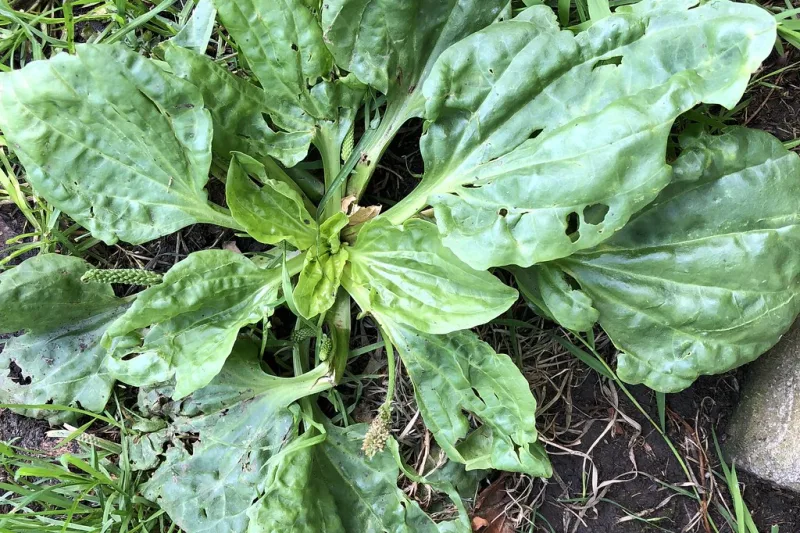
Plantain is a perennial herbaceous plant that grows almost anywhere: along roadsides, in meadows, in yards, on trodden ground, and even in cracks in the pavement. The best-known species used in folk medicine are broadleaf plantain (Plantago major), with its broad, oval leaves, and ribwort or narrowleaf plantain (Plantago lanceolata), with narrow, lance-shaped leaves. Both have been valued for centuries for leaves rich in soothing mucilage and in substances that aid wound healing and calm the respiratory tract. Folk names such as “the path-side plant” speak volumes about where we find it and what it does.
Table of Contents
- What plantain is and where it grows
- Composition and active principles
- Health benefits
- Traditional uses in the village
- How to prepare plantain: step-by-step recipes
- Dosage and how to use it
- How to harvest and store it
- Lifestyle and practical tips
- Practical tips and common mistakes
- Conclusion
- Frequently Asked Questions
What plantain is and where it grows
Plantain belongs to the family Plantaginaceae and includes over 200 species spread across nearly the entire globe. The most commonly encountered are broadleaf plantain and ribwort plantain. Broadleaf plantain has wide, oval leaves with clearly visible parallel veins, arranged in a rosette pressed against the ground, from the center of which rise slender, long spikes loaded with small greenish flowers. Ribwort plantain has narrow, elongated leaves, also with longitudinal veins, and shorter, thicker spikes with whitish-yellow stamens that stand out.
This plant is a true survivor. It grows on poor, compacted soils that other plants would avoid. That is precisely why we see it so often on beaten paths, on playgrounds, along the edges of fields. Tradition says that plantain “follows people,” because it thrives where the soil is trodden and packed down. The leaves stay green from spring until late autumn, and the plant spreads easily through the small, numerous seeds carried by its spikes.
For remedies, the young, tender leaves are used in particular, but also the seeds, which have their own distinct properties. In some traditions even the root was used. The important thing is to harvest the plant from clean places, far from busy roads, from land treated with pesticides, or from polluted areas, because plantain, being so hardy, absorbs and retains substances from the environment in which it grows.
Composition and active principles
Plantain’s healing power comes from a remarkable combination of active substances concentrated mainly in the leaves. Studies suggest that plantain contains a range of compounds that explain the effects observed by entire generations of people.
The most important group of substances are the mucilages, viscous compounds that, on contact with water, form a protective gel-like layer. These are responsible for plantain’s soothing and emollient effect, whether we are talking about an irritated throat or a wound on the skin. The mucilage coats and protects the tissues, calming irritation.
Plantain also contains aucubin, an iridoid glycoside to which both tradition and modern research attribute antimicrobial and anti-inflammatory properties. In addition, we find tannins, substances with an astringent effect that help stop minor bleeding and tighten tissues, as well as flavonoids with an antioxidant role. The leaves also provide an appreciable amount of vitamin C, vitamin K and minerals such as zinc, potassium and silicon.
Plantain seeds, especially those of certain related species, are particularly rich in soluble fiber and mucilage. These are known for their beneficial effect on intestinal transit, acting as a gentle laxative and a regulator of digestion. The combination of mucilage, aucubin, tannins and flavonoids makes plantain a plant with multiple actions: soothing, healing, mildly antiseptic and anti-inflammatory.
Health benefits
Helps soothe cough and the respiratory tract
The best-known use of plantain is for cough. The mucilage in the leaves forms a protective film over the irritated throat lining, calming the dryness and itching that triggers dry coughs. At the same time, the plant has a mild expectorant effect, helping to thin and expel secretions in the case of a productive cough. This is why plantain syrup and tea are valued traditional remedies for colds, mild bronchitis, laryngitis and hoarseness. Studies suggest that plantain extracts may help calm an irritated respiratory tract.
Supports wound healing and skin irritation
Folk tradition has always used plantain as a kind of “living bandage.” A crushed leaf, applied to a scratch, a small cut, an insect sting or a blister, soothes the pain, reduces redness and helps the skin recover faster. The tannins have an astringent effect and help stop minor bleeding, while aucubin and mucilage help clean and protect the affected area. Plantain was considered a first-aid remedy that you always had “on hand” out in the field.
Supports digestion and intestinal transit
Thanks to the mucilage and fiber, plantain has a gentle regulating effect on digestion. The leaves can soothe irritation of the stomach and intestinal lining, while the seeds rich in soluble fiber support normal transit, offering natural help in cases of occasional constipation. At the same time, the soothing effect can also be useful in mild bouts of diarrhea, through the astringent action of the tannins.
Supports oral and throat health
Gargling with plantain tea is a traditional remedy for sensitive gums, mouth ulcers and an inflamed throat. The astringent and mildly antiseptic effect helps calm irritation and support the healing of small lesions in the mouth. Many grandmothers recommended rinsing the mouth with plantain decoction after tooth extractions or in cases of mild gingivitis.
A source of antioxidants and vitamins
The young leaves of plantain are edible and provide a supply of vitamin C, vitamin K and flavonoids with an antioxidant role. In the past, in spring, the tender leaves were added to salads, soups and dishes as a strengthening “green” after the long winter, when the body needed fresh vitamins.
Traditional uses in the village
In folk medicine, plantain held a place of honor precisely because it was available to anyone, at any time. Village elders called it “the doctor at the roadside.” Here are some of the uses handed down from the old folk:
- For wounds and scratches: the washed and crushed leaf was applied directly to the wound, exactly as in grandma Veta’s story.
- For insect stings: the leaf rubbed between the palms and placed on the sting eased the itching and swelling.
- For cough and colds: a sweet syrup, pleasant even for children, or a warm tea drunk with honey, was made from the leaves.
- For corns and rough skin on the soles: the leaves were tied over the hardened areas overnight.
- For tired or irritated eyes: compresses with cooled, well-strained plantain tea.
- As spring food: the young leaves went into “wild-greens soup” alongside nettles, sorrel and wild orache.
These practices were not random. They endured because they worked, observed and confirmed by people attentive to the nature around them.
How to prepare plantain: step-by-step recipes
Plantain tea (infusion)
Tea is the simplest form of preparation and is used both internally, for cough and digestion, and externally, for gargling and compresses.
- Place 1-2 teaspoons of dried leaves (or a handful of chopped fresh leaves) in a cup.
- Pour over 250 ml of boiled water, but let it cool for a minute so it is not at a rolling boil. Water that is too hot can destroy some of the mucilage.
- Cover the cup and let it steep for 10-15 minutes.
- Strain and drink the tea warm, sweetened if you like with honey, which strengthens its soothing effect on the throat.
Cold maceration for mucilage
To preserve as much mucilage as possible, some prefer cold maceration.
- Place 1 teaspoon of dried leaves in a glass with 250 ml of cold water.
- Let it macerate for 6-8 hours (overnight, for example), at room temperature.
- Strain in the morning and drink. You can gently warm the liquid without boiling it.
Plantain cough syrup
Syrup is the favorite remedy for children and for dry cough. Here is a traditional method.
- Thoroughly wash a generous amount of fresh plantain leaves and chop them finely.
- In a clean jar, layer alternately a layer of leaves and a layer of sugar (or honey, if you prefer). Press each layer lightly.
- Fill the jar, cover it and leave it in a cool, dark place (traditionally buried in the ground or kept in the cellar) for 3-4 weeks, until the leaves release a sweet, syrupy juice.
- Strain the syrup, squeeze the leaves well and store the liquid in the refrigerator, in a clean bottle.
- Take one teaspoon 2-3 times a day in case of cough.
A faster variant involves gently simmering the leaves with water and honey, but cold maceration with sugar better preserves the active principles.
Leaf poultice for the skin
- Choose a few fresh, healthy leaves and wash them well under running water.
- Crush them gently with a clean pestle, with a spoon, or simply by rubbing them between washed palms, until they release their juice.
- Apply the leaf paste directly to the scratch, sting or irritated area.
- Fix it in place with gauze or a clean handkerchief and let it act for 30-60 minutes. Repeat a few times a day.
Dosage and how to use it
For internal use, the usual amount is 2-3 cups of tea per day, drunk between meals, in courses of about two to three weeks, followed by a break. Syrup is usually taken as one teaspoon 2-3 times a day for adults and half a teaspoon for older children, always with the doctor’s approval in the case of little ones.
For gargling, the cooled tea is used 3-4 times a day, after meals. For external use, the poultice or compresses can be repeated several times throughout the day, until the irritation or scratch improves. As with any plant, it is recommended to start with small amounts to check individual tolerance.
How to harvest and store it
Plantain leaves are ideally harvested from spring to early summer, before or at the beginning of flowering, when they are richest in active principles. Choose healthy specimens of a vivid green, without spots or signs of disease, and harvest far from roads, from treated agricultural land and from polluted areas.
After harvesting, wash the leaves only if absolutely necessary, shake them well to remove dust, and dry them in the shade, in a well-ventilated spot, spread out in a single layer on a clean surface or tied in small bunches and hung up. Drying in direct sun or at too high a temperature destroys some of the active substances. Once they are completely dry and crumble easily, store them in paper bags or glass jars, away from light and moisture. Dried leaves keep their qualities for about a year.
Lifestyle and practical tips
Plantain is a wonderful example of the philosophy of “remedies at our feet.” Including it in everyday life means not just using it when you fall ill, but looking at the nature around you with new eyes. Many people today rediscover the joy of gathering healing plants, of preparing their own tea or syrup, and of reducing dependence on store-bought products.
You can always keep a jar of dried plantain leaves on hand for the cold season, when coughs and colds are frequent. Combined with a balanced diet, good hydration and enough rest, plantain becomes a gentle support rather than a cure-all. For a better effect on the respiratory tract, plantain tea can be combined with thyme, linden or elderflower, while for digestion it goes well alongside mint or chamomile.
Practical tips and common mistakes
Mistake no. 1: Harvesting at the edge of a busy road. Precisely because plantain grows abundantly next to roads, many people pick it from there. This is a mistake, because the plant absorbs exhaust fumes, heavy metals and dust. Look for clean areas, away from traffic.
Mistake no. 2: Boiling the leaves for a long time. Mucilage, plantain’s main asset for the throat and digestion, is sensitive to high heat. An infusion (a short steeping) or cold maceration preserves these substances far better than prolonged boiling.
Mistake no. 3: Applying unwashed leaves to wounds. The leaf is an excellent remedy, but if you place it dirty on an open wound you risk introducing germs. Always wash the leaves well before applying.
Mistake no. 4: Unrealistic expectations. Plantain helps with mild cough, irritation and small scratches. It does not cure pneumonia, a serious infection or a deep wound. For serious conditions, see a doctor.
Mistake no. 5: Prolonged use without a break. Like any plant, plantain is used in courses, not endlessly. After two or three weeks of regular tea consumption, take a one-week break.
Mistake no. 6: Drying it incorrectly. Leaves left in strong sun or in an unventilated pile go moldy or lose their qualities. Dry them in the shade, spread out in a single layer.
Conclusion
Plantain is living proof that nature provides us with simple, effective and free remedies, right under our feet. This humble plant, which you tread on daily without noticing, has for centuries been a reliable ally for cough, wounds, stings and mild digestive problems. Rich in soothing mucilage, in antiseptic aucubin and in astringent tannins, plantain remains a valuable traditional remedy, easy to prepare at home as tea, syrup or poultice. Used with common sense, gathered from clean places and with respect for its limits, plantain can become a friendly presence in your kit of natural remedies. And if you ever scrape your knee in the yard, remember grandma Veta and look in the grass for the leaf that “stops the bleeding and draws out the bad.”
Frequently Asked Questions
Can plantain be eaten? Yes. The young, tender plantain leaves are edible and can be added to salads, soups or wild-greens broths. They have a slightly bitter taste and provide vitamins and fiber. Older leaves become fibrous and less pleasant in taste.
What is the difference between broadleaf and narrowleaf plantain? Broadleaf plantain (Plantago major) has wide, oval leaves, while narrowleaf or ribwort plantain (Plantago lanceolata) has narrow, lance-shaped leaves. Both have similar medicinal uses, being rich in mucilage. In folk practice they are often used interchangeably.
Can I use plantain for children’s cough? Traditionally, plantain syrup was given to children for cough because of its pleasant taste. However, for small children caution is recommended and it is best to consult a pediatrician first. Honey, sometimes used in the syrup, must not be given to babies under one year old.
How quickly does plantain act on wounds? Applied correctly to small scratches and stings, plantain quickly soothes pain and itching, and visible improvement usually appears within one or two days. For larger or non-healing wounds, medical care is needed.
Can I drink plantain tea every day? Yes, but it is recommended to use it in courses of two to three weeks, followed by a break, rather than drinking it endlessly. Two to three cups a day is a reasonable amount for a healthy adult.
Does plantain have any contraindications? People allergic to plants in the Plantaginaceae family, pregnant or breastfeeding women (in the case of concentrated preparations), diabetics and those taking anticoagulants should be cautious and consult their doctor. In general, however, plantain is a well-tolerated plant.
Can I use fresh leaves or do they need to be dried? Both options work. Fresh leaves are ideal for poultices and for syrup, while dried leaves are practical for tea throughout the year, especially in winter when the plant is no longer available fresh.
Where should I not gather plantain? Strictly avoid the edge of busy roads, agricultural land treated with pesticides, industrial zones and polluted places. Plantain easily absorbs substances from the environment, so always choose meadows and clean places, far from traffic.