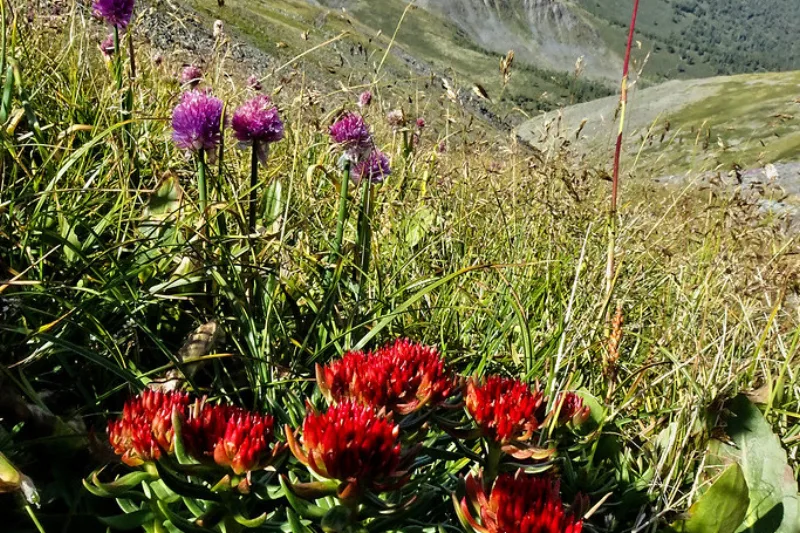

Rhodiola (Rhodiola rosea): Adaptogen for Fatigue, Stress and Energy
IMPORTANT: Rhodiola is a plant with real effects on the nervous and hormonal systems, which is why it should not be treated like an ordinary, harmless tea. Pregnant or breastfeeding women should avoid it, as there is insufficient safety data. People with bipolar disorder need to be especially careful, because rhodiola can overstimulate mood and may trigger episodes of agitation or mania. If you take antidepressants (especially serotonin reuptake inhibitors or MAOIs), blood pressure medication, blood thinners, or diabetes medication, talk to your doctor before starting, as rhodiola may interfere with them. Do not take it late in the evening, as it can cause insomnia. Rhodiola is not a substitute for medical treatment of depression, severe anxiety, or chronic burnout — it is a support, not a miracle cure.
Aunt Veronica, a woman nearly eighty years old from a mountain village in Bucovina, had a habit that no one in the family fully understood. Every late autumn, when the others were gathering the last apples and putting up their pickles, she would set off alone on the steep path that climbed toward the bare rocky outcrops above the village. She would return with a small basket filled with thick, fleshy roots that gave off a strange rose-like scent when you broke them. She washed them, sliced them, and hung them to dry in the attic on strings, like beads. “These keep my back straight and my head clear,” she would say, laughing, when asked what she was doing with “those weeds from the rocks.”
It was only later, when one of her grandchildren left for the city and studied, that the family understood the rose-scented root was rhodiola — a plant that peoples of the far north, from Siberia to Scandinavia, had used for centuries to withstand cold, fatigue, and the hard labor of the mountains. Aunt Veronica had never read a single study, but her folk instinct had guided her precisely toward one of the most prized adaptogenic plants in the world. Today, when we talk about chronic fatigue, stress, and lack of energy, rhodiola is once again capturing the attention of herbalists and ordinary people alike.
Rhodiola, known scientifically as Rhodiola rosea and popularly as “golden root” or “arctic root,” is a succulent plant that grows in the cold, high regions of the northern hemisphere. It is valued primarily for its rhizome and root, used traditionally to increase the body’s resistance to physical and mental stress. In the folk medicine of northern Europe and Asia, it was considered a plant of vitality, given to newlyweds for fertility and to soldiers for strength in battle.
Table of Contents
- What rhodiola is and where it grows
- Composition and active compounds
- Health benefits
- Traditional uses
- How to prepare rhodiola (tea, tincture, powder)
- Dosage and how to take it
- Rhodiola in everyday life
- Practical tips and common mistakes
- Precautions and contraindications
- Conclusion
- Frequently asked questions
What rhodiola is and where it grows
Rhodiola (Rhodiola rosea) is a perennial plant in the Crassulaceae family — the same family as succulent houseplants. It has fleshy, bluish-green leaves and small yellow or yellow-green flowers clustered at the tips of its stems. It grows wild in harsh, cold, rocky places — on mountain ridges, in arctic tundra, on wind-battered slopes, where few plants manage to survive. It is precisely this ability to thrive in extreme conditions that led folk tradition to associate it with resilience and adaptability.
It is found in Siberia, the Altai Mountains, Scandinavia, Iceland, the Carpathian Mountains at high altitudes, the Pyrenees, and the Alps. The part used is almost always the rhizome and root, usually harvested in autumn, when the plant has stored its active compounds. When cut, the fresh root releases a pleasant rose scent, which is the origin of the species name “rosea.” This fragrance is an indicator of quality — old or poorly dried roots lose their aroma.
The name “golden root” comes both from the golden color of the dried rhizome and from the value that northern peoples placed on it. It is said that in some regions of Siberia, families kept the location of their rhodiola patches secret and passed it down only to their descendants, like a precious inheritance.
Composition and active compounds
What makes rhodiola so special is the combination of active compounds concentrated in the rhizome and root. The most studied are:
- Rosavins (rosavin, rosarin, rosin) — a group of compounds considered specific markers of authentic Rhodiola rosea. Many standardized extracts are measured by their rosavin content.
- Salidroside (also called rhodioloside) — another important compound, associated with effects on nervous balance and stress resistance.
- Flavonoids and tannins — with antioxidant roles, helping to protect cells from oxidative stress.
- Phenolic acids — which contribute to the overall supportive effect on the body.
- Volatile oils — partly responsible for the characteristic rose scent.
Herbal tradition holds that it is not a single compound but the synergy among all of them that makes rhodiola an adaptogen. The term “adaptogen” describes a plant that helps the body “adapt” to various forms of stress — physical, mental, emotional — bringing it back toward balance. Studies suggest that rhodiola acts on the way the body responds to stress, particularly by influencing the axis linked to stress hormones and the neurotransmitter systems that regulate mood and energy.
Health benefits
Fighting fatigue and exhaustion
The best-known benefit of rhodiola is its support against fatigue, especially fatigue caused by stress or prolonged effort. Northern folk tradition used it for exactly this purpose: laborers, fishermen, and soldiers took it to endure effort without collapsing from exhaustion. Modern studies suggest that rhodiola may reduce the sensation of mental fatigue during periods of overload, helping maintain clarity and focus when the body would otherwise be tempted to give in.
Supporting resistance to stress
As a typical adaptogen, rhodiola is valued for its ability to temper an exaggerated response to stress. Rather than stimulating abruptly, as coffee does, it seems to “smooth out” the peaks and valleys, helping the body stay more emotionally stable. Many people who use it describe a feeling of active calm — not drowsiness, but a lucid quietness in which stress no longer derails the whole day.
Support for mental clarity and cognitive performance
Tradition and modern observation suggest that rhodiola may support working memory, attention, and the ability to concentrate, especially under conditions of fatigue. It is one of the favorite plants of students during exam season and of people doing demanding intellectual work, because it seems to help the mind stay sharp without the jitteriness of caffeine.
Balancing mood
Salidroside and the other compounds in rhodiola seem to influence the systems that regulate mood. Tradition associated it with a “light heart” and with chasing away melancholy. Studies suggest a possible mood-supporting effect in mild to moderate forms of stress-related low spirits; however, rhodiola is not, and should not be considered, a substitute for medical treatment of depression.
Supporting physical effort and recovery
Athletes and active people value rhodiola for its role in tolerating effort and reducing the sensation of exhaustion after exercise. Northern tradition linked it to physical endurance, and modern observation suggests it may help the body cope better with prolonged effort and support recovery.
Support for the immune system and general vitality
Like many adaptogens, rhodiola is considered a “background” plant that gradually strengthens overall vitality. Tradition used it during convalescence, after long illnesses or hard periods, to help the body regain its strength. The antioxidants in its composition contribute to protecting cells against oxidative stress.
Traditional uses
In the folk medicine of northern peoples, rhodiola had many uses. The Vikings are said, according to tradition, to have used it to preserve their strength and endurance on long expeditions. In Siberia, it was given to newlyweds as a wedding gift, a symbol of fertility and of the couple’s vitality. In the traditional medicine of the Altai Mountains, the root was prepared as an infusion to fight fatigue, colds, and “weakness of the heart.”
In some mountainous areas of Europe, rhodiola was used to help the body adapt to altitude and cold. Shepherds and herb gatherers chewed it directly or took it as a decoction before long days of work in the mountains. It was considered a plant for people who must endure — cold, effort, and solitude.
How to prepare rhodiola (tea, tincture, powder)
Rhodiola is used almost exclusively through its rhizome and root, which can be prepared in several ways. Here are the traditional methods, step by step.
Root decoction (tea)
Because the root is hard and woody, a simple infusion is not enough — a light decoction is recommended.
- Use about one level teaspoon of chopped, dried root (roughly 2–3 grams) per cup of water (250 ml).
- Place the root in cold water and bring slowly to a boil.
- Let it simmer over low heat for 3–5 minutes, then turn off the heat.
- Cover and let it steep for another 10 minutes.
- Strain and drink warm, preferably in the morning or at midday.
The decoction has a slightly astringent taste with a floral note. It can be sweetened with a little honey, but do not overdo it.
Rhodiola tincture
The tincture is one of the most practical forms, because it preserves the active compounds well and is easy to dose.
- Chop 100 g of dried rhodiola root.
- Place it in a clean jar and pour about 500 ml of food-grade alcohol at roughly 40–50% over it.
- Close the jar and keep it in the dark, at room temperature, for 3–4 weeks, shaking it daily.
- Strain through cheesecloth, squeeze the root well, and store the tincture in dark glass bottles.
The tincture is usually taken as a few drops up to a small teaspoon, diluted in a little water, in the morning.
Rhodiola powder
Well-dried root can be ground finely in a clean coffee grinder. The resulting powder can be taken directly, mixed with a little honey or water, or added to smoothies. The usual dose is small, on the order of half a teaspoon or less, depending on concentration.
Standardized extract (capsules)
The market offers capsules with standardized rhodiola extract, usually measured by rosavin and salidroside content (a classic ratio being 3% rosavins and 1% salidroside). These have the advantage of precise dosing, but should be chosen from reputable manufacturers and used according to the directions on the label.
Dosage and how to take it
Rhodiola is usually taken for limited periods, in cycles, rather than indefinitely. Herbal tradition and modern recommendations suggest courses of a few weeks, followed by breaks.
- Decoction: one cup in the morning and, possibly, one at midday, but not in the evening.
- Tincture: a few drops up to a small teaspoon, once or twice a day, in the first part of the day.
- Standardized capsules: according to the manufacturer’s directions, usually one dose in the morning.
An important principle: rhodiola should be taken in the first half of the day. Being a tonic and mildly stimulating plant, taking it in the evening can cause insomnia or restlessness. It is also recommended to start with a small dose, to observe how your body responds, and to increase gradually if needed. Many people feel the effects best after a few days of consistent use, not immediately.
Rhodiola in everyday life
Rhodiola fits best into demanding periods — exam sessions, projects with tight deadlines, stretches of intense physical work, major schedule changes, or convalescence. It is not a plant to take “for anything,” but one to use when you feel your energy reserves dropping and stress becoming oppressive.
For an optimal effect, rhodiola works best as part of a balanced lifestyle. No adaptogen can compensate for chronic lack of sleep, disordered eating, or total inactivity. Rhodiola is a support that shows its value when combined with sufficient rest, regular movement, hydration, and clean eating. Many people take it in the morning, before a day they expect to be hard, as a kind of “shield” against exhaustion.
It is also a plant that calls for self-observation. Because its effects vary from person to person, it is worth paying attention to how you feel — whether it gives you clarity and calm or, on the contrary, agitation. In herbalism, listening to your own body is just as important as the plant itself.
Practical tips and common mistakes
Mistake no. 1: Taking it in the evening. Because rhodiola is tonic and mildly stimulating, taking it in the evening can cause insomnia. Use it in the morning and at midday at the latest.
Mistake no. 2: Using it without breaks, for months on end. Rhodiola gives the best results in courses of a few weeks, followed by breaks. Continuous, indefinite use is not recommended and may reduce the body’s sensitivity to its effects.
Mistake no. 3: Doses that are too large from the start. Many believe that “more is better” and start with high doses, which can cause restlessness, irritability, or headaches. Start with a small dose and increase gradually.
Mistake no. 4: Buying products with no clear origin. The market is full of products labeled “rhodiola” that contain other, less active Rhodiola species, or negligible amounts of active compounds. The rose scent of authentic root is a good quality indicator. Choose standardized products from reputable manufacturers.
Mistake no. 5: Expecting an instant effect. Rhodiola is not coffee. Its effects build over time, usually after a few days of use. Anyone expecting an immediate “hit” of energy will be disappointed.
Mistake no. 6: Uncontrolled combination with other stimulants. Combining rhodiola with a lot of coffee or other stimulants can overload the body. Moderation is key.
Precautions and contraindications
Although it is a generally well-tolerated plant, rhodiola is not for everyone. Here are the most important precautions:
- Pregnancy and breastfeeding: avoidance is recommended due to insufficient safety data.
- Bipolar disorder: rhodiola can overstimulate mood and may trigger episodes of agitation or mania in predisposed individuals.
- Mood medications: if you take antidepressants (especially serotonin reuptake inhibitors or MAOIs), consult your doctor, as interactions may occur.
- Blood pressure medication, blood thinners, antidiabetics: rhodiola may influence these systems; talk to your doctor.
- Insomnia and anxiety with agitation: in some sensitive people, rhodiola can worsen restlessness and sleep problems.
- Surgery: stopping at least two weeks before an operation is recommended, due to possible effects on blood clotting.
As a general rule, rhodiola is a support, not a treatment. In cases of severe chronic fatigue, depression, marked anxiety, or any persistent symptom, the first step is to consult a doctor, not to self-treat with herbs.
Conclusion
Rhodiola (Rhodiola rosea) is one of the most highly valued adaptogenic plants, a “golden root” that grows where few plants survive — on the cold rocks of the northern mountains. The tradition of the peoples of Siberia, Scandinavia, and the high mountains used it for centuries to strengthen resistance to cold, effort, and fatigue, and modern interest confirms this reputation. Used wisely — in limited courses, in the morning, in reasonable doses, and as part of a healthy lifestyle — rhodiola can be a real ally during demanding times. Like Aunt Veronica on the mountain path, who instinctively knew what she was looking for in her basket, we too can rediscover in this plant a gentle yet genuine support for energy, calm, and clarity.
Frequently Asked Questions
How long does it take to feel the effects of rhodiola? Usually the effects build gradually, over a few days of consistent use. Some people feel an improvement in mental clarity relatively quickly, but the full effect on stress resistance appears after a week or more.
Can I take rhodiola every day, indefinitely? It is not recommended. Rhodiola gives the best results in courses of a few weeks, followed by breaks. Continuous, uninterrupted use may reduce the body’s sensitivity to its effects.
Is rhodiola addictive? No, rhodiola does not create physical dependence. However, to maintain its effectiveness, it is better used in courses rather than permanently.
Is rhodiola the same as ginseng or ashwagandha? All three are adaptogens, but they have different profiles. Rhodiola is valued especially for fighting fatigue and for mental clarity, being mildly tonic. Ashwagandha is more calming, and ginseng has its own tonic profile. The choice depends on each person’s needs.
Can I take rhodiola in the evening to relax? It is not advisable. Rhodiola is a tonic, mildly stimulating plant, and taken in the evening it can cause insomnia. It should be taken in the morning or at midday.
Does rhodiola help with weight loss? Rhodiola is not a weight-loss product. It can indirectly support an active lifestyle by helping fight fatigue and tolerate effort, but it does not burn fat on its own. Healthy weight loss depends on diet and exercise.
How do I recognize good-quality rhodiola? Authentic Rhodiola rosea root has a pleasant rose scent when cut. Standardized products measured by rosavin and salidroside content, from reputable manufacturers, offer the greatest assurance of quality.
Can I take rhodiola if I take medication? If you are on medication — especially antidepressants, blood pressure drugs, blood thinners, or antidiabetics — consult your doctor before starting rhodiola, to avoid possible interactions.