
St. John’s Wort: Benefits, Uses and How to Prepare It
IMPORTANT: St. John’s Wort is one of the most pharmacologically active medicinal plants, which is precisely why it interacts with a remarkably large number of medications. It significantly reduces the effectiveness of oral contraceptives, anticoagulants (warfarin), certain heart medications (digoxin), immunosuppressants (ciclosporin), some antiretrovirals, and many synthetic antidepressants. Combining it with antidepressants in the SSRI class can trigger a dangerous “serotonin syndrome.” The plant also increases the skin’s sensitivity to sunlight (photosensitization). It should not be taken during pregnancy or breastfeeding without medical advice, and anyone on chronic medication must consult a doctor or pharmacist before using it. St. John’s Wort is not a substitute for the treatment of moderate or severe depression.
A story from the forest’s edge
Grandmother Anița, from the village under the hill, kept a habit no one dared interrupt: around midsummer, when the days were longest, she would set off at dawn, headscarf tied tight and a wicker basket on her arm, to gather the “fire herb.” She insisted the flowers had to be picked when the sun was already up but not yet scorching, “because that’s when all its power is inside it.” She would then drop them into a large jar of sunflower oil, set it on the south-facing windowsill, and watch, week after week, as the golden liquid turned, almost miraculously, into a deep ruby red. That red oil was the household’s remedy for all sorts of troubles: a burn on the hand, a scratch that wouldn’t heal, grandfather’s stiff lower back after a day of mowing.
Later, whenever one of her granddaughters arrived sad, withdrawn, on the verge of tears, Grandmother Anița never scolded or rushed her. She would put the kettle on the stove, sprinkle in a handful of dried St. John’s Wort flowers, and say in that calm voice of people who have seen much: “Drink, my dear, this golden tea drives the darkness from the soul.” She knew nothing of hyperforin or hypericin, but Romanian folk tradition had sensed, across generations, what modern research would only study much later: the link between this yellow flower and our state of mind.
What St. John’s Wort is
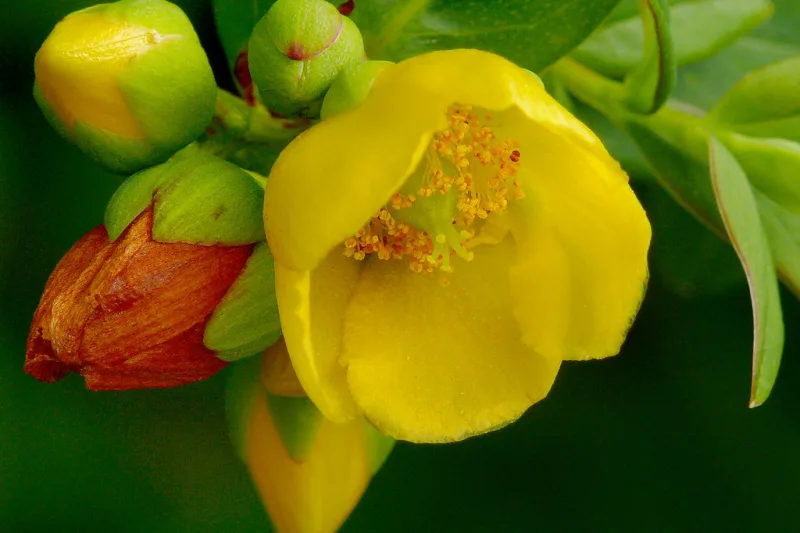
St. John’s Wort (scientific name Hypericum perforatum) is a perennial herbaceous plant of the Hypericaceae family. It grows wild across most temperate regions — at the edges of forests, in sunny meadows, on uncultivated land, along roadsides, and on dry slopes, from lowlands up into hilly country. It flowers from June through August, and its bright yellow blossoms, with numerous fine stamens radiating out like sun rays, are easy to recognize.
The name “perforatum” comes from a fascinating feature of the leaves: held up to the sunlight, they appear pierced by thousands of tiny holes. In reality these are small translucent glands filled with essential oils. And if you crush a bud or a flower between your fingers, it leaves a reddish-purple stain — the pigment hypericin, one of the plant’s most studied compounds. Because of this color, in many traditions the flower was symbolically tied to the sun, to light, and to warding off evil, and was gathered above all around the summer solstice.
St. John’s Wort is, without doubt, one of the stars of modern European herbalism. In many countries it is widely used to support emotional well-being. But, as we shall see, its power demands respect, because it comes with a serious list of cautions.
Table of Contents
- Composition and active principles
- Health benefits
- Traditional uses
- How to prepare: tea, tincture, oil
- Dosage and administration
- Lifestyle and practical tips
- Practical Tips and Common Mistakes
- Conclusion
- Frequently Asked Questions
Composition and active principles
The therapeutic value of St. John’s Wort comes from a complex mixture of compounds, the most important of which are:
- Hypericin and pseudohypericin — red-colored pigments (naphthodianthrones) responsible for the purple stain. They are also photosensitizers, which is why they explain the sun sensitivity that follows use of the plant.
- Hyperforin — a compound considered today the main contributor to the effects on mood. Studies suggest it may influence the levels of several brain neurotransmitters.
- Flavonoids (hyperoside, rutin, quercetin) — with antioxidant properties and a protective effect on blood vessels.
- Tannins — which explain the astringent action, useful in healing wounds and inflammation.
- Essential oils and proanthocyanidins — with a complementary role.
This natural cocktail does not act in isolation but synergistically. That is exactly why standardized extracts of St. John’s Wort are often dosed by their content of hypericin or hyperforin, to ensure a consistent amount of active principles.
Health benefits
Support for mood and mild low spirits
The best-known use of St. John’s Wort is mood support. Folk tradition rightly called it “the flower that drives away the darkness,” and studies suggest that standardized extracts may help in mild to moderate forms of low mood and melancholy. Hyperforin and hypericin are believed to influence the balance of neurotransmitters involved in regulating mood. It is important to stress that St. John’s Wort is meant for mild states and is in no way a replacement for a doctor’s assessment and treatment in serious cases.
Calming the nervous system
Beyond its effect on mood, St. John’s Wort has a long tradition of soothing “frayed” nerves, irritability, and nervous tension. Many folk recipes combine it with valerian, lemon balm, or hawthorn for a broader calming effect, especially during prolonged periods of stress.
Wound healing and skin care
This is where the famous red oil comes in. Applied externally, St. John’s Wort oil has a solid reputation in folk tradition for speeding up healing: minor burns (including sunburn), scratches, superficial cuts, irritation, bruises, and dry or cracked skin. The tannins and flavonoids explain its astringent and soothing action on damaged tissue.
Easing nerve pain
St. John’s Wort oil has been used since antiquity as a rub for nerve-type pains, lumbago, sciatica, and muscle aches. It is applied with a gentle massage over the painful area.
Supporting digestion
Thanks to its mild astringent and bitter action, St. John’s Wort tea has traditionally been used to calm an upset stomach, ease minor digestive cramps, and support the flow of bile.
Antioxidant action
The flavonoids in St. John’s Wort help combat oxidative stress, the process by which free radicals damage cells. A diet and lifestyle that include sources of antioxidants support long-term health.
Traditional uses
In Romanian folk medicine, St. John’s Wort held a place of honor. It was used as a tea for “troubles of the soul,” for restless sleep, and for a weak stomach. The red oil was found in every household, the universal remedy for injured skin. Compresses of St. John’s Wort infusion were applied to wounds that would not heal and to inflamed areas. Baths with a decoction of the herb were recommended for relaxation and for the skin. In some regions, the plant was hung from a beam or doorway around midsummer, with a symbolic role of protection.
How to prepare: tea, tincture, oil
St. John’s Wort tea (infusion)
- Put one teaspoon (about 1.5–2 g) of dried, chopped herb (flowers and flowering tops) into a cup.
- Pour 200–250 ml of boiling water over it.
- Cover the cup and let it steep for 8–10 minutes.
- Strain and drink the tea warm.
For the effect on mood, tradition recommends regular use over several weeks, since the effects do not appear immediately but build up gradually. The tea may be sweetened with a little honey once it has cooled slightly.
St. John’s Wort tincture
- Half-fill a clean jar with fresh St. John’s Wort flowers (or fill one-third with dried herb).
- Pour food-grade alcohol of 40–50% over it until the plant is well covered.
- Close the jar and leave it to macerate for 2–4 weeks in a dark place, shaking it daily.
- Strain through cheesecloth and store the tincture in dark glass bottles.
The tincture is more concentrated, so it is taken in small amounts (typically 15–30 drops diluted in a little water), and only on the advice of a specialist.
Red St. John’s Wort oil
- Gather fresh flowers and buds on a sunny day, after the dew has lifted.
- Fill a clean, dry glass jar with them, without packing them too tightly.
- Pour cold-pressed vegetable oil over them (olive, sunflower, or almond) until they are completely covered.
- Close the jar and leave it on a sunny windowsill for 3–6 weeks, shaking it occasionally.
- The oil will gradually turn an intense red. At that point, strain it through cheesecloth and store it in a dark glass bottle in a cool place.
This oil is used externally only, for massage and skin care. Caution: after applying it, avoid exposing the area to the sun because of the photosensitizing effect.
Dosage and administration
For tea, the usual amount is 2–3 cups a day, in courses lasting a few weeks. For standardized products (capsules, tablets, extracts), the dose is set by the manufacturer and the doctor, since it varies with the concentration of active principles. Whatever the form, it is wise to start with a small amount and observe how the body reacts.
It is essential to remember that St. John’s Wort must never be taken casually alongside medication. Before any course — especially if you are on chronic treatment — a conversation with your doctor or pharmacist is not a formality but a genuine safety necessity.
Lifestyle and practical tips
St. John’s Wort works better when it is part of a balanced lifestyle. For mood support, the plant performs best alongside regular outdoor movement, moderate exposure to natural morning light (mind the photosensitization, though), quality sleep, and a diet rich in vegetables, fruit, and healthy fats. Folk tradition tied the gathering of this plant to the sun and to light, and there is a certain wisdom in that: our inner state is profoundly influenced by the natural rhythm of the days.
When using it on the skin, first cleanse the area gently, then apply the oil in a thin layer with soft movements. For evening relaxation, a cup of warm St. John’s Wort tea, perhaps combined with lemon balm, can become a small ritual that prepares the body for rest.
Practical Tips and Common Mistakes
Mistake no. 1: Combining St. John’s Wort with medication without asking your doctor. This is the most serious mistake. The plant can cancel out the effect of oral contraceptives, anticoagulants, and many other drugs. It is not a “gentle” herb in this respect.
Mistake no. 2: Exposing yourself to the sun during a course. The skin becomes more sensitive to ultraviolet radiation, which can lead to burns or pigmentation. People with fair skin are most at risk.
Mistake no. 3: Expecting immediate results. For mood, the effects set in gradually, over several weeks of regular use. Anyone who quits after two or three days never gives the plant a chance to work.
Mistake no. 4: Using St. John’s Wort oil internally. The red oil obtained by maceration is meant for external application. For internal use, rely on the tea or standardized preparations.
Mistake no. 5: Stopping abruptly after a long course, especially if the plant was taken alongside other treatments. Any change is ideally made under a doctor’s guidance.
Mistake no. 6: Harvesting from polluted spots. Plants growing along busy roads or on chemically treated land can accumulate unwanted substances. Choose clean places, away from traffic.
Conclusion
St. John’s Wort is a remarkable plant where Romanian folk tradition and the interest of modern research meet. Its golden flower, gathered since ancient times around midsummer, offers support for mood, for the nervous system, and — in the form of the famous red oil — for the care of skin and injured tissue. Precisely because it is so active, St. John’s Wort should not be seen as a harmless cup of tea: its interactions with medication and its photosensitizing effect call for caution and, ideally, the advice of a specialist. Used wisely and with respect, it remains one of the most valuable remedies that nature places at our disposal.
Frequently Asked Questions
How long does it take to feel the effects of St. John’s Wort on mood? Unlike a sedative that works immediately, the effects on mood set in gradually. Tradition and herbal practice suggest it may take several weeks of regular use to notice a change. Patience and consistency are essential.
Can I take St. John’s Wort if I use birth control pills? It is not recommended without medical advice. St. John’s Wort can significantly reduce the effectiveness of oral contraceptives, increasing the risk of an unintended pregnancy. This is one of the best-known and most important interactions of the plant.
Does St. John’s Wort really cause sun sensitivity? Yes. Hypericin has a photosensitizing effect, meaning it makes the skin more reactive to ultraviolet rays. During a course it is advisable to avoid prolonged sun exposure and to use protection, especially if you have fair skin.
What is the difference between St. John’s Wort tea and standardized extracts? The tea is the traditional, gentle preparation, with a variable concentration of active principles. Standardized extracts (capsules, tablets) contain a consistent and higher amount of hypericin or hyperforin and are used for more pronounced effects. The latter should only be taken on a doctor’s recommendation.
Can St. John’s Wort oil be used on the face? Yes, on clean skin, in a thin layer, for irritation or dryness — provided you do not expose yourself to the sun afterward. For any sensitive skin, it is wise to test first on a small patch.
Can I drink St. John’s Wort tea every day, long term? Courses of a few weeks, followed by breaks, are common in tradition. For long-term use — especially if you are taking other medication — it is recommended to consult your doctor, since the plant is not free of effects and interactions.
How do I recognize true St. John’s Wort in the wild? Look for a plant with bright yellow flowers and numerous fine stamens, blooming in summer. Check the leaves against the light: they should appear “perforated” with translucent dots. And if you crush a bud between your fingers, it leaves a reddish-purple stain — its distinctive sign.
Is St. John’s Wort safe for children? It should not be given to children without the advice of a pediatrician. Because of its pharmacological activity and possible interactions, it is a plant that requires extra caution in the young.