
Thyme: Benefits, Uses and How to Prepare a Time-Honored Healing Herb
IMPORTANT: Thyme (Thymus vulgaris) is generally well tolerated as a food and seasoning, but its essential oil and concentrated preparations call for caution. Pregnant women should avoid medicinal amounts and thyme essential oil, since folk tradition attributes uterine-stimulating effects to it. People allergic to plants in the Lamiaceae family (mint, oregano, sage), those with thyroid conditions, high blood pressure, or who take blood thinners should consult a doctor before using thyme as a remedy. Essential oil is never ingested undiluted and never applied neat to the skin. Thyme is not a substitute for medical treatment: if a cough, fever, or respiratory infection lasts more than a few days or gets worse, see a doctor.
Grandmother Veronica, from a village at the foot of the Carpathian Mountains, had a habit the whole family knew by heart: at the first sign of a cold, when one of the grandchildren started coughing in the evening, she would set the kettle on the stove and pull a bundle of dried thyme from the pantry, hung on a string from a beam. That warm, slightly pungent smell filled the kitchen and, she said, “chased the cold out of the chest.” She mixed the thyme with a little honey from the hives in the garden and a slice of lemon, and the children drank the tea with their hands wrapped around the mug. No one thought about thymol or volatile compounds back then; people simply knew that “thyme cuts the cough” and that after two or three days of tea, the chest cleared up.
That same bundle of thyme served another purpose too. When someone had a heavy stomach after a rich holiday meal, grandmother made a weaker thyme tea and gave it warm, “to settle the food.” And in spring, when she pickled vegetables or cooked beans, she always tossed a sprig of thyme into the pot, saying it “keeps the bloating away.” This dual identity — an everyday seasoning and a trusted remedy — perfectly captures what thyme means in folk tradition.
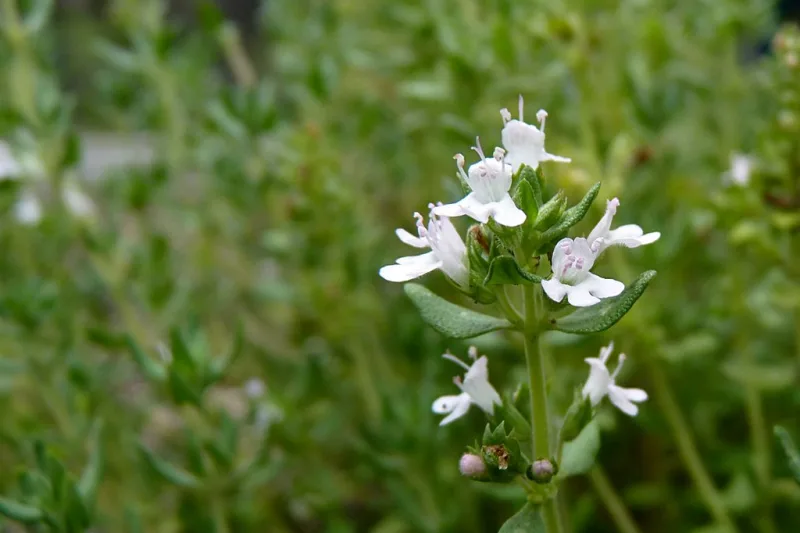
Thyme is one of the most prized aromatic and medicinal plants in the world: a small, woody shrub native to the Mediterranean, with tiny leaves and delicate white or pinkish-lilac flowers. Its scientific name, Thymus vulgaris, comes from the Greek “thymos,” linked to courage and vital strength — Romans perfumed their bathwater with thyme to gain vigor, and soldiers bathed in thyme infusion before battle. In cooking it is indispensable, but in traditional medicine thyme holds a special place precisely because of its richness in volatile oils with antiseptic and expectorant effects.
Table of Contents
- What thyme is and where it grows
- Garden thyme, wild thyme and other relatives
- Composition and active principles
- Health benefits
- Traditional uses in the countryside
- How to prepare thyme: tea, syrup, tincture, steam inhalation
- Dosage and how to use it
- Thyme in the kitchen
- How to harvest, dry and store it
- Practical tips and common mistakes
- Precautions and contraindications
- Conclusion
- Frequently Asked Questions
What thyme is and where it grows
Garden thyme (Thymus vulgaris) is a perennial subshrub of the Lamiaceae family, the same family that includes mint, basil, sage and oregano. It grows in compact clumps, 15–30 cm tall, with woody stems at the base and thin branches covered in small, oval, grey-green leaves whose edges curl slightly inward. In summer the plant becomes covered with tiny flowers clustered at the tips of the branches, very attractive to bees — thyme honey being considered one of the most fragrant.
Native to the dry, sunny regions of the Mediterranean basin, thyme prefers poor, stony, well-drained soils and tolerates drought superbly. It is precisely these harsh conditions that make it concentrate its aromatic oils: thyme grown on arid, sun-beaten ground will be far more fragrant than one pampered with water and rich soil. It grows easily in gardens, in balcony planters, and even in a pot on the windowsill, being a hardy and low-maintenance plant.
Garden thyme, wild thyme and other relatives
There is some confusion among common names. The “thyme” grown in gardens is usually Thymus vulgaris. “Wild thyme” or “creeping thyme” (Thymus serpyllum) is a wild, ground-hugging relative that grows spontaneously on hills, meadows and sunny forest edges, very widespread in wild flora. It has similar properties and is used in many traditional recipes, though its aroma is somewhat milder.
For medicinal purposes, both Thymus vulgaris and Thymus serpyllum are valuable and contain the same types of active compounds in slightly different proportions. This article focuses mainly on common thyme, but most recommendations apply to wild thyme as well.
Composition and active principles
Thyme’s therapeutic power lies in its rich, complex essential oil, whose main components are volatile phenols — especially thymol and carvacrol. These are responsible for the characteristic aroma and for the plant’s renowned antiseptic properties. Beyond the volatile oil, thyme leaves contain:
- Flavonoids (apigenin, luteolin) with antioxidant and mildly antispasmodic roles;
- Phenolic acids, including rosmarinic acid, with anti-inflammatory effects;
- Tannins, which explain the mild astringent action useful in diarrhea and mouth inflammation;
- Saponins and mucilage, which contribute to the soothing effect on the airways;
- Modest amounts of vitamins (C, A, B complex) and minerals (iron, manganese, calcium).
Thymol in particular has historically been used as a disinfectant — it even appears in the composition of some classic mouthwashes and antiseptics. Studies suggest that thyme extracts are active against a wide range of bacteria and fungi, which confirms, to some degree, the folk intuition that used thyme to “clean” the throat and chest.
Health benefits
Help for cough and the airways
Thyme’s best-known use is in respiratory ailments. Thanks to its thymol-rich volatile oil, thyme has a dual effect: on one hand it helps thin and expel secretions (an expectorant effect), and on the other it eases the spasm of the bronchial muscles, which can calm an irritating cough. Folk tradition uses thyme tea and syrup for productive cough (with phlegm), mild bronchitis, hoarseness and a “congested chest.” Thyme steam inhalations help decongest the nose and sinuses.
Supporting immunity and antiseptic action
Thyme’s phenolic compounds have, according to studies, antimicrobial and antioxidant properties. In folk medicine, thyme was considered a “strengthening” plant and was used preventively in the cold season, as an infusion drunk daily in moderate amounts. Gargling with thyme infusion is a traditional remedy for a sore throat and mild tonsillitis.
Support for digestion
Thyme is an excellent digestive aid. It stimulates the secretion of bile and gastric juices, easing the digestion of heavy, fatty meals. It has a carminative effect, meaning it reduces bloating and intestinal gas, which is why it is traditionally added to dishes of beans, cabbage or fatty meat. A weak thyme tea after a meal “settles” the stomach and combats the feeling of heaviness.
Antispasmodic action
Thanks to its flavonoids and volatile oils, thyme has a mild relaxing action on smooth muscle. This explains its use for abdominal cramps, colic and mild menstrual discomfort, taken as a warm infusion.
Oral cavity health
Thymol is a recognized antiseptic for oral hygiene. A mouth rinse with thyme infusion helps combat bad breath, soothes inflamed gums and helps maintain a healthy mouth.
Benefits for the skin
Applied externally, concentrated thyme infusion has a mild disinfectant and astringent effect. Traditionally, it was used to wash small wounds and scratches, and for herbal baths in cases of itching or irritation. Thyme compresses were used to ease rheumatic pain.
Traditional uses in the countryside
In the rural household, thyme had a well-defined place. It was gathered in summer, at flowering time, tied into bundles and dried in the shade — in the attic or pantry, away from direct sun that would have “stolen” its fragrance. From there, throughout the year, a sprig was taken for tea, for the cooking pot, or for a remedy.
Beyond cough tea and digestive aid, thyme went into the “herbal baths” given to restless children or those with irritated skin. Dried bundles were sometimes hung in the house, both for the pleasant aroma and to drive moths out of cupboards. In smoking meat and making homemade sausages, thyme was ever-present, both for flavor and for its quality as a natural preservative — bacteria multiply less readily in the presence of thymol.
How to prepare thyme: tea, syrup, tincture, steam inhalation
Thyme tea (infusion) — the basic recipe
Tea is the simplest and most-used form.
- Put 1 teaspoon of dried thyme (or 1 tablespoon of fresh thyme) into a cup.
- Pour over it 250 ml of hot water that has been boiled but allowed to “settle” for a minute after boiling.
- Cover the cup immediately — this step is essential, because the volatile oils, the main active component, otherwise evaporate with the steam.
- Let it steep for 8–10 minutes.
- Strain and, if you like, sweeten with a teaspoon of honey (added once the tea has cooled a little, not while hot) and a few drops of lemon.
For a cough, drink 2–3 cups a day, warm. For digestion, one cup after a meal.
Thyme cough syrup
A traditional remedy, especially enjoyed by children (over 1 year old, never with honey under 1 year).
- Put a good handful of fresh thyme (or 3–4 tablespoons dried) into a jar.
- Cover with liquid honey so the plant is completely submerged.
- Close the jar and let it macerate for 1–2 weeks at room temperature, shaking occasionally.
- Strain through cheesecloth, squeeze the plant well and store the syrup in the fridge.
Take 1 teaspoon 2–3 times a day. Alternatively, you can make a cooked syrup: boil the thyme in water, strain, add sugar or honey and reduce over low heat until it thickens.
Thyme tincture
- Fill a jar halfway with chopped dried thyme.
- Pour over it 40–60% food-grade alcohol until the plant is fully covered.
- Close and let it macerate for 2–3 weeks in the dark, shaking daily.
- Strain and store in dark glass bottles.
Take 20–30 drops diluted in a little water, 2–3 times a day. Tincture is not given to children and is not used by those who avoid alcohol.
Steam inhalation with thyme
For a stuffy nose and congested sinuses:
- Put 2 tablespoons of dried thyme in a large bowl.
- Pour over 1–1.5 liters of boiling water.
- Lean over the bowl, cover your head with a towel and inhale the steam for 5–10 minutes, eyes closed and at a safe distance to avoid scalding.
Inhalations are not done with young children due to the risk of scalding and of laryngeal spasm from concentrated volatile oils.
Dosage and how to use it
As a general rule, the dose of thyme for internal use, as a tea, is about 1–2 g of dried plant per cup, 2–3 times a day. For adults, a course of thyme tea is generally kept to 1–2 weeks during acute episodes (cold, cough), not permanently. Used occasionally as a food and seasoning, thyme poses no dosage concerns.
Thyme essential oil is highly concentrated and is used exclusively externally, always heavily diluted (1–2 drops per tablespoon of a carrier oil such as olive or almond oil) and never ingested without specialist supervision.
Thyme in the kitchen
Beyond its value as a remedy, thyme is an irreplaceable ally in cooking, and using it daily brings, in small doses, some of the benefits described. It pairs beautifully with meat (especially poultry and lamb), roasted vegetables, potatoes, soups and stews, tomato sauces and marinades. Unlike delicate aromatic herbs (such as basil), thyme stands up well to long cooking, gradually releasing its aroma, which is why it is added at the start of cooking.
A good trick is to add a few sprigs of fresh thyme to the oil in which you fry the garlic, at the beginning of a sauce or stew. Dried leaves are rubbed between the fingers over the food to release their oils. In the classic “herbes de Provence” blend, thyme plays a central role alongside rosemary, oregano and wild thyme.
How to harvest, dry and store it
If you grow thyme in the garden or in a pot, the ideal time to harvest for medicinal use is just before or at the start of flowering, in summer, in the morning after the dew has lifted but before the midday heat — that is when the concentration of volatile oils is highest. Cut the young branches with scissors, leaving the woody part to regenerate.
To dry, tie into small bundles and hang tips-down in a shady, airy, dry place, or spread on a sieve. Drying in direct sun or at high temperatures destroys the very oils we want. Once fully dried (the leaves should crumble easily), strip them from the stems and store in airtight jars in the dark. Dried thyme keeps its aroma best for about a year.
Practical tips and common mistakes
Mistake no. 1: Not covering the cup while steeping. This is the most widespread mistake. Thyme’s active compounds are volatile — that is, they evaporate with the steam. If you leave the cup uncovered, half the value of the tea is lost into the air. Always cover the cup and drink the tea after it has steeped under a lid.
Mistake no. 2: Boiling thyme for a long time to make tea. Infusion (pouring hot water over the plant) is the correct method, not prolonged boiling (decoction). Long boiling degrades the volatile oils. A short decoction is reserved for hard, woody parts, not for leaves.
Mistake no. 3: Adding honey to boiling-hot tea. Honey added to very hot liquid loses some of its enzymes and beneficial properties. Let the tea cool until it is just pleasantly warm, then sweeten.
Mistake no. 4: Using thyme essential oil internally or neat on the skin. The essential oil is extremely concentrated and irritating. Applied undiluted, it can cause burns and severe irritation of the skin and mucous membranes. Always dilute it, and do not ingest it except under specialist guidance.
Mistake no. 5: Taking the remedy permanently. Thyme used as a remedy (in medicinal doses) is for acute episodes, not for continuous consumption over years. As a food and seasoning, however, it can be used daily without problems.
Mistake no. 6: Storing dried thyme in clear bags, in the light. Light and air rapidly degrade the aroma. Use closed jars, away from light.
Precautions and contraindications
Although thyme is a safe plant for most people in ordinary culinary amounts, certain situations call for care:
- Pregnancy and breastfeeding: avoid medicinal amounts and the essential oil. Use as a simple seasoning in food is generally considered acceptable, but tea courses and concentrated syrup are avoided without a doctor’s approval.
- Young children: honey is never given under 1 year of age; thyme syrups and inhalations are used with caution and ideally with a pediatrician’s approval.
- Allergies: people allergic to plants in the Lamiaceae family may also react to thyme.
- Thyroid conditions: some thyme compounds could interfere with thyroid function; affected individuals should be cautious with large doses.
- Anticoagulant treatments: thyme could influence blood clotting; those taking such medications should consult a doctor.
- Severe gastric problems: in large amounts, thyme can irritate a sensitive stomach lining.
Remember: thyme is a support, not a substitute for medical treatment. Symptoms that persist or worsen require medical attention.
Conclusion
Thyme is one of those plants that perfectly blends the pleasure of flavor with usefulness for health. From the grandmother’s pantry to the modern plate, it has accompanied people as a warm aroma, a cough remedy and a trusted aid for digestion. Its richness in thymol and carvacrol gives it recognized antiseptic and expectorant properties, and the simplicity of its preparation — a well-covered tea, a honey syrup, a steam inhalation — makes it accessible to anyone. Used in moderation and with due respect for its precautions, thyme remains one of the friendliest and most useful remedies in folk tradition.
Frequently Asked Questions
How many times a day can I drink thyme tea for a cough? Generally, 2–3 cups a day, warm, for the duration of the acute episode (about 1–2 weeks). For a longer course or for children, it is best to ask a doctor’s advice.
What is the difference between garden thyme and wild thyme? Garden thyme (Thymus vulgaris) is a cultivated shrub with an intense aroma. Wild thyme (Thymus serpyllum) is the creeping wild relative that grows spontaneously on hills, with a somewhat milder aroma. Both have similar properties and are used in remedies.
Can I use fresh thyme instead of dried thyme? Yes. The general rule is to use about three times as much fresh thyme as dried, because dried herbs have a more concentrated aroma.
Is thyme tea safe during pregnancy? Small culinary amounts in food are generally considered acceptable, but courses of medicinal tea and the essential oil are avoided during pregnancy without a doctor’s approval, because of the stimulating effects traditionally attributed to the plant.
Does thyme help with a sore throat? Traditionally, gargling with lukewarm thyme infusion is used to soothe a sore throat and mild inflammation, thanks to its antiseptic and astringent properties.
Can I give thyme syrup to children? Thyme honey syrup can be given to children over 1 year old (honey is forbidden below that age), in small doses and ideally with a pediatrician’s approval. Concentrated inhalations are not recommended for very young children.
How do I best store thyme so it keeps its aroma? Dried in the shade with good airflow, then in airtight jars away from light and moisture. It keeps its qualities best for about a year.
Can I use thyme essential oil for inhalations? Yes, but very diluted — 1–2 drops in a bowl of hot water — and never with young children or people with asthma without a doctor’s approval. The essential oil is not ingested and is not applied neat to the skin.