
Wild Pansy (Viola tricolor): Skin Benefits, Uses and How to Prepare It
IMPORTANT: Wild pansy is generally a gentle, well-tolerated herb, but it is not free of precautions. People with a known allergy to plants in the violet family should avoid it. Pregnant and breastfeeding women should not use the plant internally without a doctor’s advice, due to insufficient safety data. At high doses or with prolonged use, nausea, vomiting or irritation may occur, because of the saponins it contains. If you are following any medication, especially for kidney conditions or chronic skin disorders, talk to your doctor before starting a course. Medicinal plants complement, but do not replace, professional medical care when a skin problem persists, worsens, or is accompanied by fever.
Grandmother Veta, from a village along the Bistrița valley, had a habit I have remembered all my life: every spring, when the meadows filled with tiny flowers, their three colors mixed like a painter’s palette, she would head out with her wicker basket and gather “the well-behaved flowers,” as she called them. She dried them in the attic, spread out on sheets of paper, and through the summer, whenever a neighbor’s child broke out in rashes and itching, she pulled a handful from that dried treasure and brewed a golden-green tea. “Wild pansy cleanses the blood and soothes the skin,” she would say, dabbing the little red cheeks of the children with a cloth dipped in the tea.
Many people thought this was just old folk talk, but the truth is that Aunt Veta was not far off. Wild pansy, known to botanists as Viola tricolor, is one of the oldest plants used in Romanian and European folk tradition for skin conditions and for “cleansing the blood” — that is, for supporting the body’s natural processes of eliminating waste. In this article, we will explore in detail what this delicate flower is, what it contains, how it works and, most importantly, how we can prepare and use it correctly at home.
Table of Contents
- What wild pansy is and where it grows
- Composition and active principles
- Health benefits
- Traditional uses in folk medicine
- How to prepare it: tea, infusion, compresses and baths
- Dosage and how to take it
- Wild pansy in skin and hair care
- Practical tips and common mistakes
- Conclusion
- Frequently Asked Questions
What wild pansy is and where it grows
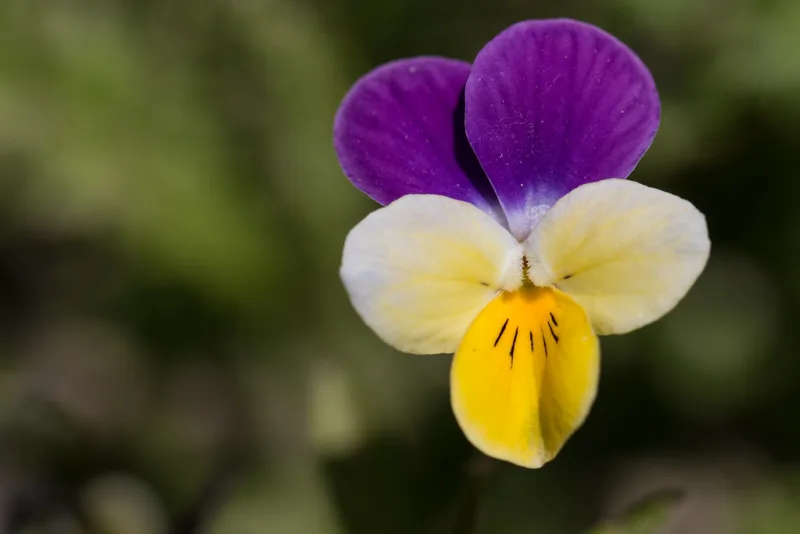
Wild pansy (Viola tricolor) is a small, annual or biennial herbaceous plant in the Violaceae family, the same family as the fragrant sweet violets. Its name comes from the appearance of the flower: three main colors — violet, creamy white and yellow — seem to sit “spotted” side by side on the same bloom. In English it is also poetically called heartsease, Johnny-jump-up or “three-faces-in-a-hood,” while in Romanian it is “trei-frați-pătați,” meaning the three spotted brothers.
The plant usually reaches 10–30 cm in height, with branching stems, oval or lance-shaped leaves and characteristic flowers bearing five irregular petals. It blooms from spring until late autumn, making it one of those generous plants that offer flowers almost throughout the warm season. We find it growing wild in meadows, hayfields, roadsides, fallow land, sandy soils and among crops, from the lowlands up toward the mountains. It is a hardy, modest plant that asks for no special conditions and has accompanied rural households for centuries.
For medicinal use, the flowering aerial part (Violae herba) is harvested — that is, the stems with leaves and flowers — at the peak of the flowering period, when the content of active substances is highest. It is dried in the shade, in a thin layer, in a well-ventilated place away from direct sun, and stored in paper bags or jars, away from moisture.
Composition and active principles
Although it looks like an unremarkable flower, wild pansy hides a rich chemistry that explains its reputation as a “friend of the skin.” Phytochemical studies suggest that the plant contains several important categories of compounds:
- Flavonoids (such as rutin, violanthin and various glycosides) — antioxidant substances that support the small blood vessels and have a mild anti-inflammatory effect.
- Saponins — compounds that explain the expectorant action (thinning of secretions) and the mild depurative effect; they are also the reason for caution at high doses.
- Phenolic acids (bound salicylic acid, caffeic acid, coumaric acid) — which contribute to the anti-inflammatory and mildly antiseptic effect.
- Mucilage — plant substances with an emollient effect, forming a soothing film over mucous membranes and skin.
- Carotenoids and tannins — with antioxidant and mildly astringent roles.
- Mineral salts, including silicon compounds, considered useful for the health of the skin and connective tissue.
This combination — flavonoids, mucilage, saponins and phenolic acids — makes wild pansy a plant with complex action: on one hand it soothes and softens, on the other it supports elimination and has a gentle anti-inflammatory effect. This is precisely why tradition has used it both internally (teas) and externally (compresses, baths).
Health benefits
Support for clear, healthy skin
The best-known use of the plant, passed down from generation to generation, is connected with skin problems. Folk tradition recommended wild pansy especially for skin prone to rashes, itching, cradle cap in infants, dry eczema and acne. The plant was thought to “cleanse the blood,” and the skin, being a mirror of the inside, would clear up as a result. In modern terms, we would say that the mucilage and flavonoids soothe local irritation, while the gentle depurative and anti-inflammatory action supports the natural healing processes.
Emollient and soothing effect on mucous membranes
Thanks to its mucilage, the plant has a remarkable emollient effect. Wild pansy tea has been used to soothe an irritated throat, to calm a dry cough and to support inflamed mucous membranes of the airways. The saponins add a mild expectorant effect, helping to thin secretions.
Mild diuretic and depurative action
Folk tradition valued wild pansy for its mild diuretic effect — that is, gentle stimulation of water elimination through the kidneys — and for its role as a “spring cleanse.” In the detox cures of our grandparents, the plant often appeared alongside nettle, dandelion and yarrow, in a blend meant to “get the blood moving” after the long winter months.
Anti-inflammatory and antioxidant support
The abundance of flavonoids and phenolic acids gives the plant antioxidant properties. Antioxidants help the body cope with oxidative stress, while the mild anti-inflammatory effect is reflected both in the skin and in general well-being. Preliminary studies suggest that Viola tricolor extracts might also hold interesting potential in other directions, but these remain subjects of research and do not justify exaggerated promises.
Calming and balancing effect
In some traditions, wild pansy tea was drunk in the evening, as a warm and gentle beverage believed to bring a sense of calm. Although it is not a true sedative, the ritual of a warm evening tea has its own well-known soothing effect.
Traditional uses in folk medicine
In Romanian villages, wild pansy was used in several ways:
- Internal tea for “cleansing the blood,” for problem skin and for coughs.
- Compresses and washes with concentrated tea, applied to areas with eczema, rashes, cradle cap or itching.
- Partial or full baths with a plant decoction, especially for children with sensitive, irritation-prone skin.
- Tea blends alongside other depurative plants (nettle, burdock, dandelion, wild pansy and yarrow), for spring cures.
- Poultices made from the steamed plant, applied locally to irritated skin.
Old European herbalists also recommended the plant under the Latin name Herba Jaceae, with mentions in herbal treatises as far back as the Middle Ages for “children’s skin diseases.” This continuity across centuries, from old remedy books to today’s grandmothers, says a great deal about the trust people have placed in this modest little flower.
How to prepare it: tea, infusion, compresses and baths
Wild pansy tea (infusion)
This is the simplest and most widespread method of preparation.
You need:
- 1–2 teaspoons of dried plant (flowering aerial part, chopped)
- 250 ml water
Steps:
- Place the plant in a cup.
- Boil the water and let it settle for 30 seconds after it has come to a boil (the water should not be violently boiling, so as not to destroy the delicate mucilage).
- Pour the hot water over the plant.
- Cover the cup and let it infuse for 10–15 minutes.
- Strain and drink the tea warm, sweetened, if you like, with a little honey (once it has cooled slightly, so as not to destroy the enzymes in the honey).
You can usually drink 2 cups per day, in courses of 2–3 weeks, followed by a break.
A stronger decoction for external use
For compresses and washes, we need a stronger preparation.
You need:
- 2–3 tablespoons of dried plant
- 500 ml water
Steps:
- Put the plant and cold water in a pot.
- Bring to a boil and simmer gently for 5 minutes.
- Turn off the heat, cover and let it infuse for another 15–20 minutes.
- Strain well.
- Use the lukewarm liquid to soak clean gauze compresses, which you apply to the affected areas 1–2 times a day.
A wild pansy bath
For irritated skin over larger areas, especially in children, a gentle bath can be soothing.
Steps:
- Prepare a larger decoction: a good handful of plant (approx. 50 g) to 2 liters of water.
- Simmer 5–10 minutes, let it infuse for 15 minutes, then strain.
- Pour the liquid into the warm bath water.
- Soak in the bath for 10–15 minutes, without rubbing the skin hard.
Poultice
For local application on a small, irritated area:
- Scald one or two tablespoons of the plant with very little boiling water, just enough to moisten it.
- Let it cool until it becomes warm and bearable.
- Wrap the plant in a piece of clean gauze.
- Apply to the affected area for 15–20 minutes.
Dosage and how to take it
As a general rule, for internal use as a tea, 1–2 teaspoons of dried plant are used per cup (250 ml), once or twice a day. Courses are usually taken for limited periods — 2 to 3 weeks — followed by a break of at least a week. This “with breaks” rhythm is recommended by herbal tradition for most depurative plants, precisely to avoid overburdening the body and to give it time to adapt.
For external use, the concentrated decoction or the stronger infusion can be used daily, as long as the skin responds well. If additional redness, stronger itching, or any sign of an unexpected reaction appears, discontinue use.
For children, doses are reduced, and internal use should only be undertaken on the recommendation of a doctor or a specialist. For children’s baths, the diluted decoction is usually well tolerated, but caution remains essential.
Wild pansy in skin and hair care
Beyond teas and compresses, the plant has also found its place in homemade natural cosmetics. Here are a few practical ideas, inspired by tradition and adapted to the modern household:
- Facial toner: a cooled, well-strained wild pansy tea can be used as a toner for skin prone to irritation. Apply with a cotton pad, morning and evening.
- Soothing ice cubes: the concentrated, cooled tea can be poured into ice cube trays and used to calm irritated skin or skin reddened by the sun (gently, never directly on broken skin).
- Scalp rinse: a lukewarm infusion can be used as a final rinse after washing the hair, for a scalp prone to itching and mild dandruff.
- An addition to herbal blends: combined with chamomile and calendula, wild pansy rounds out gentle formulas suited to sensitive skin.
These uses belong to gentle, traditional cosmetics and do not replace dermatological treatment when a diagnosed condition is present.
Practical tips and common mistakes
Mistake no. 1: Boiling the flowers for a long time. The delicate mucilage and flavonoids break down with prolonged boiling. For the tea you drink, use an infusion (hot water poured over the plant), not long boiling. The boiled decoction is reserved for external use.
Mistake no. 2: Doses that are too large, thinking “more is better.” Because of the saponins, excessive doses can cause nausea and digestive discomfort. Respect the quantities and take breaks between courses.
Mistake no. 3: Harvesting near roads or treated land. Plants gathered from roadsides or near crops sprayed with pesticides can be contaminated. Harvest from clean places, away from pollution, or buy the herb from trustworthy sources.
Mistake no. 4: Confusing it with garden pansies. Ornamental garden pansies (hybrids of Viola × wittrockiana) are not the same plant as wild pansy and do not have the same tradition of use. For remedies, Viola tricolor, the wild plant, is used.
Mistake no. 5: Unrealistic expectations. Wild pansy is a gentle, supportive plant. It is not a miracle medicine and does not cure overnight. The benefits appear gradually, with consistent courses, and are felt best as part of a healthy lifestyle.
Mistake no. 6: Ignoring warning signs. If a skin problem worsens, becomes infected (hot, swollen, with pus), or is accompanied by fever, the plant is not enough. See a doctor.
Conclusion
Wild pansy is living proof that the most modest plants often hide the most beautiful traditions. This tricolored little flower, found in meadows and at the edges of roads, has accompanied households for centuries, valued especially for the gentleness with which it soothes irritated skin and for its role in spring “cleansing” cures. Rich in flavonoids, mucilage, saponins and phenolic acids, the plant combines an emollient action with a mildly anti-inflammatory and depurative one. Used with measure — in teas for internal use and in compresses, baths or poultices for external use — it can become a pleasant, natural ally. The important thing is to use it sensibly, in courses with breaks, from clean sources, and to remember that when a problem persists, a doctor’s advice remains irreplaceable.
Frequently Asked Questions
Are wild pansy and garden pansies the same thing? Not quite. Wild pansy (Viola tricolor) is the modest wild plant with small flowers. Garden pansies are ornamental hybrids derived from it and other viola species, with large, colorful blooms. For traditional remedies, the wild plant is used.
Can I drink wild pansy tea every day, indefinitely? The traditional recommendation is to take courses of 2–3 weeks, with breaks. Continuous use over very long periods is not advised, especially because of the saponins. The breaks allow the body to rest.
Is it safe for children? For baths and external compresses, the diluted decoction is generally well tolerated and has been used traditionally for the sensitive skin of little ones. For internal use in children, however, a doctor’s advice is needed.
Does it really help with eczema and acne? Folk tradition recommends it for skin prone to irritation, dry eczema and acne, and studies suggest an anti-inflammatory and emollient effect. Still, the plant is a support, not a stand-alone treatment for diagnosed dermatological conditions.
How do I recognize the plant when gathering it? Look for a small plant, 10–30 cm tall, with flowers bearing five irregular petals in which violet, creamy white and yellow are mixed, often with dark stripes toward the center. It blooms from spring until autumn. If you are unsure, buy the dried herb from pharmacies or health stores.
Can it be combined with other plants? Yes. Traditionally, it is combined with nettle, burdock, dandelion, yarrow or chamomile, in depurative or skin-soothing blends. The important thing is to know the properties of each plant in the mix.
Can pregnant women use the plant? As a precaution, in the absence of sufficient safety data, internal use is advised against during pregnancy and breastfeeding, without a doctor’s approval.
How do I store the dried plant? In paper bags or glass jars, in a dry, dark, cool place. Keep it away from moisture and direct light. Used within about a year, it retains its properties best.