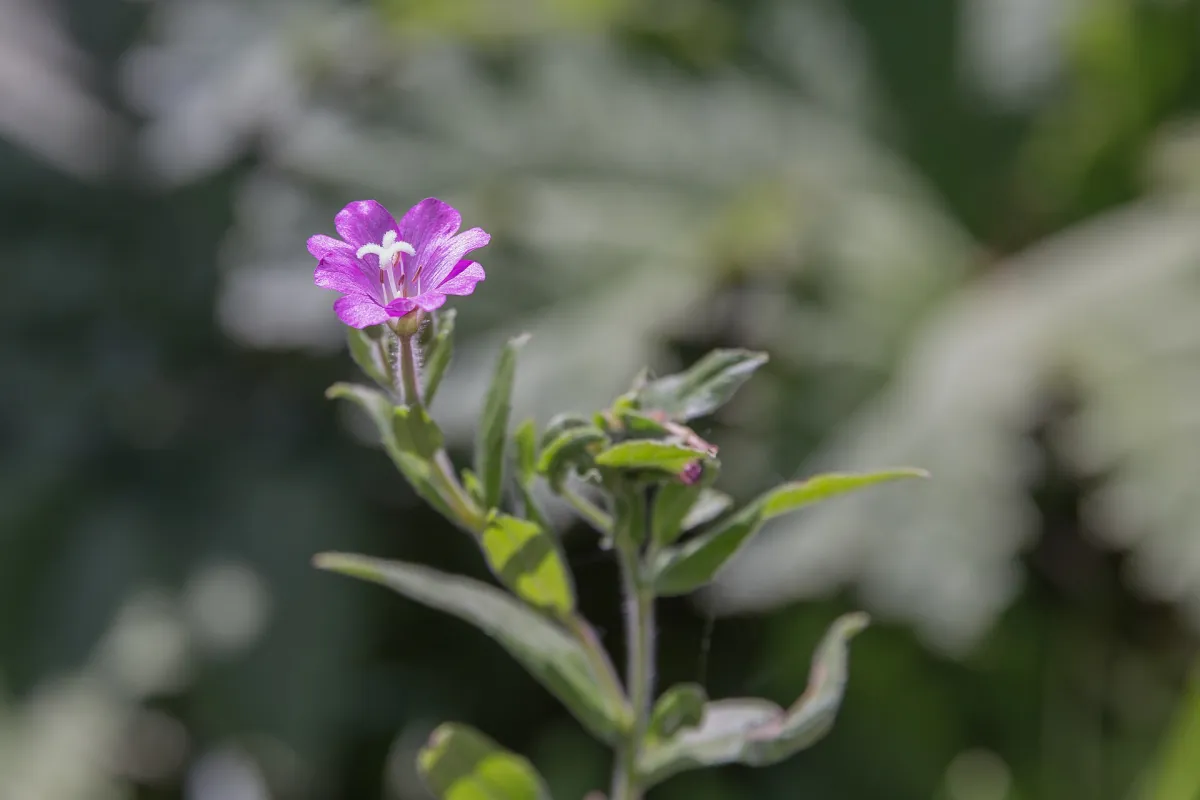
 Photo: William Crochot (Medium69), CC BY-SA 4.0, via Wikimedia Commons
Small-flowered willowherb (Epilobium parviflorum) is the herb many men look for as a prostate tea: it is traditionally used for the urinary symptoms of benign prostatic hyperplasia (BPH) and in chronic prostatitis, as an add-on. It contains oenothein B, a tannin that in laboratory studies inhibits enzymes involved in prostate growth and has anti-inflammatory effects. It is taken as a short infusion, 1 teaspoon per cup, twice a day. Human clinical studies are few, so the tea does not replace a urology check-up.
The plant became popular in Romania after the books of Austrian herbalist Maria Treben, who recommended it strongly. Below you will find what is true, what is exaggerated and how to use it safely.
Key takeaways
- The flowering aerial parts of the small-flowered species are used: E. parviflorum, E. montanum, E. roseum; fireweed (E. angustifolium) is also widely sold.
- The key compound: oenothein B (an ellagitannin), plus flavonoids (myricetin, quercetin).
- In the lab: it inhibits 5-alpha-reductase and aromatase, with anti-inflammatory and antioxidant effects.
- Clinical evidence: limited, a few small studies with extracts; no evidence that it prevents prostate cancer.
- Before any course: see a urologist and have a PSA test, because BPH and prostate cancer symptoms can be identical.
What willowherb is and how to recognise it
The genus Epilobium includes several species in the Onagraceae family, called “pufuliță” (little fluff) in Romanian because of their seeds, which carry tufts of silky white hairs and float away in autumn. Small-flowered willowherb (E. parviflorum) grows 30-80 cm tall, with hairy stems, soft elongated leaves and small flowers, 6-10 mm, pale pink to violet, with four petals notched at the tip. The fruit is a long, thin capsule.
It grows in damp places: ditches, stream banks, marshes and shady roadsides. It is easy to tell apart from fireweed or rosebay willowherb (E. angustifolium, now Chamaenerion angustifolium), a much taller plant (1-2 m) with showy spikes of large purple-pink flowers that colonises clearings and felled woodland.
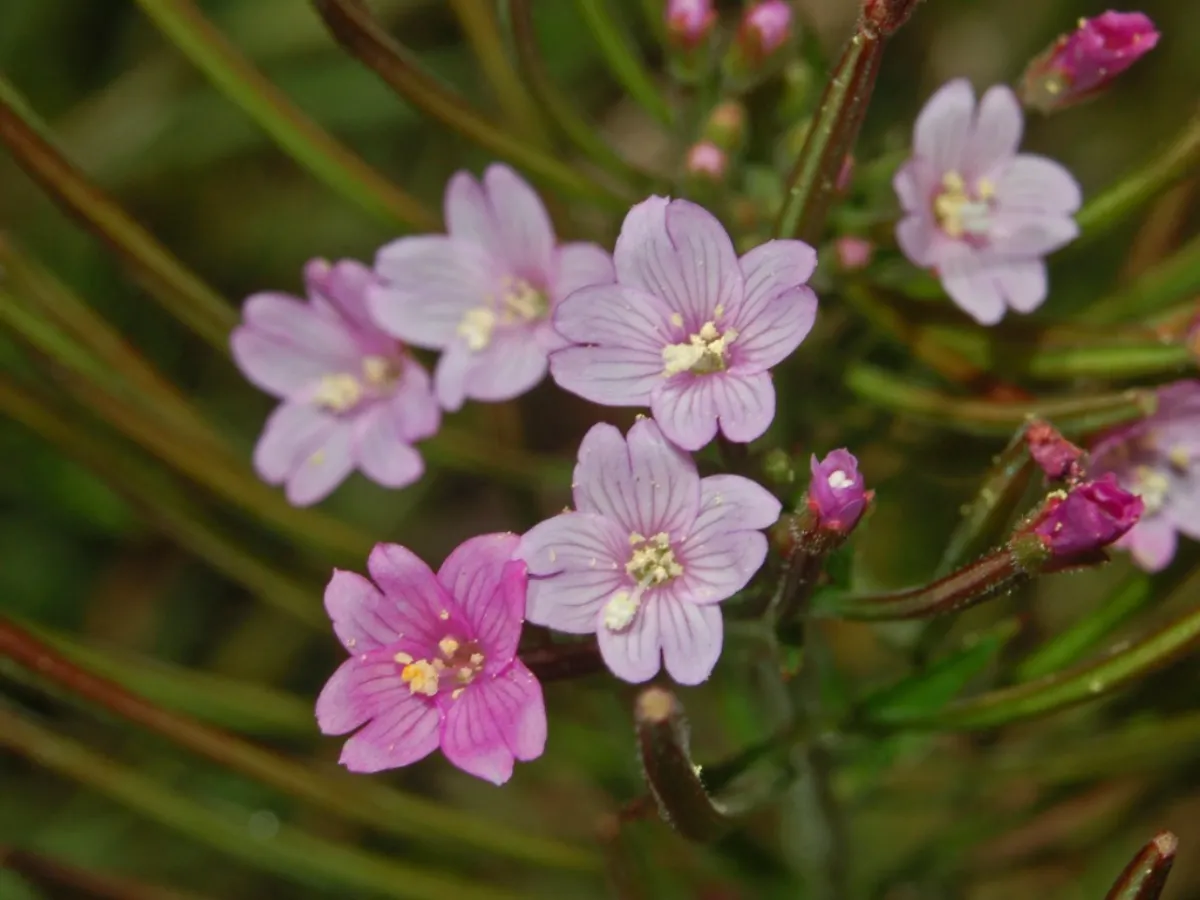 Photo: Hectonichus, CC BY-SA 3.0, via Wikimedia Commons
Which species is used?
Maria Treben explicitly recommended the small-flowered species and warned against fireweed. Modern chemical analyses show, however, that E. angustifolium also contains oenothein B, and most laboratory and clinical studies have used precisely that species. In practice both are used; what matters is that the product is correctly identified and clean.
Harvesting and drying
Gather the aerial parts during flowering (June-August), cut 10 cm above the ground. Dry in the shade in a thin layer, turning daily. Store the dried herb in a closed jar away from light for up to a year.
Composition and active compounds
- Oenothein B: a macrocyclic ellagitannin considered the main active compound; in the lab it inhibits 5-alpha-reductase (the enzyme converting testosterone into dihydrotestosterone, involved in prostate growth) and aromatase.
- Flavonoids: myricetin, quercetin and kaempferol glycosides; antioxidant and anti-inflammatory.
- Phenolic acids (gallic, ellagic, chlorogenic).
- Phytosterols (beta-sitosterol) and triterpenes in small amounts.
Benefits: what tradition says and what studies show
Benign prostatic hyperplasia (BPH)
BPH affects most men after 50-60 and shows up as a weak stream, frequent urination, getting up at night to urinate and a feeling of incomplete emptying. Willowherb has traditionally been used for exactly these symptoms. Laboratory studies explain why: inhibiting 5-alpha-reductase is also how some prostate medicines work. Clinically, at least one small randomised trial with a standardised Epilobium extract reported improvement in urinary symptoms and night-time urination compared with placebo. The results are promising but not enough to recommend the herb instead of urological treatment. For a full picture, read our articles on prostate problems and nocturia.
Chronic prostatitis
The anti-inflammatory and antimicrobial effects seen in the lab have led to willowherb being used as an add-on in chronic non-bacterial prostatitis. There are no dedicated clinical trials. Acute prostatitis with fever is a medical emergency treated with antibiotics; see also our article on prostatitis.
Prostate cancer: beware of promises
Online claims that willowherb “cures” or “prevents” prostate cancer are common. Some laboratory studies found that extracts slow tumour cell growth in culture, but no clinical study has shown an effect in humans. Using the tea instead of investigations or cancer treatment can cost years of life.
Other uses
Traditionally: bladder complaints in women, diarrhoea (thanks to tannins), gargles for the throat and compresses for irritated skin. These are secondary uses without studies.
How to prepare willowherb
Short infusion (traditional recipe)
- Put 1 heaped teaspoon (about 1.5-2 g) of dried herb into a cup.
- Pour over 250 ml of boiling water.
- Cover and steep for only 1-3 minutes (Maria Treben recommended a very short infusion), or up to 5-10 minutes for better tannin extraction.
- Strain.
Drink 2 cups a day: one in the morning on an empty stomach and one in the evening, 30 minutes before dinner. Do not drink the last cup right before bed, or you will need to urinate more at night.
Traditional combinations
- Willowherb + nettle (root): nettle root has the most data among European herbs for BPH.
- Willowherb + goldenrod or couch grass: when there is also urinary irritation.
Use no more than 2-3 herbs in one blend.
Commercial extract
Capsules of Epilobium extract (often standardised to oenothein B) are taken according to the manufacturer’s directions. They offer a consistent dose, but quality varies a lot between products.
Dosage guide
| Form | Amount | Frequency | Duration |
|---|---|---|---|
| Infusion | 1.5-2 g per 250 ml, 1-10 min | 2 cups/day | 6-8 weeks, then a 2-week break |
| Blend with nettle root | 1 tsp blend per 250 ml (root simmered 5 min) | 2 cups/day | 6-8 weeks |
| Standardised extract | as per label | daily | as per label, with urology review |
Any effect on urinary symptoms usually shows after 4-8 weeks. Note how many times you wake at night before and after the course for an objective assessment.
Contraindications and precautions
Willowherb is generally well tolerated, but:
- Tannins can irritate a sensitive stomach and cause constipation; drink after a light breakfast if you get heartburn.
- Iron and medicines: keep 2 hours apart from iron supplements and other drugs.
- Prostate medication (finasteride, dutasteride, tamsulosin): no well-documented interactions, but mechanisms may overlap; inform your urologist.
- Pregnancy and breastfeeding: no data, avoid.
- Children: not used.
- Note: the tea can ease symptoms and thereby delay the diagnosis of a serious problem.
When to see a doctor
- Before starting any course for prostate symptoms: urological examination, PSA, ultrasound.
- Inability to pass urine (acute urinary retention): an emergency.
- Blood in the urine or semen.
- Fever, chills, pain in the perineum (possible acute prostatitis).
- Bone pain or unexplained weight loss.
- Symptoms getting worse despite treatment.
Common mistakes
Tea instead of a urology check. BPH and prostate cancer can cause the same symptoms. A PSA test and medical examination are essential.
Buying unidentified herb. Several Epilobium species look alike; choose reliable sources.
The last cup before bed. It increases night-time urination, exactly what you want to avoid.
Expecting results in a few days. If an effect comes, it takes weeks.
Believing the tea treats cancer. There is no clinical evidence.
Conclusion
Willowherb is one of the most widely used prostate herbs in Romania, and laboratory research on oenothein B gives it a plausible basis. Clinical evidence is still at an early stage, so the tea should be seen as an add-on for mild urinary symptoms of BPH, after a urology check-up, not as a stand-alone treatment. Used correctly, two cups a day in courses of several weeks, it is well tolerated. And the most important advice remains the same: an annual prostate check after 50.
Frequently asked questions
Does willowherb tea shrink the prostate? There is no clinical evidence that it reduces prostate size. Laboratory studies and a few small trials suggest it may ease urinary symptoms, especially getting up at night.
What is the difference between willowherb and fireweed? Small-flowered willowherb (E. parviflorum) is a short plant with small, pale pink flowers. Fireweed (E. angustifolium) is tall, with spikes of large purple flowers. Both contain oenothein B.
How long can I drink willowherb tea? In courses of 6-8 weeks followed by a 2-week break, with periodic urological review.
Can I drink willowherb if I take prostate medication? There are no well-documented interactions, but tell your urologist, as the mechanisms of action may overlap.
Does willowherb prevent prostate cancer? No clinical studies show this. Prevention and early detection rely on regular check-ups and PSA testing as advised by your doctor.
Can I drink willowherb tea in the evening? Yes, but at least 2-3 hours before bed, so it does not increase night-time urination.
Is willowherb also good for women? It has traditionally been used for bladder irritation in women, but evidence is weak. For cystitis there are better-documented herbs, such as goldenrod.
Sources and further reading
- PubMed reviews on Epilobium and oenothein B (activity on 5-alpha-reductase, aromatase and inflammation).
- Small randomised clinical trials of Epilobium extract in benign prostatic hyperplasia (PubMed).
- European Association of Urology (EAU) guidelines on male lower urinary tract symptoms.
This article is for information only and does not replace medical advice. Talk to your doctor or pharmacist before using medicinal plants, especially if you take medication or have a chronic condition.