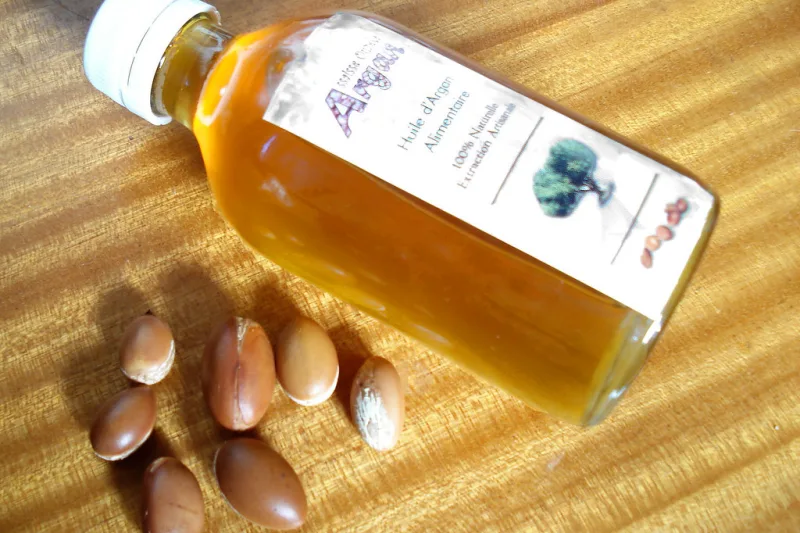

Argan Oil: Benefits, Uses and How to Apply It
IMPORTANT: Argan oil is generally very well tolerated, both applied to skin and hair and consumed internally (the culinary version). However, people with allergies to nuts or tree fruits should first do a patch test on a small area of skin (the inner forearm) and wait 24 hours before using it on the face or scalp. Cosmetic oil (cold-pressed, non-deodorized) is NOT for consumption; only the food-grade oil, made from lightly roasted seeds, is meant to be eaten. During pregnancy and breastfeeding, oil applied externally is safe, but for internal consumption in large amounts it is wise to consult a doctor. If redness, itching or rashes appear after application, stop using it. Argan oil does not replace medical treatment for serious dermatological conditions such as severe eczema, psoriasis or cystic acne — in these cases consult a dermatologist.
Aunt Zohra, a woman I met years ago in a small Berber village near Agadir, sat on a woven rug with a stone bowl between her knees, cracking those strange almond-like kernels, hard as rock, from the argan tree. Her palms were calloused and her movements smooth, repeated thousands of times. “This oil,” she told me with a smile, rubbing a drop onto the back of her hand, “keeps our skin young and our hair shiny even under the desert sun.” The women in her family had been making argan oil for generations, grinding the seed kernels on a stone mill and kneading the paste with warm water until the golden liquid came out.
Later, an aunt of mine from Romania, who had worked for a few years as a caregiver abroad, brought me a small, precious bottle of argan oil. She kept it in the bathroom cabinet like a treasure and used only a few drops in the evening, on her face and the ends of her hair. “It’s expensive, but it lasts,” she would say. And she was right: a good bottle of pure argan oil lasts for months, because you use it in tiny amounts. That is how I, too, came to treasure this “liquid gold” of Morocco.
Argan oil is a plant oil extracted from the seeds of the argan tree (Argania spinosa), a species that grows almost exclusively in southwestern Morocco, in a semi-desert region recognized by UNESCO as a biosphere reserve. The tree is extremely drought-resistant and can live for hundreds of years. From its seed kernels, rich in healthy fats, vitamin E and antioxidants, an oil prized for centuries by the Berber people for skin and hair care and for cooking is extracted. In recent decades, argan oil has become a star ingredient in natural cosmetics worldwide, added to creams, shampoos, serums and luxury care products.
Table of Contents
- What argan oil is and how it is made
- The composition of argan oil
- Benefits for hair
- Benefits for skin
- Benefits for nails, lips and cuticles
- The benefits of culinary argan oil
- How to use argan oil: recipes and methods of application
- How to choose a quality argan oil
- How to store it correctly
- Lifestyle and natural care
- Practical Tips and Common Mistakes
- Conclusion
- Frequently Asked Questions
What argan oil is and how it is made
The argan tree is a gnarled, thorny tree with a broad crown, perfectly adapted to the harsh conditions of the plains and hills of the Souss region in southern Morocco. Local goats often climb into its branches to eat the leaves and fruit — an image that has become famous. The argan fruit resembles a large olive, with a fleshy outer layer surrounding a very hard nut. Inside this nut are one to three oil-rich seeds, and the oil is extracted from them.
The traditional process is painstaking and almost entirely manual, which is why authentic argan oil is so expensive. First the fruits are dried in the sun and the pulp is removed. Then the hard nuts are cracked open with stones — a delicate task that could never be fully mechanized, since the nut is irregular. The seed kernels are ground on a stone mill, and the resulting paste is kneaded with warm water, pressed by hand until the oil separates. It takes several hours of work and large quantities of fruit to produce a single liter of oil — hence the high price.
There are two main types of argan oil:
- Cosmetic oil — made from unroasted seeds, cold-pressed, with a light golden color and a discreet scent. It is intended exclusively for application on skin, hair and nails.
- Culinary (food-grade) oil — made from lightly roasted seeds, with a darker color, a nutty taste and a pronounced aroma. It is used in cooking, in salads, or in the traditional Moroccan preparation amlou (a paste of argan oil, almonds and honey).
Today, many women’s cooperatives in Morocco produce argan oil using modern technology (mechanical cold-pressing), which maintains quality and provides an important income for local communities. When you buy certified argan oil, you often support these cooperatives.
The composition of argan oil
The richness of argan oil lies in its remarkable nutritional profile. Here are the main components that give it its value:
- Unsaturated fatty acids (about 80%) — oleic acid (omega-9) and linoleic acid (omega-6) predominate. These help maintain the skin’s lipid barrier, hydrate it and keep it elastic.
- Vitamin E (tocopherols) — argan oil is one of the richest natural sources of vitamin E, a powerful antioxidant that protects cells from oxidative stress and contributes to skin regeneration.
- Polyphenols and antioxidants — compounds that neutralize free radicals and have anti-inflammatory effects.
- Plant sterols (schottenol and spinasterol) — relatively rare in other oils, with a role in maintaining hydration and supporting skin metabolism.
- Squalene — a natural substance also present in human sebum, which helps hydrate and protect the skin.
- Carotenoids — pigments with an antioxidant effect.
This combination makes argan oil a nourishing, easily absorbed and non-comedogenic ingredient (it does not clog pores), which makes it suitable for almost all skin types.
Benefits for hair
Argan oil is probably best known for its effects on hair. Many commercial hair serums and oils contain it as a main ingredient.
Hydrates and restores shine
Fatty acids and vitamin E penetrate the hair shaft, nourishing it and restoring its elasticity. Dry, dull and rough hair becomes softer, more supple and gains a natural shine. A few drops applied to the lengths and ends are enough for a visible effect.
Reduces split ends and frizz
By sealing the hair cuticle, argan oil reduces the appearance of split ends and tames electrified or curly hair. It is ideal for thick, wavy or frizz-prone hair, especially on humid days.
Protects from heat and environmental factors
Applied before using a flat iron or a hair dryer, argan oil forms a light protective film that reduces heat damage. It also partially protects hair from sun, wind and salt water.
Supports scalp health
Gently massaged into the scalp, the oil can soothe dry, flaky skin, helping to reduce dandruff caused by dryness. A healthy scalp is the foundation of healthy hair.
Benefits for skin
On the skin, argan oil is prized for its moisturizing, regenerating and anti-aging qualities.
Deep hydration without a greasy feel
Thanks to its light structure, argan oil absorbs quickly and hydrates the skin without leaving an oily layer. It is suitable for dry skin, but also for normal or combination skin.
Anti-aging effect
Vitamin E and antioxidants help combat free radicals, the main culprits in premature skin aging. Used regularly, argan oil helps maintain elasticity, smooth fine lines and give the complexion a more radiant appearance.
Soothes irritation and inflammation
Its anti-inflammatory properties make argan oil an ally for irritated, reddened or sensitive skin. Folk tradition used it to soothe sunburned skin or skin chapped by cold.
Helps reduce scars and stretch marks
Applied consistently, the oil can improve the appearance of skin with mild scars or stretch marks, supporting regeneration and elasticity. Many women use it during and after pregnancy to keep the skin supple.
Balances oily skin
It may seem counterintuitive, but argan oil, being non-comedogenic, can also help oily skin: by hydrating it properly, it signals the sebaceous glands to produce less excess sebum.
Benefits for nails, lips and cuticles
The versatility of argan oil does not stop at hair and complexion. A few drops massaged into the cuticles and nails nourish them, preventing dryness and brittleness. On chapped lips, especially in winter, it acts as a natural restorative balm. It can also be used on elbows, knees and heels, areas prone to dryness and roughness.
The benefits of culinary argan oil
The culinary version, made from roasted seeds, has been eaten in Morocco for centuries and is valued for its healthy fat profile. Folk tradition and research suggest that moderate consumption may contribute to:
- maintaining healthy cholesterol levels, thanks to the unsaturated fatty acids;
- supporting cardiovascular health;
- providing antioxidants and vitamin E.
It has a delicate nutty taste and is used drizzled over salads, vegetables, soups, or in the traditional amlou paste. It is NOT used for frying, because high heat destroys its beneficial compounds. Important: only oil labeled as food-grade should be consumed; cosmetic oil is not meant to be eaten.
How to use argan oil: recipes and methods of application
Evening facial serum
Wash your face and apply your usual toner. Put 2–3 drops of argan oil in your palms, rub them gently to warm the oil and then press it delicately onto your face and neck, avoiding the eye area or applying very little there. It absorbs quickly and leaves the skin velvety. It can also be used in the morning, under cream or makeup, in a small amount.
Hydrating hair mask
Gently warm 1–2 tablespoons of argan oil (over a steam bath, not hot). Apply to slightly damp hair, from mid-length to the ends, also massaging the scalp if it is dry. Cover the hair with a warm towel or a shower cap and let it work for 30–60 minutes (or overnight for an intensive treatment). Then wash with shampoo. Repeat once a week.
Leave-in treatment for ends
On washed and slightly damp hair, put 1–2 drops of oil in your palms and apply only to the ends and lengths, without touching the roots. Do not rinse. It tames frizz and adds shine.
Body massage oil
Argan oil can be used alone or mixed with other oils (almond, jojoba) for a nourishing massage. Apply it to slightly damp skin after a shower for optimal absorption.
Cuticle and nail treatment
Soak your fingertips in a small bowl of argan oil for a few minutes, then massage the cuticles. Do this 2–3 times a week for stronger nails and nourished cuticles.
Improvised lip balm
Apply a drop of oil to chapped lips, possibly mixed with a little honey, for a quick restorative effect.
How to choose a quality argan oil
There are many products on the market that contain only traces of argan oil or that are diluted. To choose an authentic product:
- Look for the label 100% pure argan oil, with no other oils added; the ingredient list should show only Argania Spinosa Kernel Oil.
- Prefer cold-pressed and unroasted oil for cosmetic use.
- For culinary use, explicitly choose the culinary version (from roasted seeds).
- Authentic oil has a golden color and a discreet, slightly nutty scent; deodorized cosmetic oil has a very faint smell. If the smell is strong, rancid or chemical, avoid the product.
- The ideal packaging is a dark glass bottle (cobalt or amber), which protects the oil from light.
- If you can, support products from certified women’s cooperatives in Morocco.
How to store it correctly
Argan oil should be kept in a cool place, away from direct light and heat sources. The bottle must be closed tightly after each use to limit oxidation. A pure oil, stored correctly, generally lasts 1–2 years. If the oil develops a rancid smell or a changed color, stop using it. There is no need to keep it in the refrigerator, but you can store it there if you live in a very hot area.
Lifestyle and natural care
Argan oil delivers even better results when it is part of a balanced care routine and a healthy lifestyle. Skin and hair reflect what we eat, how much we sleep and how well we hydrate. Adequate water intake, a diet rich in vegetables, fruit, healthy fats (nuts, seeds, oily fish) and quality sleep support beauty from within, while argan oil complements it from the outside.
For hair care, avoid washing too frequently with hot water and overusing heat tools; these habits dry out the hair shaft and cancel the oil’s benefits. For the complexion, daily sun protection remains the most important anti-aging step, and argan oil can be applied in the evening, when the skin regenerates. A few drops, used consistently, do more than a large amount used rarely.
Practical Tips and Common Mistakes
Mistake no. 1: Using too much. Argan oil is concentrated. If you apply too much, the skin or hair will look greasy. Start with 2–3 drops and add more only if needed.
Mistake no. 2: Applying to dirty or overly wet hair. For best results, apply the oil to clean and only slightly damp hair (for leave-in treatment), or use it as a mask before washing. On very wet hair, the oil does not penetrate well.
Mistake no. 3: Confusing cosmetic oil with culinary oil. They are different products. Do not consume cosmetic oil and do not use the strongly roasted-smelling cooking oil on your face.
Mistake no. 4: Buying a cheap “argan” product. If the price is suspiciously low, the oil is most likely diluted or contains only a fraction of argan. Read the ingredient list.
Mistake no. 5: Giving up too soon. The effects on dry hair or mature skin appear over time, through consistent use, not overnight. Be patient for a few weeks.
Mistake no. 6: Storing in light and heat. Light and heat oxidize the oil. Keep the bottle closed, in a cool and dark place.
Mistake no. 7: Skipping the allergy test. Especially if you have sensitive skin or nut allergies, test first on a small area of skin.
Conclusion
Argan oil has rightly earned the title of Morocco’s “liquid gold.” Rich in unsaturated fatty acids, vitamin E and antioxidants, it nourishes, hydrates and protects both skin and hair, while also being a healthy food in its culinary version. The centuries-old Berber tradition, carried forward today by women’s cooperatives in southern Morocco, offers us a versatile, effective and natural product. Used in moderation, consistently, and chosen carefully to be pure, argan oil can become one of the most cherished treasures in your care cabinet. A few drops every evening, patience and a balanced lifestyle — and the results will speak for themselves.
Frequently Asked Questions
Can I use argan oil every day? Yes, argan oil can be used daily, both on skin and hair. The important thing is to use small amounts (2–3 drops for the face, a few drops for the hair ends). For intensive hair treatments (masks), once a week is enough.
Does argan oil clog pores? No. Argan oil is considered non-comedogenic, meaning that it generally does not clog pores and is suitable even for blemish-prone skin. Still, every skin is unique, so observe how yours reacts.
What is the difference between cosmetic and culinary argan oil? Cosmetic oil is made from unroasted seeds, has a light color and a discreet scent, and is used on skin and hair. Culinary oil is made from lightly roasted seeds, has a darker color and a nutty taste, and is used in cooking. They are not interchangeable.
Does argan oil help hair grow? Argan oil does not “make” hair grow faster, but it nourishes the scalp and the hair shaft, reduces breakage and split ends, so the hair stays healthier and appears thicker and longer over time. A healthy scalp supports normal hair growth.
Can I use argan oil during pregnancy? Applied externally, on skin and hair, argan oil is considered safe during pregnancy and is even popular for preventing stretch marks. For internal consumption in large amounts, consult your doctor.
Why is argan oil so expensive? Because traditional production is painstaking and largely manual: the very hard nuts must be cracked by hand, and producing a liter of oil takes many hours of work and large quantities of fruit. The quality and authenticity justify the price.
Can I mix argan oil with other products? Yes. A few drops can be added to your face or body cream, to shampoo or conditioner, or mixed with other oils (jojoba, almond, castor) for customized hair and skin treatments.
How do I know if argan oil has gone bad? An oxidized (rancid) oil develops an unpleasant, sharp smell, different from its discreet nutty scent, and sometimes changes color. If you notice these signs, stop using it.