
Arnica Oil: Benefits, Uses and How to Apply It Correctly
IMPORTANT: Arnica oil is for EXTERNAL use only, on intact skin. Do NOT apply it to open wounds, cuts, scrapes or mucous membranes, and NEVER swallow it — arnica taken internally is toxic and can cause serious heart-rhythm disturbances, digestive irritation and other dangerous effects. Avoid it during pregnancy and breastfeeding, in small children, and in people allergic to plants of the Asteraceae family (daisies, calendula, chamomile, wormwood). If redness, itching or a rash appears, stop using it immediately. For fractures, severe sprains, pain that won’t ease, or bruises that appear for no reason, see a doctor. This article is for information only and does not replace medical advice.
A story from the foot of the mountain
Grandmother Veta, a lean and nimble woman from the villages below Ceahlău, kept a small dark bottle on her pantry shelf that she simply called “mountain butter.” It was in fact a macerate of yellow flowers gathered in late June, from the high meadows the goats never reached. Whenever a grandchild came home from play with a scraped, bruised knee, or a hay-cutter returned in the evening with a back stiff from the scythe, she would take out the little bottle, drip a bit of oil into her palm, rub it to warm it, and massage the spot with gentle, circular strokes. “Arnica pulls the bruise out,” she would say, “but only on whole skin, never on a wound.”
My father used to tell how, in his youth, after falling off the cart and badly hurting his hip, he couldn’t get to a doctor for three days — and until then his grandmother rubbed his thigh twice a day with that yellow oil. When he finally reached the clinic, the nurse marveled at how quickly the huge bruise had faded. I don’t know how much was the arnica and how much was being young, but that dark little bottle has stayed in my mind as the symbol of true mountain remedies.
What arnica oil is
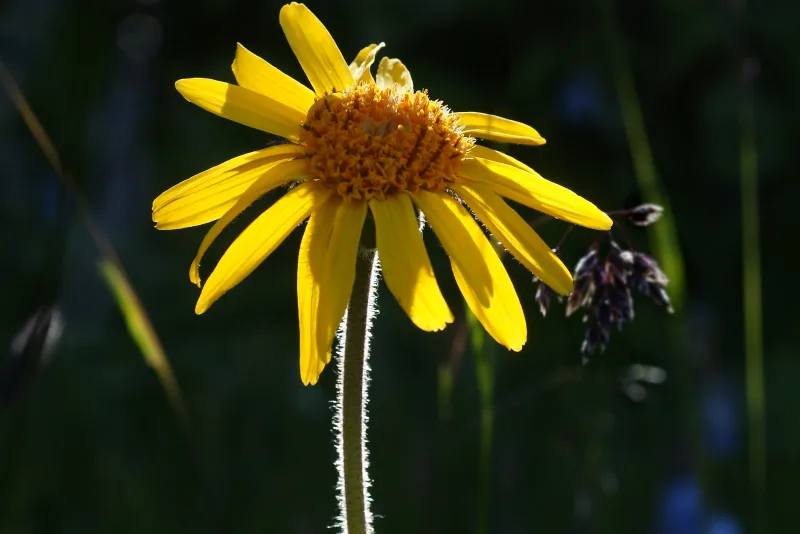
Arnica oil is not an oil “pressed” from seeds, like sunflower or flaxseed oil. It is an oil macerate: the yellow arnica flowers (usually Arnica montana, but also the cultivated Arnica chamissonis) are left to release their active principles into a base vegetable oil such as sunflower, olive or almond oil. The result is a golden oil with a herbaceous, slightly bitter smell, used for centuries in the folk medicine of Europe’s mountain regions for knocks, bruises, strains and aches.
Arnica montana is a perennial plant, protected in many countries, that grows in alpine and subalpine meadows, on poor, acidic soils at high altitudes. Its flowers look like yellow-orange daisies, with petals slightly frayed at the tips. Precisely because harvesting it from the wild is regulated or banned in many places, most arnica used today comes from cultivation or from the related chamissonis species.
In Romanian and Central European folk tradition, arnica is famous above all as a remedy for “knocks” — that is, for injuries that don’t break the skin: contusions, bruises, swellings, muscle soreness after exertion, joint stiffness. Hence its reputation as the “plant of falls.”
Table of Contents
- How arnica oil is made and what it contains
- The main health benefits
- Traditional uses
- How to make it at home (step-by-step recipe)
- How to use it correctly and in what amounts
- Combinations with other plants and oils
- Lifestyle tips for recovery
- Practical tips and common mistakes
- Conclusion
- Frequently Asked Questions
How arnica oil is made and what it contains
Arnica flowers are gathered in dry weather, when fully open, and used either fresh (slightly wilted for a few hours to lose some water) or dried. They are covered with a vegetable oil and left to macerate for several weeks, during which the fat-soluble substances in the flower pass into the oil. Unlike arnica tincture (an alcohol-based extract), the oil macerate is gentler and better suited to massage and to the skin.
In terms of composition, arnica flowers are valued for several groups of active substances which, as studies suggest and as phytotherapeutic tradition holds, explain their effects:
- Sesquiterpene lactones, especially helenalin and its derivatives — considered the main agents behind the anti-inflammatory action and the “bruise-resorbing” effect.
- Flavonoids (such as luteolin, quercetin and their derivatives) — antioxidant compounds that support the small blood vessels.
- Volatile (essential) oils — which give the characteristic smell and contribute to the mild warming sensation.
- Phenolic acids and carotenoids — which color the oil yellow-orange and act as antioxidants.
- Coumarins and triterpenes — involved in the effects on local circulation.
An important point: the very sesquiterpene lactones that make arnica useful externally also make it toxic internally and sometimes irritating to sensitive skin. That is why following the rules of external use, on intact skin, is essential.
The main health benefits
Easing bruises and contusions
The best-known use of arnica oil is for bruises (ecchymoses) and knocks. Folk tradition and part of the modern literature suggest that local application supports the reabsorption of blood pooled under the skin and reduces the pain and tension in the injured area. Many people use it after sports knocks, after light falls, or even after minor cosmetic procedures (on a doctor’s recommendation), to help the bluish marks fade faster.
Relieving muscle aches
After intense effort, a day of physical work, or sport, muscles can become sore and stiff. Massage with arnica oil is traditionally used to relax the muscles and reduce the feeling of “muscle fever.” The combination of the massage itself, which stimulates circulation, and the plant’s active principles often brings a sense of relief and pleasant warmth.
Support for joints and stiffness
People with joints that “creak,” with morning stiffness or with discomfort after exertion often use arnica oil to massage the knees, ankles, shoulders or hands. It does not cure chronic joint disease, but it can bring temporary relief of discomfort and a feeling of better mobility after application.
Help for mild sprains and strains (once a serious injury is ruled out)
In the case of mild strains, after a doctor has ruled out a fracture or a tear, arnica oil is used as an aid to soothe the swelling and pain of the area. Caution, though: never on broken skin and never as a substitute for immobilization or for a medical check-up in a serious sprain.
Local anti-inflammatory effect
Thanks to helenalin and the other compounds, arnica has a reputation as a natural anti-inflammatory applied locally. This action explains why it is valued in so many situations involving swelling, heat and pain in a struck area.
Support for surface circulation
Through massage and a mild warming effect, arnica oil is also used for tired legs, the feeling of heaviness in the calves, or areas with sluggish circulation. It is not a treatment for varicose veins or vascular disease, but it offers comfort and a sense of relaxation.
Traditional uses
In mountain households, arnica oil or salve was a “first-aid remedy” for all kinds of knocks of daily work: the hay-cutter’s back, the shoulder of the one carrying wood, the ankle twisted on the trail, the finger struck with a hammer. Women also used it for the lower-back aches that came after heavy work in the fields. Hunters and shepherds carried it with them in their bags, alongside calendula salve.
Besides massage, arnica also went into compresses and poultices: a clean cloth soaked in the oil was laid over the struck area, covered with a warm rag and left to act. It was also a frequent ingredient in homemade salves, mixed with beeswax and other mountain plants.
How to make it at home (step-by-step recipe)
If you have access to arnica flowers from legal sources (cultivated, or bought dried from a trustworthy herb shop), you can make your own oil macerate. Here is the classic cold method:
Cold macerate (the slow method)
- Prepare the flowers. Use dried or lightly wilted arnica flowers (fully fresh flowers contain water that can turn the oil rancid). You’ll need roughly a jar loosely filled with flowers.
- Choose the base oil. Cold-pressed sunflower, olive or sweet almond oil are the most common choices. For sensitive skin, almond is the gentlest.
- Fill the jar. Place the flowers in a clean, dry jar and cover them completely with oil, leaving a finger’s width of oil above them (flowers sticking out of the oil can mold).
- Macerate for 3-4 weeks. Close the jar and keep it in a warm spot away from direct light. Shake it gently once a day. Some prefer to keep it in the sun for a few hours daily, as in the old tradition.
- Strain. After 3-4 weeks, strain the oil through a piece of cheesecloth or a fine sieve, squeeze the flowers well, and transfer the oil to a dark-colored bottle.
- Label and store. Note the date of preparation. Kept in the dark and cool, the macerate generally lasts 6-12 months.
Warm macerate (the quick method)
If you’re in a hurry, you can make a warm macerate: put the flowers and oil in a bowl over a steam bath (bain-marie), on very low heat, and keep the mixture warm (without boiling) for 2-3 hours. Let it cool, then strain as above. The warm method extracts faster, but at too-high temperatures some compounds can degrade, so keep the heat as gentle as possible.
Arnica salve (bonus)
For a firmer salve, gently warm the strained oil macerate and melt beeswax into it (about one part wax to five-to-seven parts oil). Pour into small containers and let it set. You’ll get a convenient salve for spot massage.
How to use it correctly and in what amounts
- External only, on intact skin. This is the golden rule. Never on wounds, cracked skin or mucous membranes.
- Small amount. A few drops up to half a teaspoon are enough for one area. Massage gently until absorbed.
- Frequency. Generally 1-3 times a day, for short periods (a few days up to a week or two). Arnica is not for chronic, daily, long-term use.
- Patch test. Before first use, apply a drop to the inner forearm and wait 24 hours. If redness or itching appears, stop.
- Gentle massage. Use circular movements, from the periphery toward the center for bruises, and along the muscle fibers for tired muscles.
For a fresh bruise, many people apply cold first (ice wrapped in a cloth, in the first hours) and use arnica oil afterward, once the acute phase has passed, to support reabsorption.
Combinations with other plants and oils
Arnica oil pairs well with other mountain plants and oils:
- With calendula (marigold): for a mild, soothing salve, though calendula can also be used on irritated skin, unlike arnica.
- With St. John’s wort: the St. John’s wort macerate is valued for nerves and muscles, but beware — it increases sensitivity to the sun.
- With essential oils of mint or eucalyptus: a few drops in a teaspoon of arnica oil give a pleasant cooling sensation for tense muscles (use with care on sensitive skin).
- With almond or coconut oil as a base, for a more pleasant massage texture.
Do not mix arnica oil into anything meant to be swallowed, and do not combine it with products applied to open wounds.
Lifestyle tips for recovery
Arnica oil gives better results when it is part of broader care for the body:
- Rest and protect the injured area in the first days.
- Good hydration and a diet rich in vitamin C (citrus, peppers, parsley) and quality protein, which support tissue healing.
- Gentle movement as the pain eases — light stretching, walks — to avoid stiffness.
- Alternating compresses (cold in the acute phase, warm later) can accompany the application of the oil.
- Enough sleep, since muscle repair happens mostly at night.
Practical Tips and Common Mistakes
Mistake no. 1: Applying it to open wounds. This is the most dangerous mistake. Arnica on broken skin can cause severe irritation and has no place there. Use it only on intact skin.
Mistake no. 2: Swallowing the oil or undiluted tincture. Arnica taken internally, in the usual household forms, is toxic. Do not put it in tea, in food, or on your tongue.
Mistake no. 3: Long-term, daily use. Continuous application, week after week, raises the risk of contact dermatitis. Use it in short courses, for one-off episodes.
Mistake no. 4: Skipping the allergy test. People allergic to daisies, chamomile or calendula may also react to arnica. A test on a small patch of skin prevents trouble.
Mistake no. 5: Mistaking a serious injury for a simple bruise. If an ankle swells enormously, if the pain is intense, if there is deformity or you can’t use the limb, go to a doctor — arnica oil does not fix fractures or tears.
Mistake no. 6: Harvesting wild arnica without checking the law. In many areas arnica montana is protected. Buy from legal sources and check local regulations.
Mistake no. 7: Storing it in light and heat. Oil kept in the sun, in a clear bottle, turns rancid quickly. Keep it in the dark, in a dark-colored bottle.
Conclusion
Arnica oil is one of the best-known external remedies of the European mountain tradition, prized for generations for bruises, knocks, and muscle and joint aches. Its strength lies in the sesquiterpene lactones and in the simple ritual of the massage that stimulates local circulation. Used wisely — externally only, on intact skin, in short courses and after a tolerance test — it can be a useful ally in the household’s natural first-aid kit. Used wrongly — swallowed or put on wounds — it becomes dangerous. Like many old remedies, arnica shows its true value when it is respected and understood, not when it is abused.
Frequently Asked Questions
Can I put arnica oil on a cut or a scrape? No. Arnica oil is applied exclusively to intact skin. On open wounds it can cause irritation and has no beneficial role.
How fast do bruises fade with arnica oil? Tradition says regular application speeds the reabsorption of bruises, but the result depends on the size of the knock, on age and on each person’s circulation. Many people notice the marks fade somewhat faster, but there is no fixed, guaranteed timeframe.
Is arnica oil safe in pregnancy? It is recommended to avoid it during pregnancy and breastfeeding, as a precaution. Discuss any use with your doctor.
Can I use arnica oil daily, for years? This is not recommended. Arnica is used in short courses, for one-off episodes. Chronic use raises the risk of contact dermatitis.
What’s the difference between arnica oil (macerate) and arnica tincture? The oil macerate is flowers left in vegetable oil, gentle and suited to massage. The tincture is an alcohol-based extract, more concentrated, usually used diluted and also externally. Neither is to be swallowed.
Can I be allergic to arnica? Yes. People sensitive to plants of the Asteraceae family (daisies, chamomile, calendula, wormwood) may react. Always do a test on a small patch of skin.
Does arnica oil help with chronic joint pain (osteoarthritis)? It may bring temporary relief of discomfort and stiffness, through massage and a local effect, but it does not treat the underlying disease. For chronic conditions, consult your doctor.
Can I put arnica oil on my face after a cosmetic procedure? Only on the recommendation and under the supervision of the doctor who operated on you, and never on skin with sutures or open wounds. Facial skin is sensitive, and post-operative decisions belong to the doctor.