
Coconut Oil for Hair: Benefits, How to Apply It and Natural Recipes
IMPORTANT: Coconut oil is generally safe to apply to hair and scalp, but it is not right for everyone or for every hair type. People with very fine hair or a scalp that gets oily quickly may find that the oil weighs the strands down and leaves a greasy feel that is hard to wash out. Before your first use, do a patch test on a small area of skin (behind the ear or on the wrist) and wait 24 hours — coconut allergies, though rare, do exist. If you have seborrheic dermatitis, fungal dandruff (caused by the yeast Malassezia) or a diagnosed scalp condition, ask a dermatologist before using any oil, because in some cases fats can feed micro-organisms and make the problem worse. Coconut oil does not replace medical treatment for pathological hair loss, scalp infections or other conditions — in those situations, see a specialist.
A story from Grandma Veta
I can still recall the sweet, creamy scent in the kitchen of Grandma Veta, from a village in the Olt Valley. She kept a small jar of coconut oil on the windowsill, next to the geraniums, and used it for everything: greasing the pan, rubbing it on her work-cracked hands, and in the evenings, before bed, running a small dab through the long, thick braid she never cut. “Hair wants good fat, just as a person wants good food,” she would say, rubbing the oil between her palms until it melted and became as clear as water.
What Grandma did out of instinct and inherited habit, today’s cosmetologists and trichologists explain through the unusual composition of this oil. Women in tropical regions — from India to the Pacific islands — have used coconut oil on their hair for centuries, and that tradition has reached us too, where it has become one of the most beloved natural remedies for healthy, shiny, easy-to-comb hair.
What coconut oil is and why it is special for hair
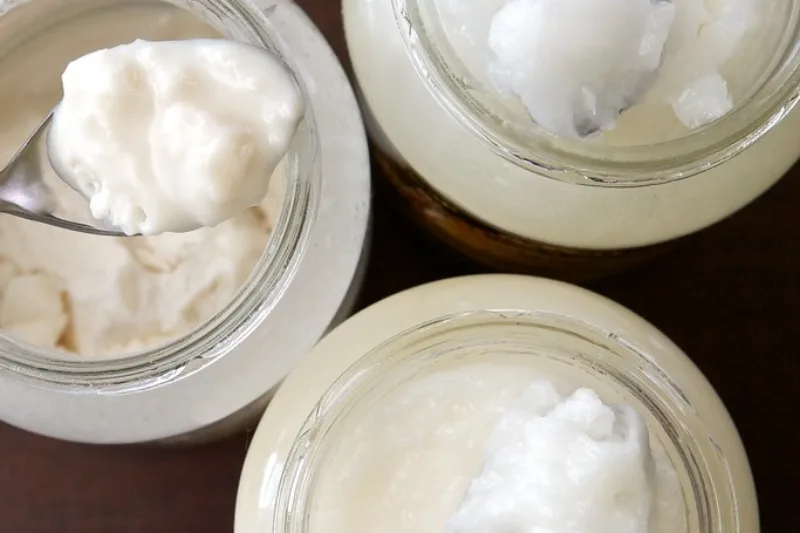
Coconut oil is extracted from the kernel (copra) of the coconut, either by cold-pressing the fresh flesh (virgin oil, the most prized in cosmetics) or through industrial refining. At room temperature it is solid and white, creamy, but it melts instantly on contact with skin, becoming a clear liquid that is easy to spread.
What makes it truly valuable for hair care is its high content of lauric acid, a medium-chain fatty acid with a small molecule. Unlike many other plant oils whose molecules are too large to penetrate the hair shaft and which sit only on the surface, lauric acid has an affinity for hair proteins (keratin) and the ability to actually penetrate the cortex of the strand. Studies suggest that this property helps reduce protein loss from hair, both in healthy strands and in those damaged by coloring, bleaching or flat-ironing.
Table of Contents
- What coconut oil is and why it is special for hair
- The composition of coconut oil
- Benefits for hair and scalp
- Which hair type it suits
- How to apply coconut oil to hair
- Coconut oil hair mask recipes
- Coconut oil for scalp and dandruff
- How to choose and store it
- Lifestyle for healthy hair
- Practical tips and common mistakes
- Conclusion
- Frequently Asked Questions
The composition of coconut oil
The fatty-acid profile of coconut oil explains most of its effects on hair:
- Lauric acid (roughly half the total) — the star fatty acid, with a small molecule that penetrates the shaft and has antimicrobial properties.
- Myristic and caprylic acids — round out the moisturizing and protective action.
- Palmitic, oleic and stearic acids — contribute to the protective film effect on the surface of the strand.
- Vitamin E (tocopherol) — a natural antioxidant that helps protect the oil from going rancid and supports scalp health.
- Polyphenols and trace minerals — present mainly in cold-pressed virgin oil.
The small size of the lauric acid molecule is precisely the key. Many oils “sit” on the hair and only make it look glossier, while coconut oil also works from within, nourishing the structure of the strand.
Benefits for hair and scalp
Reduces protein loss and strengthens the strand
The best-documented benefit of coconut oil is its ability to limit protein loss from hair. Keratin, the protein the strand is made of, gradually “leaks out” through repeated washing, sun exposure, chlorinated water and chemical treatments. Studies suggest that applying coconut oil before or after washing helps keep these proteins in the strand, which translates into stronger hair that is less brittle and less prone to breakage.
Deeply moisturizes dry hair
Dry, rough, static-prone, hard-to-detangle hair regains its suppleness with coconut oil. It forms a fine film that “seals” moisture inside the strand and smooths the cuticle scales, so that light reflects more evenly and the hair looks shinier.
Protects split ends
The ends are the oldest and most damaged part of the hair. A small amount of coconut oil applied daily to the ends helps lubricate them, reduces friction and slows the appearance of new split ends. It does not “glue” an already-split end back together — that requires a trim — but it prevents further damage.
Reduces frizz and static
In humid weather, hair absorbs moisture from the air and swells, becoming frizzy and hard to control. The film left by coconut oil acts as a barrier, limiting excess water absorption and keeping the hairstyle in place longer.
Supports a balanced scalp
Thanks to lauric acid, coconut oil has gentle antimicrobial properties. Applied sparingly to a dry, irritated scalp, it can soothe itching and mild flaking. Massaging with oil also stimulates circulation at the scalp, which folk tradition associates with healthier hair.
Helps detangling and offers heat protection
Applied in a small amount to wet hair, coconut oil makes combing easier and reduces breakage during detangling. Used before blow-drying, it also offers partial protection against heat, though it does not replace a specialized heat protectant at very high temperatures.
Which hair type it suits
Coconut oil does not work the same for everyone, and this is important to understand so you are not disappointed:
- Thick, coarse, dense, curly or wavy hair — this is where coconut oil delivers the most spectacular results. It nourishes, tames and adds shine.
- Dry, damaged, colored or bleached hair — benefits greatly from oil treatments, which restore the look and strength of the strand.
- Fine, thin hair — careful! Coconut oil can weigh the strand down and make it look flat and greasy. For this hair type, use very small amounts, only on lengths and ends, avoiding the roots.
- Oily scalp — avoid applying to the roots; focus on lengths and ends.
There is also a quirk: some people with hair very sensitive to protein find that coconut oil dries their hair out even more, making it stiff. If you notice this effect, reduce frequency or alternate with a lighter oil such as argan or jojoba.
How to apply coconut oil to hair
Pre-shampoo mask
This is the most effective method, recommended by trichologists. Melt an amount of oil (a teaspoon for short hair, up to 2-3 tablespoons for long, thick hair) by rubbing it between your palms. Apply it to dry or slightly damp hair, starting from the mid-length down to the ends and avoiding the roots if you have an oily scalp. Leave it on for at least 30 minutes — ideally 1-2 hours or even overnight (with a towel or cap on the pillow). Then wash with shampoo, perhaps twice, to fully remove the excess.
Leave-in treatment on the ends
On clean, dry hair, rub a tiny amount of oil (about the size of a grain of rice) between your palms and run it over the ends only. This daily gesture keeps the ends supple and reduces splitting.
Scalp massage
For a dry scalp, warm a little oil and gently massage it in with your fingertips for 5-10 minutes, using circular motions. Leave it on for 30 minutes, then wash. The massage relaxes and, according to tradition, stimulates the strands.
Coconut oil hair mask recipes
Nourishing coconut oil and honey mask
- 2 tablespoons coconut oil
- 1 tablespoon natural honey
- (optional) a few drops of lavender essential oil
Melt the oil, mix with the honey, apply to lengths and ends, leave for 30-45 minutes under a warm cap, then wash. Honey attracts and retains moisture, ideal for very dry hair.
Repairing coconut oil and egg mask
- 1 tablespoon melted coconut oil (slightly cooled so it does not “cook” the egg)
- 1 whole egg (or just the yolk for dry hair)
Beat the egg, fold in the oil, apply to all the hair, leave for 20-30 minutes and rinse with lukewarm water (not hot!), then wash. The egg adds protein and shine.
Anti-dandruff coconut oil and lemon mask
- 2 tablespoons coconut oil
- juice of half a lemon
Mix and massage into the scalp, leave for 20 minutes, then wash. The acidity of the lemon and the antimicrobial action of the oil may help with mild dandruff. Do not use if your scalp is irritated or scratched.
Detangling and shine oil
- 1 tablespoon coconut oil
- 1 teaspoon castor oil (for density) or argan oil (for lightness)
Mix and use a small amount as a leave-in treatment on wet hair.
Coconut oil for scalp and dandruff
Dandruff has several causes — dry scalp, seborrheic dermatitis, excess Malassezia yeast. Coconut oil can help especially when dandruff is accompanied by dryness, thanks to its moisturizing and gentle antimicrobial effect. It is massaged into the scalp, left to act, then washed out well. Important: if the dandruff is heavy, greasy, accompanied by redness or intense itching, it may be a fungal problem, and in that case the oil can sometimes worsen the situation — consult a dermatologist.
How to choose and store it
- Choose virgin, cold-pressed coconut oil, preferably organic. It has a pleasant coconut scent and retains more beneficial compounds than refined oil.
- Refined oil (odorless) is cheaper and also works on hair, but has fewer antioxidants.
- Storage: at room temperature, away from direct light and heat sources. It solidifies below 24-25°C (75-77°F) and melts above that — this is normal and does not affect quality. The shelf life is long (usually 1-2 years), because coconut oil is very stable against oxidation.
- Use a clean, dry spoon to take the oil from the jar, so you do not introduce water or impurities.
Lifestyle for healthy hair
No oil makes up for a lifestyle that weakens hair. For visible results, combine coconut oil treatments with:
- A diet rich in protein, iron, zinc and B vitamins — hair is, in essence, protein.
- Adequate hydration and enough sleep.
- Reducing heat sources (flat iron, very hot blow-dryer) and aggressive chemical treatments.
- Gentle combing, from the ends toward the roots, with a wide-tooth comb on wet hair.
- Protecting hair from strong sun and chlorinated pool water.
Practical tips and common mistakes
Mistake no. 1: Using too much. More is not better. Excess oil leaves hair greasy, hard to wash and flat. Start with a small amount and increase only if needed.
Mistake no. 2: Applying to the roots on oily or fine hair. For these hair types, oil at the roots leads to a greasy look fast. Apply only to lengths and ends.
Mistake no. 3: Rinsing with hot water after the egg mask. Hot water coagulates the egg in your hair and you will have an unpleasant surprise. Always use lukewarm water.
Mistake no. 4: Expecting miracles overnight. Hair grows slowly, and apparent repairs are cosmetic. Real benefits appear after a few weeks of consistent use.
Mistake no. 5: Skipping the patch test. Even though coconut allergies are rare, it is worth testing first, especially on a sensitive scalp.
Mistake no. 6: Using it on hair that is already protein-sensitive. If your hair becomes stiff and dry after coconut oil, stop and choose a lighter oil.
Conclusion
Coconut oil is one of the most accessible and versatile natural remedies for hair care. Thanks to lauric acid, which penetrates the hair shaft, it helps reduce protein loss, deeply moisturizes, protects the ends and brings shine to dry, damaged hair. It is not, however, a universal solution: fine hair and an oily scalp tolerate it poorly, and for scalp conditions a doctor’s advice is needed. Used in moderation and consistently — especially as a pre-shampoo mask — coconut oil can visibly transform the look of your hair, exactly as women in folk tradition have known for generations.
Frequently Asked Questions
How many times a week can I use coconut oil on my hair? For a pre-shampoo mask, once or twice a week is enough for most people. On the ends, as a leave-in, you can apply a tiny amount daily.
Can I leave coconut oil on my hair overnight? Yes, this is an effective method for very dry hair. Protect your pillow with a towel or wear a cap, and in the morning wash it out well with shampoo.
Does coconut oil help hair grow? There is no evidence that it makes hair grow faster. However, by reducing breakage and split ends, it helps hair retain its length and look fuller over time.
Why does my hair feel drier after I use coconut oil? Some people have protein-sensitive hair. The lauric acid that binds proteins can make the strand stiff in these individuals. Reduce frequency or switch to argan or jojoba oil.
How do I get coconut oil out of my hair if I used too much? Wash twice with shampoo. You can apply the shampoo directly to dry, oiled hair before wetting it — that way it emulsifies the oil better.
Is coconut oil good for dandruff? It can help with dandruff accompanied by dryness, thanks to its moisturizing and antimicrobial effect. For greasy or fungal dandruff, consult a dermatologist, because the oil can sometimes worsen the problem.
Can I use food-grade coconut oil on my hair? Yes, good-quality food-grade virgin coconut oil is perfectly suitable for hair too. The important thing is that it is pure, with no additives.
Does coconut oil protect hair from sun and salt water? It offers partial protection through the film it leaves on the strand, useful at the beach. It does not, however, replace a specialized product with a protection factor for long exposure.