
Lavender Essential Oil: Benefits, Uses and How to Use It
IMPORTANT: Lavender essential oil is highly concentrated and should never be applied undiluted to the skin, except for tiny spot applications on small areas. Before first use, do a patch test on a small area of skin. Do not swallow it except under the guidance of a qualified specialist. Pregnant or breastfeeding women, young children, people with epilepsy, severe asthma or very sensitive skin should ask their doctor first. Lavender essential oil is not a substitute for medical treatment of anxiety, depression, chronic insomnia or any other condition — if symptoms persist, see a doctor.
Aunt Veta, from the village at the foot of the hill, had a habit no one ever forgot: every summer evening, before bed, she would put a few drops of lavender oil on the corner of her pillow and on her wrist. She used to say that ever since she started doing this, “sleep comes on its own, without being called.” Her rooms always smelled of a blossoming field, and little sachets of dried lavender hung in her wardrobes, among the clothes, to keep moths away and lend everything a pleasant scent. Whenever a grandchild arrived restless or tearful, Aunt Veta would rub their temples with a massage oil into which she had mixed a drop or two of lavender diluted in sunflower oil, and the child would settle down as if by magic.
The same story repeats itself, in different versions, in many households. Lavender is one of the most beloved aromatic plants in the world, and its essential oil has become a symbol of relaxation and balance. Its floral, herbaceous, slightly sweet scent is recognized instantly and associated with calm, cleanliness and restful sleep.
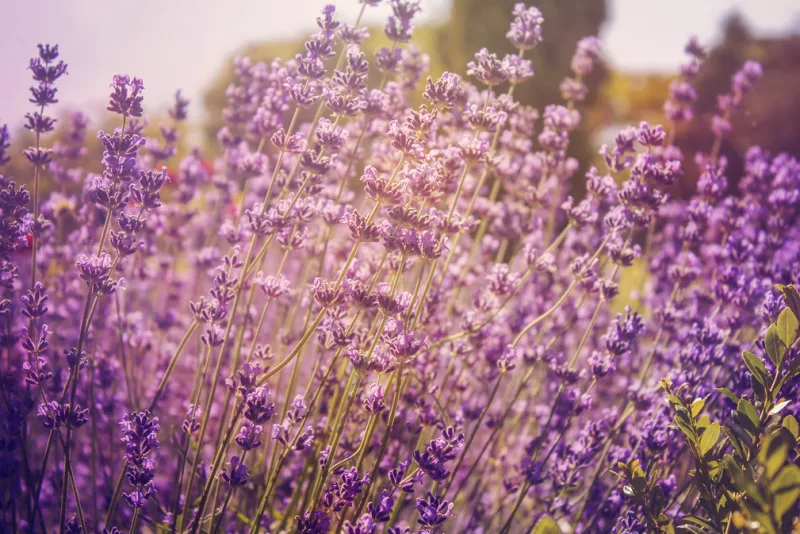
Lavender essential oil is obtained by steam-distilling the fresh or lightly wilted flowers of the Lavandula angustifolia plant (true lavender, considered the finest from a therapeutic standpoint) or of other related species. An impressive quantity of flowers is needed to produce a small amount of oil, which is why an authentic, good-quality oil is never very cheap. Lavender thrives in poor, well-drained, sunny soils. Native to the Mediterranean region, it is now grown in many parts of the world, including Romania, where the purple fields draw more and more visitors.
Table of Contents
- What lavender essential oil is and how it is made
- Composition and active principles
- Benefits for health and well-being
- Traditional and modern uses
- How to use it correctly (step-by-step recipes)
- Dosage and how to use it
- How to choose a good lavender oil
- Lifestyle: relaxation rituals with lavender
- Practical tips and common mistakes
- Conclusion
- Frequently Asked Questions
What lavender essential oil is and how it is made
Lavender essential oil is the aromatic, volatile liquid extracted from the flowers of the lavender plant. Unlike a “lavender massage oil” (which is often simply a scented vegetable oil), pure essential oil is a concentrated substance, traditionally obtained by steam distillation. Steam passes through the flowers placed in a still, carries the volatile compounds along with it, and on cooling the floral water (the hydrosol, or “lavender water”) separates from the essential oil itself.
Several types of lavender are used for oil:
- Lavandula angustifolia (true or “fine” lavender) — prized for its delicate aroma and gentleness; the preferred choice in calming aromatherapy.
- Lavandin (a hybrid) — has a higher yield and a more penetrating, slightly camphor-like scent; more common in cheaper products and cosmetics.
- Lavandula latifolia (spike lavender) — richer in camphor, with a harsher aroma.
For soothing home use, fine lavender (angustifolia) remains the queen. Its scent is the one we instinctively associate with relaxation.
Composition and active principles
The aroma and effects of lavender oil come from a complex blend of volatile compounds. The most important and most studied are:
- Linalool — a monoterpene alcohol largely responsible for the floral scent and for the calming effects attributed to lavender.
- Linalyl acetate — the ester that gives the oil its sweet, fine note and contributes to the sense of relaxation.
- Smaller amounts of terpinen-4-ol, lavandulol, ocimene, cineole and other terpenes, which round out the aromatic profile and the plant’s action.
Studies suggest that these molecules, especially linalool and linalyl acetate, interact with the nervous system and may influence the state of relaxation. This is precisely why lavender is one of the most researched plants in aromatherapy. It must be said, however, that effects vary from person to person and that aromatherapy is a support, not a miracle treatment.
Benefits for health and well-being
Relaxation and reduced nervous tension
The best-known benefit of lavender is its calming effect. The scent of lavender has been used for centuries to ease agitation, soothe restlessness and create an atmosphere of peace. Studies suggest that inhaling the aroma of lavender may help diminish the sense of tension and induce a state of calm. Many people use a lavender diffuser in the evening as a “signal” that the busy day is over and it is time to unwind.
More restful sleep
Lavender and good sleep go hand in hand in folk tradition. Dried lavender sachets placed under the pillow, a few drops of oil on the pillowcase, or a diffuser switched on half an hour before bed are habits passed down for generations. Studies suggest that the aroma of lavender may contribute to sleep that feels calmer and deeper, especially in people who find it hard to relax in the evening. It is not a sleeping pill, but it can be part of a healthy evening ritual.
Support for the skin
Properly diluted, lavender oil is valued in skincare. Folk tradition uses it to soothe minor irritations, insect bites, redness and sensitive skin. Its pleasant aroma makes it a popular addition to creams, soaps and massage oils. For any more serious skin problem (an open wound, an infection, an extensive rash), a doctor is needed.
Comfort for muscles and joints
A massage oil with a few drops of diluted lavender added is traditionally used to relax tense muscles after a hard day or after exertion. The combination of the massage itself and the calming aroma creates a pleasant sense of release.
Support for a calmer mind
Many people use lavender in moments of stress — before an exam, an important meeting, or simply at the end of a demanding day. A few breaths from a tissue onto which a drop of lavender has been placed can help “reset” one’s mood. The effect is largely linked to the association of the aroma with calm and to the ritual itself.
Help for tension headaches
Tradition recommends gently massaging the temples and the back of the neck with a well-diluted lavender oil when a headache caused by fatigue and tension sets in. The gentle motion, the calming scent and the moment of pause can bring relief. Severe, frequent headaches, or those accompanied by other symptoms, do require medical evaluation.
Traditional and modern uses
Over time, lavender has had many uses. It was placed in wardrobes and drawers to scent clothes and keep moths away. Sachets of dried flowers were used to perfume rooms and bed linen. Lavender water (the hydrosol) was used as a refreshing facial tonic and a delicate fragrance. In modern aromatherapy, the essential oil is used in diffusers, massage oils, relaxing baths and “natural” cosmetic products.
How to use it correctly (step-by-step recipes)
The key to using essential oils is dilution and moderation. Less is, most of the time, more.
1. Diffuser for relaxation
- Fill the diffuser reservoir with water, following the device’s instructions.
- Add 3–6 drops of lavender essential oil.
- Switch the diffuser on 20–30 minutes before you want to relax or fall asleep.
- Diffuse intermittently, not for hours on end; an airy room and a subtle aroma are preferable.
2. Soothing massage oil
- Pour 2 tablespoons (about 30 ml) of a base vegetable oil (sunflower, sweet almond, jojoba or fractionated coconut).
- Add 3–6 drops of lavender essential oil (a gentle concentration of about 1%).
- Mix well.
- Use for a relaxing massage on the shoulders, neck or feet in the evening.
3. Relaxing bath
- Mix 4–6 drops of lavender oil with a tablespoon of vegetable oil or a handful of bath salts (essential oils do not dissolve in water, so they need a “carrier”).
- Add the mixture to the warm water of an already-filled tub.
- Soak for 15–20 minutes, breathing calmly.
4. Pillow spray for sleep
- In a small glass spray bottle, put 2 tablespoons of distilled water and a teaspoon of alcohol (for example, neutral vodka, to help dispersion).
- Add 8–10 drops of lavender oil.
- Shake well before each use and spray lightly onto the pillow and bedding from a distance, a few minutes before bed. Avoid soaking the fabric.
5. Quick “pocket” inhalation
Put a single drop of lavender oil on a tissue or a cotton handkerchief and breathe in deeply a few times whenever you feel the need to calm down. It is the simplest and safest method.
6. Spot application on the skin
For a minor irritation or an insect bite, mix one drop of lavender oil with a few drops of vegetable oil and apply only to that area. Never apply pure essential oil to large areas of skin.
Dosage and how to use it
For the skin, a safe general-use concentration is about 1–2% essential oil in the base oil — that is, around 1–2 drops of essential oil per tablespoon (5 ml) of carrier oil. For children, the elderly or people with sensitive skin, the concentration should be even lower, or use should be avoided without a specialist’s advice.
For diffusing, 3–6 drops in an average room are enough. The aroma should be pleasant and discreet, not overwhelming.
The essential oil should not be swallowed in home use. Internal use of essential oils is a practice for specialists and should not be improvised at home.
How to choose a good lavender oil
- Look on the label for the botanical name, ideally Lavandula angustifolia, and the words “100% pure essential oil.”
- An authentic oil is sold in dark glass bottles, which protect the volatile compounds from light.
- The scent should be floral, fine, slightly herbaceous — not chemical, sharp or “detergent-like.”
- A very low price may be a sign of dilution or synthetic “fragrance”; authentic oil has a reasonable, but not negligible, cost.
- Keep the bottle tightly closed, in a cool place away from light, and use it within a reasonable period of time.
Lifestyle: relaxation rituals with lavender
Lavender gives its best results when it is part of a ritual. A simple evening ritual might look like this: half an hour before bed, turn off the screens, switch on a lavender diffuser, do a few gentle stretches, read a few pages and spritz a little lavender spray onto the pillow. Repeated every evening, this pattern “tells” the brain that sleep is coming.
During the day, a drop of lavender on the wrist or on a tissue can be a small “pause button” when stress builds up. The important thing is not to turn lavender into a solution for every problem — it is a pleasant support, but a balanced lifestyle (regular sleep, movement, good food, time away from screens) remains the foundation.
Practical tips and common mistakes
Mistake no. 1: Applying pure essential oil directly to the skin over large areas. Essential oil is highly concentrated and can irritate. Always dilute it in a vegetable oil, except for spot application on very small areas.
Mistake no. 2: Skipping the patch test. Before first use on the skin, apply a small amount of diluted mixture to the inside of the forearm and wait 24 hours. If redness, itching or irritation appears, stop.
Mistake no. 3: Diffusing for hours without a break. An aroma that is too intense and prolonged can cause headaches or nausea. Diffuse intermittently and air out the room.
Mistake no. 4: Swallowing the essential oil. At home, essential oils are not taken internally. This practice belongs to specialists.
Mistake no. 5: Confusing essential oil with scented massage oil. Pure essential oil is highly concentrated; a ready-to-use “lavender oil” for massage is already diluted. Read the label carefully.
Mistake no. 6: Buying the cheapest product. Very cheap oils are often diluted or synthetic. For fine aromatic effects, an authentic oil is worth it.
Mistake no. 7: Using it on young children or during pregnancy without medical advice. For these groups, caution is mandatory. Ask your doctor before any use.
Conclusion
Lavender essential oil is, rightly, one of the most cherished treasures of aromatherapy. Its floral, calming aroma makes it a pleasant ally for relaxation, more restful sleep and gentle skincare, when used sensibly: properly diluted, in small amounts and with respect for basic precautions. Lavender does not cure anything, but it can turn an ordinary evening into a moment of calm and become part of a more balanced lifestyle. As with any natural remedy, the key lies in moderation, in the quality of the product and in common sense — and if a health problem persists, the right place remains the doctor’s office.
Frequently Asked Questions
Can I put lavender oil directly on my pillow? Yes, a few drops on a corner of the pillowcase is a common practice, but watch out for stains on light-colored fabric. A cleaner option is a diluted pillow spray, applied from a distance.
Does lavender oil really help with sleep? Tradition and studies suggest that the aroma of lavender may contribute to a state of relaxation that favors falling asleep, especially as part of an evening ritual. It is not a sleeping pill and does not replace treatment for chronic insomnia.
Can I use lavender oil undiluted on my skin? As a rule, no. For application over large areas, always dilute it in a vegetable oil. Spot application on a very small area can be done with caution, after a patch test.
Is it safe for children? For young children, essential oils should be used with great caution and, ideally, only after a doctor’s advice. Concentrations must be much lower, and some uses are entirely contraindicated at a young age.
Can I use lavender oil during pregnancy? During pregnancy and breastfeeding, always seek your doctor’s advice before using essential oils, including lavender.
Why does my lavender oil smell “chemical”? It is probably a synthetic or low-quality product. An authentic Lavandula angustifolia oil has a floral, fine, pleasant scent, not a sharp or artificial one.
How much lavender oil should I put in the diffuser? For an average room, 3–6 drops are enough. The aroma should be pleasant and discreet, not overwhelming.
Can I swallow lavender oil? No, in home use essential oils are not taken internally. Internal use is for specialists and should not be improvised.