
Olive Oil: Benefits for Heart and Skin, Uses and How to Use It
IMPORTANT: Olive oil is a safe food for most people, but it remains energy-dense (about 9 kcal per gram, like all fats). Consumed in large amounts without regard to the rest of your diet, it can contribute to weight gain. People with gallstones or gallbladder problems should introduce fats gradually and talk to their doctor, since fats stimulate gallbladder contraction. Applied to the skin, olive oil is generally well tolerated, but in people with acne-prone skin or atopic dermatitis it can sometimes worsen irritation; test first on a small patch. Never replace prescribed medical treatment with oil-based “remedies,” and consult your doctor if you have high cholesterol, high blood pressure or any chronic condition.
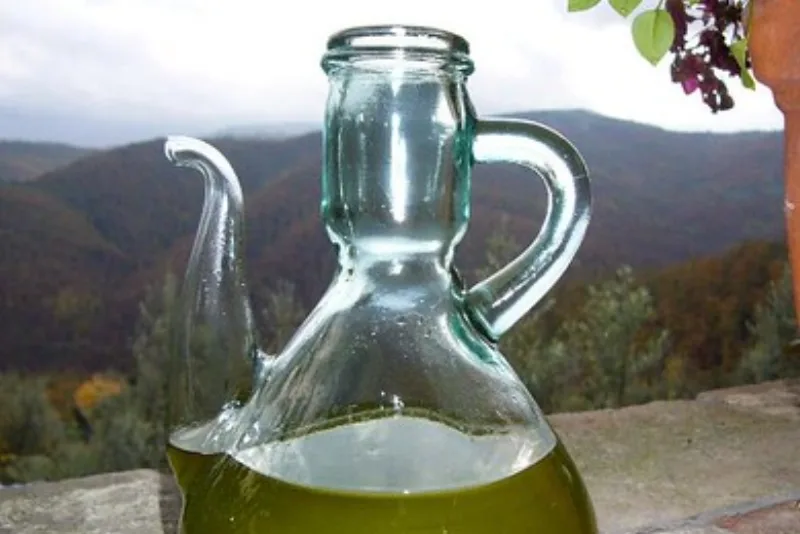
A clay cruet and the smell of fresh olives
Aunt Florica, from the villages along the Danube valley, kept a small fired-clay cruet in her pantry, reserved especially for “the good oil.” It wasn’t cheap cooking oil, but the olive oil a granddaughter brought all the way from Greece, in green-gold bottles. She used it with the thrift of a wise housewife: a few drops over the tomatoes from the garden, a spoonful in the morning “for the stomach,” and the rest she kept for healing — for hands cracked by winter work, for the girls’ hair before the holidays, and for rubbing the temples when a headache struck.
“Olive oil is like a good friend,” she would say. “It doesn’t shout, it doesn’t brag, but it’s always there when you need it.” And she was right in a way that researchers would only later confirm: this discreet oil, with its slightly bitter taste and a peppery tickle in the throat, is one of the most studied foods in the world for its effects on the heart, the blood vessels and longevity.
Olive oil is simply the fatty juice pressed from the fruit of the olive tree (Olea europaea), a Mediterranean tree that can live for hundreds — sometimes more than a thousand — years. Unlike other vegetable oils, usually extracted from seeds through chemical processes at high temperatures, good extra virgin olive oil is obtained purely mechanically, by pressing the fruit, without excessive heat and without solvents. That is why it keeps its aroma, color, vitamins and, above all, those precious compounds called polyphenols.
Table of Contents
- What olive oil is and how it is made
- Types of olive oil: extra virgin, virgin, refined
- The composition of olive oil
- Health benefits
- Olive oil for the heart and cholesterol
- Olive oil for the skin
- Olive oil for the hair
- Traditional household uses
- How to use it in the kitchen
- Recipes and preparations with olive oil
- How to choose a good olive oil
- How to store it correctly
- Practical tips and common mistakes
- Conclusion
- Frequently Asked Questions
What olive oil is and how it is made
The olive tree is an evergreen with silvery undersides to its leaves and small fruits that, depending on ripeness, turn from green to purplish-black. The fruits are usually harvested in late autumn and early winter. The fewer hours that pass between harvest and pressing, the more aromatic the oil and the richer in active compounds.
The traditional process has a few simple steps. First, the olives are washed and crushed — once with large millstones, today with metal mills — into a paste. The paste is slowly kneaded (a process called malaxation) so that the fine oil droplets join together. Then, by pressing or centrifugation, the oil is separated from the water and the solid residue. If this whole process is done at temperatures below 27°C, we speak of “cold” extraction, and the resulting oil keeps the maximum aroma and polyphenols.
Worth knowing: the term “cold pressed” or “cold extracted” is not just marketing but a real indication that the oil was not heated to squeeze more from the fruit. Heat increases yield but destroys precisely the compounds that make olive oil so valuable.
Types of olive oil: extra virgin, virgin, refined
Not all olive oils are the same, and the differences matter enormously for both health and taste.
Extra virgin olive oil is the top of the range. It is obtained exclusively by mechanical means, has very low free acidity and an impeccable taste, free of defects (no rancid, musty or earthy notes). It is the richest in polyphenols and antioxidants. This is the oil that both folk tradition and modern research recommend for health.
Virgin olive oil is also mechanically extracted but has slightly higher acidity and a somewhat less refined taste. It remains a good product, just a step below extra virgin.
Refined olive oil comes from virgin oils with defects that are “cleaned up” through physical and chemical processes. The result is an almost neutral oil, without aroma and depleted of polyphenols. On the label, the product often sold simply as “olive oil” is in fact a blend of refined oil with a little virgin oil to give it back a hint of flavor.
Olive pomace oil is the lowest on the scale, obtained from the residue left after pressing, with the help of solvents. It has few qualities and is used mostly for industrial frying.
The practical conclusion of experienced cooks: for daily use and for remedies, choose extra virgin.
The composition of olive oil
What does this green-gold liquor actually contain?
First, monounsaturated fats, especially oleic acid (an omega-9 fatty acid). This makes up the greater part of olive oil and is considered the “good fat,” friendly to the heart.
Second, polyphenols — compounds with names such as oleuropein, hydroxytyrosol and oleocanthal. These are powerful antioxidants and are responsible for the bitter and slightly pungent, peppery taste of a good extra virgin oil. In fact, that pleasant “burn” at the back of the throat when you taste a very fresh oil comes precisely from oleocanthal.
Third, vitamin E (tocopherols), an antioxidant that protects the fats in the oil (and in the body) from oxidation, and vitamin K, important for blood clotting and for bones.
This whole package — healthy fats plus antioxidants — explains why olive oil holds a central place in what nutritionists call the Mediterranean diet.
Health benefits
Support for the heart and blood vessels
The best-documented effect of olive oil concerns the cardiovascular system. Studies suggest that replacing saturated fats (lard, excess butter, fats from processed meats) with the monounsaturated fats in olive oil is associated with a better cholesterol profile and a better condition of the blood vessels. The folk tradition of Mediterranean peoples, who often live long and active lives, seems to have confirmed this for centuries.
Antioxidant and anti-inflammatory
The polyphenols in extra virgin oil act like “firefighters” at the cellular level, helping to fight oxidative stress — that internal wear and tear caused by free radicals. Oleocanthal in particular has properties that, according to studies, recall the mechanism of mild anti-inflammatories, though in a much gentler and more natural form.
Support for digestion
In folk medicine, a spoonful of olive oil taken on an empty stomach in the morning was considered a remedy for constipation and for “cleansing the liver.” The oil lubricates the digestive tract and gently stimulates the secretion of bile. Many housewives also used it to soothe mild stomach upset.
Satiety and balance
Although it is caloric, olive oil provides a feeling of fullness and makes meals tastier and more satisfying. A salad dressed with good olive oil keeps you full longer than a “dry” one.
Olive oil for the heart and cholesterol
Because the subject of the heart is so important, it deserves a few extra lines. The basic idea, supported by research and by Mediterranean experience, is this: not all fats are enemies. The monounsaturated fats in olive oil, consumed in moderation and in place of less healthy fats, seem to help the body maintain a better balance of cholesterol — supporting the “good” cholesterol (HDL) and helping keep oxidized “bad” cholesterol (LDL) under control.
In practice, this means simple habits: cook with olive oil instead of margarine or lard; pour raw oil over vegetables and salads; gradually give up greasy industrial sauces in favor of a simple dressing of oil and lemon. These small changes, repeated daily, count for more than any short-term “cure.”
A caution, though: olive oil is not a medicine. If you have high cholesterol or cardiovascular disease, it is a support to your diet, not a substitute for the treatment your doctor recommends.
Olive oil for the skin
The tradition of using olive oil on the skin is as old as Mediterranean civilization. Even today it remains a treasured ingredient in natural skincare.
Deep hydration. Olive oil helps restore the skin’s natural barrier and retain water. A few drops rubbed into hands cracked by winter, into rough elbows and heels, leave the skin softer. Aunt Florica used it for exactly this.
Gentle cleanser. The “oil cleansing” method involves massaging the face with a little olive oil, then removing it with a soft cloth dampened in warm water. The oil dissolves makeup and sebum without drying the skin.
Soothing mild irritation. On dry, flaky skin, a thin layer of oil can ease the feeling of tightness. For babies, however, it is wiser to ask the doctor first, because their delicate skin sometimes reacts differently.
Nail and cuticle care. Massaging the cuticles with warm olive oil keeps them supple and prevents cracking.
One precaution: on oily, acne-prone skin, oil applied abundantly can clog the pores. Use small amounts and watch how your skin responds.
Olive oil for the hair
For dry, coarse hair or hair with split ends, olive oil is a natural mask valued for generations.
The simplest method is a hair mask: gently warm 2–3 tablespoons of olive oil (just until lukewarm, not hot), apply it to the lengths and ends — not necessarily to the roots if your scalp is oily — massage gently, wrap your hair in a warm towel and leave it on for 30 minutes to an hour. Then wash with shampoo, usually twice, to remove the oil completely.
The oil helps smooth the hair cuticle, reducing the “frizzy” look and adding shine. For a dry scalp or mild dandruff, a massage with warm olive oil can soothe and hydrate the scalp.
Traditional household uses
Beyond the kitchen and body care, housewives of old found all sorts of uses for olive oil:
- For the ears: a few drops of lukewarm oil were used to soften earwax plugs (only on a healthy ear, with no eardrum perforation — ask your doctor if in doubt).
- For wood: a cloth with a little oil polished wooden furniture and nourished it.
- For leather: rubbing boots and belts with oil kept them supple.
- As a home remedy: rubbing the temples with warm oil, sometimes mixed with a few drops of essential oil, for relaxation.
How to use it in the kitchen
This is where the most common confusion arises. Many believe that extra virgin olive oil “is not good for cooking” or, conversely, that it can be heated indefinitely. The truth lies in between.
Extra virgin olive oil is actually surprisingly stable under heat, thanks to its monounsaturated fats and antioxidants. It can be used without problems for ordinary cooking: sautéing vegetables, stir-frying, baking, sauces. It is not ideal, however, for deep frying at very high and repeated temperatures, both for reasons of cost and because such temperatures destroy the fine aromas.
The healthiest use remains raw: poured over salads, over boiled vegetables, over bread, over soups, in hummus or in dressings. That way you benefit from all the polyphenols intact and from the full aroma.
Recipes and preparations with olive oil
Simple Mediterranean dressing
Mix 3 tablespoons of extra virgin olive oil with 1 tablespoon of fresh lemon juice (or apple cider vinegar), a pinch of salt, freshly ground pepper and, if you like, a touch of mustard and a little oregano. Beat well with a fork until it emulsifies. It is the perfect dressing for any vegetable salad.
Bread with oil and garlic (homemade bruschetta)
Toast slices of good bread, rub them with a clove of raw garlic, drizzle with extra virgin olive oil and sprinkle with salt and a few basil leaves. A simple, fragrant and healthy appetizer.
Herb-infused oil
In a clean bottle, put olive oil and add a few sprigs of rosemary, thyme and a few garlic cloves. Leave to infuse for a few days, in a cool, dark place. Note: oil with fresh garlic should be kept in the fridge and used within a few days, for safety.
“Morning” spoonfuls
Folk tradition recommended a spoonful of extra virgin olive oil on an empty stomach, perhaps with a few drops of lemon, as a tonic for digestion. Start with small amounts if you are not used to it.
How to choose a good olive oil
A few markers for the keen-eyed cook:
- Look for the words “extra virgin” and, ideally, “cold pressed.”
- Prefer dark bottles (green or brown), because light degrades the oil.
- Check the harvest or bottling date — the fresher the oil, the better.
- A good oil tastes fruity, slightly bitter and peppery in the throat. A complete lack of any taste is a sign of refined or poor oil.
- A clearly stated origin (a single country or region) is usually a good sign.
How to store it correctly
Olive oil has two great enemies: light and heat, plus air. Keep it in a cool, dark place, away from the stove, well sealed. Do not keep it on the windowsill, however lovely the bottle looks in the light. A dark bottle offers the best protection. Use the oil within a reasonable time after opening — fresh is always better.
Practical tips and common mistakes
Mistake no. 1: Keeping the oil next to the stove. It seems practical, but heat and light spoil it quickly. Move it to the pantry or a closed cupboard.
Mistake no. 2: Buying large bottles “on offer.” If you don’t use much, the oil oxidizes before you finish it. Better to buy smaller bottles and use them fresh.
Mistake no. 3: Confusing “olive oil” with “extra virgin.” On the label, plain “olive oil” is often a refined blend. Read carefully.
Mistake no. 4: Using it only for frying. Most of the benefits come from raw consumption. Save the good oil for salads and for finishing dishes.
Mistake no. 5: Applying it abundantly to oily skin. On acne-prone skin, overdoing the oil can clog pores. Less is more.
Mistake no. 6: Expecting “miracles.” Olive oil is an excellent food, but not a medicine. It works as part of a balanced lifestyle, not on its own.
Conclusion
Olive oil, especially quality extra virgin, is one of the most precious gifts of Mediterranean tradition — and one of the few foods praised alike by grandmothers and scientists. Rich in healthy fats, antioxidants and polyphenols, it supports the heart, nourishes the skin and hair, and turns the simplest vegetables into a tasty meal. The secret lies not in large amounts but in choosing a good oil, storing it correctly and using it daily, sensibly and with pleasure — exactly as Aunt Florica did, with her clay cruet and her wise saying that olive oil is “the good friend” who is always there when you need it.
Frequently Asked Questions
What is the difference between extra virgin olive oil and ordinary olive oil? Extra virgin is extracted purely mechanically, has low acidity, an impeccable taste and the highest content of polyphenols and antioxidants. Plain “olive oil” is usually a refined blend, more neutral in taste and poorer in beneficial compounds. For health, choose extra virgin.
Can I cook with extra virgin olive oil? Yes. Thanks to its monounsaturated fats and antioxidants, it is fairly stable at ordinary cooking heat (sautéing, stir-frying, baking). For repeated deep frying at very high temperatures it is not the most economical choice, and the fine aromas are lost. The healthiest use remains raw.
How much olive oil can I have per day? Mediterranean tradition suggests a few tablespoons a day, built into meals. Being caloric, it must be counted in your daily fat total. Moderation is key.
Does olive oil help with weight loss? Not directly — it is a caloric food. But through the satiety it provides and by replacing less healthy fats, it can support a balanced diet. The amount matters.
Is olive oil good for skin and hair? Yes, it has been used for thousands of years as a moisturizer for the skin and as a mask for dry hair. On oily or acne-prone skin, use small amounts and test first.
Why does good olive oil “burn” a little in the throat? The pleasant peppery sensation at the back of the throat comes from oleocanthal, a valuable polyphenol. It is a sign of fresh oil rich in antioxidants, not a defect.
How can I tell if the oil has gone bad? A rancid oil has an unpleasant smell and taste, like something “old” or like “crayon wax.” If it has been left in light and heat, it loses its aroma. Smell and taste it — a good oil is fruity and pleasant.
Should olive oil be kept in the fridge? Not necessarily. In the cold it can turn cloudy and partly solidify (it returns to normal at room temperature). A cool, dark, well-sealed spot is enough. The exception is oils infused with fresh garlic, which should be kept in the fridge and used quickly.