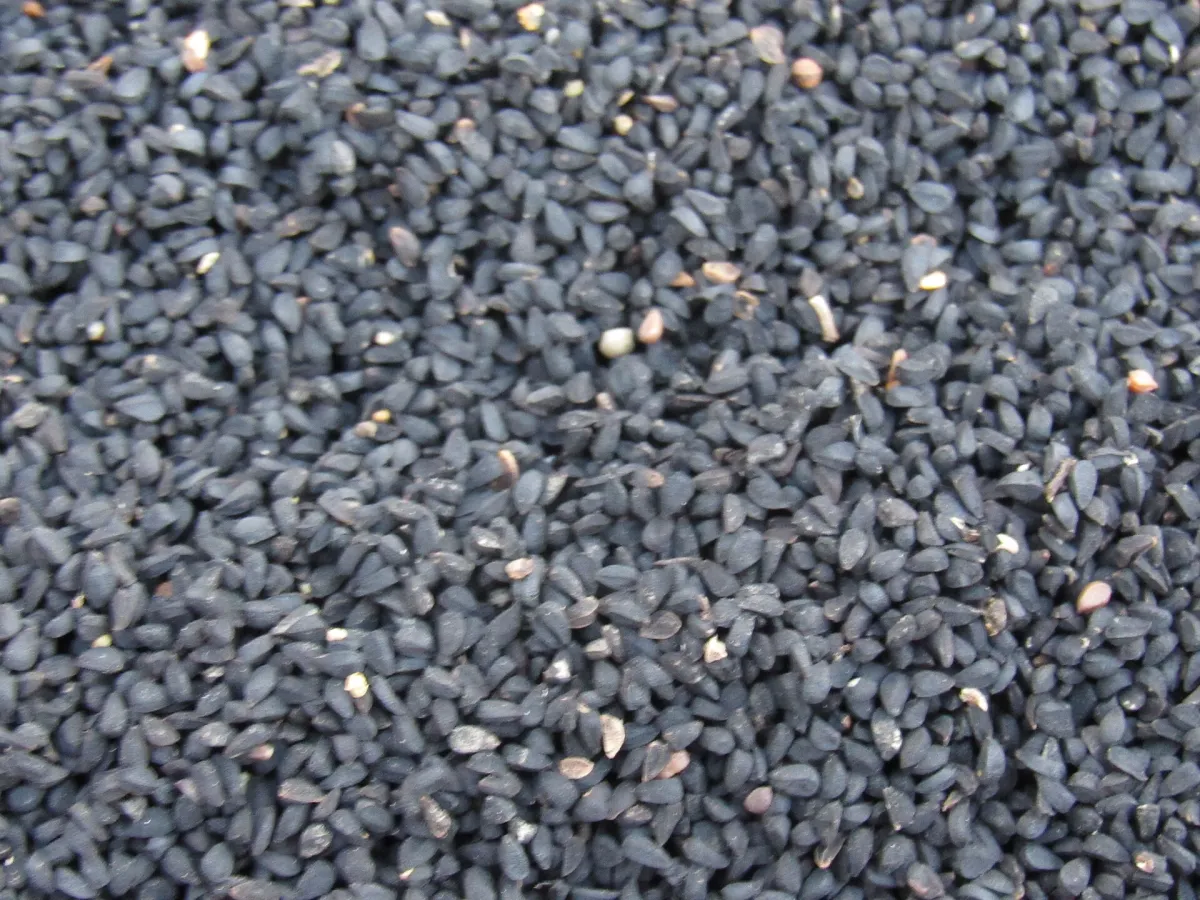
 Photo: Daniel Schwen, CC BY-SA 2.5, via Wikimedia Commons
Food-grade rapeseed oil, sold as canola oil in North America, is not toxic: it comes from bred varieties that are very low in erucic acid, and EU law strictly caps that compound. It has the least saturated fat of any common cooking oil and a far better omega-6 to omega-3 ratio than sunflower oil. Refined rapeseed oil handles everyday cooking and moderate-temperature frying, while cold-pressed rapeseed oil is best for dressings and gentle heat.
Key takeaways:
- Old rapeseed was high in erucic acid; modern food varieties, including canola, contain under 2%, the EU legal limit.
- Typical profile: about 7% saturated fat, over 60% monounsaturated fat and roughly 9-10% plant omega-3 (ALA).
- Its omega-6 to omega-3 ratio is about 2:1, while regular sunflower oil contains almost no omega-3.
- Refined: smoke point around 200-230 °C (390-445 °F), fine for cooking and occasional frying; cold-pressed: for raw use and low heat.
- 1-2 tablespoons a day in place of saturated fat supports healthier cholesterol, but it does not replace oily fish.
What is rapeseed oil?
Rapeseed (Brassica napus) belongs to the cabbage family, alongside mustard, kale and radish. Its bright yellow fields bloom in April and May across Europe, and countries such as Romania, France, Germany and Poland are major growers. The small black seeds contain around 40-45% oil.
Rapeseed, canola and industrial rapeseed
The ‘toxic canola’ myth comes from history. Traditional rapeseed was rich in erucic acid and bitter glucosinolates and was used mainly for lamp oil, lubricants and industry. In the 1970s, Canadian plant breeders used conventional breeding, not genetic engineering, to develop low-erucic varieties and named them canola. In Europe the equivalent varieties are called ‘double zero’ (00): low in both erucic acid and glucosinolates.
High-erucic rapeseed is still grown, but for biodiesel, lubricants and plastics, and it cannot legally be sold as cooking oil. In practice, food-grade rapeseed oil and canola oil are the same kind of product with different names.
Is canola oil bad for you? The facts, one by one
Erucic acid
The concern has a real but dated origin. In 1970s animal studies, large amounts of high-erucic rapeseed oil caused fat deposits in heart muscle (myocardial lipidosis). Similar effects have not been shown in humans at the levels found in today’s diet.
The European Food Safety Authority (EFSA) reassessed erucic acid in 2016 and set a tolerable daily intake. Average adult exposure sits below it; only some young children with high intakes of certain foods might approach it. EU Regulation 2019/1870 therefore caps erucic acid at 20 g/kg (2%) in vegetable oils, with stricter limits for infant foods. Modern varieties usually test well below that cap.
Refining, hexane and processing contaminants
Most supermarket canola oil is refined: seeds are pressed, extracted with hexane, then the oil is neutralised, bleached and deodorised at high temperature (often labelled RBD). Hexane evaporates almost completely and residues are regulated. Deodorisation can create small amounts of trans fats and glycidyl or 3-MCPD esters, contaminants shared by all refined oils, including sunflower, and limited by EU law.
Refining does not make the oil poisonous, but it strips out vitamin E, polyphenols and flavour. If you want a minimally processed option, choose cold-pressed rapeseed oil.
Is it genetically modified?
Most canola grown in Canada and the US is genetically modified. In the EU, cultivation of GM rapeseed is not authorised, and foods with more than 0.9% GM ingredients must be labelled.
Heat-sensitive omega-3
The one genuinely practical objection concerns alpha-linolenic acid (ALA), the plant omega-3 in rapeseed: it oxidises more easily than monounsaturated fat. That makes canola oil a poor choice for long, repeated deep-frying in the same batch of oil. Choosing the right type and controlling the temperature solves most of the problem.
Nutrition: fat profile and active compounds
Figures vary with variety and processing, but rapeseed oil typically provides:
- saturated fat: about 7%, the lowest of the common oils;
- monounsaturated fat: over 60%, mostly oleic acid, the same fat that dominates olive oil;
- omega-6 (linoleic acid): about 18-20%;
- omega-3 (ALA): about 9-10%;
- vitamin E (mainly gamma-tocopherol), vitamin K and plant sterols; cold-pressed oil also keeps carotenoids and polyphenols, hence its deeper colour.
Like any fat, it supplies about 9 kcal per gram, roughly 120 kcal per tablespoon.
Health benefits: what the evidence shows and what is unproven
Rapeseed oil has no real folk-medicine tradition; historically it lit lamps rather than filled remedy books. Its benefits come from nutrition science and clinical research.
- LDL cholesterol. Clinical trials and meta-analyses consistently show that replacing saturated fats (butter, lard, palm oil) with canola oil lowers LDL cholesterol. On this basis the US FDA approved a qualified health claim in 2006: about 1.5 tablespoons a day, replacing saturated fat without adding calories, may reduce the risk of coronary heart disease. ‘Qualified’ means the evidence is supportive but not conclusive.
- Heart health. The Lyon Diet Heart Study, in people who had survived a heart attack, used a Mediterranean-style diet with an ALA-rich rapeseed oil margarine and reported favourable outcomes. The Nordic diet also relies on rapeseed oil. The benefit belongs to the whole eating pattern, not the oil alone.
- Plant omega-3. One tablespoon nearly covers an adult’s adequate daily ALA intake. The body converts very little ALA into EPA and DHA, the active forms found in fish, so canola oil cannot replace oily fish or fish oil.
- Blood sugar and inflammation. A few small studies suggest modest effects on glucose control, and the balanced omega ratio is plausibly helpful, but a direct effect on chronic inflammation has not been clearly shown.
If your levels are already high, treat the oil as a diet tool, not a treatment; see our guide to high cholesterol.
Canola vs sunflower vs olive oil: which one for everyday cooking?
In Romania and much of Eastern Europe, sunflower oil is the default kitchen oil. It is not a bad oil, but it brings a lot of omega-6 and virtually no omega-3. Rapeseed oil can take over many of its jobs, while extra virgin olive oil remains the top choice for raw use and gentle cooking.
| Oil | Saturated | Monounsaturated | Omega-6 | Omega-3 | Approx. smoke point | Best use |
|---|---|---|---|---|---|---|
| Refined rapeseed/canola | ~7% | ~62% | ~19% | ~9% | 200-230 °C | daily cooking, baking, occasional frying, mayonnaise |
| Cold-pressed rapeseed | ~7% | ~62% | ~19% | ~9% | around 160 °C or lower | dressings, vegetables, low heat |
| Regular refined sunflower | ~11% | ~20% | ~65% | under 1% | ~225 °C | cooking, frying; high in omega-6 |
| High-oleic sunflower | ~9% | ~80% | ~10% | under 1% | ~230 °C | frying, very stable |
| Extra virgin olive | ~14% | ~73% | ~10% | under 1% | 190-210 °C | raw, sautéing, medium-heat cooking |
Approximate values; smoke point varies with brand and freshness.
Smoke point is not the whole story. Oxidative stability matters too: extra virgin olive oil has a lower smoke point than refined oils yet holds up well in cooking thanks to its oleic acid and polyphenols. Regular sunflower oil, rich in linoleic acid, breaks down under prolonged heating faster than its high smoke point suggests.
A simple household strategy: refined canola or high-oleic sunflower for daily cooking and occasional frying, extra virgin olive or cold-pressed rapeseed oil for salads.
 Photo: Didier Descouens, CC BY-SA 4.0, via Wikimedia Commons
How to cook with rapeseed oil
Raw: dressings and mayonnaise
Cold-pressed rapeseed oil tastes nutty with a faint brassica note, lovely on raw vegetable salads, potato salad or bean dips. Refined canola oil, with its neutral taste, makes excellent homemade mayonnaise:
- Put 1 room-temperature egg yolk, 1 teaspoon of mustard and a pinch of salt in a bowl.
- Add 200-250 ml refined rapeseed oil, drop by drop at first, then in a thin stream, whisking constantly.
- Finish with 1-2 teaspoons of lemon juice.
- Refrigerate and use within 2-3 days. Because it contains raw egg, avoid it in pregnancy, young children and frail older adults.
Medium-heat cooking and baking
For softening onions, sautéing vegetables or stews, use refined oil over medium heat: the pan should sizzle, not smoke. In cakes and sweet breads, refined canola oil can replace melted butter at about three quarters of the amount (75 g oil for 100 g butter).
Frying: clear limits
- Use only refined or high-oleic canola oil, never cold-pressed.
- Heat to 170-180 °C (340-355 °F). Without a thermometer: small bubbles form around a wooden spoon dipped in the oil, and a bread cube browns in about a minute.
- Never let the oil smoke. If it does, turn off the heat and ideally discard it once cool.
- Do not overcrowd the pan: the temperature drops and food soaks up more oil.
- Once cool, strain through a fine sieve and store in the dark. Reuse no more than 2-3 times, for similar foods.
- Discard it if it has darkened, foams, turns thick, smokes at lower temperatures or smells acrid.
How much rapeseed oil per day?
There is no therapeutic dose, just a sensible place in your daily diet. Guidelines suggest fat should supply roughly 20-35% of calories, with saturated fat under 10%. For an adult:
- 1 tablespoon (15 ml) a day covers the adequate intake of plant omega-3;
- 1.5-2 tablespoons (20-30 ml) is the amount used in cholesterol research, but only instead of butter, lard or other saturated fats;
- if you are losing weight, measure with a spoon: 3-4 extra tablespoons a day add 350-500 kcal.
Buying and storing it
 Photo: Iifar, CC BY-SA 3.0, via Wikimedia Commons
- For raw use, look for ‘cold-pressed’ or ‘virgin’ on the label; for cooking, ‘refined’.
- Choose dark glass or opaque packaging and check the best-before date.
- Keep it away from the stove and from light. Refrigerate cold-pressed oil after opening and use it within about 2-3 months.
- Rancid oil smells of paint, wet cardboard or fish and tastes bitter and sharp. Throw it out.
Contraindications, interactions and who should be careful
- Allergy: rare. People allergic to mustard or other brassicas should be cautious, especially with cold-pressed oil, which may contain traces of protein.
- Vitamin K antagonist anticoagulants (warfarin, acenocoumarol): the oil contains vitamin K. It is not forbidden, but keep intake steady, avoid sudden changes and tell your doctor if your diet shifts.
- Gallbladder or pancreatic problems: any large amount of fat can trigger pain; use small portions spread through the day.
- Infants: never add oil to a baby’s bottle; during weaning, follow your paediatrician’s plan.
- Treated heart disease: the oil does not replace statins or other prescribed medicines.
When to see a doctor
- swelling of the lips or tongue, hives or breathing difficulty after a meal: this is an emergency, call 112 or your local emergency number;
- upper-right abdominal pain after fatty meals, with nausea, fever or yellowing skin;
- raised LDL cholesterol on blood tests, especially with a family history of heart attack or stroke;
- greasy stools, persistent diarrhoea or unexplained weight loss.
Common mistakes
Frying in cold-pressed oil. It smokes quickly, loses its flavour and oxidises.
Reusing the same frying oil for days. Breakdown products build up with every heating.
Thinking more is better. The benefit comes from replacing saturated fat, not from piling oil on top of it.
Relying on canola for omega-3 instead of fish. ALA converts poorly to EPA and DHA. For extra ALA, add some flaxseed oil, used only cold.
Storing the bottle next to the stove or on a sunny windowsill. Heat and light speed up rancidity.
Conclusion
Food-grade rapeseed (canola) oil is safe and nutritionally valuable: little saturated fat, plenty of oleic acid and plant omega-3, at an affordable price. Use refined oil for daily cooking and occasional frying at 170-180 °C, and cold-pressed oil for salads. In place of saturated fats, alongside olive oil and oily fish twice a week, it is a smart everyday choice.
Frequently asked questions
Is canola oil healthier than sunflower oil? In terms of fat profile, yes: it has less saturated fat, more oleic acid and meaningful omega-3. High-oleic sunflower oil is similarly stable for frying but provides no omega-3.
Can you fry with canola oil? Yes, if it is refined and kept at 170-180 °C. Avoid smoking, reuse it no more than 2-3 times and never deep-fry in cold-pressed rapeseed oil.
Does canola oil contain dangerous erucic acid? Food-grade oil in the EU comes from low-erucic varieties and must stay under the 2% legal limit. At current intake levels, EFSA does not consider it a health risk for adults.
What is the difference between canola and rapeseed oil? Canola is the Canadian name for rapeseed varieties bred to be low in erucic acid and glucosinolates. European food-grade rapeseed oil comes from equivalent ‘double zero’ varieties.
Is rapeseed oil good for cholesterol? Used instead of butter or lard, it helps lower LDL cholesterol. It does not treat high cholesterol on its own and does not replace medication.
Can I cook with rapeseed oil for children? Yes, from weaning onwards, in small amounts in purées or cooked meals, following your paediatrician’s advice.
Why does cold-pressed rapeseed oil smell slightly of cabbage? Rapeseed is a cabbage relative, and unrefined oil keeps its natural aroma compounds. A mild vegetal smell is normal; a paint-like or fishy smell means the oil is rancid.
Sources and further reading
- EFSA Panel on Contaminants in the Food Chain (CONTAM), ‘Erucic acid in feed and food’, EFSA Journal, 2016.
- Commission Regulation (EU) 2019/1870 on maximum levels of erucic acid and hydrocyanic acid in certain foodstuffs.
- U.S. Food and Drug Administration, Qualified Health Claim: Unsaturated Fatty Acids from Canola Oil and Reduced Risk of Coronary Heart Disease, 2006.
- World Health Organization, Saturated fatty acid and trans-fatty acid intake for adults and children: WHO guideline, 2023.
- de Lorgeril M. et al., Lyon Diet Heart Study final report, Circulation, 1999.
- NHS, ‘Fat: the facts’.
Informative content only; it does not replace a consultation with a doctor or pharmacist.