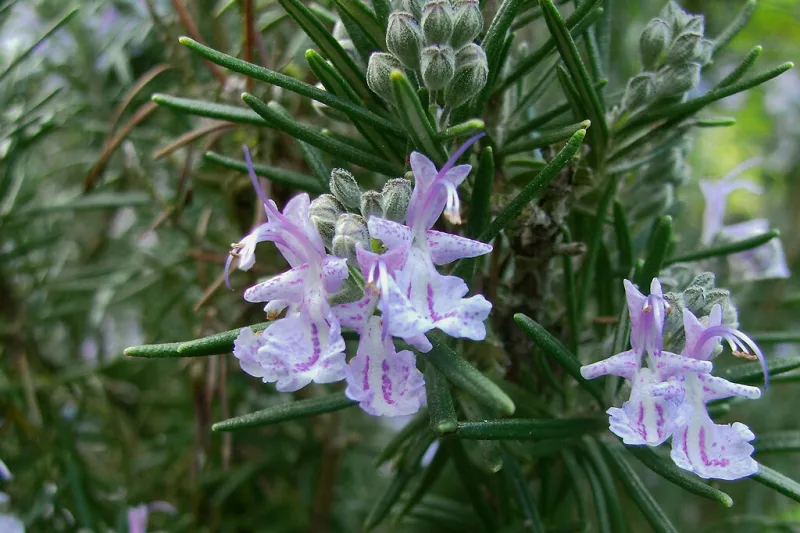

Rosemary Essential Oil: Benefits, Uses and Step-by-Step Recipes for Hair and Circulation
IMPORTANT: Rosemary essential oil is highly concentrated and should never be applied neat (undiluted) to skin or scalp — always dilute it in a carrier oil (coconut, olive, jojoba, sweet almond). It is contraindicated during pregnancy and breastfeeding, in people with epilepsy or a tendency toward seizures, and in those with uncontrolled high blood pressure, since rosemary can stimulate circulation and blood pressure. Do not take it internally without professional guidance, and do not use it on children under 6. Always perform a patch test on a small area of skin before first use. If you are on medication or have a chronic condition, consult your doctor before using this oil.
Grandmother Veronica, from a village at the foot of the Carpathians, kept a whole row of dark little bottles in her pantry, each with its own story. The one holding rosemary oil, though, she kept closest at hand — on the top shelf, beside the cracked mirror. On autumn evenings, when her legs ached after coming down the mountain with the cattle, she would warm a little olive oil in her palms, add a few drops of rosemary, and rub her ankles and calves until a pleasant warmth crept up her legs. “Rosemary wakes up sleeping blood,” she would say, swearing that by morning her legs felt as light as when she was twenty.
Her granddaughters, however, remembered something else: that sharp, fresh, almost forest-like smell that filled the kitchen when she massaged her scalp with the same diluted oil before braiding her long, thick plait — which she still wore even at eighty. “If you want hair like mine,” she told them, “feed the root, not the tip.” It was the simple, mouth-to-mouth wisdom surrounding a plant that the Greeks and Romans once held sacred.
Rosemary essential oil is produced by steam-distilling the flowering tops and leaves of Rosmarinus officinalis (now also classified as Salvia rosmarinus), a Mediterranean shrub with narrow, needle-like leaves and an unmistakable scent of pine, camphor and herbs. It is one of the oldest and most prized essential oils, used for thousands of years in folk medicine, ritual and perfumery. Today it is sought after mainly for its effects on hair, peripheral circulation and mental clarity.
Table of Contents
- What rosemary oil is and how it is made
- Composition and active compounds
- Health benefits
- Traditional uses
- How to use it: step-by-step recipes
- Dosage and how to apply it
- Lifestyle: weaving rosemary into your daily routine
- Practical tips and common mistakes
- Conclusion
- Frequently asked questions
What rosemary oil is and how it is made
Rosemary is a perennial shrub native to the Mediterranean, where it grows wild on rocky, sun-baked coasts. Its leaves contain tiny glands filled with aromatic volatile oils, and these are what — through steam distillation — yield the essential oil. A large quantity of plant material is needed to produce a small amount of pure oil, which is why authentic essential oil is so concentrated and potent.
An important distinction must be made. Rosemary essential oil is a volatile, highly concentrated product obtained by distillation, and it is never used undiluted. It is completely different from a rosemary macerate or infused oil, which is made by steeping rosemary sprigs in a carrier oil (such as olive) and is much gentler. Romanian folk tradition often relied on the more accessible macerate, but the modern essential oil offers a far higher concentration of active compounds.
On the market you will find several rosemary “chemotypes” — chemical variants of the same plant, depending on where it was grown. The best known are the camphor chemotype (stimulating, good for muscles and circulation), the cineole chemotype (better for the respiratory system) and the verbenone chemotype (gentler, prized for skin and hair). For hair care, many people prefer the verbenone or cineole chemotype.
Composition and active compounds
The aroma and effects of rosemary oil come from a complex blend of volatile compounds. Among the most important are:
- 1,8-cineole (eucalyptol) — responsible for the fresh sensation and the decongestant effect on the airways.
- Camphor — a stimulating compound that contributes to the warming effect and the activation of local circulation, which is why rosemary has always been linked to massage for tired muscles.
- Alpha-pinene and beta-pinene — terpenes with a resinous, pine-like scent and toning properties.
- Borneol and bornyl acetate — contributing to the relaxing, balancing effect.
- Verbenone — present mainly in that chemotype and prized for its effects on skin and regeneration.
Beyond the essential oil, the rosemary leaf itself is rich in antioxidant compounds such as rosmarinic acid, carnosic acid and carnosol, which explain why the plant has also been used as a general tonic and a natural food preservative. Studies suggest that these antioxidants help protect cells against oxidative stress, although most of the essential oil’s benefits come from external use and from inhaling the aroma.
Health benefits
Stimulating hair growth and scalp health
The best-known benefit of rosemary oil concerns the hair. Folk tradition has always used it to strengthen the strand and stimulate growth, and modern interest in this effect keeps growing. Rosemary is believed to improve microcirculation at the scalp, delivering more blood, oxygen and nutrients to the hair follicles. A better-nourished scalp can support healthier follicles and more resilient hair.
Studies suggest that regular scalp massage with diluted rosemary oil may help in cases of thinning hair and may reduce itching and flaking. Many people also use it to combat dandruff, thanks to its cleansing, balancing properties on the skin of the scalp.
Supporting peripheral circulation
Rosemary’s “warming” effect, due especially to camphor, makes it a traditional ally for cold feet and hands, for the feeling of heaviness in the legs and for tired muscles. Massage with diluted rosemary oil stimulates surface circulation and gives a pleasant sense of vitality, which is why it was never missing from the toolkit of those who worked physically or stood for long hours.
Easing muscle and joint discomfort
Thanks to its toning and mildly analgesic local effect, rosemary oil has always been used in massages for contracted, stiff or overworked muscles after exertion. Modern athletes sometimes include it in post-workout massage oils, and folk tradition recommended it for aches, rheumatism and back pain.
Mental clarity, memory and focus
Rosemary has been associated with memory since antiquity — Greek students wore sprigs in their hair during exams. Its fresh, penetrating aroma has an invigorating effect on the mind; many people find that inhaling the oil helps them wake up, concentrate and fight off mental fatigue. Studies suggest the rosemary aroma may support attention and alertness, which explains its popularity in daytime aromatherapy.
Support for breathing
Thanks to its cineole content, rosemary oil has a decongestant effect. Inhaled with care and in the right dilution, it can help clear the nose and create a sense of freer breathing during mild colds, and it is often combined with eucalyptus or thyme.
Toning and balancing the skin
Used very diluted in skincare (especially the verbenone chemotype), rosemary has astringent and balancing properties and is appreciated by those with oily or blemish-prone skin. It helps cleanse the pores and leaves a feeling of freshness.
Traditional uses
In the country household, rosemary was almost never absent. Dried sprigs were tucked among clothes to keep moths away, burned to “cleanse the air” in a sick person’s room, and used to smoke meats. Rosemary water — the famous tonic once known as “Hungary Water” — was used as a perfume, a rejuvenating face lotion and a hair rinse.
Women rinsed their hair with strong rosemary infusion to add shine and to subtly deepen the color of brown or dark hair. Men rubbed their scalps with rosemary macerate to slow hair loss. For tired feet, warm rosemary baths were prepared, and for colds people inhaled the steam from a pot of boiled water with rosemary sprigs.
How to use it: step-by-step recipes
Scalp massage oil for hair growth
You need a nourishing carrier oil and rosemary essential oil. The correct ratio for the scalp is roughly 5 drops of essential oil per tablespoon (15 ml) of carrier oil.
- In a small bowl, add 2 tablespoons of gently melted coconut oil or jojoba oil.
- Add 8-10 drops of rosemary essential oil and, optionally, 5 drops of peppermint oil for an extra cooling effect.
- Mix well.
- Apply to the scalp with your fingertips and massage in circular motions for 5-10 minutes, without scratching the skin.
- Leave it on for at least 30 minutes (or overnight, with a towel on your pillow), then wash with a gentle shampoo.
- Repeat 2-3 times a week. Patience is essential: hair effects show over months, not days.
Massage oil for circulation and tired legs
- Into a 50 ml bottle, pour sweet almond oil or olive oil.
- Add 15-20 drops of rosemary essential oil (camphor chemotype, ideal for circulation).
- For an even warmer effect, add 5 drops of ginger or leaf cinnamon.
- Shake the bottle.
- Massage the calves, ankles and soles with firm strokes, moving from the foot toward the knee to support the return of blood.
- Use in the evening after a long day on your feet.
Inhalation for mental clarity
- Place 2-3 drops of rosemary oil on a handkerchief or tissue and breathe in deeply a few times when you feel mentally tired.
- Or add 4-5 drops to an aromatherapy diffuser to scent your workspace or office.
Inhalation for freer breathing
- In a bowl of hot (not boiling) water, add 2-3 drops of rosemary oil and 2 of eucalyptus.
- Cover your head with a towel and inhale the steam for 5 minutes with your eyes closed. People with asthma should avoid concentrated steam inhalations.
Toning aromatic bath
- Mix 5 drops of rosemary oil with a tablespoon of full-fat milk or a handful of bath salt (which helps the oil disperse in water).
- Add the blend to a warm bath and relax for 15-20 minutes. Excellent for tired muscles and a refreshing lift.
Dosage and how to apply it
For essential oil, the golden rule is dilution. Use a 1% dilution for the face (about 1 drop per tablespoon of carrier oil), 2-3% for the body and scalp, and up to 5% for intense local muscle massage, but no more. Using it neat can cause irritation, burning and sensitization.
For inhalation, 2-5 drops are enough. Aromatherapy should be done in short sessions rather than continuously, to avoid overstimulation. Internal use of the essential oil is not recommended without professional supervision, as it is highly concentrated. For consumption, the safe alternative remains an infusion of rosemary leaves (a tea), not the essential oil.
Store the oil in a dark glass bottle, away from light and heat, tightly closed, to preserve its properties.
Lifestyle: weaving rosemary into your daily routine
Rosemary should not be seen only as a “crisis remedy” but as a daily companion. A fresh sprig in the kitchen, sprinkled over potatoes or meat, brings the same beneficial aromatic compounds. A warm rosemary infusion in the morning can replace part of your coffee, offering a gentle tonic for mind and digestion.
For those who work at a desk, a rosemary diffuser in the first part of the day can support concentration, while a short scalp massage in the evening with diluted oil becomes a small ritual of relaxation and care. Combined with regular movement, good hydration and quality sleep, rosemary amplifies its effects on circulation and overall vitality. The key is consistency: the most visible effects, especially on hair, appear in those who use the plant regularly rather than sporadically.
Practical Tips and Common Mistakes
Mistake no. 1: Applying the essential oil neat to skin or scalp. This is the most common and most dangerous mistake. The essential oil must always be diluted in a carrier oil. Applied neat, it can cause severe irritation and long-term sensitization.
Mistake no. 2: Expecting instant results for your hair. The hair follicle has a long growth cycle. Effects should be judged after at least 8-12 weeks of consistent use, not after a few applications.
Mistake no. 3: Using it during pregnancy or with epilepsy. Rosemary is a stimulant and is contraindicated in pregnancy, breastfeeding and in people prone to seizures. These contraindications are not optional.
Mistake no. 4: Confusing essential oil with macerate. The two products have completely different concentrations. A recipe meant for the (gentle) macerate must not be applied to the (highly concentrated) essential oil.
Mistake no. 5: Storing it in a clear bottle, in the light. Light and heat degrade the volatile compounds. Always use dark glass bottles kept in a cool place.
Mistake no. 6: Inhaling too much. More is not better. Prolonged or overly concentrated inhalations can cause headaches, especially in sensitive people.
Mistake no. 7: Skipping the allergy test. Before first use, apply a drop of the diluted blend to the inner forearm and wait 24 hours.
Conclusion
Rosemary essential oil is a concentrated gift from a plant humanity has cherished for thousands of years. From Grandmother Veronica’s well-tended scalp to modern routines for hair care and circulation, rosemary remains a versatile, accessible and lovely-smelling ally. Used correctly — always diluted, with respect for the contraindications and with patience — it can bring real benefits for hair, tired legs, tense muscles and a clear mind. As with any natural remedy, success lies in consistency, in moderation, and in the common sense to pair it with a healthy lifestyle and your doctor’s advice when needed.
Frequently Asked Questions
How quickly does hair grow with rosemary oil? There is no quick answer. Results, if they appear, are seen after 8-12 weeks of consistent use, 2-3 times a week, in the form of scalp massage with diluted oil. Rosemary supports a healthy scalp but is not a miracle overnight solution.
Can I apply rosemary oil directly to my scalp? No, never neat. Always dilute 5-10 drops in a tablespoon or two of carrier oil such as coconut or jojoba. Applying it neat can irritate the scalp.
Does rosemary oil really help circulation? Folk tradition and its stimulating aroma recommend it for massaging cold feet and hands or for a feeling of heaviness. The massage itself improves local circulation, and rosemary enhances the sense of warmth and vitality.
Is it safe to use rosemary oil during pregnancy? No. Rosemary is contraindicated during pregnancy and breastfeeding. There are gentler care options for this period, but rosemary essential oil should be avoided.
Can I drink rosemary essential oil? Internal use is not recommended without professional guidance, as it is highly concentrated. For a gentle internal effect, choose an infusion (tea) made from rosemary leaves.
Which carrier oil is best for hair? Coconut oil, jojoba oil and castor oil (in small amounts) are among the most prized for the scalp. Jojoba most closely resembles the skin’s natural sebum and absorbs easily.
How do I choose a quality rosemary oil? Look for a 100% pure, steam-distilled oil with the botanical name (Rosmarinus officinalis or Salvia rosmarinus) and chemotype listed on the label, packaged in dark glass. Avoid products vaguely labeled “perfume” or “fragrance oil.”
How long does rosemary oil keep? Well stored in a tightly sealed dark glass bottle, away from light and heat, rosemary essential oil retains its quality for roughly 2-3 years.