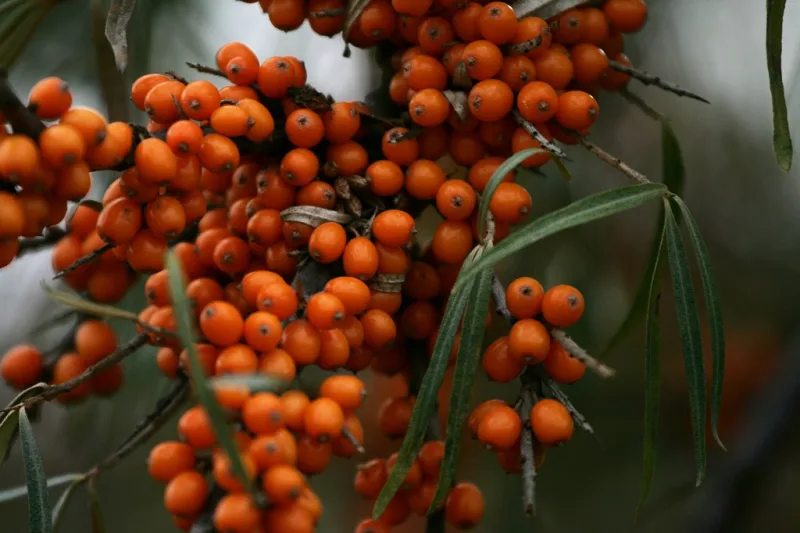

Sea Buckthorn Oil: Benefits, Uses and How to Use It Correctly
IMPORTANT: Sea buckthorn oil is generally well tolerated, but there are situations in which it should be used with caution. Pregnant and breastfeeding women should consult a doctor before taking it internally. People on anticoagulant medication (such as warfarin or high-dose aspirin) should be careful, as sea buckthorn may slightly affect blood clotting. Those with very low blood pressure, gallstones, or known allergies to berries should seek a specialist’s advice. When applying it to the skin, do a patch test first on a small area, especially if you have sensitive skin. Sea buckthorn oil does not replace prescribed medical treatment and should not be used as a substitute for medical care in serious conditions.
A Story from the Mountains
Aunt Veronica, a woman in her seventies from a village at the foot of the Carpathians, tended a thorny sea buckthorn bush that grew right at the edge of her garden. Every autumn, when the orange berries lit up like amber beads on the branches, she would put on thick gloves and patiently gather the tart little fruits. “The thorns prick me, but the reward is worth it,” she would say with a laugh, showing her scratched hands. From the fruit she pressed a thick juice, and the yellow-orange oil that rose to the top she kept in a dark little bottle, like a precious remedy.
In winter, when her grandchildren came in with lips cracked by frost or a scratch on their hands, Aunt Veronica would take out that little bottle and gently dab the irritated skin. “Sea buckthorn heals everything that burns and everything that cracks,” she liked to say. And when a cold came around, she would take a few drops on her tongue, convinced that the golden fruit kept her on her feet. Whole generations in her village grew up believing in the power of this humble plant, which blooms where few others can survive.
What Is Sea Buckthorn Oil
Sea buckthorn oil is obtained from the fruit and seeds of the plant Hippophae rhamnoides, a thorny shrub that grows wild along riverbanks, on sandy terrain, and on mountain slopes across Europe and Asia. Its small, bright orange or yellow berries are among the richest natural sources of vitamins and rare fatty acids. Romanian folk tradition has long regarded it as “liquid gold,” and the folk medicine of Tibet, Mongolia, and Russia has used it for centuries.
There are actually two main types of oil: one extracted from the fruit pulp, an intense orange color and very rich in carotenoids, and one extracted from the seeds, lighter in color and richer in essential omega 3 and omega 6 fatty acids. Many products on the market combine both types. What makes sea buckthorn oil truly special is its high content of palmitoleic acid (omega 7), a rare fatty acid that occurs naturally in human skin, which is why it is so prized in cosmetics.
Table of Contents
- How sea buckthorn oil is made
- Composition and active compounds
- Health benefits
- Sea buckthorn and skin beauty
- Traditional and modern uses
- How to use it correctly (internal and external)
- Useful recipes and combinations
- How to choose quality sea buckthorn oil
- Lifestyle tips
- Practical tips and common mistakes
- Conclusion
- Frequently asked questions
How Sea Buckthorn Oil Is Made
The traditional process began with pressing the fresh fruit to obtain juice, which was then left to separate naturally — the oil, being lighter, rose to the surface and was carefully collected. Today, modern methods use cold pressing or supercritical carbon dioxide (CO2) extraction, which preserves the heat-sensitive vitamins and the intense orange color intact.
Cold pressing is the method preferred by many artisanal producers, because it uses no solvents and maintains the integrity of the nutrients. CO2 extraction is more technologically advanced and produces a very concentrated, pure oil. Regardless of the method, a good-quality sea buckthorn oil should have an orange to reddish color, a characteristic slightly tart and fruity smell, and a fairly dense texture. The amount of fruit needed for a small amount of oil is enormous, which explains the relatively high price of authentic products.
Composition and Active Compounds
The richness of sea buckthorn oil is hard to match in the plant world. Among its most valuable components are:
- Vitamin C — sea buckthorn berries contain remarkable amounts, often exceeding citrus fruits, although some is lost in the oil extraction process.
- Vitamin E (tocopherols) — a powerful antioxidant that protects the skin and cells.
- Carotenoids — beta-carotene, lycopene, and zeaxanthin, responsible for the orange color and with antioxidant roles.
- Palmitoleic acid (omega 7) — a rare fatty acid similar to that found in human skin sebum.
- Essential omega 3, 6, and 9 fatty acids — especially in the seed oil.
- Phytosterols — compounds that support the skin barrier.
- Flavonoids and polyphenols — with anti-inflammatory and antioxidant effects.
This combination of antioxidants and fatty acids explains why sea buckthorn oil is valued both for internal use and for skin care. Studies suggest that the antioxidants in sea buckthorn may help combat oxidative stress, one of the factors involved in cellular aging.
Health Benefits
Supporting Immunity
Folk tradition has always used sea buckthorn to strengthen the body during the cold season. Its wealth of vitamin C, carotenoids, and flavonoids offers natural support to the immune system. Many rural households would take a few drops of oil or a spoonful of sea buckthorn syrup at the first signs of a cold, convinced that it helped the body defend itself.
Skin and Mucous Membrane Health
Palmitoleic acid and carotenoids support tissue regeneration. Studies suggest that sea buckthorn oil may help maintain the integrity of mucous membranes, which is why it is traditionally used for digestive discomfort and mild stomach irritation.
Antioxidant and Anti-Aging Effect
The combination of vitamin E, vitamin C, and carotenoids makes sea buckthorn oil a powerful defender against free radicals. These compounds help neutralize oxidative stress, which contributes to the premature aging of skin and cells.
Cardiovascular Health
The essential fatty acids and phytosterols in the oil are traditionally associated with maintaining a balanced lipid profile. Studies suggest a possible role in supporting blood vessel health, although it should not be seen as a substitute for a healthy lifestyle.
Healing of Wounds and Minor Burns
Perhaps the best-known traditional use of sea buckthorn oil is for irritated skin, minor burns, sunburn, and superficial wounds. In Russian folk medicine, sea buckthorn oil was widely used to speed up skin healing and soothe inflammation.
Sea Buckthorn and Skin Beauty
No other aspect has made sea buckthorn oil as popular today as its cosmetic effects. Because palmitoleic acid is so similar to the skin’s natural lipids, the oil is absorbed relatively easily and helps nourish the complexion deeply.
For mature skin, the antioxidants help reduce the fine appearance of wrinkles and restore a healthy glow. For dry or cracked skin, the fatty acids rebuild the lipid barrier and soothe the feeling of tightness. For sensitive or irritated skin, the calming properties can reduce redness and discomfort. Many people use a few drops in the evening, mixed into their usual cream or applied directly to dry areas.
A word of caution, though: because of the intense orange pigments, pure sea buckthorn oil can leave a slight golden tint on the skin, which is why it is used in small amounts or diluted in another carrier oil, such as jojoba or almond oil.
Traditional and Modern Uses
In the traditional household, sea buckthorn was used in its entirety. Syrups, jams, and teas were made from the fruit, and the oil was kept as a winter remedy. Today, sea buckthorn oil is found in:
- Capsules and dietary supplements for internal use
- Creams, serums, and balms for skin care
- Hair and nail products
- Lip balms for protection in cold weather
- Drops and products for mild digestive discomfort
How to Use It Correctly
Internal Use
For internal use, the usual dose is small — generally a few drops up to a teaspoon per day, depending on the product’s concentration and label recommendations. It can be taken pure, on the tongue, or mixed into a spoonful of honey or a glass of warm water. It is recommended to take it in the morning, on an empty stomach or during a meal. To support immunity during the cold season, many people take it in courses of a few weeks, with breaks in between.
External Use on the Skin
For the face, two or three drops are enough. Warm them between the palms and apply gently to clean skin, possibly mixed with your usual cream. For dry areas of the body, elbows, knees, or heels, it can be applied directly. On minor burns or sunburn, apply a thin layer after the skin has cooled down.
For Hair
A few drops massaged into the scalp or applied to dry ends can nourish the hair and restore shine. Leave it to work for 30 minutes before washing, or use it as an overnight treatment in a very small amount.
Useful Recipes and Combinations
Evening hydrating serum: Mix 5 drops of sea buckthorn oil with a tablespoon of jojoba oil. Apply in the evening, after cleansing the skin, massaging gently.
Regenerating mask: Combine a teaspoon of honey, a few drops of sea buckthorn oil, and a teaspoon of full-fat yogurt. Apply to the face for 15-20 minutes, then rinse with lukewarm water.
Balm for cracked lips: Mix sea buckthorn oil with a little melted beeswax and coconut oil, then let it solidify in a small container.
Immunity tonic: A teaspoon of honey with a few drops of sea buckthorn oil, taken in the morning during the cold season.
Soothing massage oil: Dilute sea buckthorn oil in sweet almond oil for a nourishing massage of dry skin.
How to Choose Quality Sea Buckthorn Oil
An authentic oil should be cold-pressed or CO2-extracted, with an intense orange to reddish color and a characteristic fruity-tart smell. Avoid very cheap products, as they may be diluted with inexpensive vegetable oils. Read the label: it should clearly indicate whether it is pulp oil, seed oil, or a combination. Store the oil in a dark glass bottle, away from light and heat, and use it within a reasonable time after opening, as the fatty acids can oxidize.
Lifestyle Tips
Sea buckthorn oil works best as part of a balanced lifestyle. A diet rich in fresh fruits and vegetables, adequate hydration, quality sleep, and protecting the skin from excessive sun exposure amplify its antioxidant benefits. During the cold season, combine internal use with a varied diet and moderate exercise to support your immunity. For the skin, sea buckthorn gives better results when used consistently in small doses rather than occasionally in large amounts.
Practical Tips and Common Mistakes
Mistake no. 1: Using pure oil in too large amounts on the face. The orange pigments can temporarily tint the skin. The solution: dilute it in another carrier oil or use just a few drops.
Mistake no. 2: Storing the oil in light or heat. This accelerates oxidation and the loss of properties. Keep it in a dark glass bottle, in a cool place.
Mistake no. 3: Expecting immediate results from internal use. The benefits appear gradually, in regular courses, not overnight.
Mistake no. 4: Applying it to serious burns or deep open wounds. Serious injuries require medical care, not natural remedies.
Mistake no. 5: Ignoring the allergy test. Especially for sensitive skin, test first on a small area.
Mistake no. 6: Buying a very cheap oil of unknown origin, which may be diluted or of poor quality.
Conclusion
Sea buckthorn oil is one of nature’s most precious gifts in the arsenal of traditional Romanian remedies. Rich in vitamins, antioxidants, and the rare fatty acid omega 7, it unites two worlds: skin care and support for internal health. From the winter-cracked skin of children in mountain villages to the modern shelves of cosmetics, sea buckthorn has kept its reputation as “liquid gold.” Used in moderation, chosen with care, and stored correctly, sea buckthorn oil can become a trusted ally for radiant skin and supported immunity. As with any natural remedy, however, moderation and common sense remain the best guides.
Frequently Asked Questions
Can sea buckthorn oil be taken internally every day? Yes, in small doses, many people take it daily in courses of a few weeks. Follow the label instructions and take breaks between courses. If you are on medication, consult your doctor.
Does sea buckthorn oil help with wrinkles? The antioxidants and fatty acids in the oil support skin elasticity and can reduce the fine appearance of wrinkles. Results appear with consistent use, not immediately.
Does sea buckthorn oil stain the skin or clothes? Yes, because of the intense orange pigments it can leave marks. Use small, diluted amounts and avoid contact with light-colored fabrics.
What is the difference between pulp oil and seed oil? The pulp oil is orange, rich in carotenoids and omega 7, ideal for the skin. The seed oil is lighter and rich in omega 3 and 6, valued for internal use.
Can I use sea buckthorn oil on sunburn? Traditionally it is used for mild sunburn and irritated skin, applied after the skin has cooled. Serious burns require medical care.
Is it safe during pregnancy? For external use it is generally considered safe, but for internal use during pregnancy and breastfeeding it is recommended to consult a doctor.
How do I recognize authentic sea buckthorn oil? It has an intense orange-reddish color, a characteristic fruity-tart smell, is cold-pressed or CO2-extracted, and comes from a trusted producer.
How long can it be kept after opening? It depends on the product, but generally it should be used within a few months of opening, stored in a cool place away from light, to avoid oxidation of the fatty acids.