
St. John’s Wort Oil: Benefits, Uses and How to Apply It for Skin and Burns
IMPORTANT: St. John’s wort oil applied to the skin is generally well tolerated, but St. John’s wort contains hypericin, a photosensitizing compound. After applying it to your skin, avoid exposing the area to strong sunlight or tanning beds for at least 12 hours, to prevent redness, exaggerated sunburn or pigment spots. Taken internally (as tea, tincture or capsules), St. John’s wort interacts strongly with many medications: oral contraceptives (it can reduce their effectiveness), antidepressants, anticoagulants, immunosuppressants, certain heart medications and antiretrovirals. If you take any long-term medication, do NOT use St. John’s wort internally without your doctor’s approval. Pregnant or breastfeeding women should avoid the oil internally and be cautious about applying it to large skin areas. Do NOT apply oil to deep wounds, serious burns (second- or third-degree), extensive or infected burns — these require urgent medical care.
A story from the edge of the forest
Grandma Veta, from my grandparents’ village, never set off in June without a small wicker basket on her arm. “The blood of the Lord is blooming now,” she would say, pointing to the meadows scattered with tiny yellow flowers. She picked them around noon, when the sun was high and the blossoms were fully open, then packed them into a glass jar and poured sunflower oil over them. She set the jar on the south-facing windowsill and, week after week, she shook it and watched it turn a deeper red, like liquid ruby.
Whenever one of the grandchildren came to her with a scraped knee, a small burn from the stove plate, or a painful callus, Grandma Veta would reach for that red little bottle and gently dab the spot. “This oil heals both the skin and the soul,” she joked, because folk tradition held that St. John’s wort chased away sadness and fear. Every time I smell a fresh jar of St. John’s wort oil, I am carried back to that sunlit kitchen. This article gathers everything I learned from her and from today’s herbalists about this old yet surprisingly relevant remedy.
What is St. John’s wort oil
St. John’s wort oil is an infused (macerated) oil — popularly known as “red oil” or “St. John’s oil” — made by steeping fresh St. John’s wort flowers (Hypericum perforatum) in a base vegetable oil, usually sunflower, olive or almond oil. As it macerates in the sun, the pigments in the flowers — especially hypericin and hyperforin — pass into the oil and give it its characteristic ruby-red color. This color is the sign that the infusion has “taken” and that the active compounds have migrated into the fat.
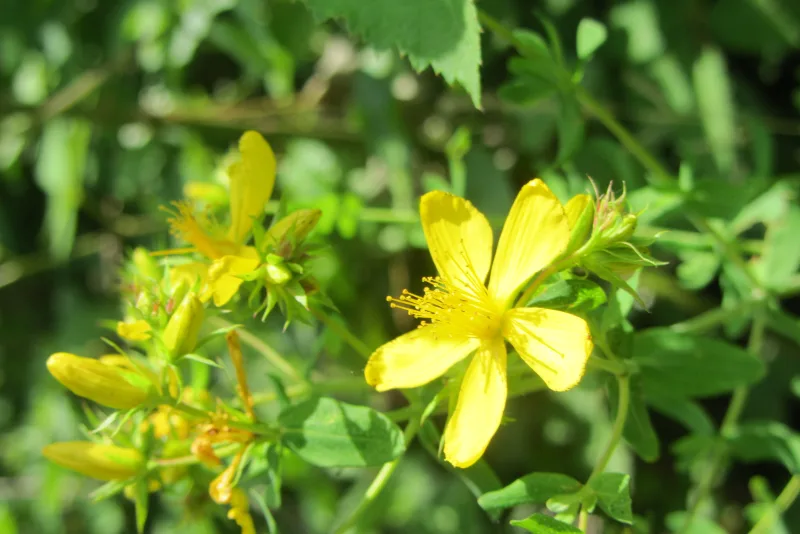
St. John’s wort is a perennial herbaceous plant, 30–80 cm tall, with branched stems and small leaves that, held up to the light, appear perforated by thousands of tiny holes (these are actually glands containing essential oils — hence the species name perforatum). The flowers are golden-yellow, with five petals and numerous stamens, and they bloom around midsummer (late June), which is why in many cultures the plant is tied to the feast of Saint John the Baptist. It grows wild at the edges of forests, in meadows, on uncultivated land and along roadsides across much of the temperate world.
Table of Contents
- What it is and how St. John’s wort oil is made
- Composition and active principles
- Benefits for skin and mucous membranes
- St. John’s wort oil for minor burns
- Other traditional uses
- How to make St. John’s wort oil at home (step-by-step recipe)
- How to apply it and dosage
- Lifestyle and practical tips
- Practical tips and common mistakes
- Conclusion
- Frequently Asked Questions
How St. John’s wort oil is made
Unlike essential oils (obtained by steam distillation) or cold-pressed oils (from seeds), St. John’s wort oil is an oil infusion. The process is simple and homely: the flowers and flower buds are covered with vegetable oil and the mixture sits in the sun for a few weeks. Heat and light help draw the fat-soluble compounds out of the plant and into the oil.
There are two traditional methods:
- Cold maceration in the sun: the jar sits at a window or in the garden, exposed to sunlight, for 3–6 weeks. This is the classic, gentle method that best preserves the more sensitive compounds.
- Warm maceration (in a water bath): for those in a hurry, the mixture of flowers and oil is kept for a few hours over very low heat in a bain-marie, without boiling. It is faster but harsher on the delicate substances.
Whichever method you use, the sign of success is the same intense red color. An oil that stays pale yellow shows that the flowers were not fresh enough, that there were too few of them, or that it did not macerate long enough.
Composition and active principles
St. John’s wort is one of the most studied medicinal plants, and its chemical richness explains the oil’s versatility. The main classes of compounds that pass into the oil are:
- Hypericin and pseudohypericin — red pigments (naphthodianthrones) responsible for the oil’s color. They are also the photosensitizing compounds, which is why caution in the sun is advised.
- Hyperforin — a phloroglucinol derivative whose properties have been studied for their soothing effect and for supporting tissue recovery.
- Flavonoids (hyperoside, rutin, quercetin) — antioxidant compounds that help protect the skin against oxidative stress.
- Tannins — with a mild astringent effect, useful for soothing superficial irritation.
- Essential oils and fatty acids from the base oil, which moisturize and form a protective film on the skin.
Folk tradition and modern studies suggest that this combination gives the oil soothing, mildly anti-inflammatory, astringent and skin-regeneration-supporting properties. It is worth stressing that, in an infused oil applied externally, the amounts of hypericin are small, so the main concern remains photosensitization rather than internal effects.
Benefits for skin and mucous membranes
Soothing irritation and redness
Thanks to its astringent tannins and protective oily film, St. John’s wort oil is traditionally valued for calming irritated, reddened or dry skin. Grandmothers used it on cracked elbows and knees, on the rough skin of hands after hard work, and on areas exposed to cold and wind.
Support for skin regeneration
Folk tradition recommends it for small scratches, superficial grazes and wounds that have already closed, helping the newly formed skin stay supple. The oily film reduces dryness and the feeling of tightness in healing skin. Note: do not apply oil to open, deep or bleeding wounds.
Hydration and elasticity
Like any plant-based infused oil, it forms a barrier that reduces water loss from the skin. Used on dry skin, on old (already healed) scars and on older stretch marks, many people feel it improves the sensation of elasticity and softness.
Relief for mild itching
For insect bites, nettle stings and small itchy irritations, a drop or two gently massaged in may bring a sense of relief, thanks to its emollient and mildly astringent effect.
St. John’s wort oil for minor burns
The best-known traditional use of “red oil” is on minor, superficial burns — for example a touch from a hot stove plate, a splash of oil from a frying pan, or a mild sunburn. The old folk said it cooled the skin and “drew out the fire.”
Here is how it was done traditionally, with today’s safety clarifications:
- Cooling first: a minor burn should immediately be held under cool running water (not ice) for 10–20 minutes. This is the essential step.
- Only after the skin has cooled and is intact (no broken blisters, no open wounds) can a thin layer of St. John’s wort oil be applied to keep the skin supple and ease the stinging sensation.
- Cover with clean gauze if needed and avoid sun exposure.
Very important: the oil should not be applied immediately to a fresh, hot burn, because the fat can trap heat. And, to repeat the warning from the start — for extensive burns, large blisters, burns on the face or joints, or second- to third-degree burns, see a doctor.
Other traditional uses
- Massage for tired muscles and joints: warmed gently between the palms, St. John’s wort oil was used to massage the back, shoulders and joints after exertion, for a relaxing sensation and moisturized skin.
- Chapped lips and corners of the mouth: a small amount applied in the evening helps soften delicate skin.
- Mature skin care: included in evening facial oils for a sense of firmness and hydration.
- Discomfort along superficial nerves: folk tradition used it to massage areas with superficial “stitch”-type discomfort, although the evidence here is largely anecdotal.
- External hemorrhoids: applied locally for its emollient, soothing effect, but only after consulting a specialist.
How to make St. John’s wort oil at home (step-by-step recipe)
Making it at home is within anyone’s reach and gives the loveliest results if you follow a few simple rules.
Ingredients:
- freshly picked St. John’s wort flowers and flower buds (a full jar, without packing them tightly)
- a quality vegetable oil: cold-pressed sunflower, extra-virgin olive or sweet almond oil (enough to cover the flowers well, plus 2–3 cm on top)
- a clean, dry glass jar with a lid
- gauze or a fine sieve for straining
- a dark glass bottle for storage
Steps:
- Picking: choose a sunny day, around noon, during the flowering season (June–July). Pick the open yellow flowers and buds, without leaves or thick stems. Make sure they are not wet from dew or rain — water encourages mold.
- Light wilting: leave the flowers in the shade for 2–3 hours, spread out on a towel, so they lose some moisture.
- Filling the jar: place the flowers in the jar without pressing them hard. Pour the oil over them slowly until they are fully covered with 2–3 cm of oil. The flowers must NOT surface above the oil, or they will mold.
- Removing air bubbles: stir gently with a clean wooden spoon to release air trapped among the flowers.
- Sun maceration: close the lid, label the jar with the date, and place it at a south-facing window or in the garden, in the sun. Shake it gently every day or every other day.
- Patience: after 3–6 weeks, the oil turns ruby-red. That color is the sign it is ready.
- Straining: strain through gauze, squeeze the flowers well and discard them. Let the strained oil settle for 1–2 days, then pour the clear part into the dark glass bottle.
- Storage: keep the bottle in a cool, dark place. Stored this way, it usually keeps for 6–12 months.
Quick water-bath variation: place the flowers and oil in a jar, set the jar in a pot of water and keep it over very low heat for 2–3 hours (the water should not come to a rolling boil). Let it cool, then macerate for another 24 hours and strain. The color will be less intense than with the long maceration, but the oil is ready the same day.
How to apply it and dosage
For external use, St. John’s wort oil is applied in a thin layer, gently massaging the target area, 1–2 times a day. A pea-sized amount is enough for a small area. On healthy skin it can be used as is; on sensitive skin or on children, many people prefer to dilute it further with almond or coconut oil.
Before first use, do a patch test: apply a drop to the crook of your elbow and wait 24 hours. If itching, redness or a rash appears, stop using it.
The golden rule: after applying, avoid the sun on the oiled area for at least 12 hours — ideally apply it in the evening. This is the most important precaution, because of the photosensitizing hypericin.
For internal use (tea, tincture, standardized capsules), the dosage is entirely different, belongs to the field of phytotherapy and should NOT be started without a doctor’s advice, especially because of the many drug interactions.
Lifestyle and practical tips
St. John’s wort oil fits beautifully into a natural skin and body care routine. A few ideas:
- Keep a small bottle in your home first-aid kit or your mountain cabin kit, for minor household incidents (after properly cooling the area).
- Use it in the evening as a relaxing massage oil for the neck and shoulders, after a day at the desk.
- Add a few drops to your bathwater for soft skin (be careful — the tub becomes slippery).
- For richer care, combine it in equal parts with calendula oil (soothing) or lavender oil (relaxing).
- Maintain a diet rich in vegetables, colorful fruit and healthy fats for resilient skin from within — no oil replaces a balanced lifestyle and proper hydration.
Practical Tips and Common Mistakes
Mistake no. 1: Picking wet flowers. Dew or rain introduces water into the jar, and water inevitably leads to mold and spoils the whole infusion. Always pick in dry, sunny weather.
Mistake no. 2: Letting flowers surface above the oil. Any plant fragment not covered by oil rots and contaminates the entire jar. Always make sure the flowers are submerged under a 2–3 cm layer of oil.
Mistake no. 3: Applying oil to a fresh, hot burn. Fat can trap heat in the skin. Always cool first with cool water for 10–20 minutes, and apply the oil only after the skin has cooled and is intact.
Mistake no. 4: Sun exposure after applying. Hypericin makes the skin sensitive to light. Apply in the evening and protect the area from the sun.
Mistake no. 5: Internal use without consulting a doctor. Internal St. John’s wort interacts with oral contraceptives, antidepressants, anticoagulants and many other medications. Do not improvise internal treatments.
Mistake no. 6: Storing in heat and light after straining. The finished oil oxidizes quickly in light. Keep it in a dark glass bottle in a cool, dark place.
Mistake no. 7: Using a rancid base oil. If the starting vegetable oil smells off, the infusion is compromised from the beginning. Always start with a fresh, quality oil.
Conclusion
St. John’s wort oil is one of the finest examples of a traditional remedy that stands the test of time: simple to make at home, affordable and surprisingly versatile for skin care, soothing mild irritation and supporting recovery from small superficial burns (after proper cooling). Our grandmothers’ “red oil” is not a cure-all, but used sensibly, respecting the precautions about sun exposure and internal interactions, it remains a trusted ally in the home’s natural kit. The key is moderation, quality ingredients and common sense: for any serious skin problem, extensive burn or condition that does not improve, the right path leads to the doctor, not to the oil jar.
Frequently Asked Questions
Why did my St. John’s wort oil stay yellow instead of turning red? Most likely the flowers were not fresh enough, there were too few of them relative to the amount of oil, or it did not macerate long enough in the sun. The red color comes from hypericin, which needs fresh, fully open flowers, plus time (3–6 weeks) and light exposure.
Can I use St. John’s wort oil on my face? Yes, many people use it in the evening, in a thin layer, for hydration and a sense of firmness. Do a patch test first, and apply it only in the evening, avoiding the sun the next day on oiled skin because of photosensitization.
Is St. John’s wort oil safe for children? For external use on small areas, many parents use it further diluted, but with children caution matters even more. Ask your pediatrician’s advice, especially for babies, and never use it internally in children without medical approval.
How long does St. John’s wort oil keep? Strained and stored properly in a dark glass bottle in a cool, dark place, it generally keeps for 6–12 months. If it smells rancid or changes consistency, throw it out.
Can I take St. John’s wort internally if I’m on birth control pills? Not without talking to your doctor. Internal St. John’s wort can reduce the effectiveness of oral contraceptives, increasing the risk of unintended pregnancy. This is one of the best-known and most important interactions of the plant.
Why must I avoid the sun after applying it? The hypericin in St. John’s wort is photosensitizing: it makes the skin more sensitive to ultraviolet light and can lead to redness, exaggerated sunburn or spots. That is why evening application and sun protection for at least 12 hours are recommended.
Can I replace sunflower oil with olive oil? Yes. Extra-virgin olive oil is an excellent base, more stable against oxidation but with a more pronounced smell. Sweet almond oil is also very pleasant on the skin. Choose the base oil according to your preferences and your skin.
Does St. John’s wort oil help with scars? Folk tradition uses it on already-healed scars to keep the skin supple and hydrated, which may improve the feeling of elasticity. Do not apply it to open or recent wounds. For significant scars, consult a dermatologist.