
Thyme Essential Oil: Benefits, Uses and How to Use It
IMPORTANT: Thyme essential oil is one of the most powerful antimicrobial oils, but also one of the most irritating to skin and mucous membranes. NEVER apply it undiluted to the skin and NEVER ingest it without the guidance of a specialist. It is contraindicated for pregnant and breastfeeding women, children under 6, people with high blood pressure, and those with blood-clotting issues or who take anticoagulants. It may interact with certain medications. Always do a patch test before use and consult your doctor if you are on any treatment.
Aunt Veronica, from the villages at the foot of the Apuseni Mountains, kept a small brown bottle of thyme oil on the top shelf of her pantry, right next to the honey and the garlic lard. Whenever someone in the house started coughing or sneezing, she would drip a few drops into a bowl of boiling water, drape a towel over the person’s head, and have them “draw the steam” until their chest cleared. “This thyme,” she would say, “chases the cold out of a body faster than any medicine.” Back then nobody talked about thymol or antimicrobial compounds, yet the village women knew, generation after generation, that thyme steam cleared the lungs and soothed a cough.
Years later, when her granddaughter moved to the city and began reading about essential oils, she was amazed to discover that her grandmother’s instinct rested on solid ground. Thyme, that humble plant growing on sunny, rocky slopes, has been a health ally for thousands of years, and its essential oil concentrates the aromatic power of hundreds of tiny leaves into a single drop. In this article we will explore in detail what thyme essential oil is, where its strength comes from, how to use it correctly, and which precautions are absolutely essential.
Thyme essential oil is obtained by steam-distilling the flowering aerial parts of the plant Thymus vulgaris or its close relatives. It is a concentrated, strongly aromatic liquid with a warm, herbaceous, slightly pungent scent, highly prized both in aromatherapy and in natural body care. Unlike the thyme used in cooking, the essential oil is dozens of times more concentrated and must be treated with great respect.
Table of Contents
- What thyme essential oil is and how it is made
- Types of thyme oil (chemotypes)
- Composition and active principles
- Health benefits
- Traditional uses
- How to use it correctly (step-by-step recipes)
- Thyme oil for hair and skin
- Dosage and dilution
- Precautions and contraindications
- Practical Tips and Common Mistakes
- Conclusion
- Frequently Asked Questions
What thyme essential oil is and how it is made
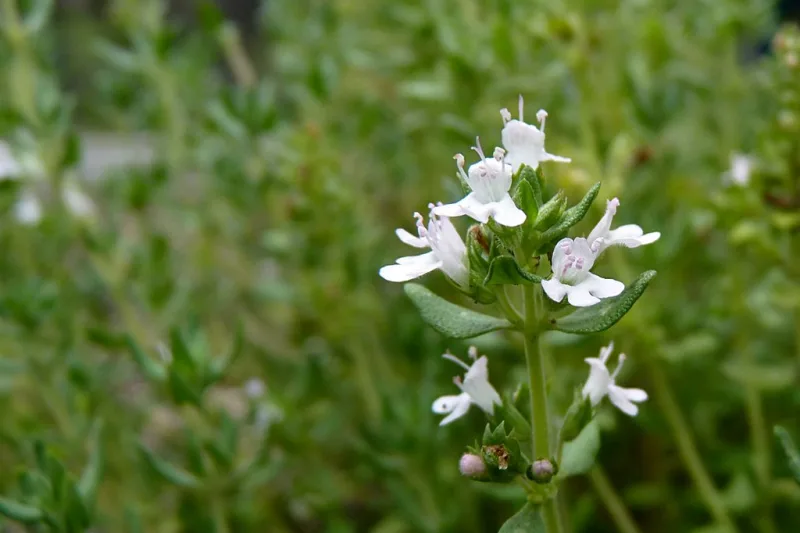
Thyme (Thymus vulgaris) is a small perennial plant in the Lamiaceae family, the same family as mint, basil, and rosemary. It has woody stems, tiny leaves, and pink-purple flowers that bees adore. It grows wild across the Mediterranean but is cultivated almost everywhere in the world, including in gardens, where it tolerates drought and strong sun very well.
To obtain the essential oil, the flowering plant is harvested, left to wilt slightly, and then steam-distilled. Hot steam passes through the plant material, carries away the volatile aromatic compounds, and upon cooling these separate from the water as a concentrated oil. A considerable amount of plant material is needed for a single milliliter of oil, which explains why this product is so potent. The water left over from distillation, called thyme hydrosol, is also used and is far gentler.
Types of thyme oil (chemotypes)
An essential point that many buyers overlook is the existence of several thyme “chemotypes.” Depending on the climate, soil, and altitude where it grows, the same species produces different dominant compounds:
- Thyme thymol – the most common and most powerful antimicrobial, but also the most irritating. Ideal for disinfection and immune support, but to be avoided on sensitive skin.
- Thyme linalool – much gentler and safer, suitable for delicate skin, older children (with caution), and sensitive individuals. It has a sweeter, more floral scent.
- Thyme geraniol – balanced, with notable antifungal and antiviral properties, gentle on the skin.
- Thyme thujanol – rare and precious, valued for its mildness and immune support.
When buying thyme oil, read the label. For use on the skin, choose the linalool or geraniol chemotypes. For surface disinfection and diffusion, the thymol chemotype is excellent.
Composition and active principles
The power of thyme oil lies in its volatile compounds. The main ones are:
- Thymol – a phenol with remarkable antiseptic, antibacterial, and antifungal properties. It is responsible for the penetrating scent and the oil’s potent action. Folk tradition has used it since ancient times, and studies suggest it is active against many microorganisms.
- Carvacrol – another related phenol with antimicrobial and antioxidant effects.
- Linalool – a gentle, calming monoterpene alcohol with antifungal action.
- p-Cymene and gamma-terpinene – terpene hydrocarbons that support the oil’s overall action.
- Borneol and geraniol – contribute to the aroma and antiseptic properties.
This combination makes thyme oil one of the most prized oils for supporting the body’s natural defenses, especially during the cold season.
Health benefits
Supports immunity and natural defenses
Thanks to its rich thymol and carvacrol content, thyme oil is traditionally used as a “shield” during the cold months. Diffused around the home, it scents the air and creates an environment less hospitable to germs. Many families use it preventively when household members start falling ill one by one.
Helps with breathing and soothes coughs
Thyme steam has always been the go-to remedy for a congested chest, cough, and blocked nose. The volatile compounds help loosen secretions and clear the airways. Gentle inhalations with a single drop of oil can ease the feeling of congestion and make breathing freer.
Antimicrobial and antifungal properties
Studies suggest that thymol has a powerful action against many bacteria and fungi. This is why thyme oil is found in many natural cleaning products, mouthwashes, and skin-hygiene solutions. Traditionally, it was used to disinfect small scratches or in foot baths against fungal issues.
Supports digestion
In the Mediterranean tradition, thyme is a great friend of the stomach. A few drops diluted in vegetable oil, gently massaged onto the abdomen, are used to soothe bloating and digestive discomfort. Its characteristic scent stimulates appetite.
Energizing and a tonic for the mind
In aromatherapy, thyme’s warm, herbaceous scent is considered invigorating. It is said to help combat mental fatigue, sluggishness, and lack of focus. Diffused in the morning, it can provide a boost of energy and clarity, which is why this subject is linked to improved mood and vitality.
Skin and scalp care
Properly diluted, thyme oil is used for blemish-prone skin and for a healthy scalp. Its properties help maintain balance, and in hair lotions it is valued for its toning effect on the roots.
Traditional uses
In the households of old, thyme and its oil had dozens of uses. It was placed in clothes drawers to ward off moths, in floor-washing water to disinfect the home, in chest steam baths, and in salves for tired muscles. Mountain shepherds rubbed small wounds with thyme, and women used it in hair-rinse water for shine and health. Folk tradition associated it with protection and cleanliness, and it was often hung in dried bunches around the house.
How to use it correctly (step-by-step recipes)
Inhalation for the chest and blocked nose
- Boil about a liter of water and pour it into a large bowl.
- Let the water cool for 1-2 minutes (it should not be boiling).
- Add just 1 drop of thyme essential oil (the gentler linalool chemotype).
- Lean over the bowl at a comfortable distance, cover your head with a towel, and breathe the steam for 3-5 minutes with your eyes closed.
- Repeat at most once a day. Note: not for young children, asthmatics, or sensitive individuals.
Natural disinfectant spray for the home
- In a 250 ml spray bottle, put 200 ml of water and 50 ml of white vinegar.
- Add 15-20 drops of thyme oil (thymol chemotype) and 10 drops of lemon oil.
- Shake well before each use and spray on surfaces (not on food, marble, or natural stone, which vinegar can damage).
Massage oil for tired muscles
- In a bottle, place 30 ml of a base vegetable oil (almond, sesame, or sunflower).
- Add 6 drops of thyme oil and 4 drops of lavender oil.
- Massage the tense areas with circular movements. Avoid any irritated skin.
Toning foot bath
- In a basin of warm water, add a tablespoon of coarse salt.
- Drip in 2-3 drops of thyme oil pre-mixed with the salt (the salt helps it disperse).
- Soak your feet for 10-15 minutes. Excellent after a long day on your feet.
Air diffusion
Add 3-5 drops to a water diffuser, according to the device’s capacity. Diffuse for 30-60 minutes, then ventilate. Do not leave the diffuser running continuously and do not diffuse in a baby’s room.
Thyme oil for hair and skin
For a toned scalp and healthy-looking hair, thyme oil can be added to your care routine. A simple method: add 2-3 drops to a tablespoon of coconut or castor oil, gently massage the scalp, leave it on for 20-30 minutes, then wash with your regular shampoo. This massage stimulates circulation at the roots.
For blemish-prone skin, a single drop of thyme oil (linalool chemotype) diluted in a teaspoon of jojoba oil can be applied locally in the evening. Always test on a small area first, as sensitive skin may react.
Dosage and dilution
The golden rule of essential oils, especially potent ones like thyme, is dilution. For healthy adults:
- On the skin: a maximum 1-2% concentration, that is, 1-2 drops of essential oil per 5 ml (one teaspoon) of carrier oil.
- In the bath: always disperse the drops in a tablespoon of salt, honey, or oil before adding them to the water, so they do not float in concentrated form.
- Diffusion: 3-5 drops per session.
- Never internally without specialist supervision.
Always start with the smallest dose and increase gradually only if your skin tolerates it well.
Precautions and contraindications
Thyme oil, especially the thymol chemotype, is powerful and can be irritating. Here are the essential precautions:
- Never undiluted on the skin – it can cause burns, redness, and sensitization.
- Contraindicated during pregnancy and breastfeeding.
- Not to be used on children under 6, and with great caution on older children.
- People with high blood pressure should avoid the phenol-rich (thymol) chemotypes.
- People taking anticoagulants or with clotting issues should consult a doctor, as phenols may affect coagulation.
- Avoid contact with the eyes and mucous membranes.
- A patch test is mandatory – apply one diluted drop to the inner elbow and wait 24 hours.
- Keep the bottle away from children, out of light and heat.
In case of irritation, wipe the area with vegetable oil (not water, which does not dissolve the oil) and stop using it.
Practical Tips and Common Mistakes
Mistake no. 1: Applying it undiluted to the skin. This is the most dangerous mistake. Pure thyme oil can cause chemical burns. Always dilute it in a carrier oil.
Mistake no. 2: Using the wrong chemotype. Many people buy thyme oil without checking the chemotype. For skin you need linalool; thymol is for cleaning and diffusion.
Mistake no. 3: Overdosing in the diffuser. “More” does not mean “better.” Too many drops can cause headaches and airway irritation.
Mistake no. 4: Using it on young children or during pregnancy. This oil is not for everyone. Respect the contraindications.
Mistake no. 5: Ingesting it without supervision. Ingested essential oils can be toxic. Do not use them internally on your own initiative.
Mistake no. 6: Dropping it directly into bath water. The oil does not dissolve in water; always disperse it in salt, honey, or oil.
Mistake no. 7: Storing it in the light. Essential oils oxidize in light and heat. Keep them in dark bottles in a cool place.
Conclusion
Thyme essential oil is a true treasure of nature: concentrated, aromatic, and full of beneficial compounds such as thymol and carvacrol. Used correctly and with the respect its power deserves, it can be a valuable ally during the cold season, in natural home cleaning, in hair and skin care, and in supporting a good mood and vitality. The key, however, is moderation and dilution: just as in the wisdom of our grandparents, who knew that the most powerful remedies are used sparingly. Start with small doses, choose the chemotype suited to your purpose, and always listen to your body.
Frequently Asked Questions
Can I use thyme oil directly on my skin? No. Thyme essential oil must always be diluted in a carrier oil (almond, jojoba, coconut), at a maximum concentration of 1-2%. Applied undiluted, it can cause severe irritation or burns.
Which chemotype is safest for the skin? The linalool chemotype is the gentlest and most suitable for sensitive skin and personal care. The thymol chemotype is stronger and recommended for cleaning and diffusion.
Is it safe for children? It is not recommended for children under 6. For older children, use it with great caution, in very low concentrations, preferably the linalool chemotype, and only on a specialist’s advice.
Can I swallow it for a cough or sore throat? Not without the advice and supervision of a specialist. Ingested essential oils can be toxic. For a cough, the safe traditional method is steam inhalation.
How do I choose a quality thyme oil? Look for a 100% pure oil with the botanical name (Thymus vulgaris) and chemotype indicated on the label, packaged in a dark bottle. Avoid products vaguely labeled as “fragrance oils.”
How long can I diffuse thyme oil? 30-60 minutes per session is enough, followed by ventilation. Continuous diffusion is not recommended, as it can irritate the airways.
Does it really help with colds? Folk tradition and aromatherapy have long used it to ease respiratory discomfort and to scent the air with antimicrobial compounds. However, it does not replace medical treatment; see your doctor for persistent symptoms.
How is it stored correctly? In its original bottle, tightly closed, away from light, heat, and the reach of children. That is how it best retains its properties, usually for several years after opening.