 Photo: OneUpOnUs, CC BY-SA 4.0, via Wikimedia Commons
Activated charcoal genuinely helps in one well-documented situation: certain acute poisonings with medicines or toxic substances, given early (ideally within the first hour) on the advice of a doctor or poison centre. Evidence for gas and bloating is modest, and claims about detox, hangovers and teeth whitening are not backed by science. The biggest everyday risk is that it also binds oral medicines, including the contraceptive pill, and can make them stop working.
Key takeaways:
- Activated charcoal holds (adsorbs) substances on its surface while they are still in the gut, before they reach the bloodstream. It is not absorbed and does not cleanse the body.
- Proven use: selected acute poisonings, as a single large dose (usually 25-100 g in adults), decided by a doctor.
- It does not bind alcohol, iron, lithium, corrosive acids and alkalis, or petroleum products.
- For flatulence, the EU accepts a claim based on 1 g before and 1 g after a meal, but the effect is modest and meant for occasional use.
- Take any medicine at least 2 hours before charcoal or 2-3 hours after it. The pill may be compromised.
- Black stools are normal after charcoal, but they can hide digestive bleeding.
What activated charcoal is
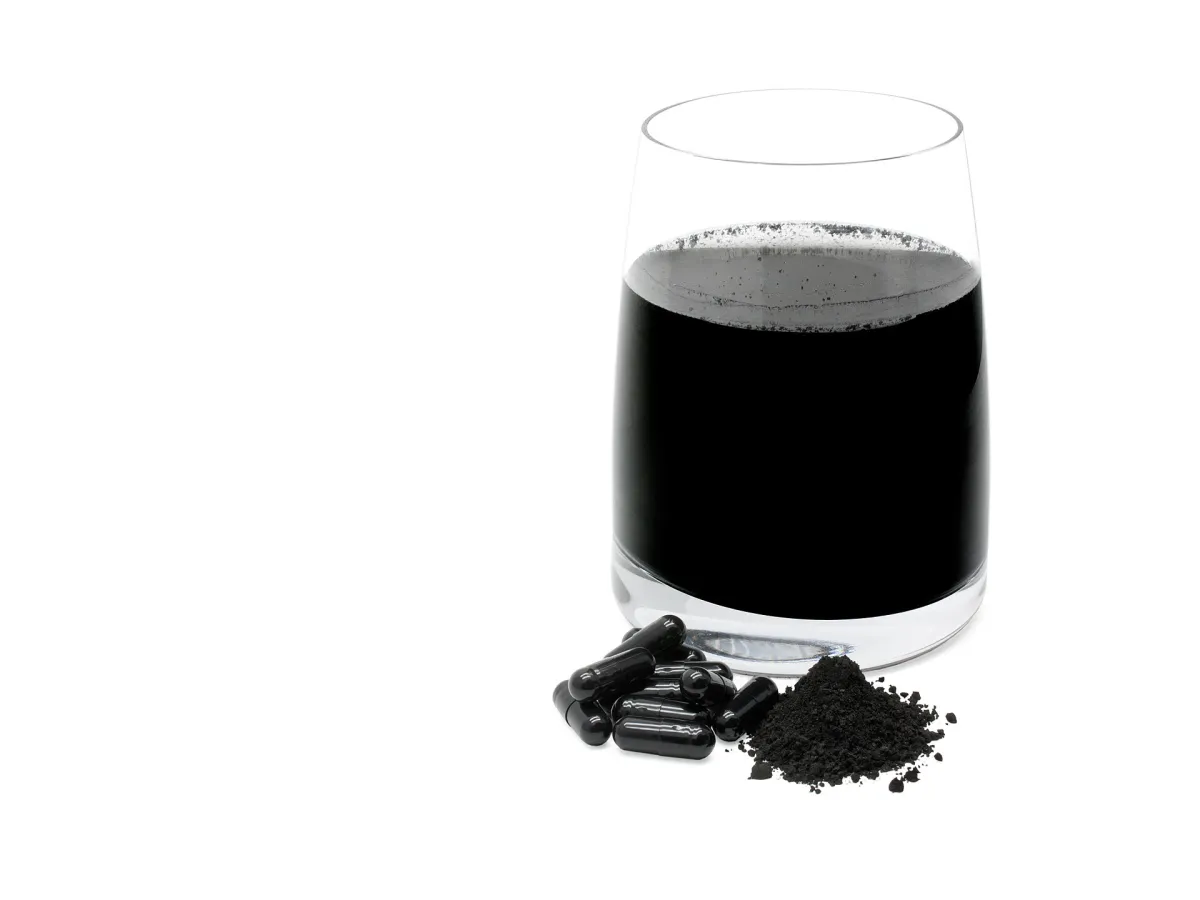
Activated charcoal (medicinal charcoal, Carbo activatus) is made by carbonising carbon-rich materials such as coconut shells, wood or peat, then “activating” them with steam or gases at very high temperatures. This creates an enormous network of microscopic pores: a single gram has an internal surface area of hundreds to more than a thousand square metres.
It has nothing in common with barbecue briquettes or charcoal from a wood stove, which can contain toxic hydrocarbons and lack the necessary porosity. Never try to make medicinal charcoal at home or use products not intended for human use.
Adsorption, not absorption
Activated charcoal passes through the stomach and intestine without entering the blood. Along the way, organic molecules stick to the surface of its pores: many medicines, some plant and mushroom toxins, some pesticides. This is called adsorption. The bound complex leaves the body in the stool, which turns black.
Two practical consequences follow. First, charcoal does not hunt down toxins around the body and does not cleanse the liver, kidneys or blood. The exception is a hospital technique using repeated doses for a few drugs that return to the gut via bile. Second, charcoal cannot tell a poison from your blood pressure, thyroid or contraceptive pill. It binds them just as well.
Where it really helps: acute poisoning
Activated charcoal is on the WHO Model List of Essential Medicines as an antidote. International toxicology guidance (the joint position of the American and European clinical toxicology associations, AACT and EAPCCT) recommends selective use, not routine use:
- it is given when the swallowed substance is known to bind to charcoal and the amount is potentially dangerous;
- effectiveness drops quickly over time: it is greatest within the first hour after ingestion, and benefit later on is uncertain, with some exceptions such as extended-release tablets;
- the person must be fully alert and able to protect their airway, otherwise charcoal can be inhaled into the lungs, a serious complication.
For a handful of drugs (for example carbamazepine, phenobarbital, theophylline, quinine and dapsone), multiple doses are given every few hours, strictly in hospital and under a protocol.
Substances charcoal does NOT bind
- alcohols: ethanol (drinks), methanol, ethylene glycol (antifreeze);
- metals and salts: iron, lithium, potassium;
- corrosive acids and alkalis: caustic soda, drain cleaners, descalers. Here charcoal is actually contraindicated because it hampers endoscopy;
- petroleum products: petrol, paraffin, solvents.
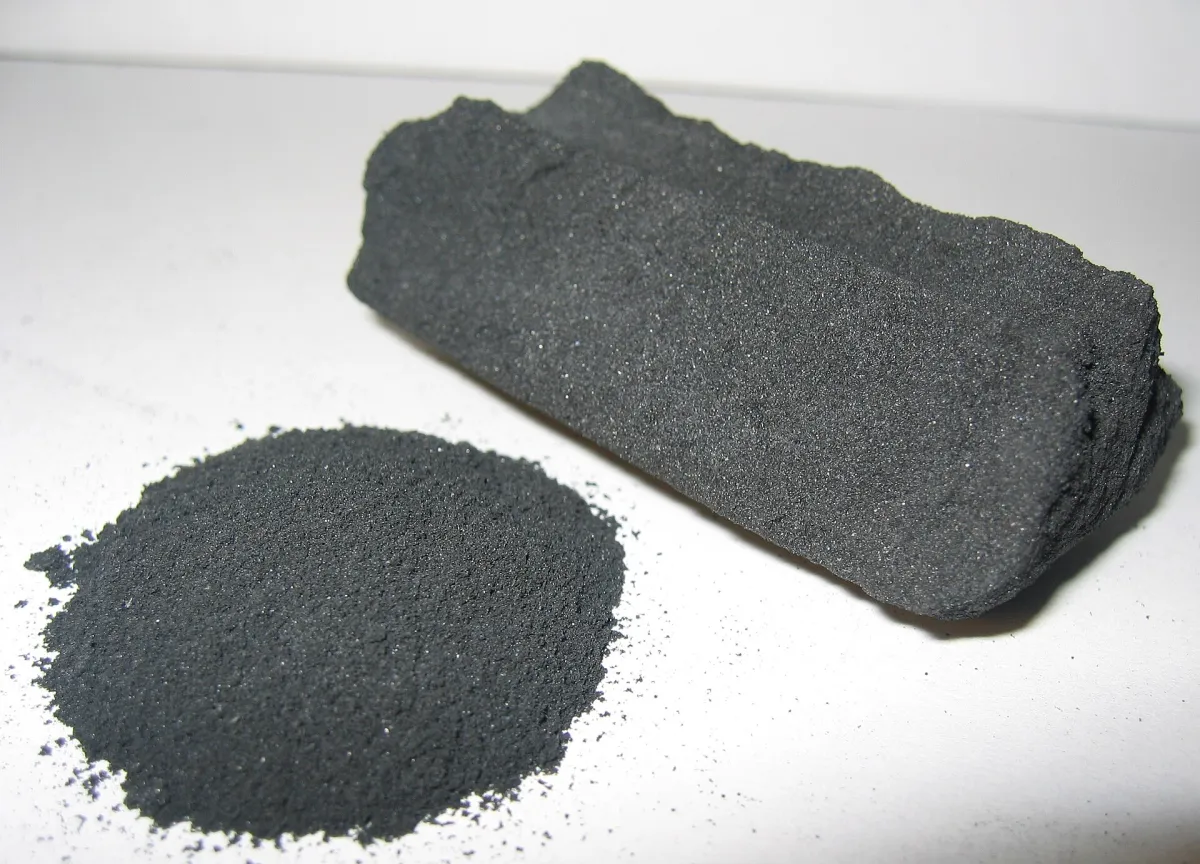 Photo: Ravedave (talk), CC BY 2.5, via Wikimedia Commons
What to do if someone swallows something dangerous
- Call emergency services (112 in Europe, or your local poison control line) and say what was swallowed, how much and when. Keep the packaging or bottle.
- Do not make the person vomit and do not give milk, oil, vinegar or salt as an “antidote”.
- Give activated charcoal at home only if a doctor or poison centre explicitly tells you to, and only if the person is fully awake and swallowing normally.
- In children, even a single tablet of an adult medicine can be dangerous: go to the emergency department, do not wait for symptoms.
The 250 mg tablets sold over the counter are not suitable for poisoning: a 50 g dose would mean 200 tablets. Hospitals use powder or ready-made suspension.
Uses with weak or mixed evidence
Gas and bloating
The European Food Safety Authority (EFSA) assessed the data in 2011 and accepted the claim that activated charcoal contributes to reducing excessive flatulence after eating, provided that 1 g is taken at least 30 minutes before a meal and 1 g shortly after. Clinical studies, however, are few, small and inconsistent.
In practice it may help now and then, for example after a meal of beans or cabbage, but it does not fix the cause of chronic bloating: irritable bowel syndrome, lactose intolerance, SIBO, constipation or eating too fast. If you are bloated almost every day, look for the cause rather than taking charcoal with every meal. See our guide to bloating.
Acute diarrhea
Charcoal is a traditional diarrhea remedy and appears on many over-the-counter labels. Modern evidence is weak: it does not convincingly shorten an episode, and WHO recommendations for acute diarrhea focus on oral rehydration salts, not adsorbents. The real risk is twofold: you take charcoal instead of rehydrating, and black stools can mask digested blood. What actually matters is covered in our articles on diarrhea and food poisoning.
The myths: detox, hangovers, teeth whitening
Detox drinks and black lemonades
The idea that the body stores vague “toxins” that charcoal pulls out has no scientific basis. Your liver and kidneys do that job continuously. Charcoal detox drinks and capsules have shown no benefit, but they can reduce absorption of medicines taken the same day and often cause constipation.
Hangovers
Alcohol is a small molecule absorbed very quickly from the stomach and small intestine, and charcoal barely holds on to it. There is no evidence that charcoal prevents or relieves a hangover. Fluids, rest and a light meal help more. Details in our article on hangovers.
Teeth whitening
A literature review published in 2017 in the Journal of the American Dental Association concluded there is insufficient evidence for the effectiveness and safety of charcoal toothpastes. The whitening effect comes from scrubbing off surface stains. Charcoal powder is abrasive and can wear down enamel, worsening tooth sensitivity; many products contain no fluoride, and particles can lodge along filling margins and in the gum line. Daily brushing with pure charcoal is best avoided.
How to use it correctly, when it makes sense
For occasional gas, adults
- Check whether you have taken any other medicine in the past 2 hours. If so, postpone the charcoal.
- Take 1 g (for example four 250 mg tablets, or the number of capsules stated on the pack) 30 minutes before the meal with a glass of water (200-250 ml).
- Take another 1 g right after the meal.
- Use it for 1-2 days at most, not as a habit. Avoid other medicines for the next 2-3 hours.
For mild acute diarrhea
Follow the product leaflet exactly, do not exceed 2-3 days and rehydrate in parallel with oral rehydration salts. If diarrhea lasts longer or you develop fever, blood or signs of dehydration, see a doctor.
If you use powder
Stir the dose into a glass of room-temperature water, mix well and drink at once, because it settles quickly. A straw limits staining of teeth and tongue. Rinse your mouth afterwards. Watch your clothes and a white sink: the powder stains easily.
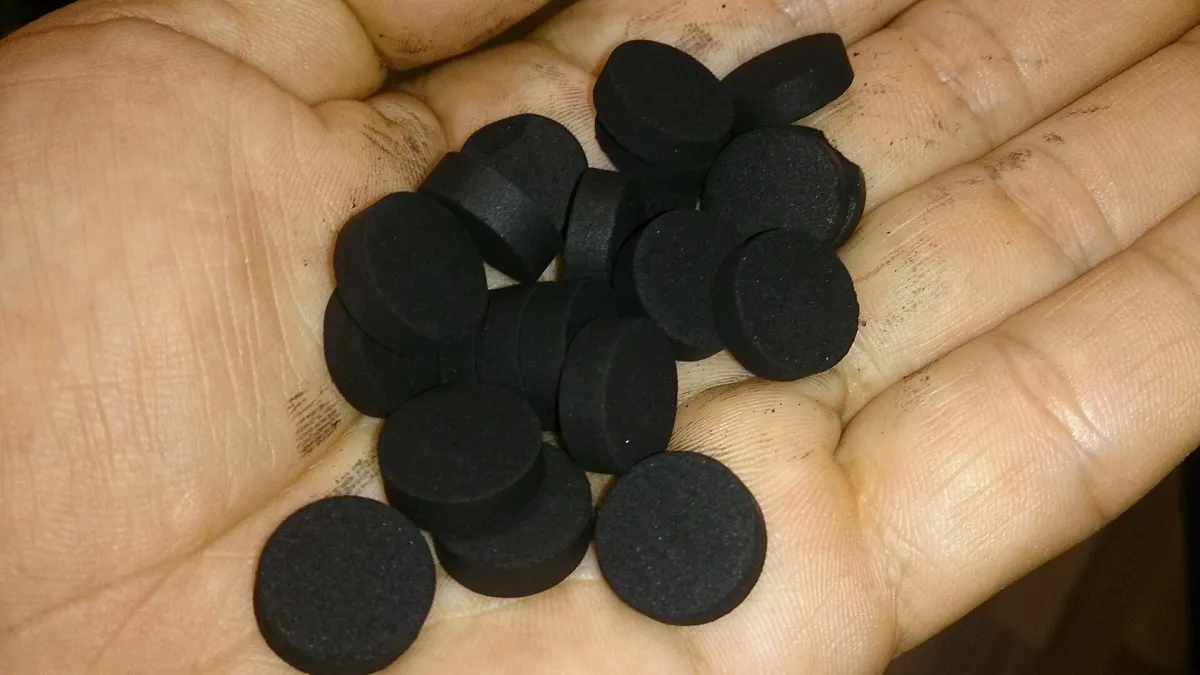 Photo: ProjectManhattan, CC BY-SA 3.0, via Wikimedia Commons
Typical doses
| Situation | Dose | Who decides | What the evidence says |
|---|---|---|---|
| Acute poisoning, adult | 25-100 g once (often 50 g), ideally within the first hour | Doctor or poison centre | Recommended selectively in toxicology guidance |
| Acute poisoning, child | About 1 g/kg body weight, with age-based limits | Doctor only | As above |
| Multiple doses (carbamazepine, theophylline, phenobarbital etc.) | Every few hours, per protocol | Hospital only | For a few specific drugs |
| Gas after meals | 1 g 30 min before + 1 g after the meal | Occasional self-care | EFSA-accepted claim, modest evidence |
| Mild acute diarrhea, adult | As per leaflet, 1-3 days | Pharmacist, leaflet | Weak |
| Detox, hangover, whitening | Not recommended | - | No evidence of benefit |
The big risk: it blocks medicines and the pill
This is the part few people read on the box. Activated charcoal binds substances in the gut whether they are toxic or useful. If you take charcoal “for your stomach” an hour after your morning tablets, part of the dose may simply leave in the stool. For some medicines, even a small drop in absorption matters a lot.
| What you take | Spacing rule |
|---|---|
| Most oral medicines | At least 2 hours before charcoal or at least 2-3 hours after |
| Contraceptive pill | Avoid charcoal. If you took it within about 3 hours before or after the pill, treat that pill as missed, follow the pill leaflet and use condoms for 7 days |
| Narrow-margin drugs: levothyroxine, antiepileptics, oral anticoagulants, digoxin, antiarrhythmics, immunosuppressants | Only with your doctor’s approval |
| Antidepressants, antibiotics, oral diabetes medicines | Strict spacing of at least 2 hours, ideally no charcoal during treatment |
| Supplements: iron, vitamins, probiotics, concentrated herbal teas | Same 2-hour spacing |
If you take an essential medicine every day, ask your pharmacist before using charcoal, even occasionally. There are often better options for gas or diarrhea.
Contraindications: who should avoid activated charcoal
- bowel obstruction, ileus, very slow transit or chronic constipation;
- suspected gut perforation or digestive bleeding;
- recent abdominal surgery;
- reduced alertness, drowsiness or difficulty swallowing (aspiration risk);
- swallowing corrosive substances or petroleum products;
- significant dehydration;
- young children, only on medical advice;
- pregnancy and breastfeeding: charcoal is not absorbed, but it can reduce absorption of iron and other treatments, so ask your doctor;
- anyone on essential medicines (see the table above).
Side effects
Black stools and a dark tongue (harmless), constipation, nausea and vomiting, especially at high doses. Rarely, large or repeated doses can cause bowel obstruction. Inhalation into the lungs in drowsy people can cause severe pneumonia.
When to see a doctor
- any suspected swallowing of a toxic substance, a large amount of medicine or unknown mushrooms: call emergency services;
- black, sticky, foul-smelling stools that appeared before charcoal or persist more than 48 hours after stopping, red blood in the stool, or vomit that looks like coffee grounds;
- diarrhea lasting more than 2-3 days in adults or more than 24 hours in a young child, high fever, signs of dehydration;
- bloating with weight loss, severe pain, vomiting, or no stool and no wind;
- severe abdominal pain or repeated vomiting after taking charcoal.
Common mistakes
Swallowing charcoal together with your morning tablets. You reduce their effect without noticing.
Forgetting about the pill. This is the riskiest combination for an unplanned pregnancy.
Daily “preventive” charcoal for bloating. It masks the cause and promotes constipation.
Giving charcoal at home to a child who swallowed pills instead of calling for help. Lost time matters more than any remedy.
Charcoal after a night of drinking. It does not bind alcohol or prevent a hangover.
Brushing daily with charcoal powder. It wears enamel, and the whitening is only superficial.
Using 250 mg tablets for poisoning. The dose is dozens of times too small to make a difference.
Conclusion
Activated charcoal is a valuable antidote in certain poisonings when it is given early, in a large dose and under medical guidance. Outside that setting, the benefits are modest (occasional gas) or absent (detox, hangover, whitening). If you use it, keep the 2-3 hour gap from every medicine and never combine it with the contraceptive pill without backup protection.
Frequently asked questions
How long after activated charcoal can I take my medicine? The general rule is at least 2-3 hours after charcoal, or at least 2 hours before it. For narrow-margin drugs such as levothyroxine or anticoagulants, ask your doctor before taking charcoal at all.
Does activated charcoal stop birth control from working? It can reduce absorption of the pill. If you took charcoal within about 3 hours before or after your pill, treat it as a missed pill, follow the leaflet instructions and use condoms for 7 days.
Can I take activated charcoal every day for bloating? It is not recommended. It is meant for occasional use. Frequent bloating has a cause worth finding, and daily use promotes constipation and drug interactions.
Does activated charcoal help with a hangover? No. Alcohol is absorbed quickly and binds very poorly to charcoal. Fluids and rest are more useful.
Does charcoal toothpaste whiten teeth? It only removes surface stains and is abrasive. There is no solid evidence of long-term effectiveness and safety, and many products lack fluoride.
What should I do if my child swallowed pills or a cleaning product? Call emergency services or poison control immediately, keep the packaging and do not induce vomiting. Only give activated charcoal if a doctor explicitly tells you to.
Why are my stools black after activated charcoal? This is a normal effect that usually lasts 1-2 days. If black stools persist after stopping, or are sticky and foul-smelling, it may be digestive bleeding and you should see a doctor.
Can I take activated charcoal while pregnant? Charcoal is not absorbed into the blood, but it can reduce absorption of iron and other treatments you may need in pregnancy. Use it only after talking to your doctor or pharmacist.
Sources and further reading
- American Academy of Clinical Toxicology and European Association of Poisons Centres and Clinical Toxicologists, Position paper: Single-dose activated charcoal, Clinical Toxicology, 2005.
- AACT and EAPCCT, Position statement and practice guidelines on the use of multi-dose activated charcoal in the treatment of acute poisoning, Journal of Toxicology: Clinical Toxicology, 1999.
- EFSA Panel on Dietetic Products, Nutrition and Allergies, Scientific opinion on health claims related to activated charcoal and reduction of excessive intestinal gas accumulation, EFSA Journal, 2011.
- Brooks J.K., Bashirelahi N., Reynolds M.A., Charcoal and charcoal-based dentifrices: A literature review, Journal of the American Dental Association, 2017.
- World Health Organization, WHO Model List of Essential Medicines, antidotes section.
Informational content only; it does not replace a consultation with a doctor or pharmacist. In case of poisoning, call emergency services immediately.