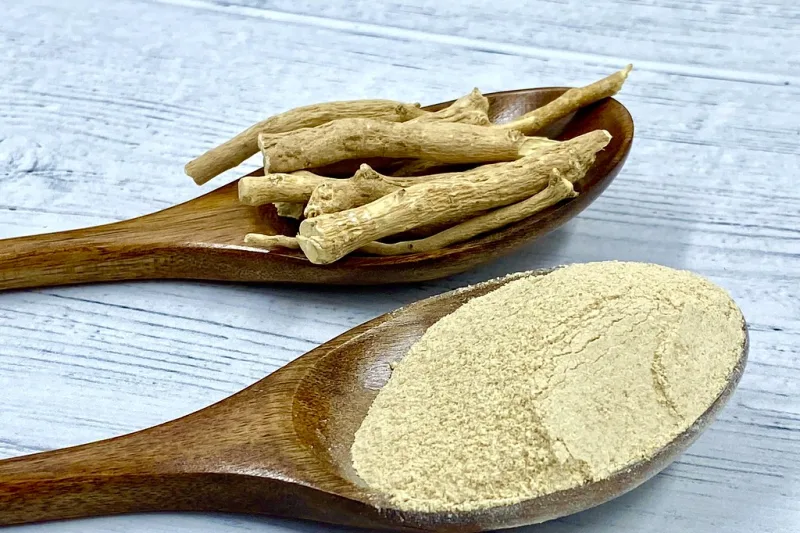

Adaptogenic Herbs for Stress: The Complete Guide to Natural Balance
IMPORTANT: Adaptogenic herbs are potent natural remedies, not harmless everyday teas. They influence the hormonal system, the thyroid, blood pressure, and the nervous system. They must not be used during pregnancy or breastfeeding, in young children, or by people with autoimmune conditions without medical approval. They can interact with medications for thyroid, blood pressure, diabetes, sedatives, blood thinners, and immunosuppressants. If you are on any treatment, have a chronic illness, or are facing surgery, consult your doctor or pharmacist before starting. Adaptogens do not replace medical treatment for depression, clinical anxiety, or severe burnout — they are support, not a cure-all.
Old Aunt Veta from the village at the foot of the mountain had a saying for anyone who complained of exhaustion: “You don’t beat hardship by pushing harder, but by teaching your body to bend like the reed in the wind.” The old woman kept a few dried roots in a wooden drawer, brought years ago by a grandson who had wandered into the world, and she would set them to macerate in plum brandy. She said a teaspoon in the morning — especially in autumn, when the days shorten and the soul grows heavy — helped her “stop being afraid of work.” Back then no one in the village used the word “adaptogen,” yet our grandparents knew, by instinct and experience, that certain plants don’t whip you with energy like strong coffee — they help you endure better whatever life throws your way.
Today we call these plants adaptogens — a term coined in the twentieth century by researchers studying herbs used for thousands of years in the traditional medicine of India, China, Siberia, and the Altai Mountains. The classic definition states that an adaptogen is a plant that helps the body “adapt” to stress of any kind — physical, mental, climatic, or biological — gently nudging it back toward balance without pushing it in one direction or another. In other words, an adaptogen calms you when you are agitated and energizes you when you are depleted. This “intelligent,” two-way action is precisely what sets them apart from ordinary stimulants.
Table of Contents
- What adaptogenic herbs are and how they work
- The main adaptogenic herbs and their benefits
- Ashwagandha — the calm of the Indian root
- Rhodiola rosea — Siberia’s golden root
- Ginseng — the king of tonic herbs
- Holy basil (Tulsi) and other adaptogens
- How to prepare and take adaptogens
- How to choose the right adaptogen for you
- The lifestyle that amplifies adaptogen effects
- Practical tips and common mistakes
- Conclusion
- Frequently Asked Questions
What adaptogenic herbs are and how they work
To understand adaptogens, we first have to understand stress. When the body perceives a threat — a work deadline, a sleepless night, a bitter frost, or an infection — the adrenal glands release cortisol and adrenaline. This “fight or flight response” is useful in the short term, but when stress becomes chronic, the system stays stuck “switched on.” Permanently elevated cortisol wears the body down, disrupts sleep, weakens immunity, favors abdominal fat storage, and leaves us with that deep fatigue we can’t shake off no matter how much we sleep.
This is where adaptogens come in. Studies suggest that these plants act on the hypothalamic-pituitary-adrenal axis (the HPA axis), the command center of the stress response. Instead of bluntly stimulating or sedating, they appear to “fine-tune” cortisol production — lowering it when it is too high and supporting it when the body is depleted. Many contain compounds such as saponins, polyphenols, and glycosides that, according to preliminary research, support cellular energy production and protect cells from oxidative stress.
Folk tradition and modern research converge on a few shared traits of a true adaptogen: it is generally safe and non-toxic at normal doses, it has a non-specific action (it boosts resistance to several kinds of stress), and it has a normalizing effect, drawing the body back toward balance rather than toward excess. One key point to remember: adaptogens do not work “instantly” like coffee. Their effect builds over time, across several weeks of regular use.
The main adaptogenic herbs and their benefits
The world of adaptogens is vast, but a handful of plants stand out through long tradition and the attention of researchers. We’ll walk through the most important ones, each with its own personality. You’ll notice that some are more “calming” (suited to anxiety and insomnia), while others are more “energizing” (suited to fatigue and poor concentration).
Ashwagandha — the calm of the Indian root
Ashwagandha (Withania somnifera), also called “Indian ginseng,” is probably the best-known adaptogenic herb of our time, although it has been used in Ayurvedic medicine for over three thousand years. Its Sanskrit name roughly translates as “the smell of the horse,” referring both to the characteristic scent of the root and to the vigor it is said to confer.
Ashwagandha is valued above all for its calming and balancing effect. Studies suggest it may help lower cortisol levels and ease the sensation of stress and anxiety, which is why it is favored by those who feel “on edge,” irritable, or who cannot fall asleep because of racing thoughts. Tradition also recommends it for supporting physical energy, muscle tone, and sleep quality. Precisely because it tends to be soothing, it is often taken in the evening or in two doses, morning and night.
Rhodiola rosea — Siberia’s golden root
If ashwagandha is gentle and calming, rhodiola (Rhodiola rosea) is energizing and sharp. It grows in the cold, rocky regions of Siberia, Scandinavia, and the Carpathian Mountains, and the Vikings and Siberian hunters used it to withstand cold, fatigue, and prolonged exertion. It is also called the “golden root” or “arctic root.”
Rhodiola is the adaptogen of choice when the main problem is mental and physical fatigue. Studies suggest it may ease the sensation of exhaustion, improve concentration and stamina, and support good mood during periods of overwork. Unlike ashwagandha, rhodiola is usually taken in the morning on an empty stomach, because in some people it can be too stimulating in the evening and disrupt sleep.
Ginseng — the king of tonic herbs
Asian ginseng (Panax ginseng) is perhaps the most revered tonic in traditional Chinese medicine. Its root, which sometimes takes on a shape resembling a human body, was considered so precious that it was once worth more than gold. Ginseng is classically recommended for vitality, energy, and overall performance.
Tradition credits it with the ability to strengthen a weakened body, support immunity, and help convalescents regain their strength. Modern studies explore its role in supporting cognitive function and energy levels. There is also American ginseng (Panax quinquefolius), considered more “cooling” and gentler, as well as Siberian ginseng (Eleutherococcus senticosus) which, though not botanically a true ginseng, is a valued adaptogen for supporting stamina and immunity.
Holy basil (Tulsi) and other adaptogens
Holy basil, or Tulsi (Ocimum sanctum), is a sacred plant in India, often grown in courtyards. Unlike our culinary basil, Tulsi has a spicier, warmer aroma. It is valued as a gentle adaptogen with a calming effect on the mind, along with support for immunity and digestion. It is often drunk as a daily tea, making it one of the most accessible and safe adaptogens for beginners.
Other adaptogens worth mentioning: schisandra (Schisandra chinensis), a “five-flavor” berry used to support the liver and energy; maca (Lepidium meyenii), a root from the Andes prized for vitality and hormonal balance; astragalus (Astragalus membranaceus), a pillar of Chinese medicine for immunity; and reishi (Ganoderma lucidum), an adaptogenic mushroom called the “mushroom of immortality” in Asian tradition, used for calm and support of natural defenses.
How to prepare and take adaptogens
Adaptogens come in many forms, each with its own advantages. Here are the most common ones and how to use them correctly.
Root powder
The most traditional form, especially for ashwagandha and maca. The fine powder is stirred into a glass of warm milk (dairy or plant-based), water, a smoothie, or yogurt.
Recipe: bedtime milk with ashwagandha
- Warm a cup (about 200 ml) of milk over low heat without bringing it to a boil.
- Add half a teaspoon (about 1–2 g) of ashwagandha powder.
- For flavor, add a pinch of cinnamon, a little cardamom, and optionally a teaspoon of honey once it has cooled slightly.
- Stir well and drink 30–60 minutes before bed.
The infusion (tea)
Suited especially to Tulsi, but also to chopped roots. Place a teaspoon of dried herb in a cup, pour over hot water (not boiling for leaves, nearly boiling for roots), cover, and let it steep for 5–10 minutes for leaves or 10–15 minutes for roots. Strain and drink. Hard roots, such as ginseng or astragalus, are better prepared as a decoction: simmered over low heat for 15–20 minutes to extract the compounds.
The tincture
The alcohol extract is concentrated and easy to dose. It is usually taken as a few drops (according to the product instructions) diluted in a little water. The tincture is practical for rhodiola and ginseng. Those who avoid alcohol can choose glycerites or capsules.
Capsules and standardized extracts
The most convenient and predictable form, because it provides a fixed dose. They are especially useful for rhodiola and ashwagandha, where standardized extracts (for example, standardized for withanolides in ashwagandha, or for rosavins and salidroside in rhodiola) guarantee a consistent concentration of active principles.
About the length of a course: Tradition and modern practice recommend taking adaptogens in courses of 6–12 weeks, followed by a break of 1–2 weeks. This cycling prevents the body from getting used to them and maintains effectiveness. Always start with a low dose and increase gradually, watching how your body responds.
How to choose the right adaptogen for you
The most common mistake is choosing a “trendy” adaptogen without matching it to yourself. Here is a simple guide:
- Do you feel anxious, irritable, “on edge,” sleeping poorly? Look for calming adaptogens: ashwagandha, Tulsi, reishi.
- Do you feel drained, with no energy, no drive, your mind “foggy”? Look for energizing adaptogens: rhodiola, ginseng, eleuthero.
- Do you want general, gentle immune support? Astragalus and Tulsi are good options.
- Are you looking for hormonal balance and vitality? Maca and ashwagandha are traditionally associated with this purpose.
Don’t combine too many adaptogens at once, especially at the start. Begin with a single one, observe it for a few weeks, and only then consider a combination. Less is often more.
The lifestyle that amplifies adaptogen effects
No adaptogen in the world can make up for a lifestyle that constantly generates stress. The plants are support, but the foundation remains how you live. Here are the pillars that make the difference:
Sleep is the most powerful free “adaptogen.” Without 7–8 hours of quality sleep, the stress axis stays dysregulated no matter how many herbs you take. Go to bed at regular hours, darken the bedroom, and avoid screens for an hour beforehand.
Movement in moderation — a daily walk, some light exercise — regulates cortisol far more effectively than exhausting exertion, which in already depleted people can deepen the fatigue.
Breath and stillness: a few minutes of slow, deep breathing, or simply sitting in silence in the morning, lowers nervous system activation. Our grandparents simply called it “sitting on the porch for a while.”
Nutrition: regular meals rich in vegetables, quality protein, and good fats, without an excess of sugar and coffee, support stable blood sugar and therefore more balanced cortisol.
Practical tips and common mistakes
Mistake no. 1: You expect an instant effect. Adaptogens are not quick energizers. Give them 2–4 weeks of regular use before judging whether they help. Impatience makes many people give up too soon.
Mistake no. 2: You take the wrong adaptogen for your problem. If you are already agitated and you take rhodiola in the evening, you may wake up even more tense. Match the plant to your need: calming or energizing.
Mistake no. 3: You use them endlessly, without breaks. Continuous, uninterrupted use can diminish the effect. Respect dosing cycles with breaks.
Mistake no. 4: You ignore drug interactions. Adaptogens influence the thyroid, blood pressure, blood sugar, and sedation. If you take medication, don’t rely on “it’s natural, so it’s safe” — ask your doctor.
Mistake no. 5: You buy poor-quality products. The market is full of diluted or contaminated powders. Choose trustworthy producers, with standardized extracts and purity testing.
Mistake no. 6: You believe the adaptogen solves everything. If you sleep four hours a night and live on coffee, no plant will save you. The adaptogen is the final layer of support, not the foundation.
Conclusion
Adaptogenic herbs represent one of the most fascinating bridges between traditional wisdom and modern scientific interest. From the ashwagandha root of Ayurveda to the rhodiola of the Vikings and the ginseng of Chinese emperors, these plants have accompanied humanity in its struggle with fatigue and life’s hardships. They are not instant miracles but patient allies that, used wisely and on the foundation of a healthy lifestyle, can help body and mind better withstand the daily storms. As Aunt Veta used to say, the secret is not to push harder but to bend like the reed. Use them with respect, in moderation, and with your doctor’s advice when needed — and let time do its work.
Frequently Asked Questions
What exactly are adaptogenic herbs? They are plants that help the body adapt to stress, drawing it back toward balance. Their action is “two-way”: they calm you when you are agitated and support energy when you are depleted, without bluntly stimulating or sedating.
How long until I feel the effects? Usually between 2 and 4 weeks of regular use. Adaptogens work slowly and steadily, not instantly like coffee. Patience is essential.
Can I take several adaptogens at once? Yes, but it is not recommended at the start. Begin with a single one, observe how you respond for a few weeks, and only then consider a combination, ideally with the advice of a specialist.
Are they safe during pregnancy and breastfeeding? No. Adaptogenic herbs must not be used during pregnancy or breastfeeding without the explicit approval of a doctor, because they influence hormones and there is insufficient safety data.
Which adaptogen is good for sleep and anxiety? Ashwagandha is the best known for its calming effect and sleep support. Tulsi and reishi are also gentle, soothing options.
Which adaptogen is good for energy and fatigue? Rhodiola is the classic choice for mental and physical fatigue, followed by ginseng and eleuthero. They are usually taken in the morning.
Do I need to take breaks from adaptogens? Yes. Courses of 6–12 weeks followed by breaks of 1–2 weeks are recommended, to maintain effectiveness and avoid the body getting used to them.
Can I replace my medication with adaptogens? No. Adaptogens are complementary support, not a substitute for medical treatment for depression, clinical anxiety, thyroid disease, or other conditions. Never stop a treatment without your doctor’s approval.