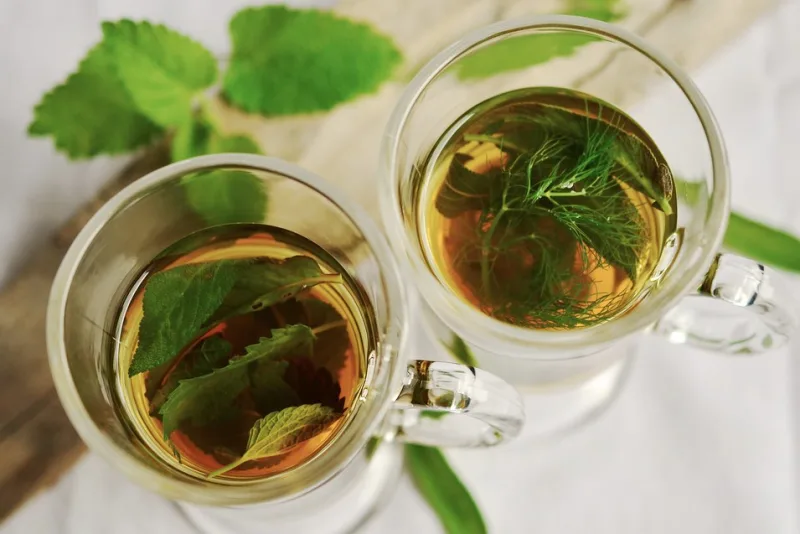

Herbal Gargles for Throat and Mouth
IMPORTANT: A herbal gargle is a supportive remedy for mild throat and mouth discomfort, not a substitute for medical treatment. If a sore throat lasts more than a few days, is accompanied by high fever (over 38.5°C / 101°F), difficulty swallowing or breathing, pus on the tonsils, a skin rash, or greatly swollen glands, see a doctor — it may be strep throat requiring antibiotics. A gargle must NOT be swallowed and is not recommended for young children who cannot yet gargle safely (generally under age 6) because of the risk of aspiration. People allergic to plants in the Asteraceae family (chamomile, calendula, echinacea) should be cautious. Pregnant and breastfeeding women should avoid sage gargles in large amounts or over long periods. Gargle solutions do not keep indefinitely — make them fresh or refrigerate for at most one day.
Grandma Veta, from the village at the foot of the hill, had an unshakeable ritual every late autumn, when the children came home from school with cheeks reddened by the cold and irritated throats. She would set a small enamel kettle on the stove and toss in a handful of dried chamomile flowers and a few sage leaves from the garden. “You don’t swallow it, you scatterbrain,” she would tell her grandchildren, laughing, “you rinse your throat with it, morning and evening, and the pain is gone.” Every child in the house learned to gargle before they learned to write, and the jar of dried herbs always stood within reach, next to the salt and the honey.
Years later, when one of the grandchildren became a student in the city and had his first bout of tonsillitis far from home, the first thing he looked for at the pharmacy was sage. “Grandma’s gargle” stayed in the minds of many of us as the simplest, most accessible remedy for the throat — a humble gesture, yet surprisingly effective when done correctly. In this article you’ll find everything you need to know about herbal gargles: how they work, which herbs to use, step-by-step recipes for every situation, and the mistakes you should avoid.
The gargle is one of the oldest and most widespread methods of caring for the throat and mouth. In practice, it means rinsing the throat and mouth with a liquid — usually a herbal infusion, salt water, or a honey solution — which you hold in your throat, head tilted back, and agitate with exhaled air for a few seconds before spitting it out. The mechanism is simple: the liquid mechanically washes away mucus, debris, and some of the microbes on the surface of the mucous membrane, while the active substances in the herbs (volatile oils, tannins, flavonoids) calm inflammation, reduce stinging, and create an environment less friendly to bacteria. It is a remedy thousands of years old, found among Egyptians, Greeks, and in traditional medicine the world over.
Table of Contents
- What a gargle is and how it works
- When a herbal gargle helps
- The best herbs for gargling
- How to prepare a gargle correctly (step-by-step recipes)
- Recipes for specific situations
- How often and how to gargle
- Effective herb combinations
- Lifestyle tips for a healthy throat
- Practical tips and common mistakes
- Conclusion
- Frequently Asked Questions
What a gargle is and how it works
A gargle is a technique for rinsing the back of the mouth and the pharynx (the throat itself) with a therapeutic liquid. Unlike a simple mouth rinse — which targets the teeth, gums, and tongue — a gargle requires the liquid to reach as far down the throat as possible without being swallowed. That is why the head is tilted back and you exhale gently through the liquid, producing the characteristic gurgling sound.
The effects of a gargle work in several ways. First, there is a mechanical washing effect: rinsing removes thick mucus, food particles trapped in the tonsillar crypts, allergens, and part of the surface microbial load. Second, there is an osmotic effect, especially with a salt gargle: the hypertonic saline solution “draws” water out of the inflamed tissues, reducing swelling (edema) and the feeling of pressure. Third, the herbs provide active substances with astringent, anti-inflammatory, and mildly antiseptic effects.
It is important to understand that a gargle acts mainly locally, at the surface. It does not “kill the infection” deep down and does not replace an antibiotic when one is needed (for example, in strep throat). Its real role is to ease symptoms — pain, stinging, the feeling of dryness — and to support natural healing by keeping the mucous membrane clean and moist.
When a herbal gargle helps
A gargle is useful for a wide range of minor throat and mouth complaints. Here are the main situations where it is worth trying:
- Sore throat and irritation at the onset of a cold or viral infection, when the throat “scratches” and stinging appears on swallowing.
- Mild pharyngitis and laryngitis, with a feeling of dryness, hoarseness, and the need to clear your voice.
- Tonsillitis (as a supportive treatment alongside what your doctor prescribes), to clean the tonsillar crypts and reduce inflammation.
- Mouth ulcers and small sores, where a gargle with astringent, healing herbs speeds recovery.
- Mild gingivitis and gum inflammation, as an adjunct to brushing.
- Bad breath (halitosis), when the cause lies in the mouth or throat.
- Discomfort after minor dental procedures — always only with your dentist’s approval.
- Dry throat in people who talk a lot (teachers, singers, public speakers).
A gargle is not indicated as the main treatment for severe infections, abscesses, breathing difficulties, or any situation with signs of seriousness. In these cases, a medical consultation is mandatory.
The best herbs for gargling
Not every herb is suitable for gargling. The most effective are those rich in tannins (astringent), volatile oils (antiseptic), and mucilage (soothing). Here are the most valuable ones:
Sage (Salvia officinalis)
Sage is probably the most prized gargling herb. It contains volatile oils (thujone, cineole), tannins, and phenolic acids with strong astringent and antiseptic effects. Folk tradition recommends it for sore throat, tonsillitis, and mouth inflammation. It has a slightly bitter, astringent taste that pleasantly “tightens” the mucous membrane.
Chamomile (Matricaria chamomilla)
Chamomile is gentle and anti-inflammatory, thanks to the bisabolol and azulene in its volatile oil. It is ideal for irritated, sensitive membranes, for mouth ulcers, and for children (above the age at which they can gargle safely). It has a pleasant, sweetish taste.
Calendula (Calendula officinalis)
Calendula is remarkable for its healing and anti-inflammatory effect. It is very useful for mouth ulcers, small sores, and after dental procedures. The orange flowers contain flavonoids and triterpenes that support tissue regeneration.
Thyme (Thymus vulgaris)
Thyme is rich in thymol, a compound with a strong antiseptic and expectorant effect. A thyme gargle is excellent when an irritated throat is accompanied by a cough and secretions. It has an intense, slightly pungent aroma.
Yarrow (Achillea millefolium)
Astringent and anti-inflammatory, yarrow is traditionally used for inflamed, bleeding gums and irritated throats. It has a pronounced bitter taste.
Oak bark (Quercus robur)
Very rich in tannins, oak bark has a strong astringent effect, useful for gingivitis and “slack,” bleeding membranes. It is used as a decoction (a simmered brew), not an infusion, and for short periods only, as it is very strong.
Ribwort plantain (Plantago lanceolata)
Rich in mucilage, plantain forms a protective, soothing film over an irritated membrane. It is gentle and suitable for a very dry, stinging throat.
Mallow (Malva sylvestris)
Like plantain, mallow is a mucilaginous, soothing herb, ideal for dry and inflamed throats. It is best prepared by cold maceration to preserve the mucilage.
How to prepare a gargle correctly (step-by-step recipes)
There are three main ways to prepare the base for a gargle: an infusion (for delicate flowers and leaves), a decoction (for hard barks and roots), and cold maceration (for mucilaginous herbs). Here they are step by step.
The classic gargle infusion
- Place 1 teaspoon of dried herb (or 1 tablespoon of fresh herb) in a cup.
- Pour 250 ml of boiling water over it.
- Cover the cup with a saucer (so the volatile oils are not lost) and steep for 10-15 minutes.
- Strain well, so no plant pieces remain that could be aspirated.
- Let the liquid cool until it is lukewarm, not hot (37-40°C / 98-104°F, like body temperature).
- Gargle with the lukewarm liquid; never use hot liquid, which would burn the already irritated membrane.
The decoction (for barks and roots)
- Place 1 teaspoon of chopped bark (for example, oak bark) in a small pot.
- Add 250 ml of cold water.
- Set over low heat and simmer, covered, for 10-15 minutes.
- Let it rest another 10 minutes, then strain.
- Cool to body temperature before use.
Cold maceration (for mallow, plantain)
- Place 1-2 teaspoons of herb in a cup.
- Pour 250 ml of room-temperature water over it.
- Let it macerate for 6-8 hours (for example, overnight), stirring occasionally.
- Strain and use. You may gently warm the liquid until lukewarm, without boiling it.
The correct gargling technique
- Take a mouthful of lukewarm liquid (about 20-30 ml).
- Tilt your head back without closing the throat completely.
- Exhale gently through the liquid, producing the gurgling sound, for 20-30 seconds.
- Spit out the liquid — do not swallow it.
- Repeat until you finish the amount (usually a full glass, over 3-4 rounds).
- After gargling, avoid eating or drinking for 15-30 minutes so the active substances can work.
Recipes for specific situations
Sage gargle for sore throat and tonsillitis
Infuse 1 teaspoon of dried sage in 250 ml of boiling water for 15 minutes. Strain, cool, and gargle 3-4 times a day. For extra effect, add a pinch of salt. Sage is the most effective herb for an inflamed throat.
Salt water gargle (the simplest)
Dissolve half a teaspoon of salt in a glass of lukewarm water (250 ml). Stir until fully dissolved. Gargle several times a day. The saline solution reduces swelling and cleans the membrane. It is the basic remedy — cheap and always at hand.
Chamomile and honey gargle for an irritated throat
Prepare a chamomile infusion, cool it to lukewarm, then dissolve a teaspoon of honey in it. (Note: add honey only to lukewarm liquid, not hot, to preserve its properties.) Honey adds a soothing and mildly antibacterial effect. Chamomile calms the membrane.
Calendula gargle for mouth ulcers and sores
Infuse 1 teaspoon of calendula flowers in 250 ml of boiling water, strain well, and gargle slowly, focusing on the affected area. Done 3-4 times a day, calendula speeds the healing of mouth ulcers.
Oak bark gargle for inflamed gums
Prepare an oak bark decoction (see above), cool it, and use 2-3 times a day for a maximum of 5-7 days in a row. The strong astringent effect firms the gums, but prolonged use can excessively dry the membrane.
Thyme gargle for an irritated throat with a cough
Infuse 1 teaspoon of thyme, strain, and gargle 3 times a day. The thymol in thyme helps disinfect the throat and has an expectorant effect.
Baking soda gargle for ulcers and acidity
Dissolve half a teaspoon of baking soda in 250 ml of lukewarm water. The alkaline solution neutralizes acidity in the mouth and soothes ulcers. It can be alternated with a salt gargle.
How often and how to gargle
For a good effect, gargle 3-4 times a day, ideally:
- In the morning, after waking.
- After lunch.
- In the afternoon or evening.
- Before bed.
In the acute phase of a sore throat, you can gargle even every 2-3 hours without problems if you use gentle infusions (chamomile, sage, salt water). For strong decoctions (oak) and herbs with intense volatile oils (thyme), limit yourself to 2-3 times a day and do not use them for more than a week in a row.
Each gargling session should last at least a minute in total, split into several rounds of 20-30 seconds. The longer the liquid stays in contact with the membrane, the better the effect.
Effective herb combinations
Herbs can be combined to gather several effects. Here are a few mixtures proven by tradition:
- Sage + chamomile (equal parts): a balanced astringent and anti-inflammatory effect. A universal mixture for sore throat.
- Calendula + chamomile: gentle and healing, perfect for mouth ulcers and sensitive membranes.
- Sage + thyme: strongly antiseptic, for an irritated throat with secretions and cough.
- Yarrow + oak bark: very astringent, for inflamed, bleeding gums (short term).
- Mallow + plantain: soothing and emollient, for a very dry, stinging throat.
For mixtures, use 1 teaspoon of the herb blend per 250 ml of water and prepare it according to the dominant herb (infusion for flowers/leaves, decoction if you included barks).
Lifestyle tips for a healthy throat
A gargle works best as part of broader throat care:
- Stay well hydrated. A dry throat is more vulnerable; drink water, lukewarm teas, and soups.
- Humidify the air in your home, especially in winter when radiators dry the air.
- Avoid smoking and secondhand smoke, which constantly irritate the membrane.
- Rest your voice when hoarse; don’t strain your vocal cords.
- Wash your hands often to reduce the risk of respiratory infections.
- Consume honey and warm teas to soothe the throat between gargling sessions.
- Air out the room and keep a moderate temperature.
- Support your immunity through enough sleep, a diet rich in vitamin C, and exercise.
Practical tips and common mistakes
Mistake no. 1: Using hot liquid. Many people gargle with the infusion straight off the stove. Hot liquid burns the already irritated membrane and worsens the pain. Always use lukewarm liquid at body temperature.
Mistake no. 2: Swallowing the solution. A gargle is not to be swallowed, especially those with salt, baking soda, or oak bark, which in large amounts can upset the stomach. Always spit out the liquid.
Mistake no. 3: Straining poorly. If plant pieces remain in the liquid, they can be accidentally aspirated. Strain very well, ideally through a double layer of gauze.
Mistake no. 4: Gargling too briefly. A 2-3 second rinse has no effect. Hold the liquid in your throat for 20-30 seconds per round.
Mistake no. 5: Too high a salt concentration. A solution that is too salty dries and irritates the membrane. Stick to the ratio of half a teaspoon per glass.
Mistake no. 6: Prolonged use of strong herbs. Oak bark and excess sage, used over long periods, can dry the membrane. Use them in moderation, in short courses.
Mistake no. 7: Delaying a medical consultation. A gargle does not cure strep throat. If symptoms persist beyond 3-4 days or high fever and pus on the tonsils appear, see a doctor.
Mistake no. 8: Keeping the solution for days. Herbal infusions spoil quickly. Make them fresh or refrigerate for at most one day.
Conclusion
A herbal gargle is one of the simplest, cheapest, and most effective folk remedies for throat and mouth discomfort. With a teaspoon of sage or chamomile, a glass of water, and a little salt, you can ease a sore throat, speed the healing of mouth ulcers, and care for inflamed gums. The secret lies in a few simple rules: lukewarm liquid, strained well, slow gargling for 20-30 seconds, repeated several times a day, and never swallowed. Used correctly and in moderation, a herbal gargle is a valuable support — but remember that it does not replace a medical consultation when symptoms are serious or persistent.
Frequently Asked Questions
How often can I gargle with herbs? Usually 3-4 times a day. In the acute phase, with gentle infusions (chamomile, sage, salt water), you can gargle every 2-3 hours. Strong herbs (oak bark, concentrated thyme) should be limited to 2-3 times a day.
Can I accidentally swallow the gargle solution? An accidental sip of a herbal infusion is not dangerous, but a gargle should not be swallowed intentionally — especially solutions with salt, baking soda, or oak bark, which can upset the stomach. Always spit out the liquid.
Which is the best herb for a sore throat? Sage is traditionally considered the most effective for an inflamed throat, thanks to its astringent and antiseptic effect. Chamomile is a gentler alternative, and calendula is ideal for mouth ulcers.
Can children gargle? Only children old enough to gargle safely, without swallowing or aspirating the liquid — generally over age 6. For younger ones, choose other methods (lukewarm teas, honey after age 1).
Does a salt water gargle really work? Yes. The saline solution reduces swelling through an osmotic effect, cleans the membrane, and creates an environment less friendly to bacteria. It is the basic remedy — cheap and effective.
Can I gargle during pregnancy? A salt water or chamomile gargle is generally considered safe. However, avoid sage gargles in large amounts or over long periods during pregnancy and breastfeeding, and consult your doctor.
How long should I hold the liquid in my throat? For each round, hold the liquid and gargle for 20-30 seconds, then spit it out. In total, a session should last at least a minute.
Does a gargle replace antibiotics? No. A gargle eases symptoms and supports healing, but it does not treat a bacterial infection that requires antibiotics, such as strep throat. If symptoms are serious or persistent, see a doctor.