
Herbal Salves: How to Make Them at Home, Step by Step
IMPORTANT: Homemade salves are meant for external use on intact skin. Do not apply salves to deep open wounds, severe burns, weeping infections, or rashes of unknown origin without medical advice. Always perform a patch test on a small area of skin (the inner forearm) 24 hours before first use, especially if you have sensitive skin, allergies, or dermatitis. Some plants (for example comfrey) must NOT be applied to broken skin because of their pyrrolizidine alkaloids, and must never be used internally. Pregnant or breastfeeding women, young children, and people with chronic conditions should ask a doctor or pharmacist before using herbal preparations. A homemade salve is not a substitute for medical treatment of a serious condition.
Old Aunt Aurelia, from the village at the foot of the hill, kept a whole row of little tins and small jars filled with yellow-green salves on the shelf beside the stove. Their smell — of calendula, melted wax, and warm oil — filled the kitchen every time someone came in with a scraped hand, a twisted ankle, or skin cracked from working the fields. “Don’t rush, child,” she would say while I helped her stir the pot, “a good salve is made with patience, not with high heat. The plants give their strength slowly, like a wise person.”
That is how I learned that a salve is not simply fat mixed with plants. It is the result of a process thousands of years old, in which the active principles from flowers and leaves pass into an oil, and that oil — thickened with a little beeswax — becomes a dense cream that stays on the skin and nourishes it slowly. In this article I will show you, step by step, how to make herbal salves at home: from choosing your raw material to pouring them into tins and storing them properly.
A salve (or ointment) is essentially a semisolid blend made of a fatty base (vegetable oils and/or fats) and a thickening agent (most often beeswax), into which the useful substances from plants have first been extracted. Unlike a cream, a salve contains no water, which makes it more stable, more occlusive, and better suited to protecting and soothing the skin. Romanian folk tradition used it for scrapes, cracks, stings, rough hands and heels, tired muscles, and dry skin.
Table of Contents
- What a herbal salve is and how it works
- Basic ingredients: oils, wax, and herbs
- Herbs suited to salves and what tradition says
- Method 1: cold-infused oil
- Method 2: warm-infused oil (fast)
- Turning the oil into a salve (the base recipe)
- Concrete recipes, step by step
- Dosage, consistency, and adjustments
- How to store it and how long it lasts
- Lifestyle tips and natural skin care
- Practical tips and common mistakes
- Conclusion
- Frequently Asked Questions
What a herbal salve is and how it works
The skin is a barrier, but also a surface that partially absorbs fat-soluble substances. A salve takes advantage of exactly this property: the fatty base stays on the skin, forms a protective film that reduces water loss (the occlusive effect), and at the same time gradually releases the compounds extracted from the plants. This is why salves are valued for dry, cracked, or irritated skin — they “seal in” moisture and create a calm environment for repair.
The process has two clear stages. The first is extraction: we put the plant (fresh or, more safely, dried) into a vegetable oil and give it time for the fat-soluble substances — volatile oils, resins, carotenoids, certain flavonoids — to pass into the oil. The result is an infused oil (or macerated oil). The second stage is thickening: we warm the infused oil with beeswax, which, on cooling, binds everything into a creamy paste that is easy to apply and to store.
The beauty of the method lies in its simplicity. You need no laboratory equipment, only clean ingredients, suitable vessels, and patience. On the other hand, hygiene and proper drying of the herbs are essential: leftover water is the main enemy, because it encourages mold and rancidity.
Basic ingredients: oils, wax, and herbs
Carrier oils. These form the body of the salve. The most commonly used in home tradition are:
- Sunflower oil and olive oil — affordable, stable, good for classic infusions (calendula, comfrey).
- Coconut oil — semisolid at room temperature, it adds firmness and has a pleasant scent; useful in salves for dry skin.
- Sweet almond oil, jojoba, avocado oil — finer, nourishing, suited to the face and to sensitive skin.
- Clean rendered lard — used in Romanian villages as a base for “hard” salves, very occlusive; however, it has a distinctive smell and goes rancid faster than cold-pressed vegetable oils.
Beeswax. This is the classic thickening agent. It gives consistency, helps the salve “stay” on the skin, and itself has an emollient and mildly protective effect. It comes in pastilles or blocks; grate it finely so it melts evenly. For vegan versions you can use candelilla wax (stronger, used in smaller amounts) or carnauba wax.
Herbs. They can be fresh (more intense scent, but a greater risk of water and mold) or dried (recommended for beginners, much safer). You use flowers, leaves, roots, or bark, depending on the plant.
Optional: a few drops of essential oils (lavender, chamomile, tea tree) for scent and added effect, and a small amount of vitamin E (tocopherol) as a natural antioxidant that extends freshness.
Herbs suited to salves and what tradition says
Folk tradition and classic herbalism use a number of established plants for external preparations. Here are the best known, with the note that this information reflects traditional use, not medical advice:
Calendula (Calendula officinalis)
The yellow-orange flower is the “star” of homemade salves. Studies suggest that calendula extracts have soothing properties, and traditionally it is used for irritated, cracked, or dry skin. Calendula salve is probably the most popular and gentlest beginner’s preparation.
Comfrey (Symphytum officinale)
Comfrey root is traditionally used for musculoskeletal discomfort and for rough skin. Caution: comfrey contains pyrrolizidine alkaloids and is used externally only, on intact skin only, for short periods; it must not be applied to open wounds and must never be used internally.
St. John’s wort (Hypericum perforatum)
St. John’s wort infused oil turns a ruby red and is traditionally used to soothe skin and muscles. Important: it can increase sensitivity to the sun (a photosensitizing effect), so treated skin should not be exposed to strong sunlight.
Plantain (Plantago) and yarrow (Achillea millefolium)
Plantain leaves and yarrow flowers appear often in traditional salves for minor scrapes and irritated skin.
Chamomile (Matricaria chamomilla) and lavender (Lavandula)
Chamomile is valued for its soothing effect on sensitive skin, and lavender for its scent and relaxing feel; both fit well in gentle salves, including for older children (with care and after a patch test).
Method 1: cold-infused oil
This is the “grandmother’s method,” slow but the best at preserving heat-sensitive compounds.
- Prepare the plant. Use dried herb (for example calendula flowers). If you use fresh plant, let it wilt for a few hours to lose some of its water.
- Fill the jar. Place the plant in a clean, dry jar without packing it down: about three-quarters full for dried herb, nearly full for fresh herb.
- Cover with oil. Pour in oil (sunflower, olive) until the plants are completely covered, with at least 1–2 cm of oil above them. Any plant sticking out of the oil will mold.
- Macerate. Close the jar, label it with the date, and keep it in a warm, bright spot (or in the dark, as you prefer) for 3–4 weeks. Shake it gently every day.
- Strain. Filter through cheesecloth or a fine sieve, squeezing the plant well. Let the oil “settle” for a day, then pour it off, leaving the sediment behind.
Cold infusion has a fine aroma and a beautiful color, but it requires time and very well-dried herb.
Method 2: warm-infused oil (fast)
When you don’t have a few weeks to wait, gentle warming speeds up the extraction.
- Place the dried herb and oil in a bowl set over a double boiler (bain-marie): a bowl over a pot of hot water. Do not put the oil directly over the flame.
- Keep the oil warm, without boiling, at about 50–70 °C (120–160 °F), for 2–3 hours. The oil should not sizzle; if it smokes, it is too hot.
- Stir from time to time. You will see the oil take on color.
- Strain through cheesecloth and squeeze well. The warm-infused oil is ready to use as soon as it cools.
The warm method is practical and safe for beginners, as long as you control the temperature. Too much heat degrades the compounds and makes the oil go rancid.
Turning the oil into a salve (the base recipe)
Once you have the infused oil, turning it into a salve is simple and quick.
Base ratio: roughly 1 part beeswax to 4–5 parts oil (by weight). For example, 20 g of wax to 100 ml of oil gives a salve of medium consistency. More wax = a harder salve; less wax = softer, close to a fluid balm.
- Melt the grated wax into the infused oil over a double boiler, stirring until it dissolves completely.
- Remove from heat. If you are using essential oils and vitamin E, add them now, once the mixture has cooled slightly (below about 60 °C / 140 °F), so the aromas do not evaporate.
- The consistency test: drop a little on a cold plate and wait a minute. If it is too soft, add a bit more wax; if too hard, add a little oil and re-melt.
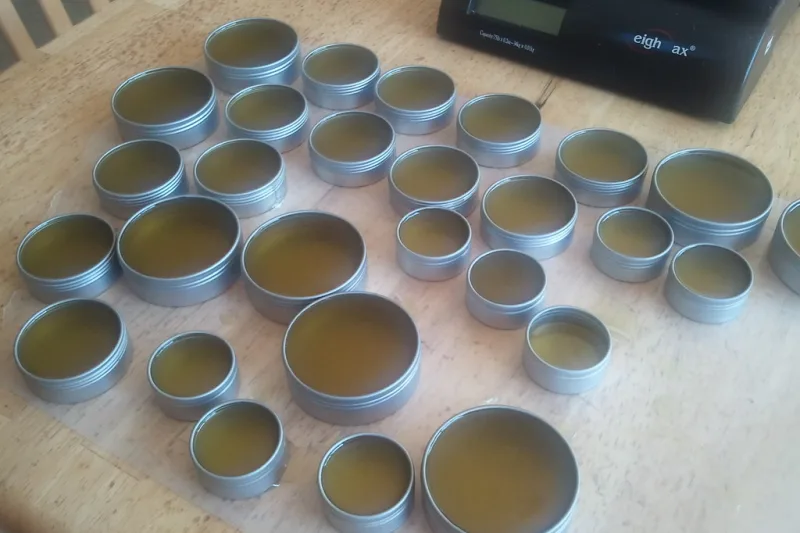
- Pour quickly into clean, dry tins or small jars while the mixture is still liquid.
- Let it set at room temperature, without a lid, until completely cool; only then put the lids on and label with the name and date.
Concrete recipes, step by step
Calendula salve (all-purpose, gentle)
- 100 ml calendula infused oil
- 18–20 g grated beeswax
- optional: 5–6 drops lavender essential oil, the contents of one vitamin E capsule
Melt the wax into the infused oil over a double boiler, add the essential oil and vitamin E after removing from heat, then pour into tins. Traditionally used for dry skin, cracked hands and lips, rough elbows and heels.
Comfrey salve (for muscles and rough skin)
- 100 ml comfrey root infused oil
- 20 g beeswax
Identical procedure. External only, intact skin only, short periods. Not on open wounds, not internally, not during pregnancy.
St. John’s wort balm (soothing)
- 100 ml St. John’s wort infused oil (red)
- 18 g beeswax
Traditionally useful for tired muscle areas. Do not expose treated skin to the sun.
“Winter” salve for cracked hands
- 60 ml calendula infused oil + 40 ml coconut oil
- 20 g beeswax
- optional: 1 teaspoon of very runny honey (mixed in well at the end) or a few drops of chamomile essential oil
Coconut oil gives a pleasant firmness and a velvety texture, ideal for the cold season.
Dosage, consistency, and adjustments
“Dosage” for a salve means, above all, consistency and the amount applied. The rule is: a thin layer, gently massaged in, once or twice a day, on clean, dry skin. Large amounts are not needed — a fatty salve works better in a thin layer.
For consistency, keep this practical guide in mind:
- Soft balm (lip, face): about 15 g wax to 100 ml oil.
- Medium salve (general use): about 20 g wax to 100 ml oil.
- Hard salve (pocket tins, warm climate): about 25 g wax to 100 ml oil.
In summer, when it is warm, increase the wax a little so the salve does not soften; in winter, reduce it so it stays easy to spread.
How to store it and how long it lasts
A properly made, water-free salve keeps for 6–12 months. For the longest possible life:
- Use perfectly clean and dry vessels and utensils.
- Store the salve in a cool place, away from direct light and heat.
- Take it from the tin with a clean spatula or washed fingers, so you do not introduce moisture and bacteria.
- Add vitamin E as an antioxidant — it slows rancidity.
Signs it has gone off: a sour/rancid smell, a sudden color change, spots of mold. In any of these cases, throw it away without hesitation.
Lifestyle tips and natural skin care
A good salve works better when the skin is cared for from the inside too. Stay well hydrated, eat foods rich in healthy fats (fish, nuts, seeds, olive oil), and protect your hands with gloves during chores involving water and detergents. Apply the salve in the evening, before bed, to hands and heels, ideally with a pair of thin cotton gloves or socks over them — the skin repairs itself overnight. For lips, a thin layer of balm applied often protects against wind and cold. And don’t forget: the best “active ingredient” is consistency — a salve used regularly in a thin layer gives better results than one applied occasionally in large amounts.
Practical Tips and Common Mistakes
Mistake no. 1: Damp or insufficiently dried plants. Water left in the plant ends up in the oil and causes mold and rancidity. Use well-dried herb, or wilt fresh plant thoroughly before infusing.
Mistake no. 2: Plants sticking out of the oil. Any fragment of plant not covered by oil will mold and spoil the whole jar. Always keep a 1–2 cm layer of oil on top.
Mistake no. 3: Heating too strongly. Hot, smoking oil destroys the beneficial compounds and goes rancid. With the warm method, keep it at 50–70 °C, never at a boil and never directly over the flame.
Mistake no. 4: Too much or too little wax. Without the “drop on a cold plate” test, you risk a salve that is either rock-hard or liquid. Test before pouring it all out.
Mistake no. 5: Unsterilized or damp tins. Containers must be perfectly dry. A drop of water at the bottom of the jar drastically shortens the preparation’s life.
Mistake no. 6: Applying to open wounds or ignoring contraindications. Some plants (comfrey, St. John’s wort) have strict rules. Read the contraindications and do the patch test.
Mistake no. 7: No label. A few months later you will no longer know what is in the tin or how old it is. Write down the plant, the oil, and the date you made it.
Conclusion
Making herbal salves at home is one of the most accessible and satisfying pursuits in the tradition of folk remedies. With three basic ingredients — a clean oil, beeswax, and a well-chosen, well-dried herb — and a little patience, you can make natural salves for dry skin, cracked hands, or tired muscles. The secret is in the details: dry herbs, enough oil on top, gentle heating, clean vessels, and clear labels. Use them sensibly, externally only and on intact skin, respect each plant’s contraindications, and for any serious skin or health problem, see a doctor. The rest is the pleasure of making something clean, fragrant, and useful with your own hands — exactly as Aunt Aurelia did, with patience and a low flame.
Frequently Asked Questions
Can I use fresh plants instead of dried ones? Yes, but with care. Fresh plants contain water, which encourages mold and rancidity. If you use them, let them wilt for a few hours and use the salve sooner. For beginners, dried plants are much safer.
What can I replace beeswax with for a vegan version? You can use candelilla wax (in a smaller amount, since it is harder) or carnauba wax. You will need to adjust the proportions with the cold-plate drop test, because these waxes thicken more strongly than beeswax.
How long does a homemade salve last? A water-free salve, made and stored properly, generally lasts 6–12 months. Vitamin E as an antioxidant and storage in a cool, dark place extend freshness. Discard it if it smells rancid or mold appears.
Why does the infused oil sometimes mold? Almost always because of water: insufficiently dried plants, plants sticking out of the oil, or damp jars. Make sure everything is dry and that the plants are completely covered with oil.
Can I apply the salve to an open wound? Not without medical advice. Homemade salves are for intact skin (dry, cracked, rough). For open wounds, serious burns, or infections, consult a medical professional.
Which oil is best for salves? For classic infusions, sunflower and olive oil are affordable and stable. Coconut oil gives a pleasant firmness, while almond or jojoba oils are finer and suited to the face. Choose according to your purpose and skin type.
Do I absolutely have to add essential oils? No. They are optional, for scent and an added effect. If you use them, add only a few drops, put them in after removing from heat, and always do a patch test, as they can irritate sensitive skin.
Can homemade salves be used on children? With care and after consulting a doctor, especially for young children. Avoid plants with contraindications (comfrey, St. John’s wort) and strong essential oils for little ones. Children’s skin is more sensitive, so a patch test is mandatory.