
Herbal Tinctures: A Complete Guide to Making and Using Them at Home
IMPORTANT: Tinctures contain concentrated alcohol and powerful active compounds. They are not suitable for children, pregnant or breastfeeding women, people with alcohol dependence, liver disease, or pancreatitis, without medical advice. Many plants interact with medications (anticoagulants, antidepressants, blood-pressure drugs, immunosuppressants, contraceptives). A tincture is not a substitute for prescribed treatment. Before using any tincture, especially if you are on chronic medication or have a diagnosed condition, consult your doctor or pharmacist. Use only plants you can identify with certainty — confusing one species for another can be dangerous.
Grandmother Maria, from the Apuseni mountains, kept an entire shelf of brown bottles in her pantry, each with a cork stopper and a label written in indelible pencil: “St. John’s wort,” “calendula,” “dandelion,” “green walnut.” She kept them in the dark, shook them once a day with an almost ritual gesture, and knew by heart how many drops were needed for each ailment. When someone in the village came down with a cold, she would reach for the echinacea tincture she had made back in autumn and drop it into a small glass of water. “The tincture captures the plant’s strength and keeps it through the year,” she would say. “The herb withers, but the remedy remains.”
That pantry smelled of alcohol and dried herbs, and her method was nothing mystical — it was simply applied chemistry learned from experience: alcohol extracts and preserves a plant’s active substances far better and for far longer than water does. Today, as we rediscover traditional remedies, the tincture remains one of the most elegant and practical ways to preserve the power of plants. In this guide I will show you, step by step, what a tincture is, how to make one correctly at home, how to dose it, and which mistakes to avoid.
A tincture is, in essence, a concentrated extract obtained by macerating plants (fresh or dried) in a solvent — most often food-grade alcohol, sometimes a mix of alcohol and water, or, in alcohol-free versions, glycerine or vinegar. The word comes from the Latin tinctura, “dyeing, coloring,” because the liquid takes on color as it draws out pigments and active compounds. Unlike a tea, which extracts only what is soluble in hot water and is drunk immediately, a tincture captures a broader spectrum of compounds (including resins, oils, and alkaloids that are poorly water-soluble) and keeps for years.
Table of Contents
- What a tincture is and how it works
- Why alcohol, and what strength to choose
- Fresh-plant vs. dried-plant tinctures
- What you will need
- How to make a tincture step by step (the folk method)
- The precise, weighed method (for consistent results)
- Alcohol-free tinctures: glycerites and oxymel
- How to dose and administer
- Plants commonly used in tinctures and what they help with
- How to store them and how long they last
- Lifestyle and the wise use of tinctures
- Practical Tips and Common Mistakes
- Conclusion
- Frequently Asked Questions
What a tincture is and how it works
Picture the plant as a pantry full of useful substances: some are water-soluble (sugars, tannins, certain acids), others only alcohol-soluble (resins, certain volatile oils, alkaloids, fat-loving flavonoids). The hot water in a tea draws out only part of these. Alcohol, by contrast, is an “ambidextrous” solvent: mixed with water in the right proportions, it dissolves both the water-loving and the fat-loving compounds. That is why a tincture is, in theory, a more complete extract of the plant.
Beyond extraction, alcohol plays a second essential role: preservation. At a sufficient concentration, alcohol prevents the growth of bacteria, yeasts, and molds, so a properly made tincture stays stable for years without refrigeration. This has always been its great practical virtue: a summer harvest, turned into tinctures, keeps “the strength of summer” within reach all winter long.
Folk tradition used tinctures for a wide range of purposes — from strengthening the body and supporting digestion to calming the nerves or caring for the skin. Modern studies suggest that many traditionally used plants do indeed contain bioactive compounds, but a homemade tincture is not a standardized medicine, and its effects vary depending on the plant, the quality of the raw material, and the method of preparation.
Why alcohol, and what strength to choose
The right alcohol for tinctures is food-grade ethyl alcohol — never rubbing alcohol, isopropyl, methanol, or denatured “blue spirit,” which are toxic. In practice, you use neutral-tasting spirits with a known alcohol content: vodka, double-distilled spirit, or, in the traditional version, good-quality fruit brandy (with the caveat that its own flavors carry over into the final product).
Concentration matters enormously, because it determines what you extract:
- 40% alcohol (about 80 proof, classic vodka) — the universal choice, suitable for most dried plants and for beginners.
- 45–60% alcohol — recommended for fresh, juicy plants, since these bring a lot of their own water that dilutes the mixture; a stronger alcohol compensates for that water.
- 60–70% alcohol — for plants rich in resins and oils (propolis, hop cones, certain aromatic roots).
- 25–40% alcohol — sometimes enough for plants rich in mucilage and water-soluble tannins.
The simple folk rule: dried plants — medium-strength alcohol; fresh, juicy plants — stronger alcohol. For anyone just starting out, 40% vodka is the safe starting point for almost anything.
Fresh-plant vs. dried-plant tinctures
Both versions are valid, but they behave differently.
Fresh plants retain aromas and volatile compounds that are lost in drying, but they contain a lot of water, which lowers the final alcohol concentration. For that reason, you use stronger alcohol (45–60%) and a plant-to-liquid ratio richer in plant. Aromatic leaves, sturdy flowers (calendula, St. John’s wort), and some juicy roots lend themselves well to fresh maceration.
Dried plants are more concentrated (they have lost their water), are easier to dose, and are available year-round. For them, 40% alcohol is usually enough, and the traditional ratio is more dilute than for fresh plants, because the dried plant “soaks up” a lot of liquid and swells.
What you will need
- A clean glass jar with an airtight lid (ideally wide-mouthed).
- Your chosen plant — dried or fresh, identified with certainty and clean.
- Food-grade alcohol of the right concentration.
- Cheesecloth or a dense cloth for straining.
- A fine sieve and, optionally, a funnel.
- Amber dropper bottles for final storage.
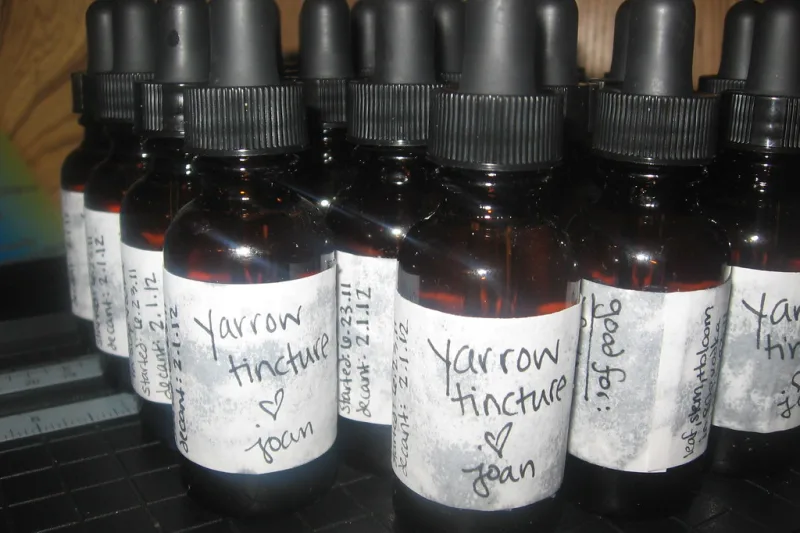
- A label on which you note: the plant, the part used, the alcohol strength, the date of preparation, and the date of straining.
Hygiene is essential: the jar and utensils must be washed thoroughly and dried, with no traces of dirty water that could introduce microbes.
How to make a tincture step by step (the folk method)
This is the “by eye” method, used for generations — simple and forgiving.
- Prepare the plant. If fresh, chop it finely (leaves, flowers, tender stems) or clean and slice the root. If dried, crumble it.
- Fill the jar. For fresh plants, fill the jar almost completely, without packing it down. For dried plants, fill about half to two-thirds, because they will swell.
- Pour in the alcohol. Cover the plant completely with alcohol, leaving at least 2–3 cm of liquid above it. Plants poking out of the alcohol can mold.
- Close and label. Put on the airtight lid and write the plant and date on the label.
- Macerate. Keep the jar in a dark, cool place (not in the sun) for 2–6 weeks. Traditionally, it is left “from new moon to new moon,” meaning about four weeks.
- Shake daily. Once a day, gently shake the jar. This renews the contact between plant and alcohol and speeds up extraction.
- Strain. After maceration, strain through cheesecloth placed over a sieve, then squeeze the remaining plant matter well to recover all the soaked-in liquid.
- Bottle. Pour the clear tincture into amber dropper bottles, label again (with the straining date), and store in the dark.
The precise, weighed method (for consistent results)
If you want reproducible tinctures, year after year, use a ratio-based method (called the “plant-to-solvent ratio”). Here is a simple, tried-and-true version:
- Dried plants: 1:5 ratio — that is, 1 part plant (in grams) to 5 parts alcohol (in milliliters). For example, 100 g dried plant to 500 ml of 40% alcohol.
- Fresh plants: 1:2 or 1:3 ratio — that is, 100 g fresh plant to 200–300 ml of 45–60% alcohol.
The steps:
- Weigh the plant and note the amount.
- Calculate the volume of alcohol according to the ratio.
- Put the plant in the jar and pour in the measured alcohol.
- Macerate for 2–4 weeks, shaking daily.
- Strain, squeeze, and bottle.
The advantage: you know exactly how “strong” your tincture is and can repeat the recipe identically. Write everything on the label so you can compare batches.
Alcohol-free tinctures: glycerites and oxymel
Not everyone can or wants to use alcohol. There are traditional alternatives:
The glycerite uses food-grade vegetable glycerine (optionally diluted with a little water) in place of alcohol. It has a sweet taste, is favored for children (on medical advice) and for those who avoid alcohol, but it extracts fat-loving compounds more weakly and keeps for less time (usually under a year, ideally refrigerated). A rough ratio: plant fully covered with glycerine, macerated 4–6 weeks.
Oxymel is an old preparation of honey and vinegar in which plants are macerated. It is not a tincture in the strict sense (it contains no alcohol), but it follows the same logic of extraction and preservation and tastes very pleasant. The honey and vinegar preserve it, and the mixture is taken diluted in water.
For those who already have an alcohol tincture, there is a simple trick: drop the dose into a teaspoon of hot water and leave it for 1–2 minutes — some of the alcohol evaporates, leaving the extract.
How to dose and administer
Dosing tinctures is one of the most delicate aspects, because they are concentrated. Folk tradition speaks in “drops” or “teaspoons,” but the real amount of active compounds depends on the plant and the concentration.
Prudent general rules, valid only for gentle plants and healthy adults:
- Many traditional tinctures are taken at around 10–30 drops, 1–3 times a day, diluted in a small glass of water.
- For stronger plants, doses are much smaller and must be set by a specialist.
- Always start with the minimum dose and observe how the body reacts over a few days.
- Do not combine several tinctures without knowing what you are doing.
Tinctures are usually taken diluted, never undiluted straight on the tongue in large amounts, because concentrated alcohol irritates the mucous membranes. Some are taken before meals (for digestion), others in the evening (for relaxation) — it depends on the plant and the traditional purpose.
Very important: these figures are indicative and cultural, not medical prescriptions. For any real condition, the correct dose is set by a doctor or a qualified herbalist.
Plants commonly used in tinctures and what they help with
In Romanian and European tradition, a few plants always appear in the tincture pantry:
Echinacea
Echinacea root and aerial parts make perhaps the best-known “cold-season” tincture. Tradition uses it to support the body at the first signs of a cold. Studies suggest a possible role in supporting immunity, but the results are mixed. It is not recommended for people with autoimmune diseases without medical advice.
St. John’s wort
St. John’s wort tincture has a beautiful reddish color and a long folk tradition for mild low moods and for skin care (externally). Caution: St. John’s wort strongly interacts with numerous medications (antidepressants, anticoagulants, contraceptives, immunosuppressants) and increases sensitivity to sunlight.
Calendula
Used mainly externally, in lotions and compresses, for irritated skin. Diluted calendula tincture is a classic of traditional skin care.
Dandelion
Dandelion root was traditionally used as a bitter tonic, to support digestion and appetite. The bitter taste is part of the effect.
Green walnut and walnut husk
These appear in traditional “cleansing” tinctures, but they are powerful and stain intensely; use them with caution.
Propolis
Propolis tincture is a classic of the Romanian pantry, traditionally used for the throat and mouth. Beware of allergies (anyone allergic to bee products should avoid it).
The list above is informative, not an invitation to treat illness. Each plant has its own contraindications.
How to store them and how long they last
A well-made alcohol tincture, with enough alcohol and properly stored, lasts many years. The golden rules:
- Keep it in amber glass, away from light.
- Store it in a cool place, far from heat sources.
- Close it tightly — rubber droppers can degrade over time, so check them periodically.
- Label clearly: plant, strength, date. An unlabeled tincture becomes, within a few years, a risky mystery.
- If you notice an off smell, unusual cloudiness, or mold (rare at high alcohol concentrations), discard it.
Glycerites and oxymel, without alcohol, keep for less time and benefit from refrigeration.
Lifestyle and the wise use of tinctures
Tinctures are tools, not magic solutions. In folk tradition, they complemented a way of life: simple food, plenty of movement outdoors, sleep in tune with the sun, and a close relationship with the plants around you. A digestive tincture does not make up for heavy, hurried meals; a “calming” one does not replace real rest.
The healthiest way to view tinctures is as occasional, conscious support — not as something you take endlessly, “just in case.” Many plants are not recommended for very long courses without breaks. Listen to your body, take into account the medication you already take, and, when needed, seek the advice of someone qualified.
Responsible harvesting is also part of the ethics of remedies: gather only from clean, unpolluted places, far from roads; do not exhaust populations of rare wild plants; and always leave enough for the plant to recover.
Practical Tips and Common Mistakes
Mistake no. 1: Using the wrong alcohol. Never rubbing alcohol, isopropyl, or methanol — they are poisonous. Only food-grade ethyl alcohol.
Mistake no. 2: A misidentified plant. Confusing one species for another can turn a remedy into a hazard. If you are not 100% sure what plant you are gathering, do not use it.
Mistake no. 3: Plant poking out of the alcohol. Uncovered plant matter molds and ruins the whole batch. Press the plant under the liquid and add alcohol if needed.
Mistake no. 4: Macerating in the sun. Direct light degrades sensitive compounds. The right place is dark and cool.
Mistake no. 5: Careless straining. Plant fragments left in the bottle cloud the tincture and can spoil it. Strain through cheesecloth and squeeze well.
Mistake no. 6: No label. A year from now, you won’t remember what is in the bottle. Note everything from the start.
Mistake no. 7: Overdosing “to make it work faster.” More does not mean better. Concentrated tinctures can cause unpleasant effects at high doses.
Mistake no. 8: Ignoring interactions. If you take medication, many plants can interfere dangerously. Ask your doctor first.
Conclusion
The tincture is one of the most beautiful legacies of folk wisdom: a simple, elegant way to capture the power of plants and preserve it over time. With a jar, good-quality food-grade alcohol, a well-known plant, and a few weeks of patience, anyone can make a clean, long-lasting tincture at home. The key lies in a few essential principles: the right alcohol, a plant identified with certainty, hygiene, maceration in the dark, daily shaking, careful straining, and clear labeling. Beyond technique, however, prudence always remains: tinctures are concentrated, they interact with medications, and they are not for everyone. Used with respect and knowledge, they remain a trustworthy pantry remedy; used carelessly, they can do harm. Learn the plant before you turn it into a remedy.
Frequently Asked Questions
How long should a tincture macerate? Generally 2–6 weeks, with a traditional optimum around four weeks. Aromatic plants and flowers may be ready sooner; tough roots take longer. Daily shaking helps extraction.
Can I use fruit brandy instead of vodka? Yes, if it has a known strength and is clean. The drawback is that the brandy’s own aroma carries over into the tincture. For a neutral product, vodka or refined spirit is more suitable.
How do I know what alcohol concentration to use? The simple rule: dried plants — about 40% alcohol; fresh, juicy plants — stronger (45–60%); resinous plants — stronger still (60–70%). For beginners, 40% vodka is the safe starting point for most plants.
Can a tincture be made without alcohol? Yes, using vegetable glycerine (a glycerite) or honey and vinegar (oxymel). These extract certain compounds more weakly and keep for less time, but they are useful for anyone avoiding alcohol. Glycerine is best kept refrigerated.
How long does a tincture last? An alcohol one, well made and kept in the dark, lasts many years. Glycerites and oxymel keep for less time (usually under a year) and benefit from refrigeration.
How many drops do you take from a tincture? For gentle plants and healthy adults, tradition speaks of roughly 10–30 drops, 1–3 times a day, diluted in water. For potent plants, doses are much smaller and must be set by a specialist. Always start with the minimum amount.
Why is the tincture taken diluted in water? Because concentrated alcohol irritates the mucous membranes and because dilution makes the taste more bearable. In hot water, some of the alcohol evaporates, which helps people who want to reduce their alcohol intake.
Can I give tinctures to children? Alcohol tinctures should not be given to children without medical advice. For young children, alcohol-free versions (glycerites) are preferred, on recommendation, but still under the supervision of a specialist.