 Photo: WIKISKYMAN, CC BY-SA 4.0, via Wikimedia Commons
Swedish bitters (the “Swedish elixir”) are a bitter tincture of 11 herbs and resins (aloe, myrrh, saffron, senna leaves, camphor, rhubarb root, zedoary, manna, theriac, carline thistle root and angelica root) macerated for 14 days in 1.5 litres of 38-40% alcohol. You take a tablespoon diluted in tea or water 1-3 times a day for sluggish digestion, and use it externally in compresses. The bitter herbs stimulate digestive secretions, but aloe, senna and rhubarb are stimulant laxatives, so the bitters should not be taken continuously for months, and the camphor makes them dangerous for children.
Swedish bitters became famous across Central and Eastern Europe through the book by Austrian herbalist Maria Treben, Health Through God’s Pharmacy, which was also translated into Romanian. She wrote that the recipe came from a Swedish doctor, Claus Samst, who supposedly lived to 104. The story is part of the remedy’s charm, not proof. Here is what it contains, how to make it and how to use it without harming yourself.
Key takeaways
- Classic recipe: 11 ingredients, about 100 g of mix to 1.5 litres of 38-40% alcohol, macerated for 14 days.
- Usual internal dose: 1 tablespoon (10-15 ml) diluted in 100-150 ml of tea, 1-3 times a day, before or after meals.
- Main effects: stimulating digestion (bitter herbs) and a laxative effect (aloe, senna, rhubarb).
- Internal use: 1-2 weeks at most in a row, then a break, because of the stimulant laxatives.
- Not for children, pregnancy, breastfeeding, inflammatory bowel disease, bowel obstruction, or anyone taking digoxin or diuretics without medical approval.
What Swedish bitters are
Bitters are preparations based on bitter herbs, used for centuries in Europe as aperitifs or digestifs. Swedish bitters belong to this family, but stand out because they contain three laxative herbs and camphor.
The “small” recipe popularised by Maria Treben (amounts for 1.5 litres of alcohol):
| Ingredient | Amount | Traditional role |
|---|---|---|
| Aloe (dried juice, Aloe ferox) | 10 g | stimulant laxative, bitter |
| Myrrh (resin, Commiphora) | 5 g | antiseptic, astringent |
| Saffron | 0.2 g | aroma, colour |
| Senna leaves | 10 g | stimulant laxative |
| Natural camphor | 10 g | local irritant, aroma |
| Rhubarb root | 10 g | laxative and astringent |
| Zedoary root (Curcuma zedoaria) | 10 g | bitter, digestive |
| Manna (dried ash sap) | 10 g | gentle laxative |
| Venetian theriac (herb blend) | 10 g | digestive tonic |
| Carline thistle root (Carlina acaulis) | 5 g | bitter, digestive |
| Angelica root | 10 g | bitter, carminative |
Some versions replace aloe with wormwood or gentian for people who do not tolerate it, and some commercial products leave out the camphor.
How it might work
- Bitter compounds (from zedoary, angelica, carline thistle, aloe) act on bitter taste receptors and reflexively increase the flow of saliva, gastric juice and bile. Hence the feeling of easier digestion after a heavy meal.
- Anthranoids in aloe, senna and rhubarb are converted by gut bacteria into compounds that stimulate colon contractions and reduce water absorption. The result is a softer stool, usually 6-12 hours later.
- Volatile oils in angelica and zedoary ease bloating and cramps.
- Myrrh and camphor are antiseptic and locally irritant, mostly useful in external applications.
What the evidence says
There are no clinical trials on Swedish bitters as a product. There are, however, assessments of some ingredients:
- The European Medicines Agency (EMA) recognises senna leaves and aloe as laxatives for short-term, occasional constipation, with clear warnings about prolonged use.
- Angelica root has an EMA monograph for traditional use in mild digestive complaints (bloating, fullness).
- For “blood cleansing”, “detox”, treating liver disease, tumours or heart problems, claims found in popular literature, there is no evidence.
So Swedish bitters may realistically help with sluggish digestion and occasional constipation. Everything else belongs to tradition.
How to make it at home
What you need
- the herb mix above (herbal shops sell it pre-weighed as “Swedish bitters herbs”);
- 1.5 litres of food-grade alcohol at 38-40% (good vodka or a neutral fruit spirit, unflavoured);
- a 2-litre glass bottle or jar with a tight stopper;
- gauze, a funnel, dark glass bottles.
Preparation, step by step
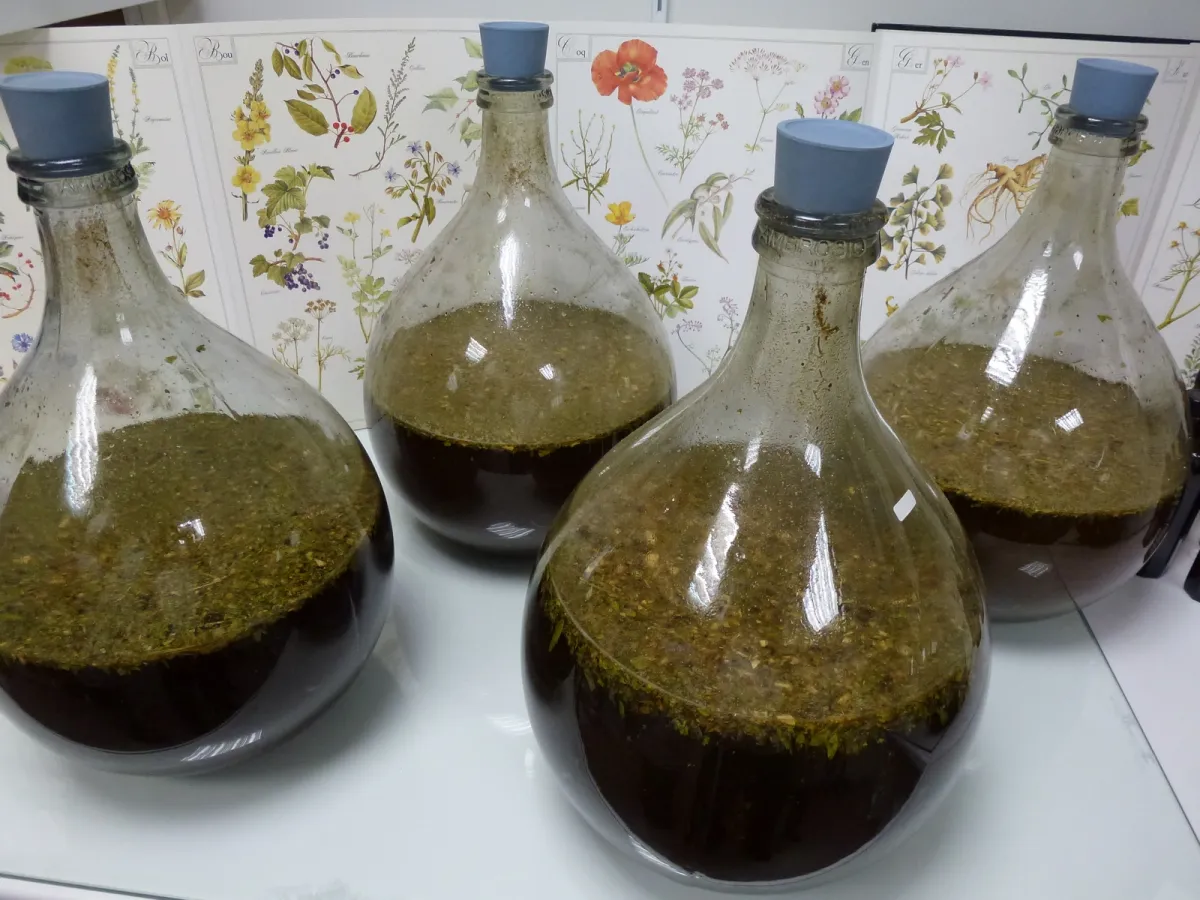
- Put the herbs in the 2-litre bottle and pour the alcohol over them. The bottle should not be filled to the brim.
- Seal tightly and leave for 14 days somewhere warm (20-25°C / 68-77°F), shaking daily. Treben recommended sunshine or a spot near the stove; a warm room is enough and safer.
- After 14 days you can strain part of it into small bottles and leave the rest on the herbs, topping up with alcohol, or strain everything through gauze.
- Store the bottles at room temperature, in the dark. Thanks to the alcohol, the tincture keeps for years.
 Photo: Krzysztof Ziarnek, Kenraiz, CC BY-SA 4.0, via Wikimedia Commons
How to use it
Internally, for digestion
| Purpose | Dose | When | How long |
|---|---|---|---|
| Sluggish digestion, bloating after heavy meals | 1 tsp-1 tbsp in 100 ml tea | after the main meal | occasionally |
| Feeling of fullness, poor appetite | 1 tsp in 100 ml water | 15-20 min before a meal | 1-2 weeks |
| Occasional constipation | 1 tbsp in 150 ml tea | in the evening | 2-3 days, max. 1-2 weeks |
Start with one teaspoon to see how your gut reacts. If you get cramps or loose stools, reduce the dose or stop. Never take it undiluted.
For gentler options for digestion, see remedies for an upset stomach and wormwood wine.
Externally, in compresses
This was Maria Treben’s favourite use and is, in fact, the safest.
- Apply a thin layer of calendula ointment or petroleum jelly to the area so the alcohol does not dry the skin.
- Soak a piece of cotton wool or gauze in the bitters (undiluted or diluted 1:1 with water) and place it on the area.
- Cover with cling film and secure with a bandage or towel.
- Leave for 1-2 hours; if the skin tolerates it well, some people leave it overnight. Dust the skin with powder afterwards.
It was traditionally used on painful joints, bruises, over the liver “for digestion” and on insect bites. For more compress ideas, see the guide to herbal compresses.
Do not apply to open wounds, eyes or mucous membranes, or on young children, because of the alcohol and camphor.
Contraindications and interactions
- Children under 12: no, neither internally nor externally over large areas. Swallowed camphor can cause seizures even in small amounts.
- Pregnancy and breastfeeding: no (stimulant laxatives, alcohol, camphor).
- Inflammatory bowel disease (Crohn’s, ulcerative colitis), appendicitis, bowel obstruction, abdominal pain of unknown cause: no.
- Flaring haemorrhoids, irritable bowel syndrome with diarrhoea: avoid.
- Medicines: stimulant laxatives lower potassium, which increases the toxicity of digoxin and adds to the effect of diuretics and corticosteroids. They can also reduce the absorption of other medicines taken at the same time.
- Alcohol dependence, liver disease, epilepsy: no.
- Allergy to the Apiaceae (angelica) or Asteraceae (carline thistle) families.
When to see a doctor
- constipation lasting more than 2 weeks or alternating with diarrhoea;
- blood in the stool, black stools, unexplained weight loss;
- severe abdominal pain, vomiting, a swollen, hard abdomen;
- heartburn or stomach pain that returns every week;
- muscle weakness, cramps or palpitations during use (possible low potassium).
Common mistakes
“A spoonful a day, for life”. Popular books recommend it as a daily tonic. With senna and aloe in the mix, long-term use can lead to laxative dependence, potassium loss and dark discoloration of the colon lining.
Taking it undiluted. 40% alcohol and camphor irritate the oesophagus and stomach.
Giving bitters to children “for colic”. Risky because of the camphor and laxatives.
Bitters instead of investigations. Persistent digestive symptoms need a diagnosis.
Unlabelled ingredients from a market stall. Aloe and senna strength varies widely. Buy the mix from controlled sources.
Conclusion
Swedish bitters are an interesting traditional preparation that combines bitter digestive herbs with strong laxatives and camphor. Used occasionally, diluted, for sluggish digestion or short-lived constipation, they can be useful. Externally, in compresses, they are safest. As a daily tonic “for everything”, as often described in folk books, they are not a good idea: the very ingredients that make them work are the ones that demand moderation.
Frequently asked questions
How much Swedish bitters can I take a day? 1 teaspoon to 1 tablespoon, diluted, 1-3 times a day, occasionally or for a maximum of 1-2 weeks in a row.
Do Swedish bitters help you lose weight? No. The laxative effect means losing water, not fat.
Can I make Swedish bitters without aloe? Yes, some versions replace aloe with wormwood or gentian. The laxative effect will be weaker; the digestive effect remains.
Why leave it in the sun? Warmth speeds up extraction. A warm room with a steady temperature gives equally good results.
How long does it keep? Thanks to the alcohol, for years, in the dark and tightly closed.
Can I use Swedish bitters during pregnancy? No. They contain stimulant laxatives, alcohol and camphor.
Do they help the liver? Bitter herbs stimulate bile flow, which can ease fat digestion, but the bitters do not treat liver disease.
Sources
- EMA/HMPC: Community herbal monographs on Sennae folium (senna leaf) and Aloe (dried aloe juice), with their restrictions on use.
- EMA/HMPC: Community herbal monograph on Angelicae archangelicae radix (angelica root).
- Maria Treben, Gesundheit aus der Apotheke Gottes (Health Through God’s Pharmacy), the source of the popular recipe.
This content is for information only and does not replace medical advice. For persistent digestive symptoms, see a doctor.