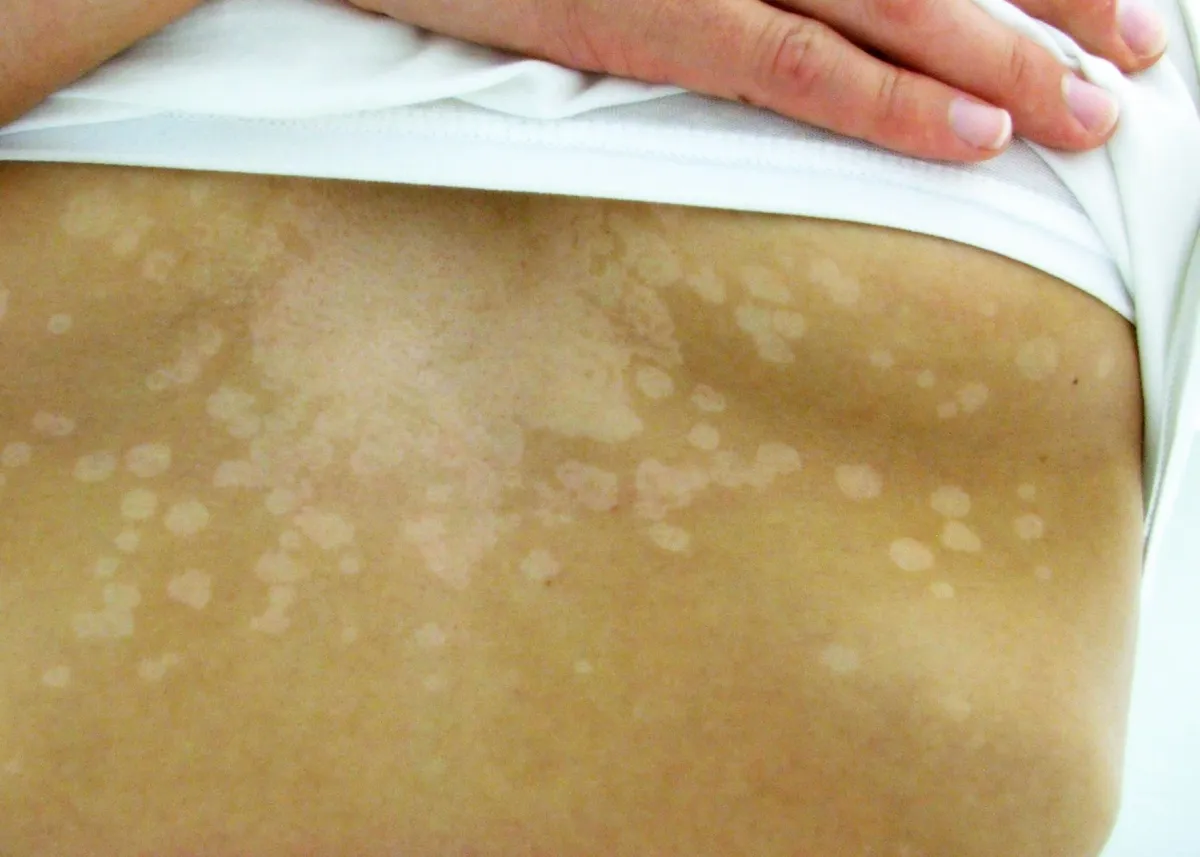
 Photo: Sarahrosenau, CC BY-SA 2.0, via Wikimedia Commons
Tinea versicolor (also called pityriasis versicolor) is a superficial skin infection with a yeast that normally lives on the skin, Malassezia. It causes small, round, white, pink or brown patches with fine scaling on the back, chest, shoulders and neck, which become obvious in summer because they do not tan. It is not contagious and not dangerous. It responds well to antifungal shampoos or creams applied to the skin, while natural remedies (tea tree oil, for example) can only be add-ons. Note that skin colour returns slowly, over a few months, even after the yeast is gone.
Many people discover the patches after a holiday, when the rest of the skin has tanned and the affected areas have stayed pale. Others see them in winter as slightly scaly brown patches. The name “versicolor” means exactly that: the colour varies. The good news is that diagnosis is usually simple and treatment inexpensive; the harder part is preventing it from coming back, because the yeast is part of the skin’s normal flora.
Key takeaways
- The cause is Malassezia yeast, present on everyone’s skin, which multiplies with heat, humidity and sweat.
- Pale patches do not tan; after treatment, colour returns within 1-6 months.
- Antifungal shampoos (ketoconazole, selenium sulfide, zinc pyrithione) used as a body wash are the core treatment.
- Tea tree oil is antifungal in laboratory studies, but it is an add-on, not a stand-alone cure.
- Relapses are common; a monthly antifungal wash in the warm season helps prevent them.
What tinea versicolor is
Malassezia is a lipophilic (fat-loving) yeast that lives on the skin of most adults, in areas rich in oil glands. Under certain conditions it changes from its harmless form into one that multiplies and invades the top layer of the skin. There it produces substances (such as azelaic acid) that locally inhibit melanin production, which is why the patches look lighter. In other people the yeast causes mild inflammation and the patches turn pink or brown.
The same yeast is involved in seborrhoeic dermatitis and dandruff, which is why some people have all three.
What it looks like
- Small round or oval patches that can merge into large areas.
- White, pink, salmon or brown colour.
- Fine, powdery scaling, especially when you stretch the skin or scratch it lightly with a fingernail.
- Located on the back, chest, shoulders, neck and arms; rarely on the face in adults.
- Mild or no itching, sometimes more noticeable when sweating.
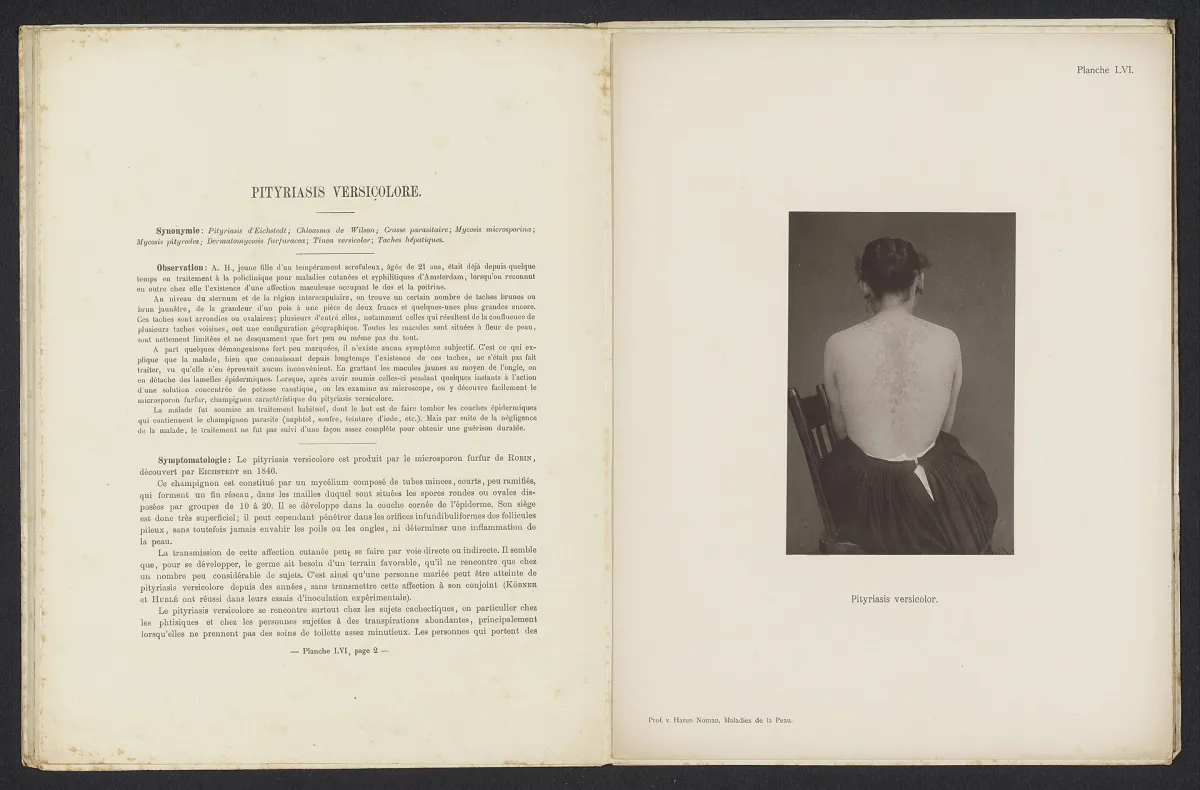 Photo: Rijksmuseum, CC0, via Wikimedia Commons
How to tell it from other white patches
| Condition | Appearance | Scaling | Typical features |
|---|---|---|---|
| Tinea versicolor | Small merging patches, white-pink-brown | Fine, powdery | Trunk, summer, teens and young adults |
| Vitiligo | Paper-white patches, sharp edges | None | Complete pigment loss, face, hands |
| Pityriasis alba | Dull white, poorly defined patches | Slight | Children’s faces, dry skin, atopy |
| Post-inflammatory pale patches | Marks after a previous lesion | None | Follows irritation or a burn |
If the patches are completely white, without any scaling, and spread on the hands or around the mouth, it may be vitiligo, a different condition that needs a dermatologist.
Causes and contributing factors
- Heat and humidity: summer, tropical climates, saunas.
- Heavy sweating and tight synthetic clothing. If you sweat a lot, see our guide to excessive sweating.
- Oily skin and heavy creams or oils applied to the trunk.
- Age: adolescence and young adulthood, when oil glands are very active.
- Weakened immunity, steroid treatment, pregnancy.
- Predisposition: some people relapse year after year.
Treatment: what works
Core treatment: topical antifungals
Dermatology guidelines recommend antifungal products applied to the skin as first line, many available without prescription:
- Ketoconazole 2% shampoo: applied to damp skin over all affected areas and a little beyond, left for 5-10 minutes, then rinsed. Daily for 3-5 days (or as your pharmacist advises).
- Selenium sulfide shampoo: left on the skin for 10 minutes, daily for 7 days.
- Zinc pyrithione soap or shampoo: gentler, useful especially for maintenance.
- Antifungal creams (clotrimazole, terbinafine and others) for small areas.
For extensive or recurrent cases, a doctor may prescribe oral treatment.
Natural remedies: add-ons, not replacements
Tea tree oil. Laboratory studies show that tea tree oil is active against Malassezia, and a clinical trial on dandruff (the same yeast) used a 5% tea tree oil shampoo with good results. For patches on the body you can add 10-15 drops to 100 ml of neutral shower gel (roughly 0.5-0.75%), apply it and leave for 3-5 minutes before rinsing. Never apply it undiluted.
Diluted apple cider vinegar. A folk remedy; acidifying the skin may make it less friendly to the yeast, but there are no serious clinical studies. A compress of one part vinegar to three parts water for 5 minutes is acceptable on unbroken skin.
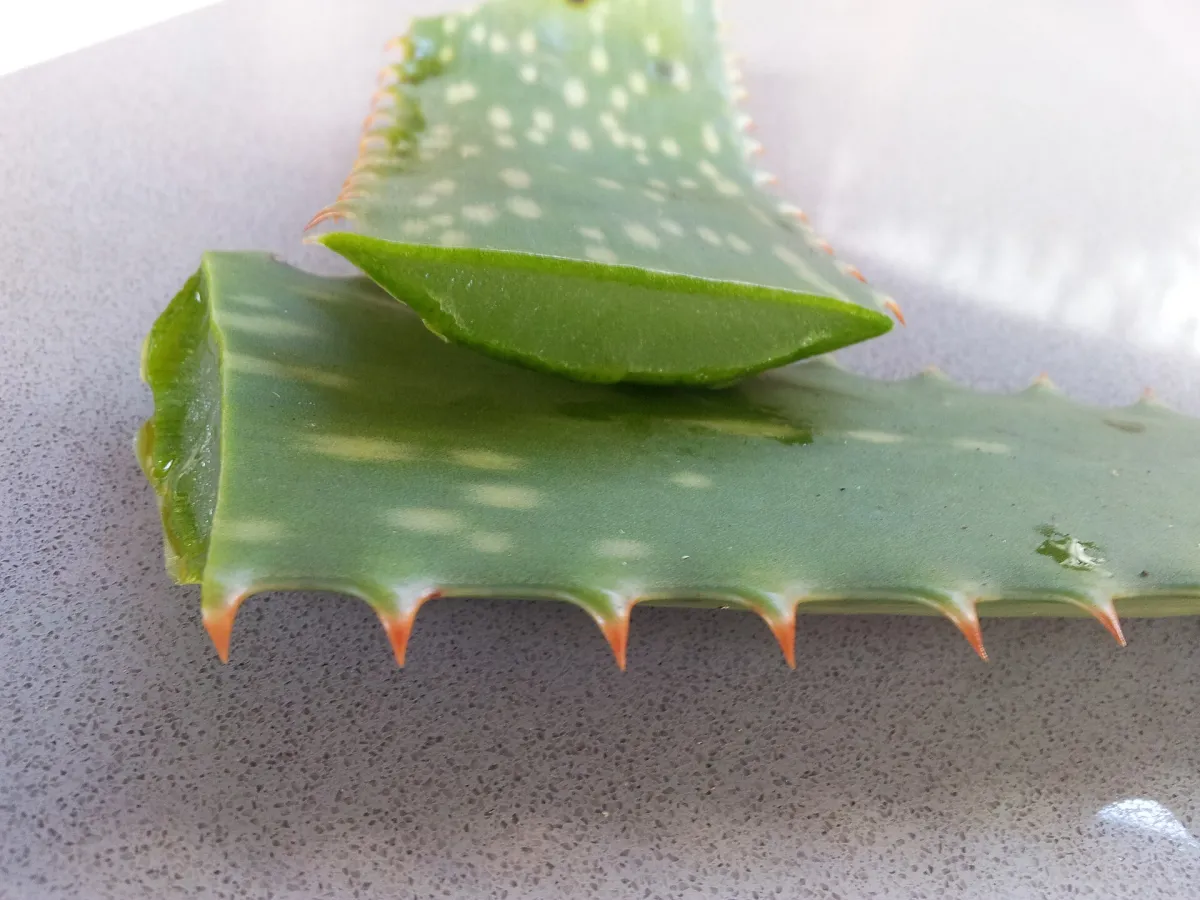
Aloe vera. It does not treat the infection, but it soothes skin irritated by treatment.
What does not help: heavy oils (olive, coconut) applied to active patches. Malassezia feeds on lipids, and some oils may encourage it.
Treatment and prevention plan
| Stage | What to do | Duration |
|---|---|---|
| Treatment | Antifungal shampoo on the skin, daily | 3-7 days |
| Add-on | Tea tree shower gel on other days | 2-4 weeks |
| Colour recovery | Moderate sun exposure, with protection | 1-6 months |
| Prevention | Antifungal wash once a month, April to October | Every year, warm season |
| Lifestyle | Cotton clothing, shower after sport | Ongoing |
Getting your colour back
Once the yeast is gone, pale patches remain for months until the pigment cells resume work. That does not mean treatment failed. If the patches are no longer scaly (the fingernail test no longer lifts any “powder”), the infection has cleared. Moderate sun helps even things out, but use sunscreen on the rest of your skin, otherwise the colour difference grows.
Contraindications and precautions
- Pregnancy: oral treatments are not used; choose topical ones with your doctor. Avoid concentrated essential oils.
- Children: ask a paediatrician before any antifungal or essential oil.
- Irritated skin: selenium sulfide and vinegar can sting; shorten contact time.
- Allergy to tea tree oil: more common with old, oxidised oil. Keep it closed and in the dark.
- Interactions: oral antifungals interact with many medicines; do not take them without a prescription.
When to see a doctor
- You are not sure of the diagnosis (white patches without scaling, on the face or hands).
- The patches do not improve after 4 weeks of correct treatment.
- The rash is very widespread or comes back several times a year.
- You have diabetes, weak immunity or take immunosuppressive medicines.
- Intense itching, redness, blisters or patches with active edges appear (it may be another fungal infection, such as ringworm).
A dermatologist can confirm the diagnosis by looking at skin scrapings under a microscope or with a Wood’s lamp.
Common mistakes
Thinking treatment failed because the patches are still pale. Colour returns slowly; what matters is that there is no more scaling.
Treating only the visible patches. The yeast is also on the surrounding skin; apply the product to wide areas.
Stopping prevention after one summer without patches. Relapse is the rule in predisposed people.
Using steroid creams without advice: they can help the infection spread.
Sunbathing excessively to “hide” the patches: the colour difference grows and the risk of burning is real.
Conclusion
Tinea versicolor is a benign but persistent skin problem. The core treatment is simple: antifungal shampoos used as a body wash for a few days, then a preventive monthly wash in the warm season. Tea tree oil and diluted vinegar can complement care, while loose clothing and showering after sweating reduce relapses. Be patient as colour returns and see a dermatologist if the diagnosis is unclear.
Frequently asked questions
Is tinea versicolor contagious? Not in any practical sense. Malassezia already lives on most people’s skin; the condition develops because of local conditions, not by “catching” it from someone.
Why don’t the patches tan? The yeast produces substances that locally inhibit melanin production. That is why patches become obvious after sun exposure.
How long do the white patches take to go away? The infection clears in 1-2 weeks of treatment, but normal colour returns over 1-6 months.
Can I treat tinea versicolor with natural remedies only? Tea tree oil is antifungal in the lab, but clinical evidence for this condition is limited. Standard antifungal treatment is safer and faster; natural remedies are an extra.
Why does it come back every summer? Because the yeast stays on the skin, and heat and sweat reactivate it. A monthly antifungal wash in the warm months greatly reduces relapses.
Can I go to the beach with tinea versicolor? Yes, but use sunscreen. Otherwise the rest of your skin tans and the patches become more visible.
Does diet affect tinea versicolor? There is no convincing evidence that any diet treats it. The main factors are heat, humidity, sweat and predisposition.
Sources
- American Academy of Dermatology (AAD): Tinea versicolor, diagnosis and treatment.
- NHS (UK): Pityriasis versicolor.
- Systematic reviews indexed in PubMed on topical and oral treatments for pityriasis versicolor.
- Satchell AC et al.: trial of 5% tea tree oil shampoo for dandruff (Journal of the American Academy of Dermatology, 2002).
Informative content only. It does not replace medical or dermatological advice.