 Photo: Ivar Leidus, CC BY-SA 4.0, via Wikimedia Commons
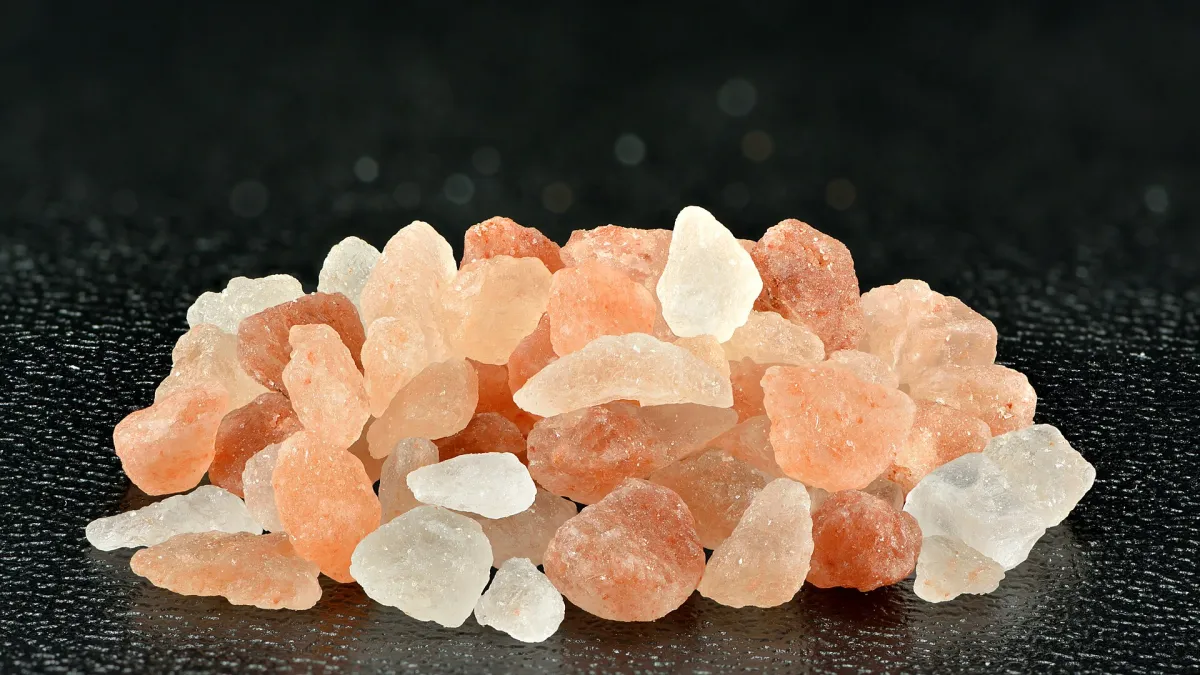
Himalayan salt is, chemically, still sodium chloride: roughly 95-98% of its weight, with traces of iron, potassium, magnesium and calcium that give it its pink color. Gram for gram it contains almost as much sodium as table salt, and the extra minerals are present in amounts far too small to matter for your health. Its real benefits are taste, texture and the lack of additives, not “detox”, and because it is usually not iodized, it can even be a step backwards for some people.
Key takeaways:
- 1 g of Himalayan salt provides about 370-390 mg of sodium, close to table salt (about 390 mg).
- The “extra” minerals cover less than 1-2% of daily needs at a normal salt intake.
- It is usually not iodized: if it is your only salt, you need iodine from other sources.
- Salt lamps, sole water and salt detox routines have no scientific support.
- The limit is the same for every salt: under 5 g a day for adults, often less with high blood pressure or kidney disease.
- The only measurable advantage: coarse crystals put less sodium into a teaspoon, not into a gram.
What Himalayan salt actually is
The name is more marketing than geography. Nearly all the pink salt sold worldwide comes from the Khewra mine and other mines in the Salt Range of Punjab, Pakistan, a few hundred kilometers from the Himalayas proper. It is rock salt (halite), formed when an ancient sea evaporated hundreds of millions of years ago, and it is mined from underground deposits.
The pink to orange tint comes mainly from traces of iron oxide. The salt is usually crushed and packed without refining and without anti-caking agents, which explains its “pure” and “natural” image.
A useful reality check: ordinary rock salt from mines in Romania, Poland or Germany has the same geological origin and a very similar composition. The main difference between them is price, not chemistry.
Himalayan salt sodium content vs table salt and sea salt
Pure sodium chloride is about 39% sodium. Any salt that is 95-99% NaCl will therefore contain 370-390 mg of sodium per gram. Real differences come from two things: moisture (damp grey salt has slightly less salt per gram) and crystal size, which changes how many grams fit into a teaspoon.
EU and UK food labels list “salt”, while US labels list “sodium”. The conversion is simple: sodium × 2.5 = salt.
| Type of salt | Sodium per 1 g (approx.) | Sodium per level teaspoon (approx.) | Iodine | Notes |
|---|---|---|---|---|
| Fine iodized table salt | 390 mg | 2,300 mg (about 6 g) | Yes | May contain an approved anti-caking agent |
| Fine Himalayan salt | 370-390 mg | 2,100-2,300 mg | Usually no | Traces of iron, potassium, magnesium, calcium |
| Coarse Himalayan salt | 370-390 mg | 1,500-1,900 mg | No | Fewer grams per spoon, not less sodium per gram |
| Fine sea salt | 380-390 mg | 2,200-2,300 mg | Rarely | Iodized versions exist |
| Grey (Celtic) salt, moist | 330-360 mg | 1,700-2,000 mg | No | Contains water, so slightly less sodium |
| Ordinary rock salt | 380-390 mg | 2,200 mg | Only if iodized | Composition close to pink salt |
| Reduced-sodium salt (with potassium chloride) | usually 30-70% less | variable | Variable | Not suitable in kidney disease without medical advice |
The practical takeaway: if you switch from table salt to Himalayan salt and keep salting by eye, your sodium intake stays essentially the same. The coarse-crystal advantage disappears completely once you grind it fine.
The “84 trace minerals” claim, in real numbers
Many packs promise “84 minerals”. Lab analyses show that, apart from sodium and chloride, pink salt contains mainly potassium, magnesium, calcium and iron, together making up a few percent at most. The other elements on those lists are present in minute traces, and some promotional charts even include toxic metals or radioactive elements labelled as “minerals”.
A quick calculation, using typical values reported in analyses, shows why these traces do not matter:
- At 5 g of salt a day, the potassium in pink salt comes to roughly 10-15 mg, against an adult need of about 3,500 mg. A single banana provides 350-400 mg.
- Magnesium reaches a few milligrams, against a daily need of 300-400 mg. A handful of pumpkin seeds provides dozens of times more.
- Iron is in the range of tenths of a milligram, in a poorly absorbed form.
A 2020 analysis of pink salts sold in Australia reached the same conclusion: to get a meaningful amount of nutrients from salt, you would have to eat so much that the sodium itself would become dangerous. The same analysis found one sample with lead above the Australian legal limit, another reason to buy only from brands that publish lab testing.
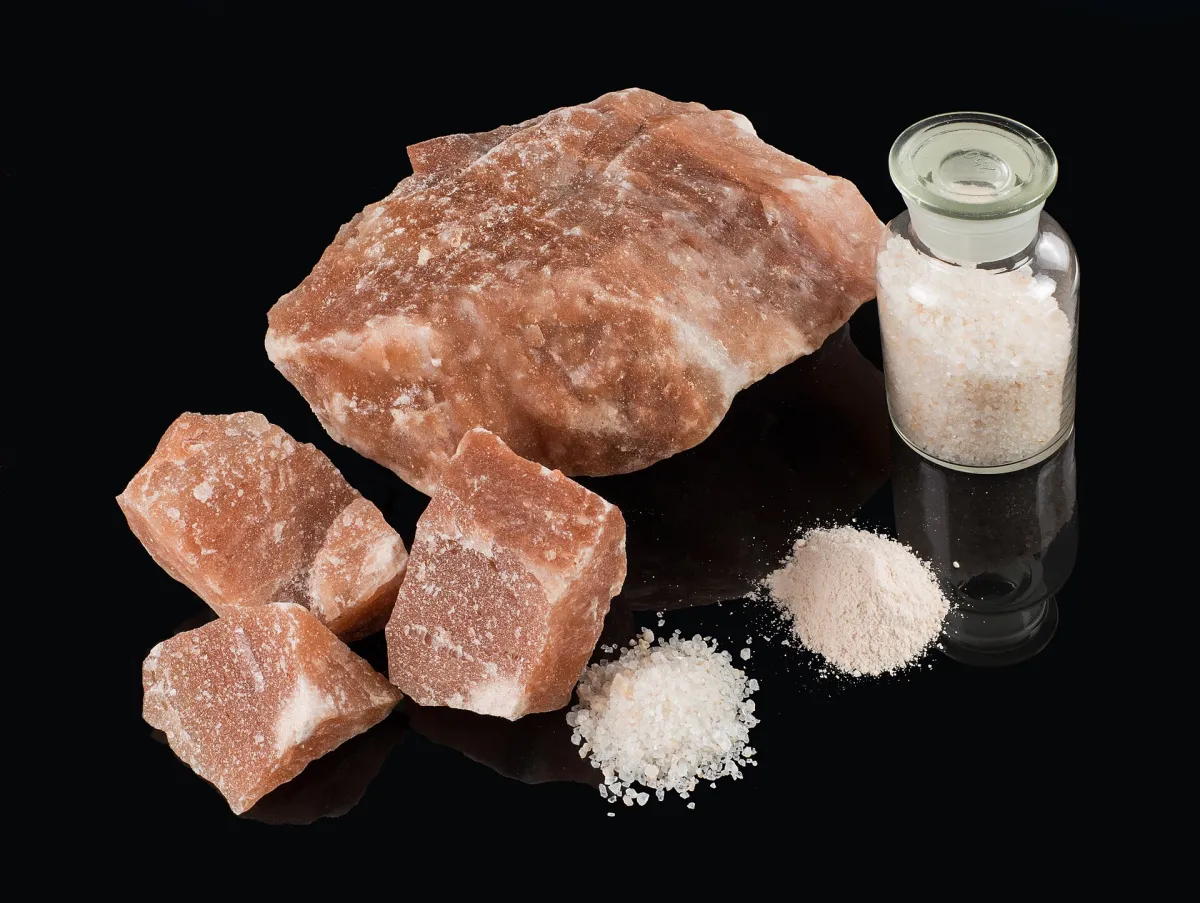 Photo: Hubertl, CC BY-SA 4.0, via Wikimedia Commons
The real benefits (few, but honest)
- Taste and texture. Coarse crystals sprinkled at the end on salad, tomatoes or a steak give a strong salty hit with less salt than fine salt stirred into the food. This is the most solid argument in its favor.
- No additives. Pink salt usually has no anti-caking agents. Those agents are approved and considered safe, but some people prefer the simplest possible products.
- Salt blocks for serving or cooking are a pleasant kitchen tool that adds a light salty note to food.
- Exercise and heat. You do lose sodium in sweat during long efforts, but any salt replaces it equally well; for diarrhea or dehydration, oral rehydration solutions from the pharmacy are the better choice.
- Gargles and nasal rinses. Plain, non-iodized salt without additives works for traditional salt-water gargles or a saline nasal rinse, but pure rock salt or sea salt works just as well.
There are no clinical studies showing that Himalayan salt lowers blood pressure or improves sleep, digestion, circulation or “electrolyte balance” better than any other salt.
Myths debunked
“It detoxifies the body”
Your liver and kidneys clear metabolic waste. Salt has no mechanism to “draw out toxins”; if anything, excess sodium gives the kidneys extra work and encourages water retention.
Sole water
Sole is a saturated solution of Himalayan salt (salt dissolved in water until no more will dissolve), taken as one teaspoon in a glass of water each morning. The promises: cellular hydration, balanced pH, better sleep, detox. None of them is backed by evidence.
A saturated solution is about 26% salt, so one teaspoon delivers roughly 1.5 g of salt, around 600 mg of sodium, about a quarter of the WHO daily limit before you have eaten anything. For someone with high blood pressure, that is the opposite of what they need. A jar of concentrated brine is also dangerous around small children: a few swallows can cause sodium poisoning.
Salt lamps
Heated salt lamps are said to release negative ions that clean the air, ease allergies and improve sleep. A salt block warmed by a small bulb does not produce negative ions in measurable amounts, and there are no controlled studies showing benefits for asthma, allergies or sleep. The warm glow can be relaxing in the evening, and that is all.
The risks, however, are real: in 2017 tens of thousands of lamps were recalled in the US over fire and electric shock hazards, and cats that lick the lamp can develop salt poisoning. Salt also absorbs moisture and can “sweat”, corroding the bulb socket.
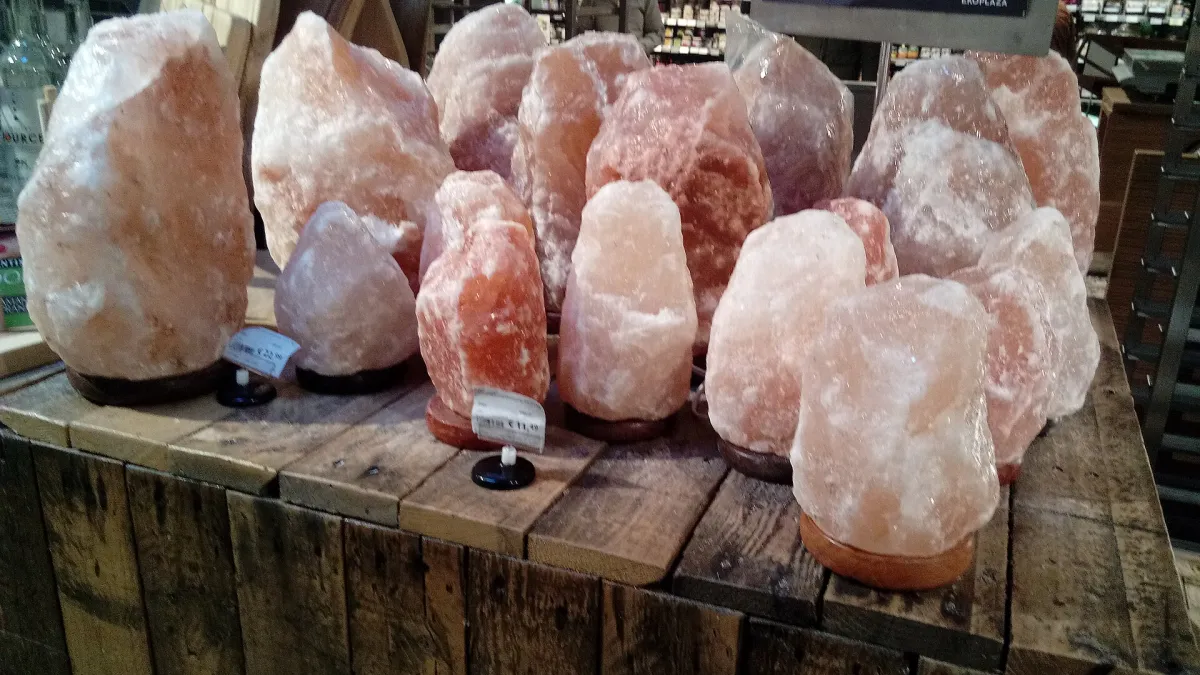 Photo: Donald Trung Quoc Don (Chữ Hán: 徵國單) - Wikimedia Commons - © CC BY-SA 4.0 International.(Want to use this image?)Original publication 📤: –Donald Trung 『徵國單』 (No Fake News 💬) (WikiProject Numismatics 💴) (Articles 📚) 22:45, 16 January 2020 (UTC), CC BY-SA 4.0, via Wikimedia Commons
“It balances pH and blood pressure”
Blood pH is tightly regulated by the lungs and kidneys, and food does not shift it meaningfully in a healthy person. As for blood pressure, sodium raises it regardless of the crystal’s color.
Salt baths and salt rooms
A warm salt bath can be relaxing, but the effect comes from the warm water, not the salt’s origin. Halotherapy (salt aerosol rooms) and speleotherapy in salt mines are popular for breathing problems; the evidence is limited and inconclusive, so they can be a pleasant extra, never a replacement for asthma or COPD treatment.
Missing iodine: the downside nobody mentions
Salt iodization is one of the most successful public health measures in history, and it ended endemic goiter in many mountain regions of Europe. Himalayan salt, like most sea salt and plain rock salt, usually contains no added iodine.
The WHO recommends about 150 µg of iodine a day for adults and 250 µg during pregnancy and breastfeeding. If you use only non-iodized salt and rarely eat fish, seafood, dairy or eggs, you risk falling short. The signs and risks are covered in detail in our article on iodine deficiency. The easy fix: keep iodized salt for cooking and use pink salt only as a finishing salt. Pregnant women should ask their doctor about iodine needs.
How much salt per day is safe
Most adults eat far more than recommended, and about three quarters of sodium comes from processed food: bread, cured meats, cheese, pickles, instant soups, sauces. The salt shaker matters less than people think.
| Group | Salt per day (maximum) | Sodium per day | Source / note |
|---|---|---|---|
| Healthy adult | under 5 g (one level teaspoon) | under 2,000 mg | WHO |
| High blood pressure | under 5 g; many doctors aim lower | under 2,000 mg, ideally toward 1,500 mg | European hypertension guidelines, AHA |
| Chronic kidney disease | under 5 g, tailored by the nephrologist | under 2,000 mg | KDIGO; no potassium substitutes without approval |
| Heart failure, cirrhosis with ascites | individualized | individualized | Set by the treating doctor |
| Babies under 1 year | under 1 g, no added salt | under 400 mg | NHS |
| Children 1-3 years | 2 g | about 800 mg | NHS |
| Children 4-6 years | 3 g | about 1,200 mg | NHS |
| Children 7-10 years | 5 g | about 2,000 mg | NHS |
A Cochrane review found that modest, sustained salt reduction lowers blood pressure, with a larger effect in people with high blood pressure. In chronic kidney disease, less sodium means easier blood pressure control, less swelling and often less protein in the urine.
How to cut salt without suffering
- Read labels: more than 1.5 g of salt per 100 g is high; 0.3 g or less is low.
- Cut down gradually: your taste buds adapt within 2-4 weeks.
- Salt at the table, at the end, rather than during cooking.
- Replace part of the salt with lovage, thyme, garlic, black pepper, lemon zest and juice.
- Rinse canned vegetables and pickles; choose lower-salt bread.
For choosing the right foods, see also our guide to kidney-friendly foods.
Contraindications, interactions and who should be careful
- High blood pressure, kidney disease, heart failure, cirrhosis, edema: Himalayan salt counts fully toward your daily limit, like any salt.
- Lithium: sudden changes in salt intake change blood lithium levels. Do not switch to a very low or very high salt diet without your doctor.
- Diuretics, corticosteroids, NSAIDs: they affect sodium and water balance; talk to your doctor before making big dietary changes.
- Potassium-based salt substitutes: helpful for many people with hypertension, but dangerous in kidney disease or with ACE inhibitors, ARBs or spironolactone because of the risk of high potassium.
- Pregnancy and breastfeeding: prefer iodized salt for cooking.
- Children and pets: keep sole jars and salt lamps out of reach.
- Quality: choose brands that publish heavy metal testing.
When to see a doctor
- home blood pressure readings repeatedly above 140/90 mmHg;
- blood pressure above 180/120 mmHg with severe headache, chest pain, vision changes or weakness on one side: call emergency services;
- swollen legs, rapid weight gain, shortness of breath on exertion or when lying down;
- persistently foamy urine or passing much less urine;
- a lump at the base of the neck, fatigue, feeling cold: possible thyroid problems;
- a child has swallowed brine or a lot of salt and is vomiting, confused or drowsy: emergency.
Common mistakes
Believing pink salt “doesn’t count”. It counts fully: it has nearly as much sodium.
Switching entirely to non-iodized salt. Especially in pregnancy, breastfeeding or for children, iodine matters.
Drinking sole every day to detox. You add sodium with no proven benefit.
Buying a salt lamp for asthma or allergies. It treats nothing and can be an electrical hazard.
Paying ten times more for “minerals”. Vegetables, fruit, legumes and seeds supply them in real amounts.
Watching the shaker and ignoring bread and cured meats. That is where most sodium hides.
Bottom line
Himalayan salt tastes good, is clean when it comes from a reputable producer and works nicely as a finishing salt. It is not a mineral supplement, it does not detox you and it is no kinder to your blood pressure than regular salt. Total amount matters, not color, and if you give up iodized salt you need to get your iodine elsewhere.
Frequently asked questions
Is Himalayan salt healthier than table salt? Not in any meaningful way. Its sodium content is almost the same and the extra minerals are negligible. Iodized table salt actually has one important advantage: iodine.
Can I use Himalayan salt if I have high blood pressure? Yes, but within the same limit as any salt, usually under 5 g a day in total, including the salt already in food. Do not treat it as a risk-free alternative.
How much Himalayan salt can I eat per day? The same as any salt: healthy adults should stay under 5 g a day in total, about one level teaspoon, and much of that already comes from bread and processed food.
Does sole water help hydration or digestion? No studies show that it does. One teaspoon of sole adds around 600 mg of sodium. Plain water is all you need for hydration.
Do salt lamps purify the air? No. They do not release meaningful amounts of negative ions and there is no evidence for allergies, asthma or sleep. They are purely decorative.
Does Himalayan salt contain iodine? Usually not, or only insignificant traces. If it is your only salt, you need other iodine sources or iodized salt for cooking.
Is pink salt better than sea salt? Neither is meaningfully healthier. Both are mostly sodium chloride with similar sodium per gram; choose by taste, texture and price, and keep iodine in mind.
Sources and further reading
- World Health Organization, “Guideline: Sodium intake for adults and children”, 2012.
- He F.J., Li J., MacGregor G.A., “Effect of longer term modest salt reduction on blood pressure”, Cochrane Database of Systematic Reviews, 2013.
- KDIGO, “Clinical Practice Guideline for the Management of Blood Pressure in Chronic Kidney Disease”, 2021.
- European Society of Hypertension, “2023 ESH Guidelines for the management of arterial hypertension”.
- Fayet-Moore F. et al., “An Analysis of the Mineral Composition of Pink Salt Available in Australia”, Foods, 2020.
- NHS, “Salt: the facts”.
Informative content only, it does not replace a consultation with a doctor or pharmacist. People with high blood pressure, kidney or heart disease should discuss salt intake with their doctor.