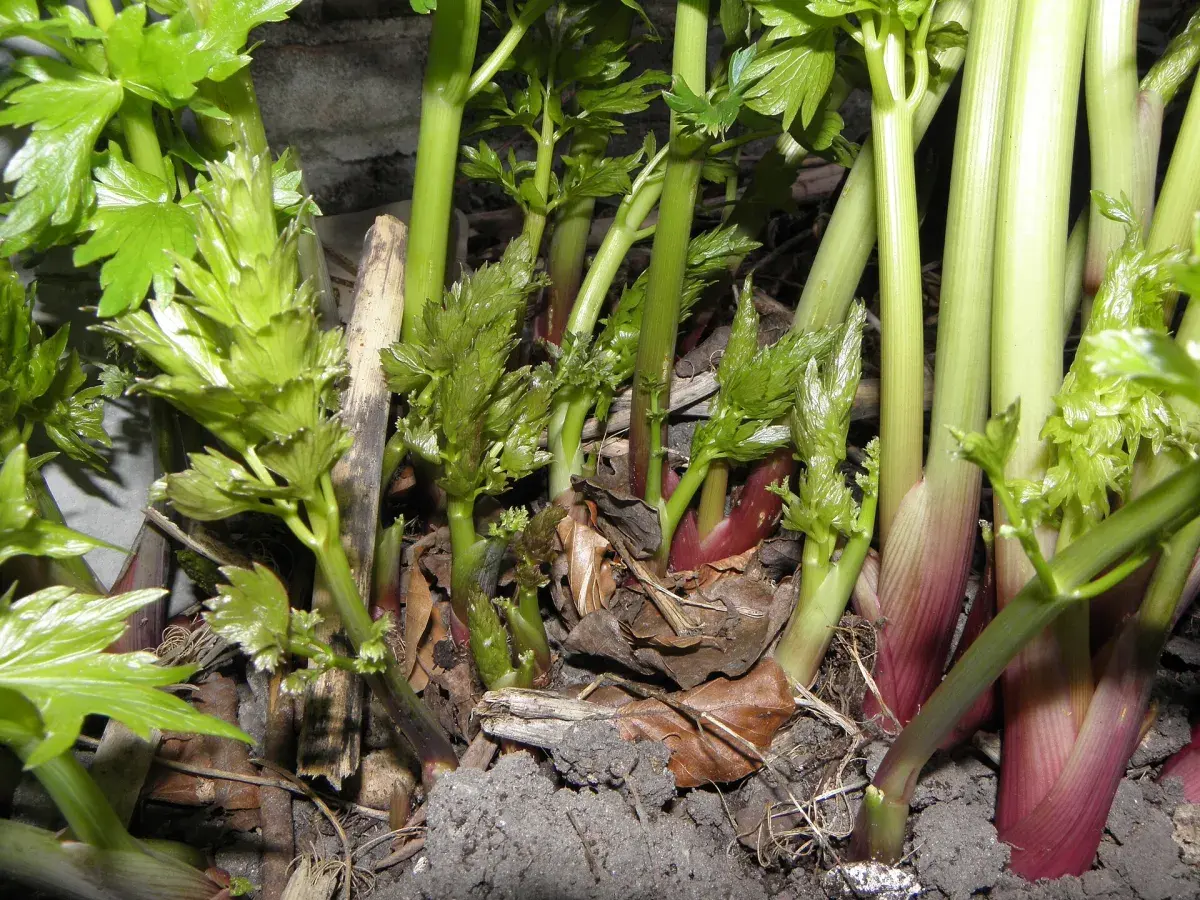
 Photo: Rob Hille, CC BY-SA 3.0, via Wikimedia Commons
Lovage (Levisticum officinale) is the aromatic herb that gives Romanian ciorbă and borș soups their characteristic taste. Its leaves help digest heavy food, and its root has a traditional use recognized by the European Medicines Agency for increasing urine output in minor urinary complaints. It should not be used medicinally during pregnancy or in kidney or heart disease with fluid retention, and it can make the skin more sensitive to sunlight.
For many Romanians, lovage is the smell of a country kitchen: a bunch added at the end to a pot of meatball or chicken soup. Few people know that the root used to be sold in pharmacies as a diuretic and digestive remedy. Here is what science says, what remains tradition, and how to use it safely.
Key takeaways
- The “soup” aroma comes from phthalides (ligustilide, butylidenephthalide), the same compounds that earned it the German nickname “Maggi herb”.
- The EMA recognizes lovage root as a traditional herbal medicine for flushing the urinary tract in minor urinary complaints, as an adjunct.
- Add the leaves to soup at the end, after turning off the heat, to keep the aroma.
- Root tea: 2-3 g per cup, 2-3 times a day, in courses of no more than 2-4 weeks.
- Avoid it as a remedy during pregnancy, with kidney or heart failure, and with heavy sun exposure.
What lovage is
Lovage is a perennial in the Apiaceae (umbellifer) family, related to celery, parsley, dill and angelica. It can grow over 2 meters tall, with thick hollow stems, large glossy celery-like leaves and greenish-yellow flowers in umbels. The whole plant smells strongly of vegetable broth.
It probably originated in southwest Asia but has been grown in European monastery gardens since the Middle Ages. In Romania it grows in almost every rural garden and lasts for years in the same spot. The leaves are used in cooking, while medicinal teas mostly use the root, harvested in autumn from plants 2-3 years old. The seeds are aromatic too and were traditionally used as a digestive.
In Romanian folklore, lovage also had a protective role: at Pentecost (Rusalii), people tucked lovage and wormwood leaves into their belts or shirts to guard against the iele, mischievous spirits of folk legend.
Active compounds
- Essential oil (0.4-1% in the root): dominated by phthalides, especially Z-ligustilide, responsible for the typical aroma and a mild antispasmodic effect.
- Coumarins and furanocoumarins (umbelliferone, bergapten, psoralen): furanocoumarins can increase the skin’s sensitivity to ultraviolet light.
- Phenolic acids and flavonoids (quercetin, kaempferol): antioxidants.
- Polysaccharides, resins and bitter compounds in the root.
Benefits: tradition and evidence
Diuretic effect and the urinary tract
The EMA’s Committee on Herbal Medicinal Products has published a monograph on Levistici radix (lovage root), recognizing traditional use for increasing urine output to flush the urinary tract, as an adjunct in minor urinary complaints. The recognition is based on long-standing use, not clinical trials. Lovage does not treat an infection: if you have symptoms of a urinary tract infection, the tea can only be a support, alongside plenty of water and the treatment your doctor recommends.
Digestion, bloating and cramps
In lab studies, phthalides and the essential oil relax smooth muscle, which explains the traditional use for bloating, gas and fullness after meals. The leaves added to soups and stews are not just flavor: they make heavy food easier to digest. For frequent digestive trouble, see also indigestion.
Expectorant effect
In folk medicine, lovage root tea was used for coughs and catarrh. The effect is attributed to the essential oil, but modern data are very limited.
Menstrual cycle
Lovage has traditionally been used to “bring on” menstruation. This very property of uterine stimulation makes it unsuitable as a remedy during pregnancy. Do not use it to regulate your cycle without seeing a gynecologist.
Antioxidant
Lovage leaves are rich in quercetin, an antioxidant flavonoid studied for anti-inflammatory effects. It is a nutritional plus, not a treatment.
Lovage in the kitchen
The golden rule: add lovage at the end. Long boiling destroys its aroma and makes it bitter.
- Sour soups and broths (meatball, chicken, vegetable, beef): a handful of chopped leaves (about 2 tablespoons) per 3-4 liter pot, after turning off the heat. Cover for 5 minutes.
- Clear soups: 1-2 whole stems in the last 5 minutes, then remove.
- Potato or vegetable stews: 1 chopped tablespoon at the end.
- Summer salads: a few young leaves, finely chopped, in a tomato salad; the flavor is strong, so use sparingly.
- Lovage salt: dried leaves ground with coarse salt in a 1:3 ratio, for soups and omelets.
- Herb butter: 1 tablespoon chopped lovage per 100 g butter, with garlic and lemon.
Storage: the leaves freeze well chopped, in small boxes or in ice cube trays with a little water. Dried, they lose some aroma but are fine for winter. Dry them in the shade in a thin layer and keep them in a closed jar.
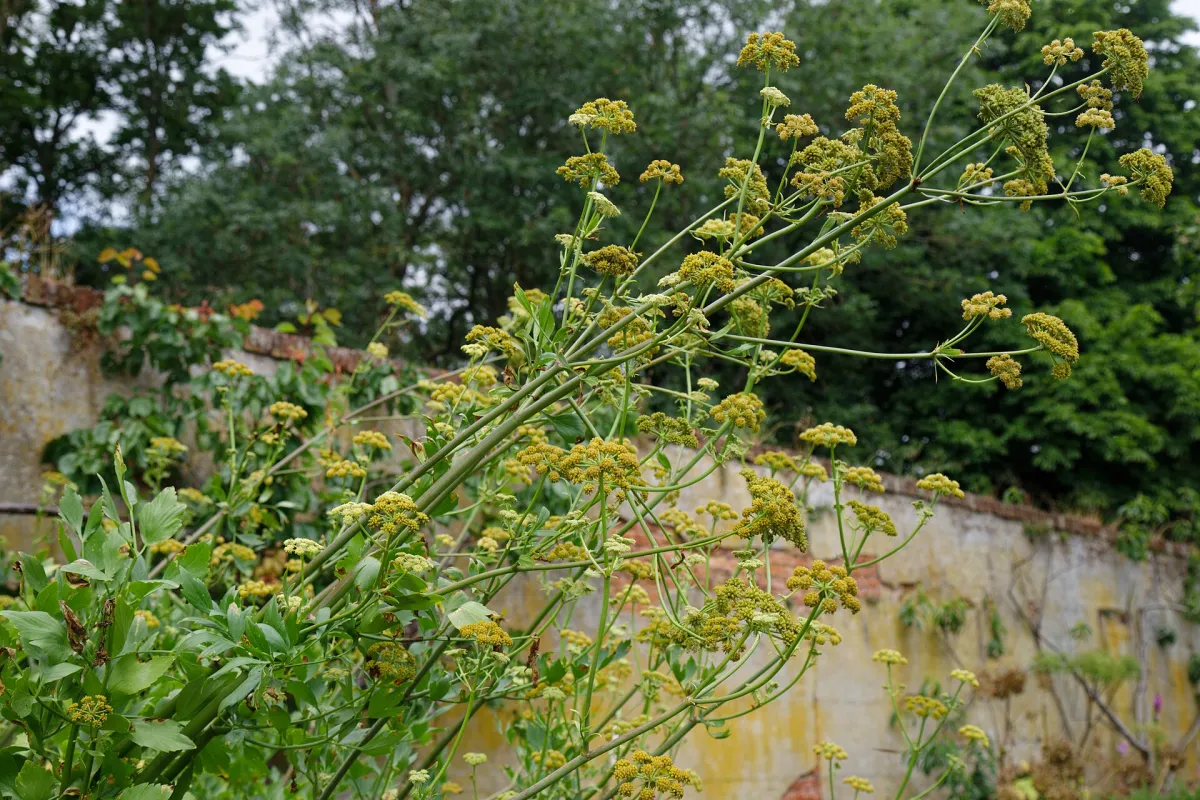 Photo: Acabashi, CC BY-SA 4.0, via Wikimedia Commons
How to prepare the remedies
Lovage root tea (for water elimination)
- Place 1 level teaspoon of dried, chopped root (2-3 g) in a mug.
- Pour over 150-200 ml boiling water.
- Cover and steep for 10-15 minutes.
- Strain and drink 2-3 times a day, in the first half of the day (so you are not up at night).
During the course, drink at least 2 liters of fluids a day; the flushing effect depends on water intake.
Leaf tea (digestive)
Pour 250 ml boiling water over 1 tablespoon of dried leaves or 2 tablespoons of chopped fresh leaves. Steep covered for 5-10 minutes and drink after meals. It tastes like broth, not like a sweet tea; a slice of lemon makes it more pleasant.
Seed tea (digestive)
½ teaspoon of crushed seeds per 200 ml boiling water, covered for 10 minutes. Drink after rich meals, no more than 2 cups a day.
Dosage guide
| Form | Adult dose | Frequency | Duration |
|---|---|---|---|
| Dried root, tea | 2-3 g / 150-200 ml | 2-3 times a day | 2-4 weeks |
| Total root per day | 4-8 g | - | short courses |
| Dried leaves, tea | 1 tablespoon / 250 ml | 1-2 times a day | occasionally |
| Fresh leaves, culinary | 1-2 tablespoons / pot | as food | no restriction |
| Seeds | ½ teaspoon / 200 ml | 1-2 times a day | occasionally |
If urinary symptoms persist for more than a week during the course, contact your doctor.
Contraindications and interactions
- Pregnancy and breastfeeding: do not use lovage as a remedy. The amounts in soup are considered safe.
- Kidney disease: acute kidney inflammation and kidney failure are contraindications for diuretic courses.
- Swelling from heart or kidney disease: if your doctor has advised fluid restriction, do not use diuretic teas. See also water retention.
- Umbellifer allergy: people allergic to celery, carrot, parsley or dill may react to lovage too.
- Photosensitivity: furanocoumarins can cause skin reactions in the sun. Avoid intense sun exposure and tanning beds during courses.
- Children: medicinal root tea is not recommended under 12.
- Medications: it may enhance diuretics and affect lithium excretion; talk to your doctor if you take such drugs or anticoagulants.
When to see a doctor
- Burning on urination, fever, lower back pain or blood in the urine.
- Leg swelling with fatigue, shortness of breath or rapid weight gain.
- Persistent abdominal pain, vomiting or changed stools for several days.
- Rash, blisters or strong skin redness after sun exposure during a course.
Common mistakes
- Boiling lovage with the soup. The aroma fades and turns bitter. Add it at the end.
- A diuretic course without water. A diuretic without enough hydration overloads the kidneys.
- Using it in pregnancy for “swelling”. Swelling in pregnancy must be assessed by a doctor, and medicinal lovage is contraindicated.
- Drinking the tea in the evening. It will wake you at night; drink it in the morning and at lunch.
- Confusing it with wild umbellifers. Some, like hemlock, are highly toxic. Use only garden or store-bought lovage.
- Long courses without breaks. Use it for 2-4 weeks, then pause.
Conclusion
Lovage is more than a “soup herb”: its aromatic leaves help digestion, and its root has traditional European recognition for increasing urine output in minor urinary complaints. Use it generously, but at the end, in the kitchen, and with moderation, in short courses, as a remedy. Avoid it medicinally during pregnancy and in kidney and heart disease, and protect your skin from the sun. For other herbs from the same family, read about parsley and dill, and for another traditional diuretic spice, about juniper berries.
Frequently asked questions
What does lovage taste like? It has a strong, aromatic taste of vegetable broth, with celery notes and a slight bitterness. That is why Germans call it the “Maggi herb”.
When should I add lovage to soup? After turning off the heat. Add the chopped leaves, cover the pot and leave for 5 minutes. Long boiling destroys the aroma.
Is lovage tea good for the kidneys? The root has recognized traditional use for increasing urine output in minor urinary complaints. It does not treat kidney disease, and it is contraindicated in kidney failure.
Can I drink lovage tea during pregnancy? No. Lovage was traditionally used to stimulate menstruation and is not recommended as a remedy during pregnancy. Small amounts in food are considered safe.
Does lovage help with weight loss? The diuretic effect removes water, not fat. It can help flavor food with less salt, which is a plus, but it is not a weight-loss remedy.
How do I store lovage for winter? Freezing it chopped in small portions works best. Dried, it keeps for a year but with a weaker aroma. Lovage salt is another practical method.
Are lovage and celery the same? No, but they are relatives in the same family and taste similar because of phthalides. Lovage is more intense and is used in smaller amounts.
Sources and further reading
- European Medicines Agency (HMPC): Community herbal monograph on Levisticum officinale Koch, radix.
- German Commission E: monograph on Levistici radix.
- PubMed: reviews on lovage essential oil composition (phthalides, furanocoumarins) and its biological activity.
Informational content only. It does not replace advice from your doctor or pharmacist.