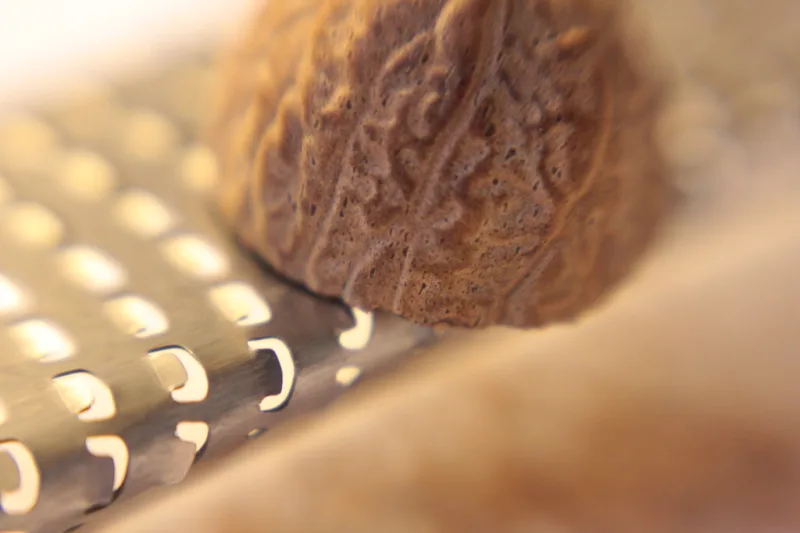

Nutmeg: Benefits, Uses and How to Use It for Sleep and Digestion
IMPORTANT: Nutmeg is a powerful spice that becomes toxic in very large amounts. A nutmeg seed contains myristicin, a compound that in high doses (typically more than one to two whole nutmegs eaten at once) can cause nausea, dizziness, palpitations, hallucinations and a deeply unpleasant state lasting for hours. Used sensibly, however, in a pinch at a time, nutmeg is perfectly safe and valuable. Pregnant and breastfeeding women should use it only as a culinary flavoring, in small amounts, and avoid “medicinal” doses. People taking psychiatric medication, blood thinners, or who have liver conditions should talk to their doctor before using it therapeutically. Nutmeg is not a substitute for medical treatment; it is a gentle, traditional support when dosed correctly.
A story from Grandma Veta
I remember Grandma Veta, who lived in an old house with a porch at the edge of the village. She kept, wrapped in waxy paper inside a little wooden cupboard, a few brown, wrinkled nuts that looked like pebbles. These were her nutmeg seeds, brought years earlier from the market by a spice merchant, and she treasured them like jewels. In the evening, whenever one of us grandchildren couldn’t fall asleep from all the excitement, Grandma would warm a cup of milk, grate “as much as catches on the tip of the knife” of that fragrant nut into it, and give it to us warm, sweetened with a teaspoon of honey. That warm, woody, sweet-bitter aroma would send us straight to sleep.
She also said nutmeg “settled the stomach” after the heavy holiday meals, when the table groaned under cabbage rolls, roast meat and sweet bread. She would add a pinch to mashed potatoes or rice puddings, “so the food doesn’t sit like stones inside us.” Many years later, I understood that Grandma was, in her intuitive way, perfectly right: folk tradition and modern science both confirm, each in its own language, the virtues of this remarkable spice.
What nutmeg is
Nutmeg is the dried seed of a tropical tree called Myristica fragrans, native to the Banda Islands (the Spice Islands) of Indonesia. The same fruit actually yields two different spices: nutmeg proper, which is the hard kernel inside, and mace, which is the bright-red, lacy covering wrapping the kernel. Both have related aromas, but mace is more delicate and fragrant, while nutmeg is warmer, sweeter and more intense.
For centuries, nutmeg was one of the most prized spices in the world, so sought-after that it sparked wars, naval expeditions and fierce trade monopolies between European powers. In traditional Asian medicine, in Ayurveda and in European folk practice, nutmeg was used both as a flavoring and as a remedy for digestive troubles, insomnia, pain and various other complaints. Today we find it easily, ground or whole, in any shop, but the whole form, freshly grated, by far retains the best aroma.
Table of Contents
- Composition and active principles
- Health benefits
- Traditional uses
- How to use nutmeg (step-by-step recipes)
- Dosage and how to take it
- Nutmeg in the kitchen and in your lifestyle
- Practical tips and common mistakes
- Conclusion
- Frequently Asked Questions
Composition and active principles
Nutmeg is a seed rich in volatile oils and fats, which explains its intense aroma and slightly greasy texture when you grate it. Among its main compounds are:
- Myristicin – an aromatic compound largely responsible for nutmeg’s neurological effects. In small amounts it contributes to a sense of relaxation and to the characteristic aroma, but in large amounts it becomes psychoactive and toxic.
- Elemicin and safrole – other volatile components that contribute to the aromatic profile and the effects on the nervous system.
- Essential oils (such as pinene, sabinene, terpinene) – which give that fresh, woody, slightly pungent note.
- Fats (nutmeg butter) – nutmeg contains a considerable amount of fat, which is why, when pressed, it yields a semisolid “butter” used traditionally in cosmetics and ointments.
- Phenolic compounds and antioxidants – which contribute to the cell-protective effects that studies suggest.
- Trace minerals – manganese, magnesium, copper, in small amounts, though only relevant at intakes that, for safety reasons, are practically never reached.
It is important to remember: because it is consumed in such tiny amounts, nutmeg is not really a nutritional source. Its value lies in its aromatic active compounds, not in calories or vitamins.
Health benefits
Support for restful sleep
Nutmeg’s best-known traditional benefit is its calming effect, which helps you sleep more soundly. For centuries, people have added a pinch of nutmeg to warm evening milk to relax before bed. Studies suggest that certain compounds in nutmeg may have a mild sedative effect on the nervous system, helping to quiet a restless mind. Unlike powerful sleeping pills, nutmeg works gently and, at the right dose, is not habit-forming. It is especially suitable for those who struggle to fall asleep because of tension and racing thoughts.
A helper for digestion
Folk tradition has always treated nutmeg as a “friend of the stomach.” It is believed to stimulate the secretion of digestive enzymes, helping the body break down heavy, fatty meals more easily. Many use it to ward off the feeling of bloating, gas and discomfort after large meals. Its warm aroma seems to “soothe” an upset stomach and reduce mild cramping. That is exactly why it appears in so many traditional recipes for puddings, creamy sauces, mashes and milk-based dishes – not only for taste, but also to make the food easier to digest.
Antioxidant properties
Nutmeg contains phenolic compounds and essential oils with antioxidant action. Antioxidants are substances that help the body cope with oxidative stress, a natural process of life that, in excess, contributes to cellular aging. Studies suggest that aromatic spices, nutmeg among them, make a modest but real contribution to the daily intake of antioxidants in a varied, balanced diet.
Support for fresh breath and a healthy mouth
In traditional medicine, nutmeg was used for its aromatic and mildly antimicrobial properties in oral care. Nutmeg oil sometimes appears in toothpastes and mouthwashes precisely because of its ability to fight the bacteria that cause unpleasant odor. At home, a pinch added to a warm drink can leave a feeling of freshness.
A calming effect on mild aches
Applied externally, in the form of a paste or oil, nutmeg has been used traditionally to soothe mild muscle and joint aches. Nutmeg butter was rubbed on sore joints for the warming, relaxing sensation it brings. This benefit belongs more to folk tradition, but it is a gentle, pleasant use for those who prefer natural external remedies.
Support for mood
The warm, enveloping aroma of nutmeg has a soothing effect on mood. In aromatherapy, sweet-woody spices are associated with feelings of comfort and safety. A cup of nutmeg milk or a fragrant dessert can bring, beyond its taste, a subtle sense of well-being, similar to the one we experience around the winter holidays.
Traditional uses
In country homes, nutmeg played several roles. Here are some of the most common:
- Evening milk with nutmeg – for restful sleep, especially for excited children and stressed adults.
- In heavy dishes – cabbage rolls, stews, mashes, puddings – to “settle the stomach” and ease digestion.
- In desserts – sweet breads, cheese pies, rice puddings, custards – both for aroma and to balance sweetness.
- Poultices and rubs – nutmeg paste or nutmeg butter was applied to sore joints.
- As a digestive tonic – a pinch in a warm tea after a holiday meal.
How to use nutmeg (step-by-step recipes)
Warm milk with nutmeg for sleep
This is the classic recipe, simple and effective, passed down from generation to generation.
You will need:
- one cup of milk (cow’s or plant-based, as you prefer)
- a pinch of freshly grated nutmeg (very little!)
- one teaspoon of honey (optional)
- a touch of cinnamon (optional)
How to prepare:
- Heat the milk in a small saucepan, without letting it come to a boil.
- Grate a very small amount of nutmeg directly into the milk – just what catches on the tip of the knife. Remember: less is better.
- Stir well and remove from heat.
- Sweeten with honey if you wish, and add the cinnamon.
- Drink the milk warm, about 30 to 45 minutes before bedtime.
Digestive tea or infusion with nutmeg
You will need:
- one cup of hot water
- a pinch of grated nutmeg
- optional: a slice of ginger or a few fennel seeds
- honey to taste
How to prepare:
- Place the nutmeg (and, if you like, the ginger or fennel) in the cup.
- Pour the hot water over them.
- Cover and let steep for 5 to 7 minutes.
- Strain if you used ginger or fennel, sweeten with honey, and sip slowly after a meal.
Nutmeg paste for external rubs
You will need:
- a little grated nutmeg
- a few drops of oil (coconut, olive or almond)
How to prepare:
- Mix the grated nutmeg with the oil until you get a thick paste.
- Apply the paste to the sore area (joint, tired muscle) and massage gently.
- Let it work for 15 to 20 minutes, then wipe off with a warm cloth.
- Always test on a small patch of skin first, to check for any allergic reactions.
Dosage and how to take it
This is perhaps the most important section about nutmeg. The amount matters enormously.
- For culinary use and gentle therapeutic use, the usual dose is a pinch (about an eighth to a quarter of a teaspoon, grated) per serving. That’s all.
- Do not exceed half a teaspoon, grated, per day for therapeutic use.
- Never consume a whole nutmeg or amounts on the order of several teaspoons at once – this is where the risk of poisoning arises.
- For sleep, a single small dose in the evening is enough.
- For digestion, a pinch after meals, occasionally, is ideal.
Use nutmeg freshly grated from the whole nut whenever you can, because the aroma and active compounds are far better preserved than in pre-ground powder, which quickly loses its flavor.
Nutmeg in the kitchen and in your lifestyle
Beyond its role as a gentle remedy, nutmeg is a star in the kitchen. It pairs wonderfully with creamy dishes and dairy: béchamel sauce, mashed potatoes, baked spinach, puddings, soufflés. Just a pinch transforms an ordinary mash into one with depth and warmth. In desserts, it beautifully complements cinnamon, cloves and ginger, being an essential ingredient of winter and holiday spice blends.
To live a balanced lifestyle, think of nutmeg as an “accent”: you use it rarely and in small amounts, but each time it brings something special. A soothing evening routine – a cup of warm milk with a pinch of nutmeg, dimmed lights, the phone set aside – can do wonders for the quality of your sleep. And meals seasoned thoughtfully, with a touch of nutmeg here and there, are not only tastier but also easier to digest.
Store whole nutmeg in a dark, airtight jar, away from light, moisture and heat. That way it keeps its aroma even for years. Grate only as much as you need, when you need it.
Practical tips and common mistakes
Mistake no. 1: Using too large an amount. This is by far the most dangerous mistake. Nutmeg is not a spice you add “with a generous hand.” More is not better – quite the opposite. Always stick to the pinch rule.
Mistake no. 2: Treating nutmeg as a powerful sedative. Some people, disappointed that a pinch doesn’t “knock them out” instantly, increase the dose looking for a stronger effect. This is exactly the behavior that leads to poisoning. Nutmeg helps gently; it is not, and should never become, a substitute for sleeping pills.
Mistake no. 3: Using old, flavorless powder. Ground nutmeg quickly loses its volatile oils. If the powder in your cupboard no longer smells of anything, it will have neither effect nor taste. Buy whole nuts and grate fresh.
Mistake no. 4: Giving it to pregnant women for therapeutic purposes. During pregnancy, nutmeg should be used only as a culinary flavoring, in small amounts. Higher doses should be avoided.
Mistake no. 5: Combining it carelessly with medication. If you take medication for the nervous system, blood thinners, or have liver problems, do not use nutmeg therapeutically without asking your doctor.
Mistake no. 6: Applying it externally without a test. Before applying nutmeg paste to your skin, test it on a small area to avoid irritation or allergic reactions.
Conclusion
Nutmeg is a perfect example of a remedy whose key lies in moderation. In small amounts, it is a warm, fragrant, friendly spice that soothes sleep, supports digestion and adds a touch of flavor and comfort to the kitchen. In large amounts, it becomes dangerous. Grandma Veta, with her pinch grated into warm milk, knew instinctively what both tradition and prudence confirm: nutmeg is to be respected. Used wisely, it is a little treasure of aroma and calm, especially on cold evenings, when a cup of warm milk with a pinch of nutmeg seems like the best thing in the world.
Frequently Asked Questions
How much nutmeg can I safely use per day? For culinary use and gentle therapeutic use, a pinch (about an eighth to a quarter of a teaspoon, grated) per serving is perfectly safe. Do not exceed half a teaspoon, grated, per day. Never consume a whole nutmeg at once.
Does nutmeg really help with sleep? Folk tradition has used it for centuries for more restful sleep, and studies suggest a mild calming effect from some of its compounds. It works gently, especially within a relaxing evening routine, and should not be regarded as a powerful sleeping pill.
Is nutmeg dangerous? In the small amounts used in cooking, no. It becomes dangerous only in large doses (on the order of one or more whole nutmegs eaten at once), when it can cause nausea, dizziness, palpitations and unpleasant hallucinations. Sticking to the small dose eliminates this risk.
Can I give children milk with nutmeg? A very small pinch in a cup of warm milk is an old tradition for restless children. Use a minimal amount and do not make it a daily habit. If in doubt, ask your pediatrician.
What is the difference between nutmeg and mace? They come from the same fruit: nutmeg is the inner kernel, and mace is the red, lacy covering around it. Mace has a more delicate, fragrant aroma, while nutmeg is warmer, sweeter and more intense.
What does nutmeg taste like? It has a warm, sweet-bitter, woody, slightly pungent and very fragrant aroma. It suits both sweet preparations and creamy, savory dishes.
Is whole nutmeg better than ground? Whole nutmeg, freshly grated, is clearly superior. The volatile oils responsible for aroma and effects are quickly lost after grinding, so pre-ground powder is much weaker in taste and action.
Can I use nutmeg for joint pain? Traditionally, nutmeg paste with a little oil was rubbed on sore joints for the warming, relaxing sensation. It is a gentle external use; test first on a small patch of skin and do not apply it to open wounds.